

This policy brief is based on IMF Working Paper No. 26/23. The views expressed in this policy brief represent only our own and should therefore not be reported as representing the views of the International Monetary Fund, its Executive Board, or IMF management.
Abstract
Nonbank financial institutions (NBFIs) play a central role in global credit markets, raising concerns about regulatory arbitrage, financial stability, and the effectiveness of macroprudential policy. While recent research shows that tighter bank regulation can unintentionally shift intermediation toward less-regulated sectors, less is known about how banking groups adjust internally. We show that banking groups reallocate corporate lending from bank subsidiaries to affiliated NBFIs when macroprudential constraints tighten. On average, in the syndicated loan market, this intra-group shift offsets more than half of the decline in bank lending induced by tighter macroprudential policies.
The rapid expansion of NBFIs — non-deposit-taking financial intermediaries such as broker-dealers, investment funds, asset managers, pension funds, and insurers — has coincided with tighter bank regulation since the 2007–09 Global Financial Crisis (GFC); see Buchak et al. (2018), Irani et al. (2021), Albuquerque et al. (2025). The NBFI share of global financial assets rose from 43% in 2008 to 51% in 2024 (FSB 2025). In syndicated lending, nonbanks originated about half of all loans to nonfinancial corporations in 2024, up from roughly 30% during the GFC (Albuquerque et al. 2025).
While macroprudential policies (MaPP) aim to strengthen financial stability by constraining banks’ balance sheets and risk-taking, they can unintentionally shift lending beyond the regulatory perimeter. Modern banking groups often combine regulated bank subsidiaries with often less-regulated nonbank affiliates. This raises a key question: how do groups adjust credit supply when bank-level constraints tighten?
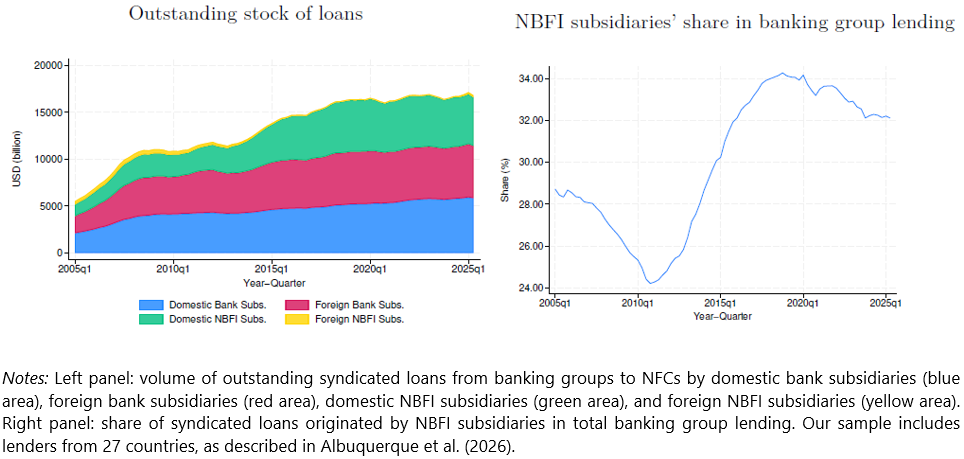
We document the rising role of nonbank subsidiaries within banking groups in the syndicated loan market, a major source of corporate financing. Figure 1 shows that affiliated nonbanks account for a growing share of group loan origination — around 32% in 2024 across a broad country sample — particularly in the United States and other systemically important advanced economies (AEs).
This structure matters because nonbank affiliates typically face lighter or differently calibrated prudential requirements. As MaPP — such as credit growth limits, stress testing, and reserve requirements — primarily bind banks, groups may respond to tighter regulation by reallocating lending toward less-constrained entities. In a new paper, we show that this intra-group channel allows banking groups to partially offset the decline in bank lending following macroprudential tightening, reshaping the transmission of policy with important implications for financial stability (Albuquerque et al. 2026).
Figure 1. Banking groups’ lending to NFCs in the corporate syndicated loan market
We use granular syndicated loan data covering 963 banking groups across 27 countries (21 AEs and 6 EMDEs) from 2005Q1 to 2023Q4 to study how NBFI subsidiaries adjust lending relative to bank subsidiaries within the same banking group following MaPP tightening. Syndicated loans are ideal for this purpose, as they are originated by both banks and nonbanks and represent a significant portion of corporates’ financing. One of our key contributions is the construction of a novel dataset linking parent banks both to their bank and NBFI subsidiaries over 2000–2024. This fills a gap in the literature that has focused on bank subsidiaries (Claessens and Van Horen 2015, Schwert 2018, Silva 2019).
We identify MaPP shocks using the Alam et al. (2025) iMaPP database, focusing on measures that directly constrain bank lending, such as loan-supply restrictions, stress-test-based prudential measures, and reserve requirements. We adopt two approaches. First, we residualize country-level MaPP indices following Albuquerque et al. (2025) and purge cyclical influences using panel regressions with country fixed effects and macrofinancial controls. The resulting residuals serve as our MaPP shocks. The second approach is a novel high-frequency announcement-based strategy covering six large AEs.
Our empirical specification includes banking group and firm×quarter fixed effects, thereby isolating within-group substitution in credit supply between bank and nonbank subsidiaries, while controlling for time-varying borrower demand (Khwaja and Mian 2008).
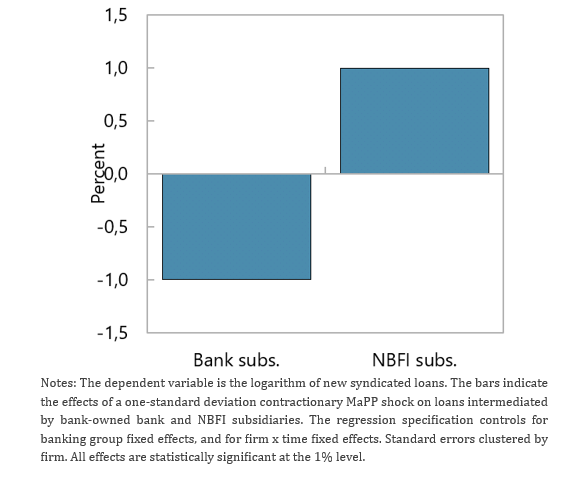
Figure 2 illustrates our novel finding of regulatory-induced lending reallocation in banking groups. Following a one-standard-deviation MaPP tightening, bank subsidiaries reduce lending by 1.0%, while NBFI subsidiaries increase lending by 2.0% relative to bank subsidiaries within the same group, or 1.0% in absolute terms. We estimate that banking groups offset, on average, more than half of the adverse impact of MaPP tightening on group-level credit growth. In other words, for every dollar of lending reduced by bank subsidiaries, more than fifty cents reappear as additional lending by nonbank entities within the same group.
Figure 2. Effect of macroprudential policy shocks on credit supply
We find little evidence that this substitution increases risk-taking or misallocation. Although NBFIs lend more to riskier borrowers on average, the additional lending following MaPP shocks is not disproportionately concentrated in higher-risk segments, consistent with Albuquerque et al. (2025). This suggests that shifting credit from bank to nonbank subsidiaries allows groups to preserve lending volumes without materially increasing overall portfolio risk.
The reallocation effect is strongest among banking groups with weaker balance sheets, which have greater incentives to circumvent regulatory constraints. It is driven mainly by U.S. banking groups and, to a lesser extent, by euro-area banking groups, with investment banks and broker-dealers accounting for most of the NBFI adjustment. These results are strongly robust to using high-frequency policy announcements to compute the MaPP shocks for six large AEs.
Overall, macroprudential tightening has a smaller impact on group-level credit supply where NBFI subsidiaries exist. The pattern reflects the existing regulatory perimeter in many jurisdictions: commercial banks face strict entity-level capital and liquidity requirements, whereas nonbank affiliates operate under lighter or differently calibrated rules. In the U.S., for example, NBFIs within bank holding companies are under consolidated Federal Reserve supervision, but capital and liquidity rules primarily bind at the holding company or bank-subsidiary level, leaving scope for internal adjustments.
A large literature shows that banking groups respond to domestic macroprudential tightening by shifting lending across borders through foreign bank subsidiaries (Houston et al. 2012, Ongena et al. 2013, Danisewicz et al. 2017). When regulation tightens at home, lending tends to migrate toward jurisdictions with looser rules. Because foreign bank subsidiaries are supervised primarily by host-country authorities, they can partially insulate the banking group from constraints imposed in the parent’s home country. We extend this logic beyond banks. In addition to reallocating activity across bank subsidiaries, banking groups may also rely on NBFI affiliates — both domestic and foreign — a dimension largely absent from the existing literature. Given their lighter regulatory treatment, NBFIs often sit in a grey area of the supervisory perimeter, making them natural vehicles to offset some of the regulatory tightening within complex financial groups.
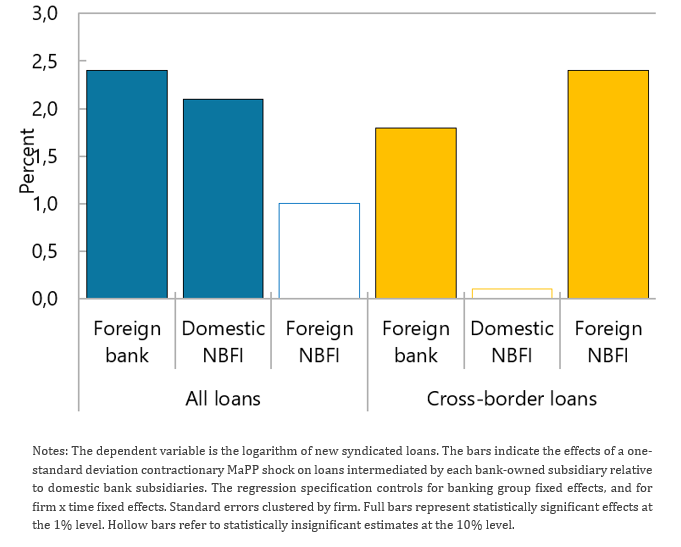
To unpack this mechanism, we split bank and NBFI subsidiaries into domestic and foreign entities. Figure 3 reveals how internal bank–nonbank linkages shape the international transmission of macroprudential policy. Focusing first on the three left bars, referring to the full sample (domestic and cross-border lending combined), we confirm the result in the literature that banking groups expand lending through foreign bank subsidiaries when domestic regulation tightens: by 2.4% relative to domestic bank subsidiaries. At the same time, parent banks also expand lending through domestic NBFI affiliates by 2.1% relative to domestic bank subsidiaries. In contrast, foreign NBFIs do not exhibit a statistically significant relative increase in lending in this specification.
The picture changes when focusing exclusively on cross-border lending — loans to borrowers located outside the parent bank’s home country (three bars on the right-hand side). Here, foreign subsidiaries, both banks and NBFIs, play a more prominent role in cushioning the impact of tighter domestic regulation. Domestic NBFIs do not seem to play a role in sustaining foreign lending.
Taken together, these results point to a dual reallocation strategy. To support lending to domestic borrowers, banking groups rely primarily on domestic NBFIs and foreign bank subsidiaries. To maintain lending abroad, they turn instead to foreign subsidiaries, both banks and nonbanks. In both cases, internal capital markets within banking groups most likely facilitate the reallocation of funds across entities and borders.
We show further in the paper that this mechanism is especially strong in core foreign markets where banking groups have an established presence. Foreign subsidiaries, banks and NBFIs, are particularly effective at sustaining cross-border lending in these markets. Meanwhile, domestic NBFI affiliates play a key role in cushioning domestic credit. This dual strategy allows banking groups to mitigate the contractionary effects of macroprudential policy both internationally and domestically.
Figure 3. Effect of MaPP shocks on lending of each subsidiary type relative to domestic bank subsidiaries
Macroprudential tightening does not simply shrink credit within banking groups — it may unintentionally redirect it. When regulation binds at the bank level, banking groups expand lending through their nonbank affiliates, offsetting more than half of the decline in bank credit.
Risk, however, does not disappear: it shifts. Greater reliance on nonbank subsidiaries deepens bank–nonbank interconnectedness and may weaken the effective reach of macroprudential policy, particularly where nonbanks operate under lighter and more opaque regulatory regimes. Stress at nonbank affiliates can spill back to the parent bank, amplifying vulnerabilities at the group level.
As financial intermediation continues to migrate beyond the traditional banking perimeter, preserving financial stability will require closer monitoring of bank–nonbank linkages, improved data, and, where appropriate, a broader regulatory lens.
Alam, Z., Alter, A., Eiseman, J., Gelos, G., Kang, H., Narita, M., Nier, E. and Wang, N. (2025), “Digging Deeper–Evidence on the Effects of Macroprudential Policies from a New Database”, Journal of Money, Credit and Banking 57(5), 1135–1166.
Albuquerque, B., Cerutti, E., Chen, N. and Firat, M. (2025), “From Banks to Nonbanks: Macroprudential and Monetary Policy Effects on Corporate Lending”, IMF Working Paper 25/96, International Monetary Fund, Washington, DC.
Albuquerque, B., Cerutti, E., Firat, M. and Kagerer, B. (2026), “Banking on Nonbanks”, IMF Working Paper 26/23, International Monetary Fund, Washington, DC.
Buchak, G., Matvos, G., Piskorski, T. and Seru, A. (2018), “Fintech, regulatory arbitrage, and the rise of shadow banks”, Journal of Financial Economics 130(3), 453–483.
Claessens, S, and Van Horen, N. (2015), ‘The Impact of the Global Financial Crisis on Banking Globalization’, IMF Economic Review 63(4), 868–918.
Danisewicz, P., Reinhardt, D. and Sowerbutts, R. (2017), “On a tight leash: Does bank organizational structure matter for macroprudential spillovers?”, Journal of International Economics 109, 174–194.
Financial Stability Board (2025), Global Monitoring Report on Non-Bank Financial Intermediation, Financial Stability Board.
Houston, J. F., Lin, C. and Ma, Y. (2012), “Regulatory Arbitrage and International Bank Flows”, Journal of Finance 67(5), 1845–1895.
Irani, R. M., Iyer, R., Meisenzahl, R. R. and Peydró, J.-L. (2021), “The rise of shadow banking: Evidence from capital regulation”, The Review of Financial Studies 34(5), 2181–2235.
Khwaja, A. I. and Mian, A. (2008), “Tracing the Impact of Bank Liquidity Shocks: Evidence from an Emerging Market”, American Economic Review 98(4), 1413–1442.
Ongena, S. R. G., Popov, A. A. and Udell, G. F. (2013), “When the Cat’s Away the Mice Will Play: Does Regulation at Home Affect Bank Risk-Taking Abroad?”, Journal of Financial Economics 108(3), 727–750.
Schwert, M. (2018), “Bank capital and lending relationships”, The Journal of Finance 73(2), 787– 830.
Silva, A. F. (2019), “Strategic liquidity mismatch and financial sector stability”, The Review of Financial Studies 32(12), 4696–4733.