

Opinions are strictly those of the authors and do not necessarily reflect the official viewpoint of the Oesterreichische Nationalbank or the Eurosystem. The authors would like to thank Olga Andreeva, Inga Baadshaug Eide and Anneli Solberg, (all from the Financial Supervisory Authority of Norway) as well as Mathias Pohl, Sebastian Rötzer, Stefan W. Schmitz, Georg Mosburger, Markus Schwaiger and Thomas Steiner (all from Oesterreichische Nationalbank) for helpful comments and remarks.
Abstract
We examine the current policy design for adjusting real estate related capital requirements for banks using the Internal Ratings-Based (IRB) approach. With a focus on measures based on Article 164 of the Capital Requirements Regulation (CRR), we show that the required assessment of loss given default (LGD) input floors has multiple deficiencies, both in the policy design and data availability. In particular, the possibility to only adjust the lowest LGDs within a given portfolio is risk inadequate. As our preferred option to enhance the regulatory framework, we propose to apply the output floor – that is currently applied on bank level – on the level of real estate exposure classes. This improves the capital adequacy of IRB banks for real estate exposure and limits the incentives to optimize capital requirements. With this proposal, we also contribute to the current debate on simplification, as the mandate to change LGDs according to Article 164 (6) CRR could be discarded.
Real estate loans account for a substantial part of banks’ balance sheets in many economies. At the same time, real estate markets are often key factors in systemic banking crises and economic downturns, which often result in significant social and economic costs.
During economic upswings, real estate booms and business cycles amplify each other, leading to higher GDP growth, increased investment, and greater consumption (Claessens et al., 2008, 2011). Prolonged upswings in real estate cycles increase the likelihood of an abrupt end to the boom (Hiebert et al., 2018; Bracke, 2013). Notably, two-thirds of real estate price booms have ended in a recession (Claessens et al., 2008, 2011). The financing of these booms, particularly through debt (i.e. bank loans) and highly leveraged institutions (i.e. banks), significantly impacts the severity of economic downturns (Crowe et al., 2013). The end of an upward spiral in real estate and credit booms can be very costly for an economy, leading to increased unemployment, declined investments, and reduced GDP (Claessens et al., 2008, 2011). Real estate booms characterized by excessive leverage and rapid loan growth can severely undermine financial stability and macroeconomic output when they collapse (Crowe et al., 2013). Systemic banking crises have substantial social and economic costs, with governments typically spending on average 7% of GDP to mitigate these crises and public debt rising by an average of 21% of GDP (Laeven and Valencia, 2018).
Thus, it is crucial for macroprudential supervisors to ensure that banks have an adequate cushion, i.e. bank capital, to absorb potential losses from real estate related loans in an adverse macroeconomic situation. In chapter 2, we will provide a general overview about the capital requirements for real estate loans and focus particularly on banks using the internal ratings-based (IRB) approach. While supervisors have multiple instruments at hand to adjust real estate related capital requirements, we will focus on the current design of Art. 164 CRR in chapter 3. In detail, we show the weaknesses in the application of this instrument and provide recommendations for enhancing the regulatory toolkit. In light of the current debate on simplification, we suggest a policy design in chapter 4 that reduces the complexity of the regulation while maintaining sound levels of capital at the same time. Chapter 5 concludes.
In general, the capital requirements regulation (CRR) specifies in detail the level of capital that is required by banks for different asset classes, including real estate related exposures. The CRR builds on the Basel framework that sets out the global standards for prudential regulation of banks. Historically, the Basel framework was based on a relatively simple framework, where a risk weight was assigned to each asset class: the so-called standardized approach (STD approach) for calculating capital requirements. With the introduction of the Basel II framework however, banks were allowed to use their own internal assessments for calculating capital requirements, the internal ratings-based approach (IRB approach). Based on The Basel Committee on Banking Supervision (BCBS), the IRB approach was implemented to ensure a higher degree of risk-sensitivity as well as provide incentives for the banks to improve their internal risk management processes (Basel Committee on Banking Supervision, 2001).
However, the IRB approach comes with a significant risk and complexity. As the level of equity that banks need to hold is based on their own calculations, supervisory safeguards had to be implemented to ensure that capital requirements are adequate. For this purpose, a range of backstops are implemented by regulatory bodies. As general principle, the CRR prescribes in detail the methods, procedures and calibrations that need to be followed within the IRB approach. Furthermore, models need to be approved by supervisory authorities in order to be used for the calculation of regulatory capital requirements. In addition, to ensure that capital requirements are not too low in comparison to the standardized approach, the output floor – based on decision by Basel Committee on Banking Supervision – was introduced with the third amendment of the CRR. The output floor limits the amount banks can deviate from capital requirements under the STD approach when applying the IRB approach. After the finalization of its phase-in in 2030, the capital requirements based on the calculations within the IRB approach cannot be lower than 72.5% of the capital requirements based on the STD approach. The output floor is applied at the bank level. Moreover, according to Article 92 (3) CRR, member states may decide that the output floor only applies at the highest level of consolidation within a banking group at the country level. This dilutes the floor’s effectiveness in limiting the capital advantage of IRB banks compared to banks in the STD approach.
Figure 1. Risk weight gap for real estate exposure of IRB banks in Europe
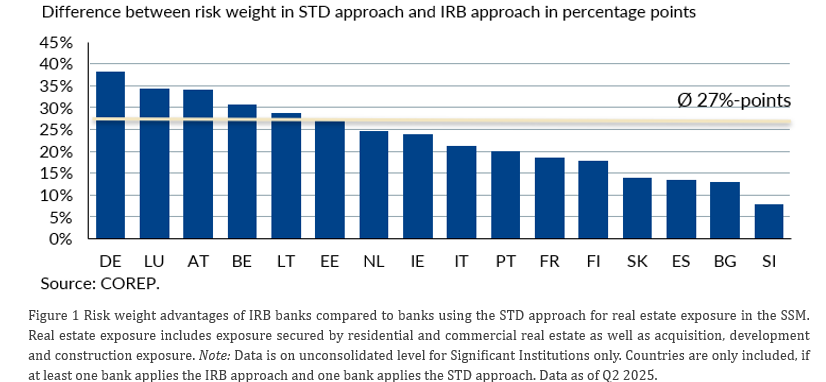
Figure 1 shows to which extent banks applying the IRB approach for real estate exposure can benefit by having lower capital requirements, despite the introduction of the output floor in 2025. Using data from supervisory reporting for Significant Institutions in the Single Supervisory Mechanism (SSM), we find that banks applying an IRB approach have a risk weight for real estate exposures that is on average 27 percentage points lower compared to banks applying the STD approach.1 To put this number into perspective: Banks in Europe applying the IRB approach have an average risk weight of 21%. This results in a level of capital that is 57% lower compared to banks in the STD approach (average risk weight of 48%). Given the significant differences in risk weights and ultimately risk-weighted assets, the capital ratios between banks applying the STD approach or IRB approach are less comparable. This also impacts the effectiveness of supervisory measures that are based on the level of risk-weighted assets (e.g. Pillar 2 requirements, combined buffer requirements).
Considering the inherent risk that is associated with real estate loans and the lower capital requirements for IRB banks, the CRR provides additional measures that can be activated by national authorities. These measures are intended to address risks to financial stability within this asset class:
Within the CRR, Article 164 (6) stipulates that national authorities have to assess at least annually whether the LGD input floors of 5% for retail exposure secured by residential property and 10% for other retail exposure secured by residential property or commercial immovable property are appropriate. LGD input floors are minimum LGD values on loan level for the respective exposure class. The mandate applies to loans that are secured by property located in, or parts of, the respective member states.
This assessment has to take losses of real estate loans collected under Article 430a CRR as well as forward-looking immovable property market developments into account. Details on indicators that should be considered in evaluating the appropriateness of the LGD input floors can be found in the respective regulatory technical standards (European Banking Authority, 2021). If the national authority finds that the input floors are inadequate and might adversely affect financial stability in a member state, it may set higher LGD input floors for exposures located in the member state. Due to the financial stability connotation the relevant authority has to ensure that the macroprudential bodies are involved in the financial stability assessments (Article 164 (5) CRR).
In general, as described above, it is necessary to ensure that the levels of capital for IRB banks are adequate. Despite the microprudential supervision of bank internal models, there remains substantial leeway in determining probabilities of default (PDs) and LGDs and the intrinsic motivation to optimize capital requirements within the bank models. However, we find that the data that should be used (loss data according to Article 430a CRR) or are required in assessing the appropriateness of LGD input floors as well as the measure design according to Article 164 CRR are either not suitable or not available. The underlying rationale for this conclusion will be discussed in the following.
Article 164 CRR states that the national authority should use data that is collected based on Article 430a CRR (“IP losses”) in order to assess the appropriateness of LGD input floors. This data contains information on losses stemming from exposures for which a bank has recognized residential or commercial property as collateral. In addition to the fact that information on past losses is not an adequate indicator for assessing financial stability concerns, the reporting design of losses is by itself ill-designed. The reporting instructions for the data state that “losses shall be reported only for exposures having defaulted during the reporting period”. However, given the time lag for workout procedures (e.g. realization of collateral values) after a default occurrence, the actual loss is typically not known to the bank at time of reporting. In this circumstance, banks are required to estimate the losses. However, estimation procedures are neither specified in detail nor verified by supervisory authorities. In addition, given the limitation to report only losses for exposures that defaulted during the reporting period, no adjustments of wrongly estimated losses that were reported in the past will take place. Thus, this data is not suitable for assessing the adequacy of LGD input floors. To ensure that data collected based on Article 430a CRR can be used effectively, reporting instructions need to be adjusted.
Furthermore, in order to evaluate the appropriateness of LGD input floors, supervisory authorities need information about the distribution of estimated LGDs within a bank for the appropriate exposure class. However, this information is not (LGD distribution) or only partially (exposure classes) available in the Common Reporting Framework (COREP).
Firstly, while there is a match for the exposure class “Retail exposure – Secured by residential real estate” in COREP and Art. 164 CRR, the exposure class “Retail exposures – Other” according to COREP does not match the exposure class “Other retail exposure secured by residential property or commercial immovable property” according to Art 164 CRR. The exposure class “Retail exposures – Other” according to COREP includes not only other retail exposure secured by residential property or commercial immovable property for which LGD input floors of 10% are prescribed but also other retail exposure secured by financial collateral, receivables, or physical collateral.
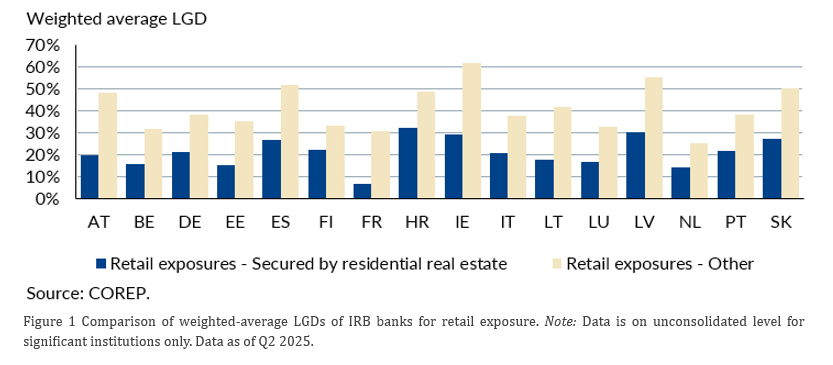
Secondly, as there is no information on the distribution available, i.e. the share of exposure that has a low estimated LGD and, thus would be affected by an increase in the LGD input floors, supervisory authorities can only rely on average LGDs as shown in Figure 1. While we observe a significant heterogeneity in weighted-average LGDs across countries,2 conclusions about the potential appropriateness of LGD input floors are not possible. Thus, also COREP data is inadequate for an assessment of LGD input floors. While data on the distribution of LGDs might be available in model documentations or validation reports, the information often lacks comparability across banks with respect to the applied definitions or scope of the models. Figure 1 also substantiates the claim of substantial leeway in estimating risk parameters: While the average LGD for RRE secured retail exposure is 7% in France it is 21% in Germany and even higher in e.g. Latvia with 30%.
Figure 2. Average LGD for retail exposure of IRB banks in Europe
Besides the deficiencies in the data that is available for assessing the appropriateness of LGD input floors, the design of the policy measure itself comes with multiple drawbacks.
Firstly, there is a strong asymmetry of risk within the portfolio in the IRB approach: The mandate according to Article 164 CRR allows to change the LGD input floors, i.e. the minimum LGD values on loan level, within the respective exposure class: e.g. retail loans that are secured by residential real estate currently have a LGD input floor of 5%. However, loans that are affected by the LGD input floors are those loans that, by definition, have the lowest losses in case of a default. Thus, if the national authority concludes that conditions in property markets pose a risk to financial stability (which would affect the whole portfolio, if not loans with higher LGDs even more), these risks could only be addressed via higher LGDs for the loans posing the lowest risk, according to Art. 164 CRR.
At the same time, as only the floor will be increased, a disproportionate shift in the LGD input floor would be necessary to have a sizeable impact on capital requirements. However, this would reduce the risk sensitivity within the respective portfolio. If a larger share of the portfolio receives a uniform LGD, i.e. the LGD input floor, no differentiation between riskier and less riskier loans can be made based on the LGD. This has also implications for loan pricing as capital requirements for loans serve as an important input for the calculations of loan rates.
Furthermore, the scope of measures for enhancing real estate related capital requirements in the STD approach and the IRB approach differ significantly. To increase risk weights for exposure that is secured by residential or commercial real estate in the STD approach, national authorities can activate a measure according to Article 124 CRR. While the measures according to Article 124 CRR directly affect the risk weights, the measure according to Article 164 CRR only indirectly affects risk weights via the LGD. This is particularly noteworthy as PDs explain a significant larger share of variations in risk weights than variations of LGDs for IRB banks. Additionally, measures according to Article 164 can only address retail exposure with higher LGD input floors, Article 124 has a broader scope as also e.g. corporate exposure that is secured by real estate can be addressed.
Another issue that complicates matters but is no showstopper for the assessment of LGDs’ adequacy comes from the fact that the IRB models have been approved by microprudential supervisors. Any measure according to Art. 164 CRR would directly override (some of) these approved LGDs. Deviations from the approved LGDs may be justified with different angles when looked at from a micro- or macroprudential point of view. While the perspective in IRB model setup and validation tends to be more backward looking, macroprudential supervisors embrace a more forward-looking perspective. For example, microprudential supervisors evaluate whether the banks accurately reflect economic downturn conditions in the LGD estimations, while macroprudential supervisors would evaluate whether LGDs adequately reflect a systemic crisis.
Not only the arguments listed in this section point towards deficiencies in the design of Article 164 CRR, but also its popularity among European policymakers. With the introduction of CRR III, no member country of the European Systemic Risk Board has activated a measure based on Article 164 CRR. While Norway had activated a measure based on Article 164 CRR until year-end 2024, the changes within the third amendment of the CRR lead to a discontinuation of this measure also in Norway. Furthermore, as multiple countries have activated other measures to address low risk weights for IRB banks (i.e. sectoral systemic risk buffers for real estate exposures of IRB banks, measures based on Article 458 CRR), this is a further indication of an inadequate design of Art. 164 CRR. Thus, the need for regulatory improvement is pervasive.
Policymakers have allowed banks to perform their own calculations for capital requirements within the IRB approach. Taking this decision as given, regulators and supervisors need to think carefully about how the regulation of banks applying the IRB approach is risk adequate and at the same time efficient to reduce societal costs. This is particularly helpful in the current debate on simplification of banking regulation. For a discussion of current proposals, see e.g. Schmitz et al. (2025).
Regarding the risks related to real estate exposure in the IRB approach, the current design, particularly with respect to measures according to Art. 164 CRR, is inefficient, risk inadequate and has significant asymmetries with Art 124 CRR. Thus, we propose to adapt the current regulatory framework with a simpler approach. Our proposals comprise a first-best option that tackles the general design of measures for addressing financial stability risks related to real estate exposure of IRB banks. This also leads to a simpler regulatory framework while maintaining solid regulatory standards for this asset class. Alternatively, if the implementation of the preferred option is (politically) not feasible, we provide proposals for specific enhancements that address the most pressing issues with respect to Article 164 CRR (second-best option).
The first-best option: The output floor should be applied on real estate exposure class level rather than bank level
The current design of the output floor eventually limits the advantage of banks applying the IRB approach with respect to their regulatory capital requirements to 27.5% on a bank level.3 However, this allows for a regulatory trade-off between exposures in the IRB approach that has higher and lower risk weights compared to the STD approach. Thus, we propose to introduce the output floor on the level of real estate exposure classes to ensure that capital requirements are not inadequately low..4 Referring to Figure 1, this would ensure that banks that have significantly lower real estate related capital requirements within the IRB approach (e.g. banks in Germany, Luxembourg, and Austria) have an adequate level of capital in a standard risk environment. More comparable risk weights would also reduce the potential disadvantage of banks applying the STD approach. This proposal comes without a significant increase in reporting or monitoring obligations for banks and supervisory authorities as this level of granularity in the regulatory reporting is already available in the current design of the output floor.
Furthermore, the adjustment of the output floor needs be complemented with existing instruments that can be activated by authorities in case of identified systemic risks in the real estate segment. Increases in the risk weights for banks applying the STD approach based on Article 124 CRR would directly translate into increases in the capital requirements for IRB banks via the output floor. Additionally, if the level of the output floor (i.e. 27,5%) is considered as inadequate due to financial stability concerns, measures based on Article 458 CRR could adjust the level of the output floor. As a further advantage, other macroprudential measures that address low capital requirements for real estate exposure, e.g. sectoral systemic risk buffers for IRB banks, might not be necessary. Thus, the regulatory complexity of multiple instruments addressing similar risks could be reduced.
This approach comes with further advantages. Given the output floor on exposure class level in combination with measures to adjust the overall level of risk weight and the difference between banks applying the STD approach and the IRB approach, there is no need to directly adjust the LGD values. Thus, Article 164 (6) CRR could be discontinued.
The second-best option: the design of Article 164 CRR as well as the data availability should be enhanced
Our less preferred option is to allow that national authorities can adjust LGD values across the whole portfolio of retail exposure secured by real estate instead of only the LGD input floors. This would reduce the asymmetry within the loan portfolio. However, this does not address that the mandate remains limited to retail exposures. This is inconsistent with the exposure classes in the STD approach. Also, estimated LGD parameters are approved and validated in an ongoing analysis by microprudential supervisors, which makes justification of changes in LGDs for forward looking / financial stability reasons somewhat more tedious.
Additionally, the meaningfulness and availability of data needs to be enhanced. Firstly, the reporting instructions for data that is collected based on Article 430a have to be changed. The accuracy of data should not depend on bank estimates of losses that cannot be verified. Secondly, an alignment of available data in supervisory reporting with exposure classes based on Article 164 CRR is necessary. Thirdly, information on the distribution of LGDs (similar to that of PDs already available) should be incorporated in COREP reporting.
As the history of real estate induced financial crises shows, adequate levels of capital for real estate exposure are crucial for maintaining financial stability. At the same time, ensuring that real estate related capital requirements are adequate, especially for banks applying the IRB approach, is a complex task for supervisors. This ambivalence led to multiple layers of supervisory measures that have been implemented over the years, both from a microprudential and a macroprudential perspective. We provide a simple approach on how to enhance the regulatory framework and data availability mostly from a macroprudential point of view. The suggested implementation of the output floor on (real estate) exposure class level reduces the supervisory need to assess the adequacy of LGDs and addresses current inconsistences within the regulatory framework.
Basel Committee on Banking Supervision. 2001. The Internal Ratings-Based Approach. Retrieved from BCBS.
Bracke, P. 2013. How long do housing cycles last? A duration analysis for 19 OECD countries. Journal of Housing Economics, 22(3), pp. 213–230.
Claessens, S., Kose, M. A., und Terrones, M. E. 2008. What Happens During Recessions, Crunches and Busts?. IMF Working Paper WP/08/274.
Claessen, S., M. A. Kose and M. E. Terrones. 2011. How Do Business and Financial Cycles Interact? IMF Working Paper, No. 11/88.
Crowe, C., G. Dell’Ariccia, D. Igan and P. Rabanal. 2013. How to Deal with Real Estate Booms: Lessons from Country Experiences. In: Journal of Financial Stability 9 (3). 300–319.
Laeven, L. and F. Valencia. 2018. Systemic bank crises revisited. In: IMF Working Paper Series 18/206.
European Parliament and Council. 2013. Regulation (EU) No 575/2013 of the European Parliament and of the Council of 26 June 2013 on prudential requirements for credit institutions and investment firms and amending Regulation (EU) No 648/2012. Official Journal of the European Union, L176, 1-337. Retrieved from EUR-Lex.
European Banking Authority. 2021. EBA/RTS/2021/12. Draft regulatory technical standards specifying the types of factors to be considered for the assessment of the appropriateness of risk weights under Article 124 (4) of Regulation 575/2013 and the conditions to be taken into account for the assessment of the appropriateness of minimum LGD values under Article 164 (8) of Regulation 575/2013. 1-42. Retrieved from EBA.
European Banking Authority. 2025. EBA report on the 2024 credit risk benchmarking exercise. Retrieved from EBA.
Hiebert, P., Jaccard, I., und Schüler, Y. 2018. Contrasting Financial and Business Cycles: Stylized Facts and Candidate Explanations. Journal of Financial Stability, vol. 38(C), pp. 72-80.
Schmitz, S. W., Posch, M., & Steiner, K. 2025. Better EU banking regulation can fuel growth, but lower capital requirements do not. Better EU banking regulation can fuel growth, but lower capital requirements do not. SUERF Policy Note | No. 373
This is simple comparison based on the average risk weights for banks using the IRB-approach and banks using the STD-approach. The comparison does not take differences in the risk density, i.e. differences in the levels of risk within the real estate portfolios into account.
The heterogeneity of estimated LGDs across countries is also shown in European Banking Authority (2025).
This level of the output floor is to be applied after the finalization of the phase-in in 2030.
Naturally, this proposal also includes that the derogation to apply the output floor only on the highest level of consolidation should be discontinued.