

This policy brief is based on BIS Working paper no 1321. The views expressed in this policy brief are those of the authors and do not necessarily reflect those of the Bank for International Settlements.
Abstract
Generative artificial intelligence (gen AI) is likely to support economic growth in the near term, but its benefits will not be evenly distributed across countries. In particular, advanced economies are better positioned than emerging market economies to reap short-run growth gains, reflecting differences in sectoral production structures and readiness to adopt AI. As a result, gen AI may widen income disparities across countries in the near term.
The rapid diffusion of generative artificial intelligence over the past two years has intensified debate about its macroeconomic implications. A growing body of evidence suggests that gen AI can raise worker productivity, foster firm growth and stimulate innovation. If adopted at scale, these gains could translate into higher aggregate productivity and faster economic growth.
However, most existing studies focus on the United States and a small group of advanced economies (AEs). Much less is known about how emerging market economies (EMEs) may be affected, particularly in the short run. This gap matters: EMEs differ markedly from AEs in their production structures, digital infrastructure, skill endowments and institutional readiness to adopt new technologies. These differences raise the possibility that AI could slow income convergence across countries.
This policy brief summarises the main findings of Gambacorta et al. (2025), which provides one of the first global assessments of how sectoral exposure to gen AI and country-level AI preparedness interact to shape short-run growth outcomes. Using data from 56 economies and 16 industries, we examine whether industries more exposed to gen AI grow faster in countries better prepared to adopt the technology.
The potential growth effects of AI stem largely from productivity gains. Micro-level evidence points to sizeable improvements in task performance following AI adoption, often ranging from 10% to more than 60%, particularly in cognitive and knowledge-intensive activities such as software development, consulting and customer support (Dell’Acqua et al (2023); Gambacorta et al, 2024; Noy and Zhang (2023); Brynjolfsson et al (2025); Cui et al (2025)). These gains tend to be larger for less experienced workers, suggesting that gen AI may act as a powerful skill equaliser.
To what extent do these task-level productivity gains translate into economy-wide increases in total factor productivity (TFP)? One of the lowest estimated productivity gains from AI is reported in Acemoglu (2024): an increase in US total factor productivity (TFP) of 0.07% annually, albeit over a decade. By contrast, Aghion and Bunel (2024), Bergeaud (2024), and Filippucci et al (2024) estimate larger TFP gains (0.3–0.9 percentage points per year), in part due to higher estimates of industries’ AI exposure. Higher productivity gains are reported in Baily et al (2023), especially in a scenario where gen AI continuously triggers innovation.
In addition to the uncertainty around productivity outcomes, there are questions about the extent to which the available estimates, obtained mostly for AEs, can be applied to EMEs. This is due to important differences in sectoral production structures between AEs and EMEs, as well as their varying preparedness to adopt AI.
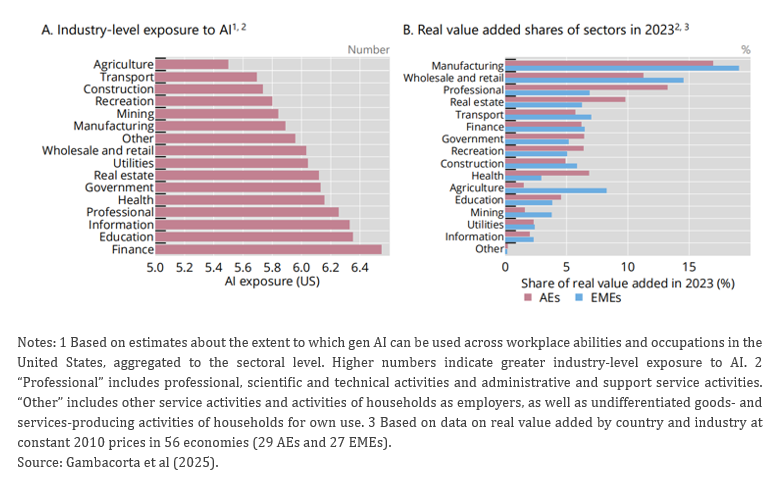
Production structure. The importance of the production structure is highlighted in Graph 1. The left-hand panel shows that finance, education and information are sectors with the highest estimated industry-level exposures to AI. This reflects the prevalence of cognitive and information-processing tasks in these sectors. By contrast, agriculture, transport and construction feature the lowest estimated AI exposures, given their reliance on physical and manual tasks. These data are based on survey information on the extent to which gen AI can be used across different workplace abilities and occupations and stem from Felten et al. (2021). The right-hand panel shows that the share of agriculture in total real value added is much larger in EMEs than in AEs. In contrast, the share of professional services tends to be smaller, which goes counter to a production structure that would favour AI deployment.
Graph 1. Industry-level exposure to AI and real value added shares of sectors
AI preparedness. Countries also differ in their ability to adopt AI. Key pillars include robust digital infrastructure, digitally skilled workforces and sound labour policies, an environment that encourages innovation and economic integration, and a solid regulatory and ethical framework. We capture these dimensions using the IMF’s AI preparedness index (AIPI; see Cazzaniga et al (2024)). The AIPI shows that AEs are typically better positioned than EMEs to adopt AI, reflecting comparatively stronger digital infrastructures, innovation capacity and regulatory frameworks.
Our empirical strategy closely follows Rajan and Zingales (1998). In their framework, the authors measure the extent of external finance dependence for each sector (using the US economy as a benchmark) and examine whether sectors that are more dependent on external finance grow disproportionately faster in countries with more developed financial markets. The parallel in our paper is using a sector-level measure of exposure to gen AI (shown in the left-hand panel of Graph 1, benchmarking the US economy) and a country-specific measure of AI preparedness (AIPI; see above) to capture the potential gains from adopting the new technology.
Using these measures of industry-level exposure to AI and country-level readiness to adopt the new technology, we estimate the impact of their interaction on the growth rate of real value added in each industry-country pair in 2022–23, after conditioning on country and industry fixed effects. Then, given the distribution of industries across countries, we compute country-specific growth effects in real value added.
These estimations use data for 56 economies and 16 industries. They also control for the use of industrial robots. This is important, as industrial robots might boost value added growth through automation of blue-collar sector activity. At the same time, gen AI could primarily affect productivity through white-collar workers.
Our results show that for the same increase in the economy’s AI preparedness, sectors with high AI exposure experience greater growth in real value added than those with lower exposure. This implies, for example, that AEs with larger professional and financial services sectors tend to receive a stronger initial boost from AI than their EME counterparts, where these sectors account for a smaller share of total real value added.
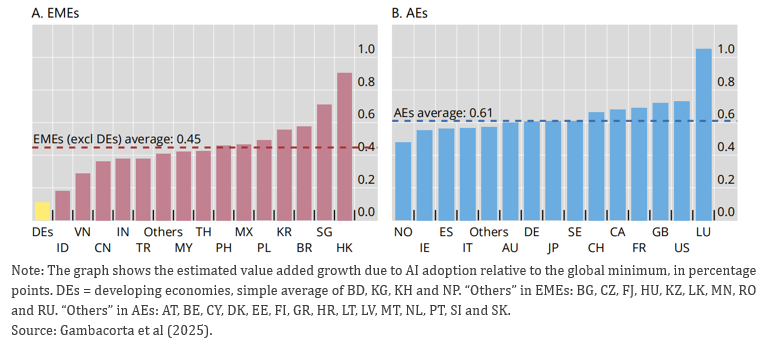
The country-specific near-term growth implications are illustrated in Graph 2. The results indicate that a standardised increase in the AIPI would typically raise real value added growth by 0.6 percentage points on average in AEs relative to the global minimum (left-hand panel), and by 0.45 percentage points on average in EMEs (right-hand panel). This implies that while many EMEs would still grow faster than AEs, the convergence of their per capita income levels could proceed more slowly.
Graph 2. Short-run growth impact of AI, relative to the global minimum
At the same time, within each country group, the results also highlight significant heterogeneity.
Among AEs, Luxembourg stands out as the economy most likely to benefit from AI in the near term, in part because of the country’s large financial sector. The United States and the United Kingdom are also among the AEs with some of the largest estimated growth impacts. Some countries in Central and Eastern Europe are estimated to experience smaller growth effects. Norway is also expected to experience a relatively small impact, largely due to the high share of the energy sector in its economy.
Among EMEs, the largest predicted impacts are in relatively high-income economies such as Hong Kong SAR and Singapore, where the financial sector share is also large. Notably, in the global sample, Hong Kong is surpassed only by Luxembourg in the near-term growth impact. In contrast, EMEs and developing economies with a larger share of low-skilled, labour-intensive manufacturing are projected to experience smaller gains.
While generative AI holds considerable promise for boosting productivity and growth, its short-run benefits are unlikely to be evenly distributed across countries. Differences in sectoral exposure, production structures and technological readiness mean that advanced economies are better positioned to benefit in the near term. Our findings suggest that generative AI may widen global income disparities, unless policy action helps level the playing field. For emerging market economies, policies that strengthen digital infrastructure, invest in skills, foster innovation and improve regulatory frameworks could enhance the growth dividends from AI. Over time, such measures may also facilitate shifts in production structures towards more AI-exposed sectors.
Acemoglu, D (2024): “The simple macroeconomics of AI”, NBER Working Paper, no 32487.
Aghion, P and S Bunel (2024): “AI and growth: where do we stand?”, mimeo.
Baily, M, E Brynjolfsson and A Korinek (2023): “Machines of mind: how generative AI will power the coming productivity boom”, Brookings.
Bergeaud, A (2024): “The past, present and future of European productivity”, paper presented at the ECB Forum on Central Banking, Sintra, July.
Brynjolfsson, E, D Li and L Raymond (2025): “Generative AI at work”, The Quarterly Journal of Economics, vol 140, no 2.
Cazzaniga, M, F Jaumotte, L Li, G Melina, A Panton, C Pizzinelli, E Rockall and M Mendes Tavares (2024): “Gen-AI: artificial intelligence and the future of work”, IMF Staff Discussion Notes, no 2024/001.
Cui, Z, M Demirer, S Jaffe, L Musolff, S Peng and T Salz (2025): “The effects of generative AI on high-skilled work: evidence from three field experiments with software developers”, available at SSRN.
Dell’Acqua, F, E McFowland III, E Mollick, H Lifshitz-Assaf, K Kellogg, S Rajendran, L Krayer, F Candelon and K Lakhani (2023): “Navigating the jagged technological frontier: field experimental evidence of the effects of AI on knowledge worker productivity and quality”, Harvard Business School Working Paper, no 24-013.
Felten, E, M Raj and R Seamans (2021): “Occupational, industry, and geographic exposure to artificial intelligence: a novel dataset and its potential uses”, Strategic Management Journal, vol 42, no 12.
Filippucci, F, P Gal and M Schief (2024): “Miracle or myth? Assessing the macroeconomic productivity gains from artificial intelligence”, OECD Artificial Intelligence Papers, no 29.
Gambacorta, L, E Kharroubi, A Mehrotra and T Oliviero (2025): “Artificial intelligence and growth in advanced and emerging economies: short-run impact”, BIS Working Papers, no 1321.
Gambacorta, L, H Qiu, D Rees and S Shan (2024): “Generative AI and labour productivity: a field experiment on coding”, BIS Working Papers, no 1208.
Noy, S and W Zhang (2023): “Experimental evidence on the productivity effects of generative artificial intelligence”, Science, vol 381, issue 6654.
Rajan R G and L Zingales (1998): “Financial Dependence and Growth”, The American Economic Review, 88(3), 559-586.