

The views are those of the authors and do not necessarily reflect those of Banque de France, LEO or Paris I Panthéon Sorbonne University.
Abstract
Artificial intelligence (AI) has much expanded over the recent period with the development of generative AI. The degree of competition within the AI value chain remains an open question. Some institutions, such as the OECD, document the competitive dynamics of several segments of the AI value chain (model development, access to AI models via the cloud, downstream AI usage) underlining that competition seems to be effective even if risks persist. However, using a complementary view on the demand side, the actual use of AI services, shows a strong dominance by one player. The impact of AI Sector competition for central banks, supervisors and more generally the financial system may be important to track, due to issues related to price setting, sovereignty, financial stability or activities such as risk management, compliance, or customer service, among others.
Several recent studies and reports have raised concerns about competitive risks within the artificial intelligence (AI) value chain. For example, in June 2024, the French Competition Authority issued an opinion1 on the competitive functioning of the AI sector, warning especially about the risk of concentration in favor of already dominant digital players2.
A recent study published by the OECD (2025)3 is based on a detailed analysis of new empirical data to document the competitive dynamics of three segments of the AI value chain.
First, in the AI model development segment, there has been an exponential increase in the number of available models, driven by a growing range of players. This diversification has led to a significant improvement in the quality-to-price ratio across a wide price range, as evidenced by the marked decline in the model price index over the past two years.
Second, regarding access to AI models via the cloud, while major providers (Amazon, Google, and Microsoft) enjoy significant competitive advantages, smaller players are managing to stand out by offering access to multiple AI models (notably open-source, via APIs) with varied capabilities and pricing at competitive rates, thanks to targeted offerings.
Third, in downstream AI usage, new entrants appear to be challenging the position of established players in certain markets, although this remains concentrated in a few sectors at this stage, particularly information and communication, as well as professional, scientific, and technical activities.
The OECD study nevertheless concludes that competition risks persist. The ability of new entrants to sustainably displace incumbent leaders remains uncertain. Moreover, major players are present at multiple levels of the value chain, reinforcing their market power.
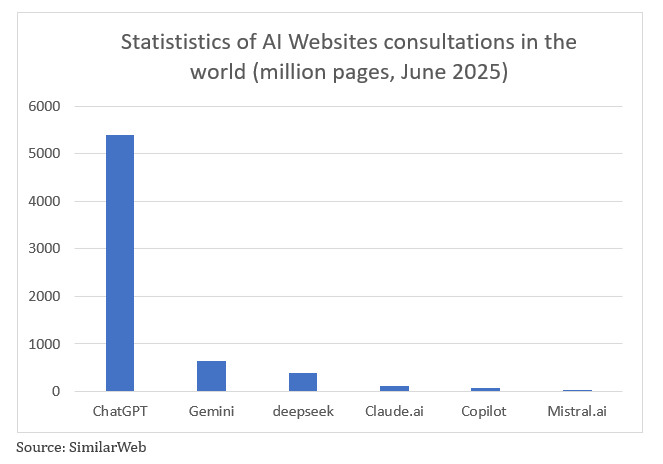
As the AI market is still evolving, there are no definitive statistics on market shares of the various players. It is therefore useful to refer to alternative sources, which consistently show the dominance of one player — ChatGPT/OpenAI — in France and globally.
Indeed, according to an Ipsos survey conducted in February 2025 in France, 68% of respondents reported using ChatGPT’s free version (and 14% the paid version), compared to only 30% for the second most-used tool, Gemini (keeping in mind that multiple tools can be used by the same person, so the total usage percentages exceed 100%).
In the meantime, notable developments have occurred, such as the emergence of Deepseek, but according to other sources, ChatGPT/OpenAI remains largely dominant (see Chart 1 for France and Chart 2 for the world).
Chart 1.
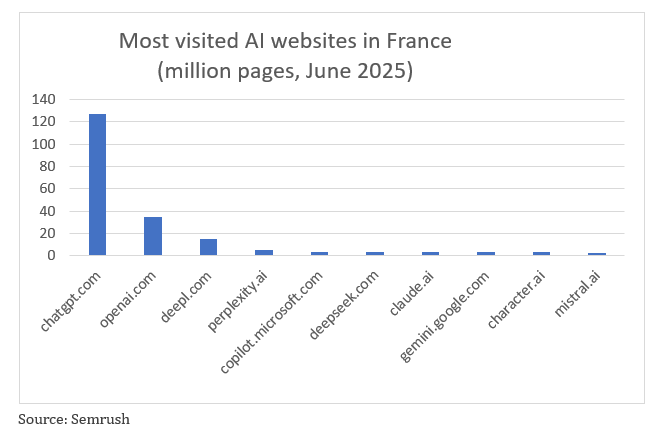
Chart 2.
The launch of ChatGPT in November 2022 attracted tens of millions of users within a few months. This dominant position appears to have been maintained since, despite the growing number of players in the sector.
Still, if general uses are concentrated in favor of one dominant player, there is room for the development of more specific models from other players, as suggested by the OECD, with potentially substantial economic gains.
While monitoring competition in the AI sector is not the responsibility of central banks, they have a vested interest in the issue due to its potential economic consequences.
An oligopolistic situation raises concerns about pricing and rent extraction by dominant players, potentially leading to higher prices and more limited supply than in a “normal” competitive environment, both upstream and downstream in the value chain.
As the French Competition Authority notes:
“[…] a single player, Nvidia, appears to hold a dominant position in the sector of computing components necessary for training foundation models. Given the significant constraints related to the supply of graphics processors and the concentration of the sector, several players fear that this context may foster potentially anti-competitive practices: – the recent study by France Digitale, based notably on interviews with around forty companies in the sector, reports potential risks such as price fixing, supply restrictions, unfair contractual conditions, or discriminatory behavior […]”
The magnitude of this impact and the risk for price stability remains to be evaluated more precisely, keeping in mind that the use of AI tools by consumers may, on the other hand, improve the comparison of prices of goods and services. Besides, a widespread adoption of AI may be viewed as a positive supply-side shock that increases productivity and reduces inflation4, at least temporarily. As noticed by the French Treasury5, there is also a possibility of economic benefits for consumers associated with network effects and economies of scale, which would make the complete analysis of costs and benefits more complex.
More generally, as underlined by an ECB Occasional Paper6, there is a possibility that digitalisation [in particular artificial intelligence] can change the structure of the economy and influence inflation via indirect channels, such as firms’ pricing behavior, market power and concentration, and firms’ productivity and marginal costs. All other things being equal, these indirect effects of digitalisation are important for monetary policy because they may affect the slope of the Phillips curve and can materialise as inflationary or disinflationary forces.
Excessive concentration also raises questions of potential sovereignty and financial stability risk if access to AI tools and related resources (e.g., GPU cards) were to be restricted in any way (e.g., outage, cyberattack, financial failure, access restriction…) for central banks and financial institutions, potentially disrupting key activities such as risk management, compliance, or customer service.
Autorité de la concurrence (French Competition Authority), 2024, « Le fonctionnement concurrentiel du secteur de l’intelligence artificielle générative », opinion 24-A-05.
« L’IA est la première technologie à être d’emblée dominée par des grands acteurs », Interview of Benoit Coeuré for Le Monde, September 2024.
”Developments in Artificial Intelligence markets: New indicators based on model characteristics, prices and providers”, Christophe André, Manuel Bétin, Peter Gal and Paul Peltier (2025). OECD Artificial Intelligence Papers n°37.
On this issue, see for example Borowski J., Fidrmuc J. and Jaworski K. (2025), Artificial intelligence and inflation in the EU, Economics Letters, Vol. 257, December: “We investigate the influence of artificial intelligence adoption on producer price inflation across economic sectors within the European Union. We show that AI diffusion is associated with reduced inflationary pressures, with effects most statistically significant in services and the Eurozone. A 10–percentage-point increase in the share of firms employing AI corresponds, on average, to a 0.3–0.6 percentage-point decline in inflation. The association between AI adoption and inflation is nonlinear. The deflationary impact on prices is more pronounced in AI-intensive sectors. Overall, the findings suggest that the integration of AI technologies constitutes a structural force dampening inflation.”
See the publication: Besson L., Dozias A., Faivre C., Gallezot C., Gouy-Waz J. and Vidalenc B. (2024), The Economic Implications of Artificial Intelligence, Trésor-Economics, Direction générale du Trésor, No. 341, April, available on the link: The Economic Implications of Artificial Intelligence | Direction générale du Trésor.
ECB Work stream on digitalization (2021), Digitalisation: channels, impacts and implications for monetary policy in the euro area, ECB Occasional Paper Series, No. 266, September, available on the link : Digitalisation: channels, impacts and implications for monetary policy.