This policy brief is based on BIS Working Papers No 1364. The views expressed are those of the authors and not necessarily those of the institutions the authors are affiliated with.
Abstract
What are the macro-financial effects of investors reassessing fiscal risk and demanding higher compensation for holding government debt? We develop a new method to identify fiscal risk shocks from daily movements in bond yields for a panel of 12 countries and analyse their impact on the economy. A rise in fiscal risk is estimated to increase borrowing costs for the broader economy, weaken currencies and lower equity valuations. Prices of goods and services also rise on impact and stay elevated for about one year, with short-term inflation expectations moving alongside them. Output enjoys a temporary boost, but this dissipates quickly, giving way to a persistent contraction induced by tighter financial conditions. The effects of fiscal risk intensify when central banks keep policy accommodative, and when sovereign risk is perceived to be already elevated.
After the COVID-19 pandemic, public debt has continued to rise, reaching post-WW2 peaks in many economies. In this environment, episodes in which the sustainability of government debt is questioned can trigger rapid and consequential adjustments in financial markets and the economy at large. When such episodes occur, not only do sovereign funding costs rise, but private financing conditions also tighten, currencies weaken and short-term inflation expectations shift.
In this policy brief, we summarize the findings in Gorea et al. (2026) who develop a new method to identify fiscal risk episodes for 12 economies and estimate their implications for macroeconomic and financial outcomes. Fiscal risk shocks are understood as unexpected changes in the current or future fiscal outlook that prompt investors to reassess the riskiness of public debt. Such shocks can follow the announcement of unfunded spending or tax cuts, or news that worsens medium-term deficits and debt.
In estimating fiscal risk shocks, the central empirical challenge is to isolate episodes where fiscal risk shifts unanticipatedly and separately from other shocks that also affect fiscal conditions, such as monetary policy surprises, inflation news and changes in global risk sentiment. The literature has identified fiscal stress events using several approaches, including bank–sovereign links, yield changes around US Treasury auction announcements or ratings information (Acharya et al., 2014; Almeida et al., 2017; Phillot, 2025).
The identification strategy in Gorea et al. (2026) rests on an intuitive pattern in investor behaviour during episodes that affect fiscal conditions. When fiscal concerns intensify, large institutional investors reallocate away from long-maturity government bonds and towards the safest investment-grade corporate bonds of similar maturity. Evidence of such rebalancing has been documented by Gomez-Cram et al. (2024), who show that the liquidity and safety services of sovereign bonds – their “convenience yield” – are perceived to weaken when unfunded government spending raises concerns about repayment. As a result, the safest private claims become relatively more attractive vis- à-vis sovereign debt, and institutional investors reduce their holdings of government bonds to invest in safe corporate bonds.
This behaviour implies that sovereign bond yields rise while the yields of the safest corporate bonds fall. To estimate true fiscal risk shocks, a sign restriction is therefore imposed in Gorea et al. (2026) that identifies fiscal risk episodes as those daily instances in which government bond yields increase while yields on safest corporate bonds of comparable maturity decrease. By construction, this method separates fiscal risk shocks from other macro shocks – such as monetary policy or symmetric inflation surprises – that tend to push both yields in the same direction.
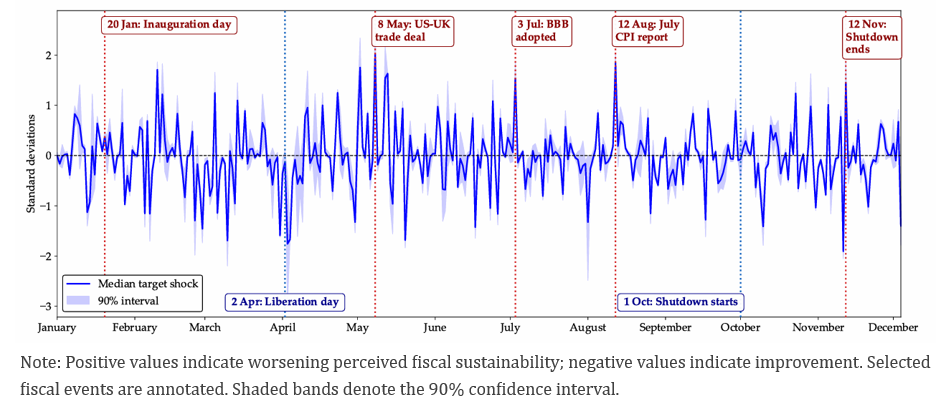
Narrative evidence shows how the estimated shocks line up with major fiscal events (Figure 1). In the United States, the “Liberation Day” tariff announcement in April 2025, was identified by this method as a reduction in fiscal risk (a negative fiscal risk shock). This reflected the expectation that the increase in tariffs on US imports would raise future tariff revenues, improving the fiscal balance and perceived fiscal sustainability. By contrast, the US-UK trade deal in May 2025 reduced the effective tariff rate on US imports from the UK, pointing to lower revenues ahead for the United States, and was identified as a positive fiscal risk shock. Similarly, the adoption of the “Big Beautiful Bill” in July 2025, which enacted sizeable tax cuts without offsetting revenue measures, is likewise estimated to be a significant positive fiscal risk shock. Anticipated political events elicit little reaction in the estimated shock series: President Trump’s second term Inauguration Day and the start of the 2025 government shutdown are not identified as significant fiscal risk shocks. In contrast, the shutdown’s resolution in November 2025 is estimated to be a positive shock, consistent with market participants’ expectations of continued unfunded government spending in the United States.
Our method also successfully identifies fiscal risk events outside the United States. The UK’s 2022 mini-budget announcement under Liz Truss’ premiership, which set out plans for large tax cuts with few credible offsetting revenue measures, is estimated to be a large positive fiscal risk shock for the United Kingdom that reversed when the plan was shelved. In Spain, during the peak of the euro area crisis in mid‑2012, the request for a €100 billion bank rescue registers as a positive fiscal risk shock – reflecting domestic banks’ substantial holdings of Spanish government bonds and heightened uncertainty about bank balance sheets, which raised doubts about fiscal sustainability. In contrast, then ECB President Mario Draghi’s “whatever it takes” pledge in July 2012 was identified as a sharp negative fiscal risk shock as the ECB signalled a credible backstop for sovereign bond markets, reducing perceived sovereign risk.
Figure 1. Estimated fiscal risk shocks for the United States in 2025
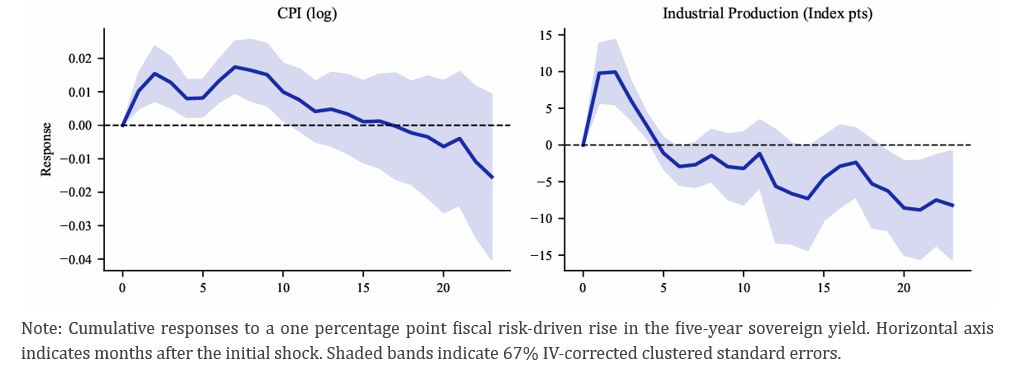
Fiscal risk shocks have important macroeconomic implications. Figure 2 shows that fiscal risk shocks are inflationary on impact and remain so for about a year, while the lift to output is fleeting. Headline inflation rises promptly and stays elevated for several months. Professional forecasters’ one-year-ahead inflation expectations rise in tandem, before gradually returning towards baseline. These inflationary pressures are consistent with the response of inflation to unfunded fiscal transfers (Cochrane, 2022; Bianchi et al., 2023; Smets and Wouters, 2024). Industrial production, by contrast, registers a brief improvement in the first few months, consistent with a short-run demand impulse often associated with fiscal expansions. However, real activity subsequently declines persistently as tighter financial conditions take hold. The more persistent inflation impulse can be explained by two main channels: first, depreciation of the trade-weighted exchange rate raises imported inflation; second, higher inflation expectations keep prices elevated temporarily, even as real activity begins to weaken. Over time, tighter funding conditions and higher borrowing costs become the dominant force, weighing on activity. As growth slows and asset valuations decline, inflation pressures gradually recede from their peak.
Figure 2. Prices and activity after a fiscal risk shock
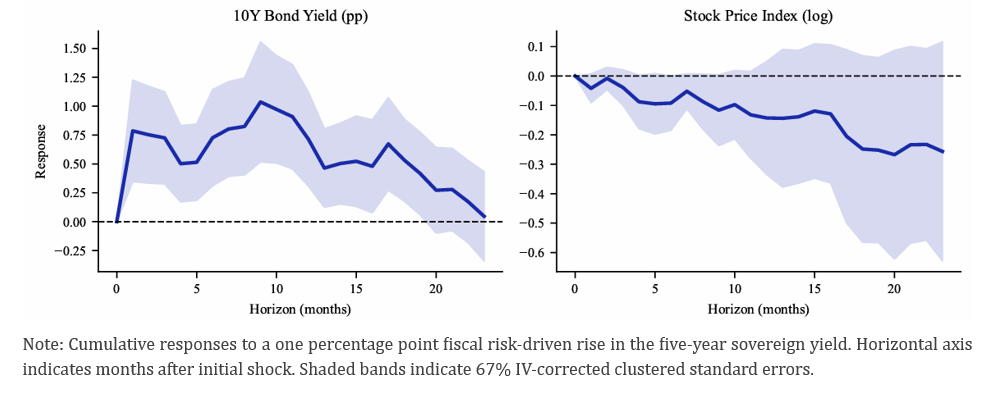
Fiscal risk repricing transmits quickly and powerfully through funding channels. Figure 3 shows that yield curves steepen as long-term sovereign yields rise by about half to one percentage point in the first year after a shock. This pattern is consistent with a higher risk premium on government debt and a compression of its convenience yield. Trade-weighted exchange rates depreciate with a short lag, reflecting a retrenchment of capital flows and a higher required compensation for currency risk. Equity prices fall and remain weak, consistent with higher discount rates, fiscal policy uncertainty and concerns about potential growth.
These channels reinforce one another. A weaker currency and elevated inflation expectations sustain price pressures even as tighter funding conditions weigh on activity. For borrowers whose costs are linked to the long end of the curve, such as corporates and mortgage holders, the steepening of the yield curve is particularly salient, since it tightens financial conditions even when short-term policy rates are unchanged.
Figure 3. Funding conditions: long-term yields and stock prices
The monetary policy stance and the initial level of sovereign risk are key amplifiers of the response to fiscal risk shocks. When policy remains accommodative after a positive fiscal risk shock – so that policy rates rise by less than a forward-looking Taylor rule would imply and real rates remain negative – the initial tightening at the long end of the yield curve is muted but temporary. Within about a year, yield curves steepen more than under an active monetary policy stance, headline inflation remains higher and real activity underperforms. Inflation expectations are also higher one year after the fiscal risk shock. In effect, accommodating a worsening of fiscal risk tends to postpone rather than prevent the tightening of financial conditions, while intensifying stagflationary dynamics.
Initial fiscal conditions also matter. When sovereign credit spreads are already elevated, the same fiscal risk shock produces larger and more persistent increases in inflation and inflation expectations, greater exchange rate depreciations, sharper rises in long-term yields and term spreads, and deeper declines in equity prices. This state dependence underscores the value of fiscal space and credibility. The higher the perceived sovereign risk is at the outset, the more powerful and costly the transmission of adverse fiscal news becomes.
Our findings indicate that fiscal risk repricing poses significant challenges for monetary policy. Fiscal risk shocks pull the economy in different directions. On impact, they are inflationary – through exchange rate depreciation and higher inflation expectations – yet they simultaneously tighten financial conditions, which over time slows borrowing and economic activity. The result is a stagflationary mix: prices rise even if output weakens. This may seem to worsen the trade-off faced by the central bank.
However, our results show that this trade-off is only apparent. The best overall outcome – even for output – arises when monetary policy is not accommodative. An active response that leans against fiscally driven inflation helps contain inflation and expectations, limits the rise in risk premia, and supports better medium-term activity than a more accommodative stance. By contrast, accommodation may briefly cushion long-term yields but ultimately allows inflation and expectations to drift higher, leading to steeper yield curves, tighter financial conditions, and weaker growth. Nor would it improve fiscal sustainability: if anything, weaker growth and higher borrowing costs would worsen debt dynamics and erode fiscal space.
These challenges are compounded by the extent to which initial fiscal conditions are already weak, as reflected in a high initial level of public debt and large sovereign risk premia. Consequently, a credible commitment to debt stabilisation by the fiscal authority, backed by clear communication on the medium-term fiscal path, would reduce the likelihood that fiscal news triggers a costly market repricing and make it easier for central banks to keep inflation expectations anchored.
Acharya, V., I. Drechsler and P. Schnabl (2014), “A pyrrhic victory? Bank bailouts and sovereign credit risk,” Journal of Finance, 69(6), 2689-2739.
Almeida, H., I. Cunha, M. A. Ferreira and F. Restrepo (2017), “The real effects of credit ratings: The sovereign ceiling channel,” Journal of Finance, 72(1), 249-290.
Bianchi, F., R. Faccini and L. Melosi (2023), “A fiscal theory of persistent inflation,” Quarterly Journal of Economics, 138(4), 2127–2179.
Cochrane, J. H. (2022), “A fiscal theory of monetary policy with partially-repaid long-term debt,” Review of Economic Dynamics, 45, 1-21.
Gomez-Cram, R., H. Kung and H. Lustig (2024), “Government debt in mature economies: Safe or risky?”, Jackson Hole Economic Symposium Proceedings.
Gorea, D., D. X. Ng and F. Zampolli (2026), “Financial and real effect of fiscal risk”, BIS Working Paper, No 1364.
Phillot, M., (2025), “US Treasury auctions: A high-frequency identification of supply shocks,” American Economic Journal: Macroeconomics, 17 (1), 245–273.
Smets, F. and R. Wouters (2024), “Fiscal backing, inflation and US business cycles,” CEPR Discussion Paper, No 19791.