

This Policy Brief summarizes Leone (2026), “Multinationals, Robots, and the Labor Share,” European Economic Review, Vol. 186, 105302. The views expressed are those of the author and do not necessarily reflect those of the Bank of Italy.
Abstract
The share of income going to workers has been falling across advanced economies for decades. Globalization and automation are among the leading explanations, but they are usually studied separately. Drawing on three decades of data on Spanish manufacturing firms, this brief shows that the two forces reinforce each other. Domestic firms taken over by multinationals become much more likely to install industrial robots, and their labor share falls by about 6.5 percentage points — one-third of which is due to robots. The trigger is market access: the new parent opens export channels, and affiliates automate to scale up. This is not retrenchment: employment rises, and the labor share falls because value added grows faster, not because wages are cut. Without multinationals, the decline in Spain’s manufacturing labor share would have been 6.5% smaller. Foreign investment thus brings growth and jobs, while also shifting how the gains are shared.
Multinational enterprises (MNEs) can expand the production possibility frontier of the countries that host them. Their affiliates employ more innovative production methods and more effective management practices than domestic firms (Bloom, Sadun, and Van Reenen, 2012), and a large body of evidence shows that acquired firms become more productive, more innovative, better financed, and more engaged in international trade (Guadalupe, Kuzmina, and Thomas, 2012). Technological change, however, is typically biased toward some production factors. If the technologies that multinationals bring to their affiliates favor capital over labor, multinational activity may also reallocate income between the two. These distributional outcomes concern policymakers, not least because they can feed anti-globalization sentiment (Colantone, Ottaviano, and Stanig, 2022).
This brief provides evidence that firms acquired by MNEs experience a reduction in their labor share. Multinational takeovers generate fundamental changes in acquired firms, and one dimension of this reorganization is the systematic adoption of industrial robots, which allow affiliates to scale up production but reallocate income away from labor. The findings make two points. First, they uncover a new channel through which multinationals redistribute income between production factors within the firms they acquire. Second, they extend the argument that globalization and technological change are among the leading drivers of the labor share decline observed in many countries (Grossman and Oberfield, 2022). Rather than alternative forces, globalization (in the form of MNEs) and technological change (in the form of robots) interact and reinforce each other in driving the downward trend.
Studying this interaction requires information that is seldom available in the same dataset: who owns a firm and which production technologies it uses. The Survey on Business Strategies (ESEE), run by the SEPI Foundation in Madrid, provides both. It is representative of Spanish manufacturing firms with at least ten employees and asks them whether they use robotics on the production line, alongside detailed information on sales, employment, wages, investment, R&D, exports, and, crucially, ownership composition.
The analysis focuses on two groups of firms: those that remain under Spanish ownership throughout (around 3,000 firms) and those that switch from domestic to foreign ownership during the sample period (102 firms). Although the second group represents only about 3% of firms in a typical year, it accounts for roughly 25% of production and exports, 15% of employment, and 30% of the capital stock. Whatever happens inside these firms matters for the aggregate.
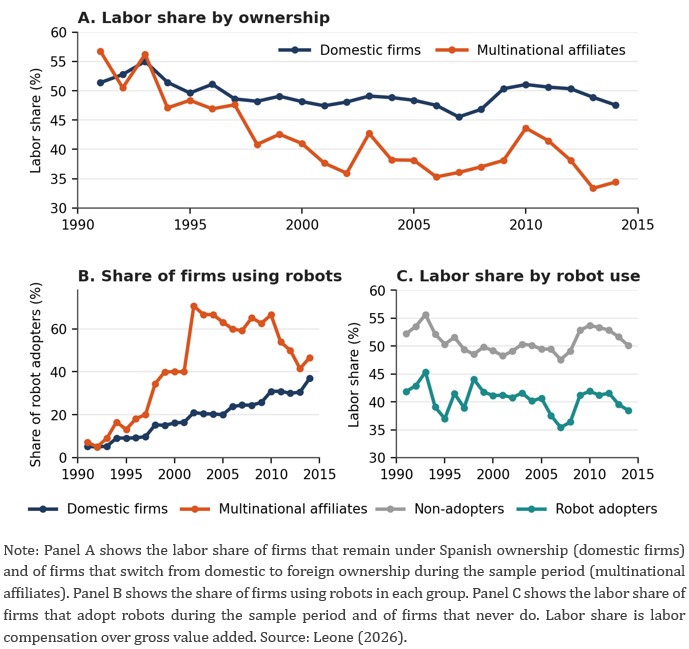
Two facts stand out (Figure 1). First, multinational affiliates have a lower labor share than domestic firms, and the gap has widened dramatically: between 1991 and 2014 their labor share fell from 56% to 34%, against a modest decline from 51% to 47% for domestic firms. Second, affiliates are consistently more likely to use robots, and robot adopters have a lower labor share than firms that never adopt.1
Figure 1. Two decades of divergence: multinational ownership, robot adoption, and the labor share in Spanish manufacturing (1991–2014)
These facts are not, by themselves, informative about causal effects. Multinationals do not buy firms at random. They pick the most productive, most innovative, and most export-oriented targets, which may have been on a different trajectory anyway. To separate the effect of the takeover from the selection of targets, the paper compares acquired firms with a group of domestic firms that looked almost identical in the year before the acquisition — in size, growth, investment, R&D, exports, and labor share — and then follows both groups over time.
The results are shown in Figure 2. After a foreign takeover, affiliates grow: employment rises by about 11% and value added by roughly 21%. Average wages, however, do not change significantly. Because output grows faster than the wage bill, the labor share falls, by 6.5 percentage points on average, or 15% relative to the sample mean. The decline is not a story of job losses; it is a story of firms getting bigger without sharing the gains proportionally with their workforce.
The same design shows that takeovers push firms toward robots. The probability of using robots increases by 11.5 percentage points after acquisition, a 30% rise relative to the average adoption rate. And adopting robots reduces a firm’s labor share by about 2.2 percentage points — an estimate obtained by comparing adopters with similar non-adopters within the same ownership group. Put together, robots account for about one-third of the labor share decline that follows a foreign takeover. These findings survive a battery of checks, including comparing acquired firms with firms bought by domestic rather than foreign parents, which isolates the multinational nature of the acquisition from the acquisition itself.
Figure 2. What happens to a firm after a foreign takeover
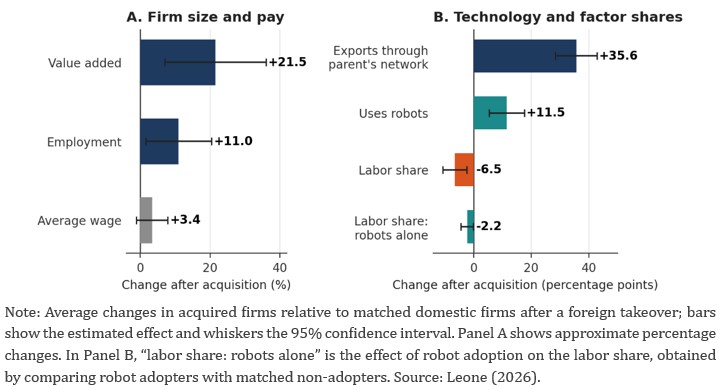
The natural question is what changes after the takeover that makes automation attractive. The data allow three hypotheses to be tested: better access to foreign markets, cheaper financing for investment, and technology transfer from the parent. Only the first receives support, in line with earlier evidence that access to foreign markets is a key driver of technology upgrading (Bustos, 2011; Guadalupe, Kuzmina, and Thomas, 2012). After acquisition, affiliates become far more likely to export through their parent’s distribution network — a 36 percentage-point increase — and their sales and exports rise accordingly. There is no evidence that they invest more in externally financed R&D or import more foreign technology.
The mechanism is therefore one of scale. The new parent brings orders from abroad, but converting potential demand into actual sales requires expanding capacity. Robots are one way to do this, but they are not factor-neutral: they reallocate income from labor to capital.
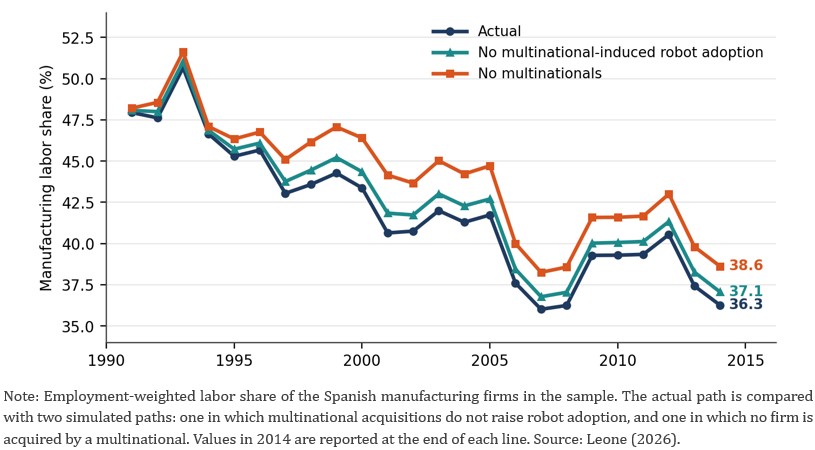
How much do these firm-level changes matter for Spanish manufacturing as a whole? Aggregating the estimates with employment weights, the paper simulates how the sector’s labor share would have evolved without multinational-induced robot adoption, and without multinationals altogether (Figure 3). In the absence of multinationals, the decline in the manufacturing labor share between 1991 and 2014 would have been about 6.5% smaller — roughly two percentage points at the end of the period. Multinational-induced robot adoption accounts for about one-third of that effect. Although these are partial-equilibrium effects and are not informative about welfare, they provide novel evidence on how globalization and automation jointly contribute to the decline of the manufacturing labor share.
Figure 3. What if multinationals had not brought robots — or had not been there at all?
Counterfactual paths of the manufacturing labor share (1991–2014)
Three messages emerge for policymakers. First, foreign direct investment is not distributionally neutral. Governments across the world compete to attract multinationals, and the evidence here confirms that acquired firms become more productive, larger, and better connected to world markets, and that they hire more workers. But the same takeover reallocates value added away from labor. The gains from FDI are real; so is the question of who captures them.
Second, the distributional cost does not, on this evidence, call for restricting foreign takeovers or discouraging robots. Employment rises, and the labor share falls because value added grows faster, not because wages are cut. The appropriate response lies in policies that help workers at risk of being displaced, rather than in slowing down the investment itself.
Third, globalization and automation should be analyzed together. Policies and monitoring frameworks that treat them as separate phenomena — one belonging to trade policy, the other to innovation policy — will underestimate their joint effect on labor income. For statistical agencies and central banks, tracking technology adoption alongside firm ownership, as the Spanish survey does, is an effective way to measure this interaction accurately.
Bloom, N., R. Sadun, and J. Van Reenen (2012). “Americans Do IT Better: US Multinationals and the Productivity Miracle.” American Economic Review, 102(1), 167–201. https://doi.org/10.1257/aer.102.1.167
Bustos, P. (2011). “Trade Liberalization, Exports, and Technology Upgrading: Evidence on the Impact of MERCOSUR on Argentinian Firms.” American Economic Review, 101(1), 304–340. https://doi.org/10.1257/aer.101.1.304
Colantone, I., G. I. P. Ottaviano, and P. Stanig (2022). “The Backlash of Globalization.” In G. Gopinath, E. Helpman, and K. Rogoff (eds.), Handbook of International Economics, Vol. 5, 405–477. Elsevier. https://doi.org/10.1016/bs.hesint.2022.02.007
Grossman, G. M., and E. Oberfield (2022). “The Elusive Explanation for the Declining Labor Share.” Annual Review of Economics, 14, 93–124. https://doi.org/10.1146/annurev-economics-080921-103046
Guadalupe, M., O. Kuzmina, and C. Thomas (2012). “Innovation and Foreign Ownership.” American Economic Review, 102(7), 3594–3627. https://doi.org/10.1257/aer.102.7.3594
Leone, F. (2026). “Multinationals, Robots, and the Labor Share.” European Economic Review, 186, 105302. https://www.sciencedirect.com/science/article/pii/S0014292126000462
Cross-country industry data for 37 economies suggest that both patterns extend well beyond Spain: where multinational production is larger, robot density — robots per thousand workers — is higher and the labor share is lower.