

This policy brief is based on the authors’ forthcoming publication in American Economic Journal: Macroeconomics. The views expressed in this policy brief represent only the authors’ own and should therefore not be reported as representing the views of the International Monetary Fund, its Executive Board, or IMF management.
Abstract
Nonbanks now play a central role in corporate credit markets. In our forthcoming paper (Albuquerque et al. 2026a), we show that when monetary or macroprudential policy tightens, nonbanks partly cushion the decline in bank lending to nonfinancial firms. This credit migration is strongest when weaker banks are involved and helps firms with nonbank relationships sustain investment and employment. The benefit may come with risks: nonbanks lend more to riskier borrowers on average, rely on less stable funding, and operate largely outside the bank regulatory perimeter. The findings point to a policy trade off: nonbanks can support credit when banks pull back, but they may also weaken policy transmission and raise financial-stability risks.
Nonbank financial institutions (NBFIs) have moved from the periphery to the core of global finance. Their share of global financial assets rose from 43 percent in 2008 to 51 percent in 2024 (FSB 2025). In the global syndicated loan market, nonbanks now account for nearly half of corporate loan origination, up from just over 30 percent during the Global Financial Crisis (Figure 1). This matters because syndicated loans are a major source of corporate finance and because both banks and nonbanks participate in this market. Nonbanks in our sample include investment banks, broker-dealers, investment funds, asset managers, finance companies, insurers, pension funds, and other non-deposit-taking intermediaries. The shift toward these lenders is most visible in advanced economies (AEs), especially the United States, but the borrowers affected by it are global.
Our paper studies what this shift means for the transmission of monetary policy (MP) and macroprudential policy (MaPP) to corporate lending (Albuquerque et al. 2026a). The central result is that when policy tightening reduces bank lending, nonbanks partly step in. That cushions firms, but it also moves credit toward a sector that is less regulated, more opaque, and more dependent on market-based funding.
Figure 1. Nonbank share in the corporate global syndicated loan market
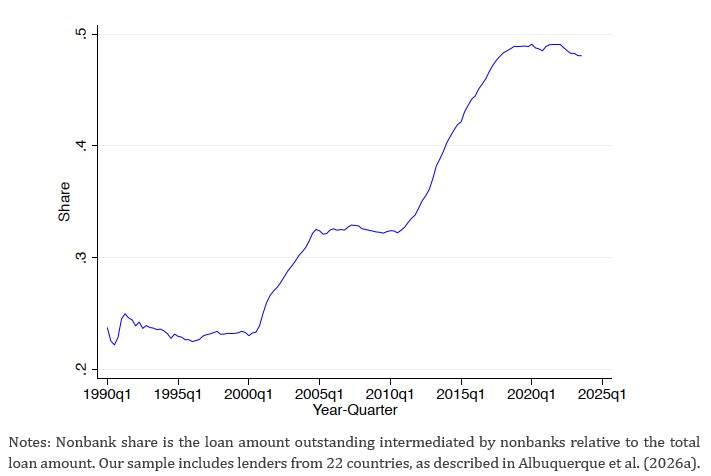
We use Dealogic syndicated loan data covering 2000-2019. The final sample includes lenders from 22 countries and nonfinancial corporate borrowers from 156 countries. This setting allows us to compare how banks and nonbanks adjust lending to the same borrowers when policy tightens.
For monetary policy, we use country-specific MP shocks from Choi et al. (2024). For macroprudential policy, we construct MaPP shocks from the IMF iMaPP database of Alam et al. (2025), focusing on tools that can constrain banks’ lending capacity. We then purge the MaPP series of observable macro-financial conditions to address potential reverse causality and endogenous policy responses.
The intuition for the role of nonbanks after the policy shocks is as follows. Monetary tightening can raise bank funding costs and trigger deposit outflows (Drechsler et al. 2017; Xiao 2020). Macroprudential tightening can strengthen bank resilience but also bind banks’ balance sheets. In both cases, credit can leak toward the less-regulated nonbanks (Kim et al. 2018; Begenau and Landvoigt 2022; Claessens et al. 2023).
Our baseline regression assesses how the supply of new syndicated loans responds to MP and MaPP shocks, focusing on differences between bank and nonbank lenders. To isolate supply effects from demand, we use firm-by-quarter fixed effects to account for time-varying borrower demand. The identification in our specification thus relies on the assumption that a given nonfinancial firm borrows from at least one bank and one nonbank in a given quarter.
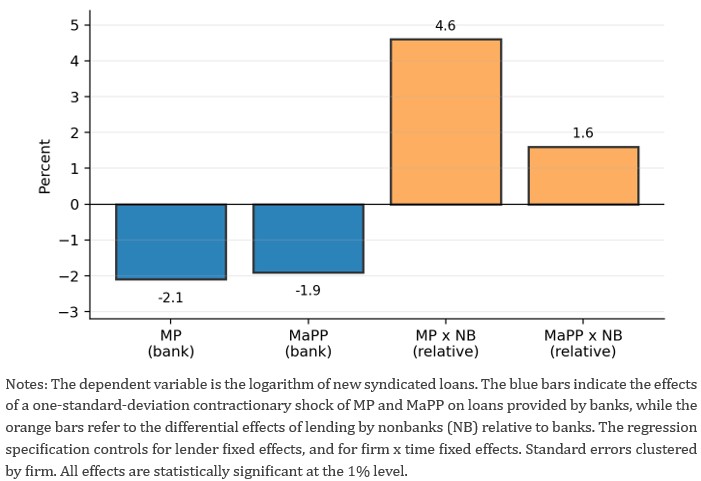
We find that bank lending falls after both contractionary MP and MaPP shocks. Figure 2 shows that a one-standard-deviation MP tightening is associated with a 2.1 percent fall in bank lending, but nonbanks increase lending by 4.6 percent relative to banks. A MaPP tightening reduces bank lending by 1.9 percent, while nonbank lending rises by 1.6 percent relative to bank lending. These estimates imply that nonbanks gain market share precisely when bank credit contracts. The result is stronger for firms that already have lending relationships with nonbanks, and is consistent with evidence on nonbanks and monetary transmission in the United States and Denmark (Elliott et al. 2026; Cucic and Gorea 2026). For MaPP shocks, the documented shift suggests tighter regulation may inadvertently push credit into the less-regulated nonbank sector (Kim et al. 2018, Begenau and Landvoigt 2022).
Albuquerque et al. (2026b) provide complementary evidence after MaPP tightening shocks: the increase in nonbank lending after macroprudential tightening is driven largely by nonbanks affiliated with banking groups. Banking groups appear to reallocate credit toward their nonbank subsidiaries, offsetting part of the contraction in group-level lending and shifting activity from regulated bank balance sheets to less-regulated nonbank entities within the same group.
Figure 2. Effect of monetary and macroprudential policy shocks on new loans
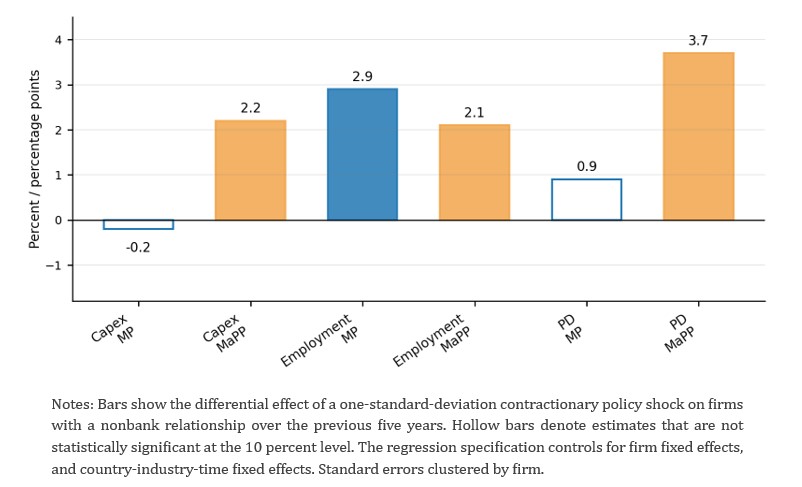
The migration of credit to nonbanks has real economic effects. Figure 3 shows that firms with a prior nonbank lending relationship tend to sustain activity better after policy tightening, with stronger evidence for MaPP shocks: firms with nonbank relationships have higher capital expenditures and employment relative to other comparable firms. But these gains do not come with a clear reduction in borrower risk. Default probabilities do not fall and actually increase after MaPP shocks. This distinction is important: nonbanks can cushion credit and support real activity, but this does not necessarily make borrowers safer.
Figure 3. Differential effects of MP and MaPP shocks on firms with a nonbank relationship
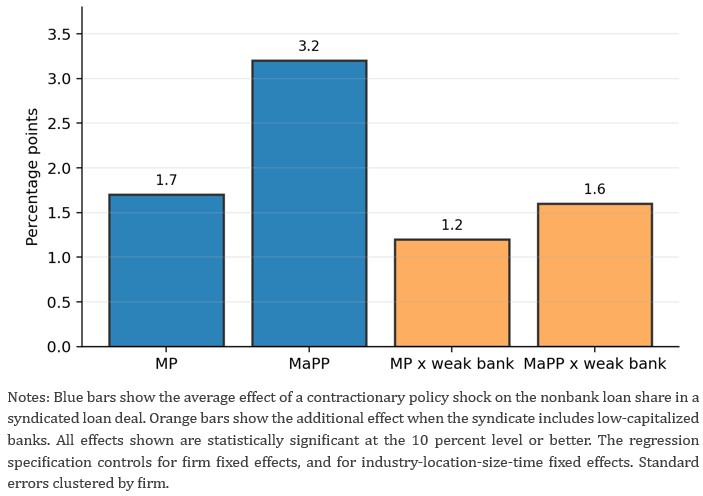
The credit migration to nonbanks is not uniform across banks. It is stronger in syndicated loan deals that include weaker banks, measured by low loan-weighted Tier 1 capital ratios or high nonperforming-loan ratios. Figure 4 shows that, in the preferred specification using low capital, the nonbank loan share rises by 1.7 percentage points after an MP shock and by 3.2 percentage points after a MaPP shock. When weak banks are present, the nonbank share rises by an additional 1.2 percentage points after MP tightening and 1.6 percentage points after MaPP tightening.
This pattern is consistent with policy tightening binding more strongly for banks closer to balance-sheet constraints. In effect, we interpret this credit reallocation as a sign that tighter policy amplifies balance sheet constraints for less-capitalized banks, reducing their lending capacity. This supports the view that post-GFC regulations, while enhancing bank resilience, may have encouraged greater nonbank participation in credit markets (Buchak et al. 2018, Irani et al. 2021, Claessens et al. 2023).
In the paper, we do not find that risky loans are disproportionately pushed to nonbanks after policy shocks. But nonbanks lend more to riskier borrowers on average, which remains relevant for financial stability (Aldasoro et al. 2025, Fleckenstein et al. 2026).
Figure 4. Nonbank share and weak-bank syndicates
A further mechanism is that banks themselves may lend more to nonbanks when MaPP tightens. We find in the paper that banks increase lending to nonbank borrowers relative to nonfinancial corporates after MaPP tightening, with stronger effects among low-capitalized banks. This helps explain how nonbanks can expand corporate lending when banks reduce direct lending to firms (Albuquerque et al. 2026a).
One interpretation is regulatory. Some frameworks can make exposures to nonbank financial borrowers less capital-intensive than exposures to nonfinancial corporates. When regulation tightens, especially for banks close to capital constraints, lending to nonbanks may become relatively more attractive. The evidence is consistent with bank-nonbank interconnectedness becoming more important when MaPP tightens (Krainer et al. 2025).
Our research highlights the growing role of nonbanks in transmitting policy shocks to the real economy. When monetary or macroprudential policy tightens, nonbanks help offset reduced bank lending to nonfinancial firms, providing an alternative funding source that can support investment and activity. This can make the financial system more flexible by reducing the real effects of policy tightening.
The risk is that credit does not disappear from the system; it migrates. If the migration is toward intermediaries with less stable funding, higher leverage, less regulatory oversight, and weaker access to emergency liquidity, financial vulnerabilities can build outside the banking perimeter. Bank-nonbank linkages can also feed risks back to banks, especially when banks fund nonbank borrowers.
These findings point to three priorities. Authorities need better data on nonbank credit intermediation and bank-nonbank exposures; macroprudential frameworks should monitor credit leakage when tools bind mainly on banks; and, where risks are systemic, the regulatory perimeter may need to broaden through tools tailored to nonbank business models. The growth of private credit makes these questions even more pressing.
Alam, Z., Alter, A., Eiseman, J., Gelos, G., Kang, H., Narita, M., Nier, E. and Wang, N. (2025), ‘Digging Deeper–Evidence on the Effects of Macroprudential Policies from a New Database’, Journal of Money, Credit and Banking 57(5), 1135–1166.
Albuquerque, B., Cerutti, E., Chen, N. and Firat, M. (2026a), “From Banks to Nonbanks: Macroprudential and Monetary Policy Effects on Corporate Lending”, American Economic Journal: Macroeconomics. Forthcoming.
Albuquerque, B., Cerutti, E., Firat, M. and Kagerer, B. (2026b), “Banking on Nonbanks”, IMF Working Paper 26/23, International Monetary Fund.
Aldasoro, I., Doerr, S. and Zhou, H. (2025), ‘Non-bank lending during crises’, Review of Finance 29(6), 1809–1832.
Begenau, J. and Landvoigt, T. (2022), “Financial Regulation in a Quantitative Model of the Modern Banking System”, The Review of Economic Studies 89(4), 1748–1784.
Buchak, G., Matvos, G., Piskorski, T. and Seru, A. (2018), “Fintech, regulatory arbitrage, and the rise of shadow banks”, Journal of Financial Economics 130(3), 453–483.
Choi, S., Willems, T. and Yoo, S. Y. (2024), “Revisiting the monetary transmission mechanism through an industry-level differential approach”, Journal of Monetary Economics 145, 103556.
Claessens, S., Cornelli, G., Gambacorta, L., Manaresi, F. and Shiinad, Y. (2023), “Do Macroprudential Policies Affect Non-bank Financial Intermediation?”, International Journal of Central Banking 19(5), 185–236.
Cucic, D. and Gorea, D. (2026), ‘Nonbank lending and the transmission of monetary policy’, The Review of Financial Studies 39(4), 966–1014.
Drechsler, I., Savov, A. and Schnabl, P. (2017), “The deposits channel of monetary policy”, Quarterly Journal of Economics 132(4), 1819-1876.
Elliott, D., Meisenzahl, R., Peydró, J.-L. and Turner, B. (2026), ‘Nonbanks, Banks, and Monetary Policy: U.S. Loan-Level Evidence since the 1990s’, Journal of Monetary Economics, forthcoming.
Financial Stability Board (2025), Global Monitoring Report on Non-Bank Financial Intermediation, Financial Stability Board.
Fleckenstein, Q., Gopal, M., Gutierrez, G. and Hillenbrand, S. (2026), “Nonbank lending and credit cyclicality”, The Review of Financial Studies 39(4), 925–966.
Irani, R. M., Iyer, R., Meisenzahl, R. R. and Peydró, J.-L. (2021), “The rise of shadow banking: Evidence from capital regulation”, The Review of Financial Studies 34(5), 2181–2235.
Kim, S., Plosser, M. C. and Santos, J. A. (2018), “Macroprudential policy and the revolving door of risk: Lessons from leveraged lending guidance”, Journal of Financial Intermediation 34, 17–31.
Krainer, J., Vaghef, F. and Wang, T. (2025), “Bank Lending to Nonbanks: A Robust Channel Fueled by Constrained Capital?”, SSRN Working Paper.
Xiao, K. (2020), “Monetary Transmission through Shadow Banks”, The Review of Financial Studies 33(6), 2379–2420.