

This policy brief is based on the author’s Bank of Finland Research Discussion Paper, Quantifying Minsky Cycles. The views expressed are those of the author and do not necessarily reflect the views of the Bank of Finland, the Eurosystem, or the University of Turku.
Abstract
This brief summarizes evidence from Quantifying Minsky Cycles (Ristolainen, 2026). The paper derives a measure of sentiment from survey beliefs that captures the component of beliefs related to the misaggregation of public information. The time and country coverage of this measure is then extended using machine-learning methods and historical news text data. The results suggest that an increase in public-information misaggregation is followed by changes in the composition of credit, especially toward household and non-tradable-sector credit. This component of sentiment also tends to rise as time passes after financial crises. These findings provide empirical support for a Minsky-style mechanism in which fading crisis experience and optimistic beliefs are associated with credit allocation patterns that have been linked to financial fragility.
A long tradition in macro-finance argues that financial crises are often preceded by credit booms (Schularick and Taylor, 2012; Greenwood et al., 2022). However, not all credit booms are equally informative about future crises as the composition of credit matters. Credit growth directed toward non-tradable corporate sectors (Müller and Verner, 2024), such as real estate and construction, has been shown to be more closely connected to financial fragility than credit growth directed toward tradable sectors.
The Minsky-Kindleberger view (Minsky, 1977; Kindleberger, 1978) provides one explanation for financial crises. In this view, periods of prosperity and financial stability can gradually encourage greater risk-taking, more optimistic assessments of future conditions, and a shift toward more fragile forms of finance. The challenge for empirical work is that the belief-based component of this mechanism is difficult to observe directly. The paper summarized here asks whether a measurable sentiment component in expectations related to misaggregation of public information predicts the types of credit expansions that are most relevant for financial stability, and whether sentiment is related to fading crisis experience.
The starting point is a measure of sentiment constructed from monthly professional forecasts of real GDP growth for 18 countries, covering 1991-2020. A forecast contains information about expected future economic growth, but it also reflects how forecasters interpret the information available to them.
In the paper, the part of professional forecasts that can be explained with public information is compared with machine-learning forecasts based on the same public information available at the time. The part of the public information professional forecasts that is unexplainable with the objective machine benchmark is interpreted as a sentiment component: optimism or pessimism relative to what the public-information benchmark implies. This measure is called public-information misaggregation sentiment, or PIMS.
Because modern survey data have limited historical coverage, the paper then uses machine learning methods and Wall Street Journal news title texts to extend the sentiment measure over time and across countries. The historical measure is obtained by learning the relationship between the survey-based sentiment measure and news-title information during the period in which both are observed, and then predicting the sentiment measure for earlier periods in which only news data are available. The resulting monthly panel covers 78 countries and extends the time coverage back to September 1903.
The first main finding is that sentiment predicts the composition of aggregate credit, but not aggregate credit growth. A positive shock to PIMS is followed by increases in household credit-to-GDP and non-tradable-sector credit-to-GDP ratios. This distinction is important: the paper does not show that sentiment simply predicts more credit everywhere. Rather, the result is that sentiment is associated with a reallocation of credit toward sectors that are more closely connected to financial fragility. The sectoral pattern is central to the policy relevance of the paper. Previous research has shown that credit booms are more dangerous when credit flows to sectors such as real estate and construction rather than to tradable sectors (Müller and Verner, 2024). The results in this paper are consistent with the idea that optimistic beliefs are linked to this type of credit allocation.
Figure 1. Local projections of credit following shocks to misaggregation of public information
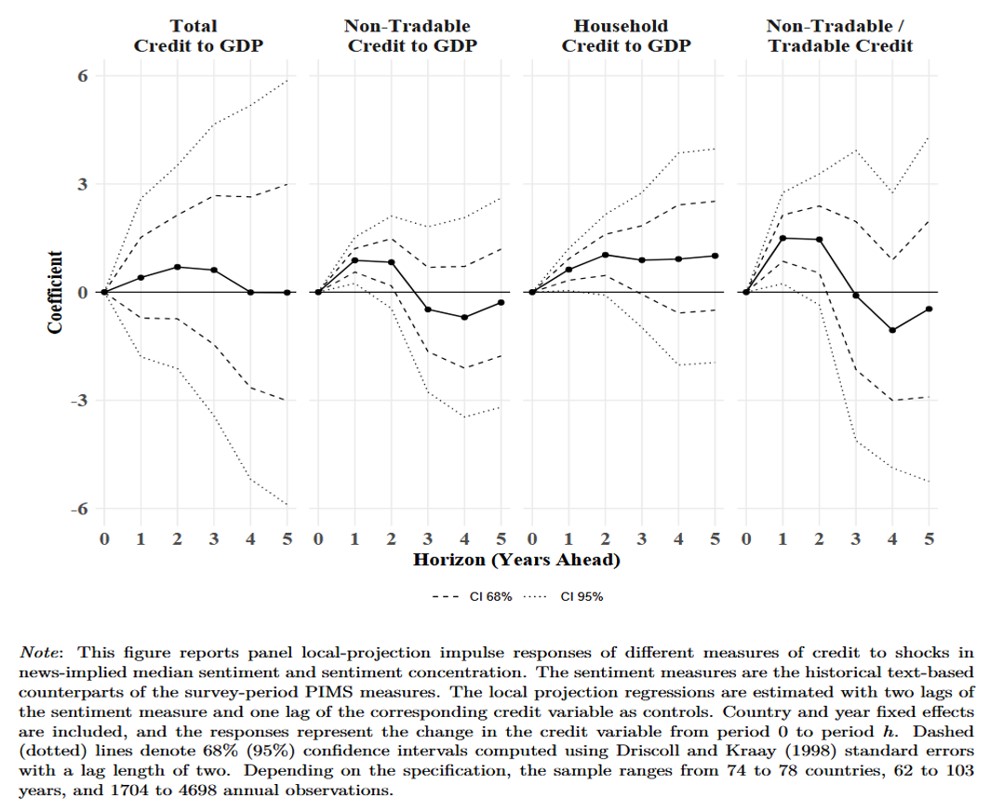
The second main finding concerns the determinants of this component of sentiment. Misaggregation of public information tends to increase as more time passes after a financial crisis, regardless of recent and current macroeconomic and financial developments. The paper also finds evidence that demographic structure is related to sentiment: a higher share of young relative to old people is associated with higher PIMS values. These patterns are consistent with the interpretation that crisis experience, and collective memory are relevant for belief formation. The paper therefore provides empirical support for a mechanism consistent with the Minsky view of financial instability: periods of stability may be associated with rising optimism as the experience of past instability gradually becomes less influential.
The results point to three policy implications.
The paper suggests that belief-based indicators may contain information that is not fully captured by standard credit measures. A sentiment indicator can complement existing financial-stability indicators by helping policymakers assess whether changes in credit are occurring in an environment of unusually optimistic expectations. If optimistic expectations coincide with rapid growth in credit or asset prices, the interpretation of those developments may differ from a situation in which expectations are more neutral.
The strongest empirical result in the paper concerns the composition of credit. Misaggregation of public information is associated with credit growth to households and non-tradable sectors rather than with a broad and uniform increase in all credit. This supports the view that financial-stability analysis should pay attention not only to aggregate credit growth, but also to where credit is flowing. In practical terms, the paper’s findings are most directly relevant for monitoring the composition of credit shifting from tradable corporate sectors to non-tradable sectors and households.
The evidence that misaggregation of public information rises as crisis memories fade has a direct policy implication: the absence of recent crises is not a sufficient reason to reduce macroprudential vigilance. A long calm period may be exactly when optimism becomes most persuasive and when pressure builds to relax safeguards.
The paper develops a way to quantify misaggregation of public information from survey beliefs. The evidence suggests that increases in this component of sentiment are followed by credit growth in sectors associated with financial fragility, especially household and non-tradable-sector credit. It also suggests that this specific sentiment component rises as crisis experience becomes more distant. For policy, this means that this survey-based sentiment measure may be a useful complement to existing credit indicators.
Driscoll, J. and A. Kraay (1998): “Consistent Covariance Matrix Estimation with Spatially Dependent Panel Data,” The Review of Economics and Statistics, 80, 549–560.
Greenwood, R., S. G. Hanson, A. Shleifer, and J. A. Sørensen (2022): “Predictable Financial Crises,” The Journal of Finance, 77, 863–921.
Kindleberger, C. P. (1978): Manias, Panics, and Crashes: A History of Financial Crises, Basic Books.
Minsky, H. P. (1977): “The Financial Instability Hypothesis: An Interpretation of Keynes and an Alternative to “Standard” Theory,” Nebraska Journal of Economics and Business, 16, 5–16.
Müller, K. and E. Verner (2024): “Credit Allocation and Macroeconomic Fluctuations,” The Review of Economic Studies, 91, 3645–3676.
Ristolainen, K. (2026): “Quantifying Minsky Cycles,” Bank of Finland Research Discussion Papers 3/2026, iSSN: 1456-6184.
Schularick, M. and A. M. Taylor (2012): “Credit Booms Gone Bust: Monetary Policy, Leverage Cycles, and Financial Crises, 1870-2008,” American Economic Review, 102, 1029–1061.