

This policy brief is based on Banco de España Documento de Trabajo No. 2619, “Digitalization and credit markets: evidence from e-invoicing”. The views expressed are those of the authors and do not necessarily reflect those of the Banco de España or the Eurosystem.
Abstract
We document the effects of electronic invoicing (eInvoicing) on credit markets. By making invoices more standardized, verifiable, and harder to falsify, eInvoicing changes lenders’ information sets, facilitating invoice-based financing and credit risk assessment. We exploit a regional eInvoicing mandate in Spain’s Basque Country and administrative credit data using a difference-in-differences design to provide three main insights. First, credit reallocates toward firms already relying on invoice-based credit (“invoice firms”) and away from non-invoice firms. Second, the cost of invoice credit falls for invoice firms, while the cost of credit rises for non-invoice firms. Third, banks’ information production changes: eInvoicing widens the dispersion of rates and banks’ risk assessments and improves their predictive accuracy for invoice firms, while it narrows dispersion and worsens accuracy for non-invoice firms. Overall, eInvoicing reshapes credit market outcomes, with uneven effects across borrowers.
Digitalization is reshaping how firms operate, make payments, and obtain financing (Berg et al., 2022; Goldfarb and Tucker, 2019). While prior work on digital payments emphasizes their implications for financial inclusion, efficiency, and competition, it has focused on payment execution, without studying the invoicing infrastructure that underpins economic transactions. This distinction matters because invoices record the counterparties, timing, and economic content of such transactions. Electronic invoicing, or eInvoicing, transforms these records into standardized, traceable, and verifiable digital documents, thereby changing the quality and usability of the recorded information. Despite its growing adoption worldwide and its policy relevance —reflected, for example, in the European Commission’s view of eInvoicing as a building block for a fully digital Single Market— there is little evidence on whether eInvoicing affects firms’ access to finance or credit markets more broadly.
Adoption is indeed spreading fast: Italy has required eInvoicing for essentially all domestic transactions since 2019, dozens of countries in Latin America and Asia have followed similar paths, and Spain’s national VeriFactu framework is scheduled for January 2027. In a recent paper (Casado et al., 2026), we provide systematic evidence that eInvoicing has a meaningful impact on firms’ financing, with clear winners and losers.
By reshaping the transactional information available to lenders, eInvoicing can affect how banks assess borrowers in general: standardized, verifiable records of firms’ commercial activity can sharpen screening and credit risk assessment, feeding into internal ratings and pricing. Digital invoices also matter more directly for the sizeable share of firms that finance themselves through arrangements explicitly tied to invoices, such as factoring or confirming (reverse factoring). For these products, the risks are precisely that an invoice is fake, duplicated, altered, or never paid; certified digital invoices mitigate these risks and lower verification costs, making invoice-based lending safer and cheaper to supply.
Identifying the causal effect of eInvoicing is difficult because mandates are usually national, leaving no comparable control group. Our setting overcomes this problem. TicketBAI, introduced by the provincial tax authorities of Spain’s Basque Country from 2021 onward, made eInvoicing compulsory in the Basque provinces — first through a voluntary phase with generous fiscal incentives, then through mandatory adoption backed by penalties — while the rest of Spain faced no comparable mandate during our sample period. Under TicketBAI, firms must issue invoices using certified software that generates a unique identification code and transmits each invoice to the provincial tax authority upon issuance. The system does not grant lenders automatic access to eInvoices: firms must still voluntarily share them. What changes is the quality and credibility of the information firms can pass on, using certified software with a unique identifier.
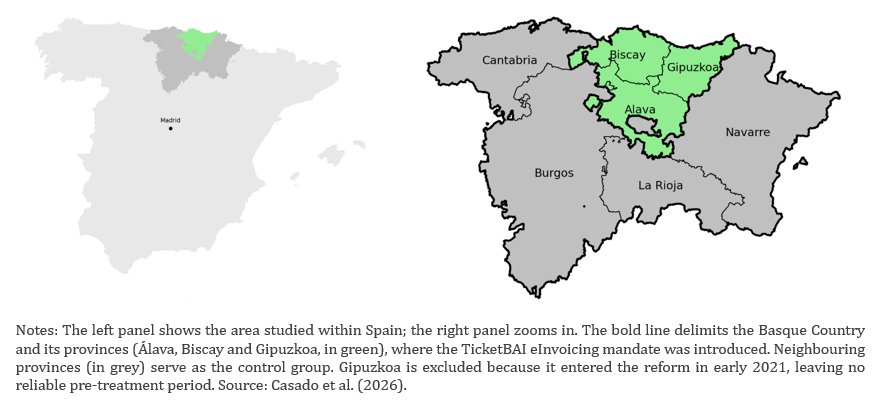
We combine this regional variation with administrative data from the Banco de España: the Central Credit Register (CIR), which records monthly loan-level information on nearly the universe of credit exposures in Spain — including loan type, interest rates, defaults and, distinctively, banks’ internal estimates of borrowers’ probability of default (PD) — matched with firms’ balance sheets. Our final sample covers more than 550’000 loans to almost 25’000 micro, small and medium-sized enterprises between January 2021 and December 2024, comparing firms headquartered in the treated provinces of Álava and Biscay with firms in the neighbouring control provinces of Burgos, La Rioja, Cantabria and Navarre (Figure 1). We estimate difference-in-differences specifications with granular fixed effects that absorb credit-demand factors and lender-specific shocks, and control for a wide range of COVID-related factors. A key dimension of heterogeneity is whether a firm already relied on invoice-based credit before the mandate (“invoice firms”) or not (“non-invoice firms”).
Figure 1. The Basque eInvoicing mandate: treated and control provinces
At the aggregate level, eInvoicing does not move total credit. This average, however, conceals a substantial reallocation. Invoice firms in treated provinces experience an increase in invoice-based credit of about 2.1% and in total credit of about 1.1% at the firm level, relative to comparable firms in control provinces. The expansion operates through both larger amounts within existing invoice-based relationships and a higher likelihood of starting new ones. Non-invoice firms move in the opposite direction: their total credit falls by about 1.4% at the firm level, driven by smaller amounts within pre-existing relationships, with no offsetting take-up of invoice-based products.
Several robustness checks reinforce a causal reading. The effects are already present during the voluntary phase and intensify once adoption becomes mandatory; they survive a more demanding within-province triple-difference specification; and they are not explained by improved tax compliance revealing higher sales — we find no differential increase in reported revenues in treated provinces after the reform. What changes is not how much activity firms report, but how credibly that activity is documented.
After the reform, credit quantities and borrowing costs move in opposite directions. Invoice firms in treated provinces obtain more credit and pay about 2.6% less for invoice-based credit at the firm level, while non-invoice firms obtain less credit and face higher borrowing costs; non-invoice credit for invoice firms also becomes relatively more expensive, even though its quantity remains flat or declines relative to the control group. Had shifts in credit demand been driving these patterns, prices and quantities would have moved in the same direction. More credit at lower rates for invoice firms, and less credit at higher rates for non-invoice firms, is difficult to reconcile with a purely demand-driven explanation and points to a role for credit supply: banks appear to redirect lending toward borrowers whose risk they can assess more precisely.
Why would banks behave this way? Because eInvoicing changes their information production. We document this along two complementary dimensions. First, dispersion: if standardized, verifiable invoices help banks discriminate among borrowers, the cross-sectional spread of loan rates and internal risk assessments should widen where the new information is relevant. This is exactly what we find. For invoice firms, the dispersion of loan rates increases by roughly 34% and that of banks’ internal PDs by about 15%; for non-invoice firms, both compress (by about 17% and 13%, respectively), consistent with banks devoting relatively less screening effort to borrowers whose records are less informative.
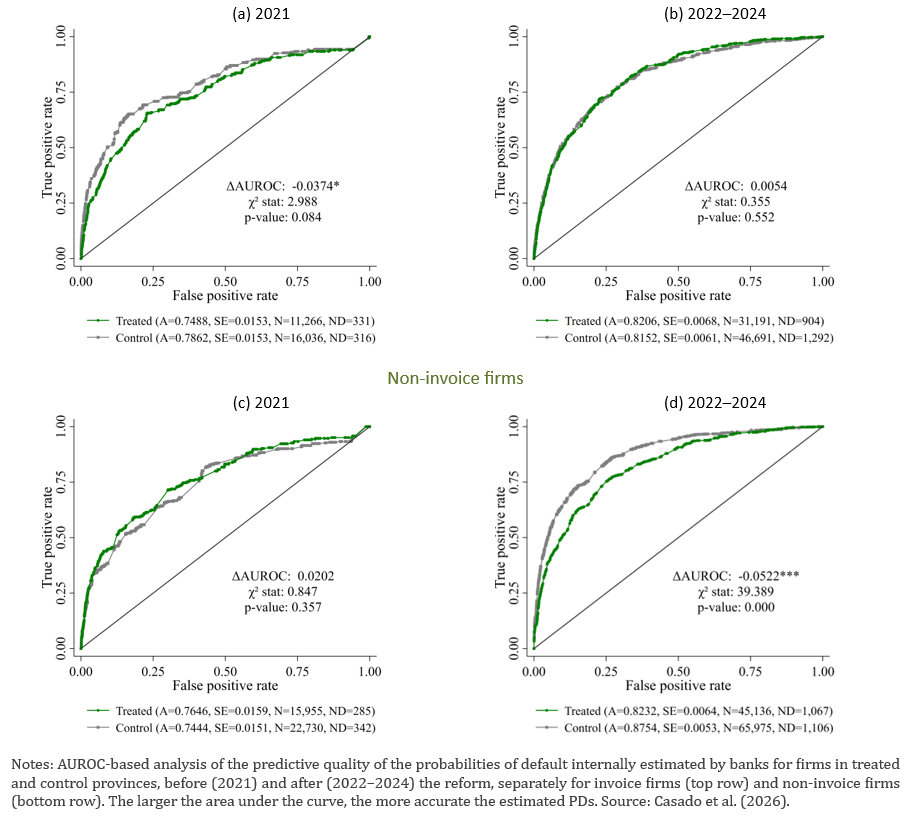
Second, predictive accuracy: using the AUROC (a standard measure of how well banks’ internal PDs rank borrowers with respect to ex-post default), we find that the predictive accuracy of banks’ risk assessments improves for invoice firms in treated provinces after the reform, closing a pre-existing gap with the control group (Figure 2, top row). For non-invoice firms, accuracy deteriorates relative to the control group (bottom row). In short, banks become better at screening and pricing the borrowers whose activity is well represented in the new digital records, and comparatively worse at screening those whose activity is not, reallocating credit accordingly.
Figure 2. Predictive quality of banks’ internal PDs before and after eInvoicing
Invoice firms
Our findings carry two main messages for policymakers. First, while often introduced with other objectives in mind, eInvoicing mandates have sizable effects on credit markets as well: by changing the quality of the information firms can credibly share with lenders, they affect who obtains credit and at what price. As mandates roll out across the EU and beyond, these credit-market effects deserve consideration alongside their original objectives.
Second, the gains from digitalization in credit markets are not uniform. A common thread across recent reforms (e.g., open banking, data-sharing frameworks, digital identity, unified payment and invoicing infrastructures) is the ambition to lower the cost of producing standardized, verifiable records in order to improve credit decisions and financial inclusion. Our evidence supports the premise: better records do sharpen lenders’ screening. But when the new records are more informative for some borrowers than for others, improved discrimination creates winners and losers, and can tighten credit precisely for firms whose activity is least represented in the new data.
Berg, T., A. Fuster and M. Puri (2022). “FinTech Lending”. Annual Review of Financial Economics, 14, 187–207. https://doi.org/10.1146/annurev-financial-101521-112042
Casado, A., M. Giometti, J. E. Gutiérrez, D. Martínez-Miera, A. Matyunina and T. Terracciano (2026). “Digitalization and credit markets: evidence from e-invoicing”. Banco de España, Documento de Trabajo No. 2619. https://doi.org/10.53479/44027
Goldfarb, A., and C. Tucker (2019). “Digital Economics”. Journal of Economic Literature, 57(1), 3–43. https://doi.org/10.1257/jel.20171452
Parlour, C. A., U. Rajan and H. Zhu (2022). “When FinTech Competes for Payment Flows”. The Review of Financial Studies, 35(11), 4985–5024. https://doi.org/10.1093/rfs/hhac022
Vives, X. (2019). “Digital Disruption in Banking”. Annual Review of Financial Economics, 11, 243–272. https://doi.org/10.1146/annurev-financial-100719-120854