

This policy brief is based on Dufouleur (2026). The views expressed in this brief are those of the author and do not necessarily reflect those of the Banque de France or the Eurosystem.
Abstract
Bitcoin is traded globally, yet national price gaps persist. Using daily data for 22 countries between 2013 and 2023 and a new database of crypto-asset regulations in 28 jurisdictions, this brief shows that regulatory design matters. Frameworks that improve legal certainty and access to regulated market infrastructure are associated with narrower price gaps and higher trading volumes, whereas partial banking bans are associated with wider gaps and lower activity. AML/CFT measures are associated with lower local prices, but uneven national implementation may shift activity across borders. The findings call for keeping compliant gateways open, coordinating enforcement internationally and monitoring the stronger transmission of shocks that may accompany integration.
Bitcoin is often described as borderless. Yet the same unit of Bitcoin can trade at different prices across countries even after local prices are converted into US dollars. Market microstructure is central to understanding this apparent paradox. Bitcoin transfers are recorded on a global blockchain, but most price discovery takes place on separate exchanges with distinct order books, levels of liquidity, fees, AML/CFT requirements, and connection to banking and payment systems. Arbitrageurs can close a price gap only if they can fund accounts, move Bitcoin across trading venues and convert the proceeds into local currency quickly, reliably and at a limited cost. Cross-country price gaps therefore reveal frictions that limits arbitrage. They show that decentralisation at the protocol level does not remove the national institutions through which most users buy, sell and hold crypto-assets.
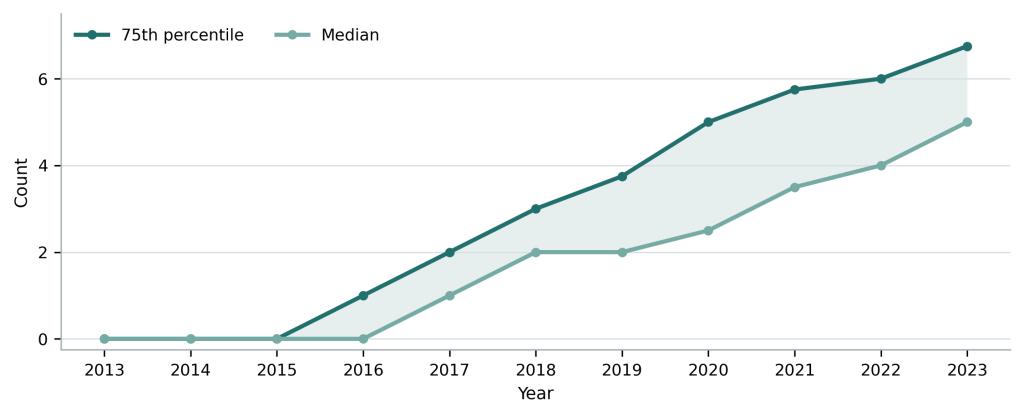
Typical gaps narrowed substantially over the sample. The annual median of daily absolute price deviations fell from about 6.5% in 2013–2014 to 0.6% in 2023, while the 75th percentile fell from 14.2% to 1.5%. Persistent outliers nevertheless indicate that country-specific barriers remain. Over the same period regulatory coverage expanded: in the 22-jurisdiction price panel, the median cumulative number of implemented measures rose from zero at end-2016 to five at end-2023, while the 75th percentile reached about 6.8. These parallel trends are descriptive and do not establish that regulation caused price convergence. They nevertheless motivate the paper’s central empirical question: whether regulatory implementation helps explain cross-country Bitcoin price gaps, and why some forms of regulation are associated with greater market integration while others are associated with greater fragmentation?
Figure 1. Cross-country Bitcoin price gaps narrowed sharply, but did not disappear
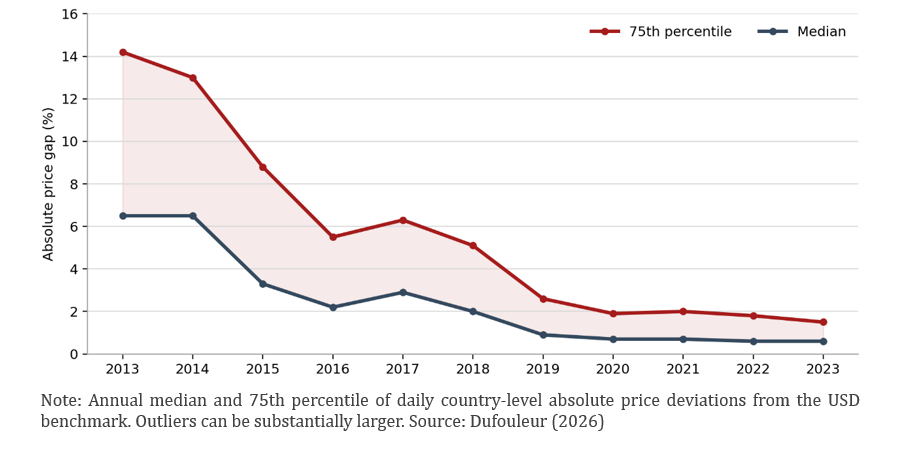
Figure 2. Cumulative number of implemented regulations per jurisdiction
The study combines daily Bitcoin prices and trading volumes for 22 countries between September 2013 and 2023 with a new database recording the implementation of crypto-asset regulation in 28 jurisdictions since 2009. It uses implementation dates, even though it controls for dates of announcement, and distinguishes rules for service providers, banking and payments, securities-law coverage, regulatory sandboxes, policies admitting crypto-related products into traditional finance, AML/CFT requirements and partial bans.
The analysis compares price gaps, local prices and volumes across countries and over time while accounting for persistent national barriers and shocks common to all Bitcoin markets. It also asks whether macro-financial factors influence market dynamics differently under supportive, restrictive and less developed regulatory regimes. The estimates provide carefully controlled associations, but they do not rank policies as if regulatory adoption were a controlled experiment.
The results reject the idea that all regulation has the same effect. Measures that make formal intermediation possible behave differently from measures that restrict access to the crypto market.
Table 1. Headline market effects differ by regulatory approach
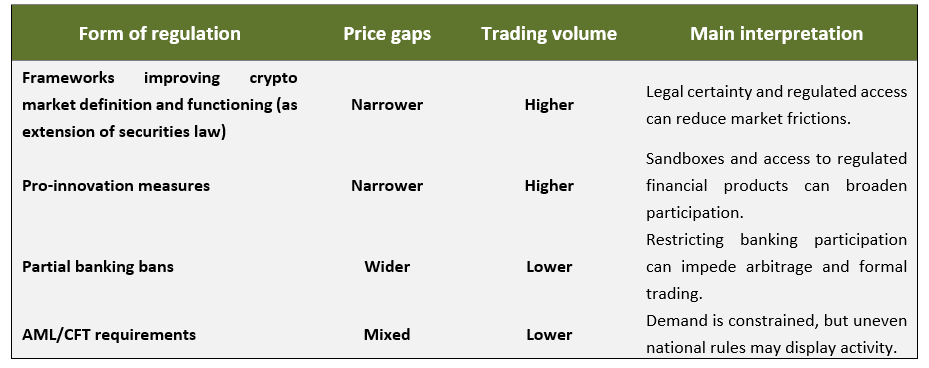
Comprehensive and pro-innovation frameworks are associated with smaller deviations from the USD benchmark and higher trading volumes. Securities-law coverage, banking and payment rules and regulatory sandboxes appear to support convergence. This is consistent with legal certainty and regulated access lowering market frictions, although the individual channels are not separately identified. Narrower gaps indicate integration, not by themselves investor protection or financial stability.
Restrictions that prevent banks from investing in crypto-assets or providing crypto services widen price gaps, lower local prices and reduce traded volumes. The estimates do not identify whether the main channel operates through payment access, banking services, direct investment or liquidity provision. However, the decline in trading activity is consistent with Copestake et al. (2023), who find that the persistent reduction in volumes following the strictest crypto bans is driven by lower institutional trading. Taken together, these findings highlight the importance of banks and other institutional investors for the liquidity and integration of local crypto-asset markets.
AML/CFT requirements have mixed effects on price convergence but are associated with lower local prices and activity. This pattern is consistent with reduced demand for anonymity-related or illicit uses, but aggregate data cannot identify users’ motives. Uneven national implementation may also encourage activity to move across borders, making international coordination central to enforcement.
Regulations that support formal market access are associated with narrower price gaps and greater trading activity. Yet closer integration also means that local markets may respond more strongly to global Bitcoin cycles and international financial conditions. Partial bans may instead isolate local markets during global price surges, but this apparent insulation comes with wider price gaps and lower trading volumes. The policy challenge is therefore not to preserve fragmentation, but to combine open, well-regulated market access with closer monitoring of cross-border shock transmission.
The evidence in this study concerns Bitcoin, not tokenised deposits, tokenised securities or central bank digital currencies. One lesson nevertheless travels: technological decentralisation does not remove dependence on the gateways connecting digital assets to bank money, custody, payments and settlement.
Tokenised deposits and wholesale CBDC arrangements may support a common settlement layer and reduce market frictions only if access, convertibility and cross-border interoperability are designed coherently. Incompatible frameworks could instead reproduce the fragmentation observed in Bitcoin markets. This is a broader policy implication of the findings, not a result directly tested in the paper.
Regulatory adoption is not random, and the analysis cannot rank every policy as if it were a controlled experiment. Moreover, the US dollar is also used as the single global benchmark, and the sample ends in 2023, before the full application of MiCA. Post-MiCA and tokenised-market evidence should test whether the same integration–exposure trade-off persists.
Bitcoin is decentralised at the protocol level, but its markets remain shaped by national institutions. The relevant choice is not regulation versus no regulation, but which rules support transparent access without unnecessary fragmentation. Well-designed gateways can improve price discovery and formal trading, provided supervision also addresses the shocks and bank–crypto linkages that integration may transmit.
Auer, R. and Claessens, S. (2018). “Regulating cryptocurrencies: assessing market reactions”. BIS Quarterly Review, September.
Copestake, A., Furceri, D., Gonzalez-Dominguez, P. (2023). “Crypto market responses to digital asset policies”. Economics Letters, 222, 110949.
Dufouleur, M. (2026), “Bitcoin market segmentation and regulatory effect”, Journal of International Money and Finance, 165, 103570.
Makarov, I. and Schoar, A. (2020). “Trading and arbitrage in cryptocurrency markets”. Journal of Financial Economics, 135(2), 293-319.