

This policy brief is based on “Global pension asset allocations and debt markets“. The views expressed are those of the authors and not necessarily those of the institutions the authors are affiliated with.
Abstract
The pensions sector is an important investor group, particularly in debt markets. This brief examines the evolution of pension fund asset allocations around the globe and documents important structural changes. In recent decades, pension investors shifted from fixed income securities to mutual fund shares. While some of these mutual funds were bond funds, the overall exposure to debt securities (directly held and indirectly through mutual funds) fell. This reallocation entailed a general shift to riskier assets, including alternative investments. Search for yield incentives appeared to contribute to this change in asset allocations, though structural drivers also played a role. We discuss the potential implications of these trends for debt markets and pension beneficiaries.
Pension funds are key investors in the global financial system. But that system has gone through important structural changes, including a quickly expanding non-bank financial institution sector and rapid growth in government debt (BIS (2025)). As pension funds have grown, their substantial holdings of government debt – and any structural changes affecting them – have become more consequential.
More generally, changes in the structure and behavior of pension funds can have important consequences for borrowers and the financial system at large. Pension funds are viewed as stable, long-term investors. They are usually prominent in the market for debt securities, as bonds provide predictable returns and durations that they can use to match their income to their obligations. But shifts in pension fund demand can affect asset prices and borrowing costs (Jansen (2025); Fang et al (2025)). These implications are ever more important as the stock of government debt grows.
This policy brief lays out some recent developments in the asset allocations of pension funds worldwide. Drawing on OECD data and other sources, and analysis from our recent paper (Ding et al (2026)), we show that pension funds have shifted their asset allocation away from directly holding debt securities towards holding mutual funds shares. This shift cannot be fully explained by increased holdings of bond funds; part of the decline in bond exposure is instead accounted for by a shift toward equities. We also found that these pension funds have increased holdings of other potentially risky assets like private equity or private credit.
Pension funds’ holdings of debt securities, particularly government debt, declined over the past several decades. As shown in Graph 1, this pattern is common across countries worldwide, notable in the US and Europe but also apparent in emerging markets. In the US, fixed income dropped from 40% of the portfolio in the 1980s to just 10% in the 2020s. Advanced European countries similarly declined from 35% in the 2000s down to 20%. For emerging markets, the portfolio share fell from 75% to 50%. Thus, even in very different economic and regulatory contexts, the same move away from debt securities is present.
Graph 1. Pension fund asset allocation around the globe
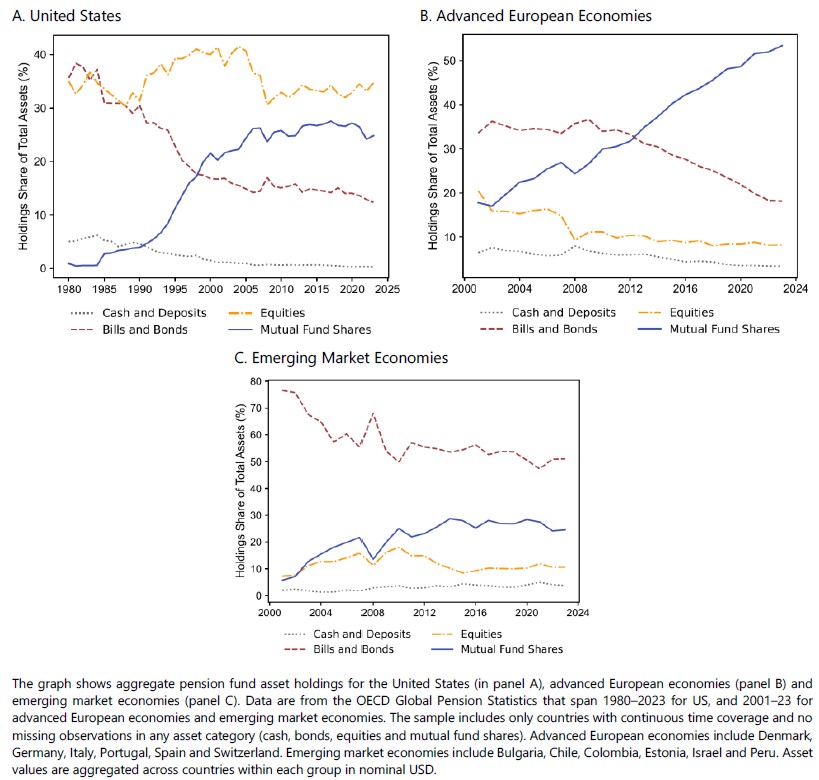
In place of debt securities, Graph 1 shows that pension assets have shifted to holding riskier assets, notably mutual fund shares. US pension funds went from negligible holdings in the 1980s to 25-30% in the 2020s. Advanced Europe and emerging markets shifted, respectively, from 20% and 5% of the portfolio in the 2000s up to 50% and 25% in the 2020s. In our full paper, we document similar trends for both defined benefit (DB) plans – which have fixed payout obligations and therefore have more incentive to hold fixed income – and defined contribution (DC) plans – where the burden of risk lies with the underlying pensioner.
The shift to holding mutual fund shares can somewhat obscure the asset composition of pension funds. For instance, if these funds sell their debt securities and purchase shares in a bond mutual fund, their underlying economic exposure to and investment in those bonds has changed little.
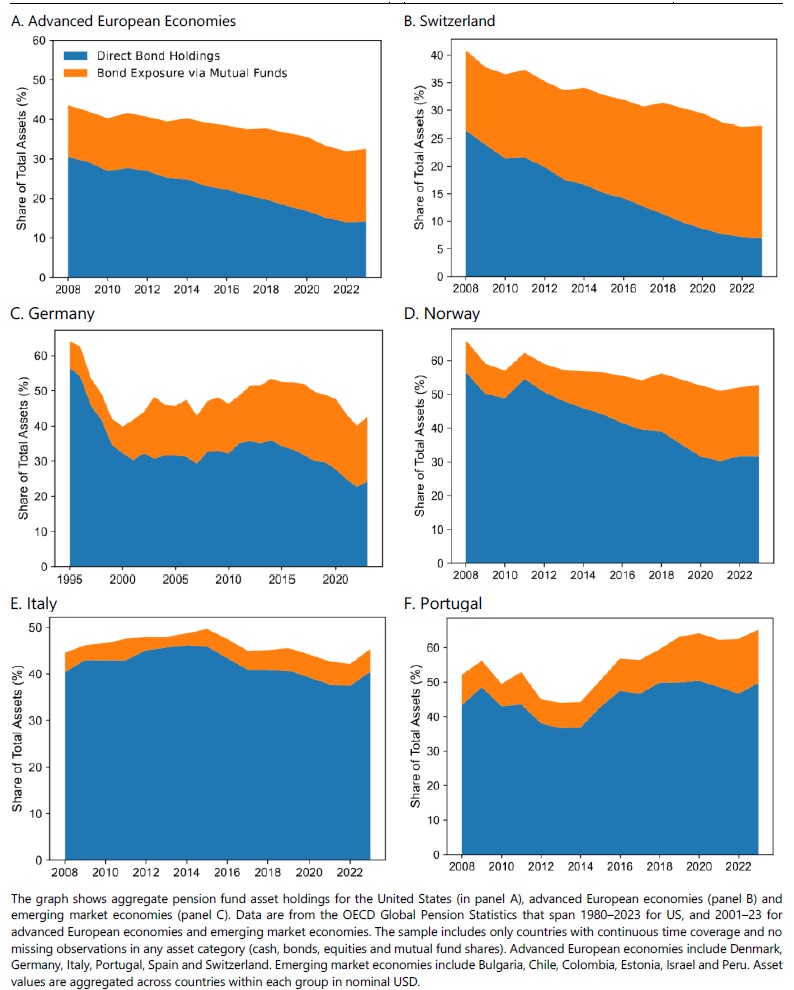
We do a “look through” analysis for advanced European countries by looking at what type of mutual funds they invest in. For most of these countries, holdings of bond mutual funds increased, indicating that pension funds get more of their exposure to debt securities indirectly. This pattern can be seen in Graph 2 which depicts the direct bond holdings in blue and the indirect bond holding through mutual funds in orange. Despite some increases in bond holdings through mutual funds, this expansion did not offset the decline in their direct holdings of bonds. Thus, the combined direct and indirect bond holdings fell for pension funds in most of these jurisdictions.
Graph 2. Direct and Indirect Bond Exposure
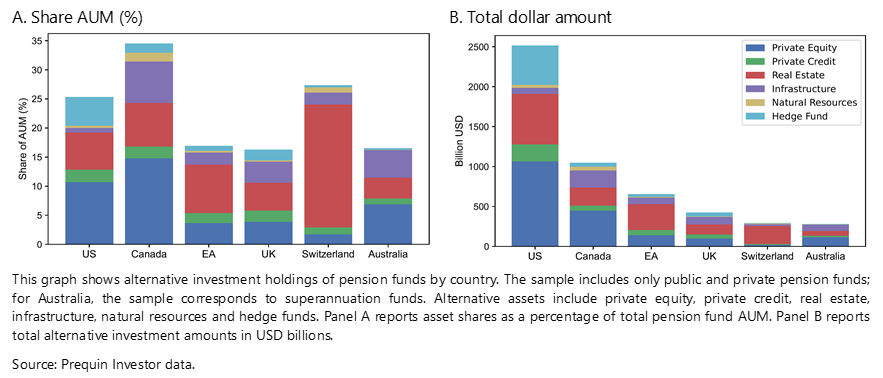
A shift away from debt securities implies that pension funds have riskier asset allocations. While direct equity holdings may not have risen, the increased mutual fund holdings indirectly increased their equity exposures. Further, many pension funds have generally shifted their portfolios towards alternative and potentially risky assets. These assets include private equity and private credit, as well as real estate and hedge funds. For instance, public sector pension funds in the United States have substantially increased investment in alternative assets, rising from under 10% of total assets in the early 2000s to over 30% in 2024. Cross-country data suggest that alternative assets now account for between 15-35% of pension funds’ portfolios, as shown in Graph 3.
This move to alternative assets comes with benefits and risks to these funds. On the upside, they can serve to diversify fund exposures and increase returns. However, these assets also tend to be less liquid and more opaque in their value. When market stress arises, holding alternative investments may make liquidity management more challenging for the pension fund, and viability of the fund more difficult to evaluate.
Graph 3. Pension fund alternative asset allocation by country
Concurrent with this broad shift in asset allocation was another key structural shift: a move from DB plans to DC plans. DB plans commit to delivering a fixed payout to the plan holder for the duration of their life. DC plans on the other hand place the plan holder as the bearer of risk. Consequently, DC plans tend to have a riskier allocation of their investments. In 2008, DB plans accounted for the majority of pension funds worldwide, but that share has since fallen to 42%, replaced by DC plans (Ding et al (2026)).
However, even absent this structural shift, the change in asset holdings would still be present. Examining DB and DC plans separately in our global sample reveals that both plan types have seen a shift away from fixed income assets and towards mutual fund shares. Thus, while these plan distinctions matter, the underlying change in the sector is broader.
While structural factors have certainly played a role, one cyclical factor deserves attention: the prolonged low interest-rate environment following the Great Financial Crisis. Low interest rates reduced returns on fixed income assets, which price off those rates. A persistently low-rate environment can thus drive a search for yield as investors seek to maintain their returns, particularly DB plans that need to meet their fixed obligations regardless of market cycles.
To examine the role of interest rates, we examine how pension asset allocations change with government bond yields. We find that as domestic government bond yields fall, pensions shift their portfolios away from debt securities and towards mutual fund shares and foreign assets. When government bond yields fall by one percentage point, the bond share in pension portfolios falls by 1 percentage point while mutual funds and foreign assets rise by 1.3 and 3 percentage points, respectively. This pattern suggests a “search for yield” motive among pension investors, one that appears common for both advanced and emerging markets and is stronger for defined benefit plans.
These changes from pension funds have important implications for both debt markets and for retirees.
Pension funds are crucial investors, typically seen as long-term investors that provide stability to the market. As pension funds step away from bond markets, other potentially more price sensitive investors step in (Fang et al (2025)). This change in investor composition has both benefits and drawbacks for the debt markets. One benefit is that price-sensitive investors, like hedge funds or asset managers, can help to lower yields on new debt issuance. On the other hand, such investors can also be more prone to exit these positions during periods of stress, further amplifying any adverse price swings.
These changes also bring tradeoffs directly to pension fund beneficiaries. A shift to mutual funds and alternative assets could boost diversification and improve returns. However, retirement portfolios are ultimately riskier, whether they are DC plans or DB plans. Thus, pension beneficiaries will need to account for these risks in their planning.
The aging populations and rising sovereign debt levels in many countries put these changes front and center for policy makers. Governments will need to account for their changing investor pool as they seek to ensure the stability and sustainability of their debt. Further, rising pension payouts as the retired population grows will put strain on the pension fund sector as a whole. The changes in pension asset allocations that we document are important context when addressing these challenges.
Bank for International Settlements (2025): “Financial conditions in a changing global financial system”, Annual Economic Report, Chapter II.
Ding, D, X Fang, B Hardy and K Lewis (2026): “Global pension asset allocations and debt markets”, BIS Papers No 172.
Fang, X, B Hardy and K Lewis (2025): “Who holds sovereign debt and why it matters”, Review of Financial Studies, vol 38 (8), pp 2326-2361.
Jansen, K (2025): “Long-term investors, demand shifts, and yields”, Review of Financial Studies, vol 38 (1), pp 114-157.