

This policy brief is based on Federal Reserve Bank of San Francisco, Working Paper 2026-13. The views expressed are those of the authors and not necessarily those of the institutions the authors are affiliated with.
Abstract
Firm heterogeneity in financial constraints is a quantitatively important driver of how monetary policy transmits to inflation. Using detailed microdata on Swedish firms, we document that smaller, financially constrained firms adjust prices significantly less than larger firms in response to changes in monetary policy. Models of customer markets and financial frictions can explain our findings: because the external finance premium rises after a monetary contraction, constrained firms cut prices less to preserve cash flows, sacrificing future market share. Additional evidence on heterogeneous sales, debt, marginal cost, and markup responses further supports this channel. This heterogeneous price response materially dampens the aggregate inflation response to monetary policy.
The 2021–23 inflation surge brought a basic question back into focus for central banks: How effective is monetary transmission to prices? Detailed micro-level empirical analysis is crucial for a thorough understanding of monetary transmission. A large literature has studied the role of financial constraints in the transmission of monetary policy to firm-level investment, employment, sales, and other outcomes. In Bauer, Czarnota and Klein (2026), we extend this literature by providing the first systematic evidence of the heterogeneous response of firm-level prices to changes in monetary policy. While previous papers such as Cloyne et al. (2023) and Jeenas (forthcoming) have found that financial constraints amplify the response of investment to changes in monetary policy, our results show that they dampen the response of prices.
Our findings can be explained by customer markets and financial frictions: because tighter monetary policy raises the external finance premium, constrained firms lower prices less to preserve current cash flow at the expense of market share and future sales. In support of this interpretation, we show that, in response to a monetary tightening, constrained firms experience a larger fall in sales, lower debt more, and increase markups more. Gilchrist et al. (2017) show that this mechanism played an important role in explaining the missing disinflation following the credit supply shock of the Great Financial Crisis. Our results show that the same mechanism operates as part of standard monetary transmission, not only during financial crises.
Our analysis is based on the monthly product-level prices underlying the Swedish Producer Price Index (PPI) for the manufacturing sector merged with yearly balance sheet data for private and public firms. The data covers the period from 2001 to 2023 and contains 340,600 month-product price observations from 4,397 unique products, produced by 2,195 unique firms. We estimate the effects of monetary policy on these prices using high-frequency monetary policy surprises: the unexpected component of Riksbank policy decisions, measured from interest rate changes on the days of Riksbank monetary policy announcements.
Our main analysis provides cross-sectional evidence on the role of financial constraints in the transmission of monetary policy to prices. We estimate the dynamic response of prices over the three years following a monetary policy shock, conditional on firms’ size, defined as the log of total assets, as a proxy for financial constraints.1
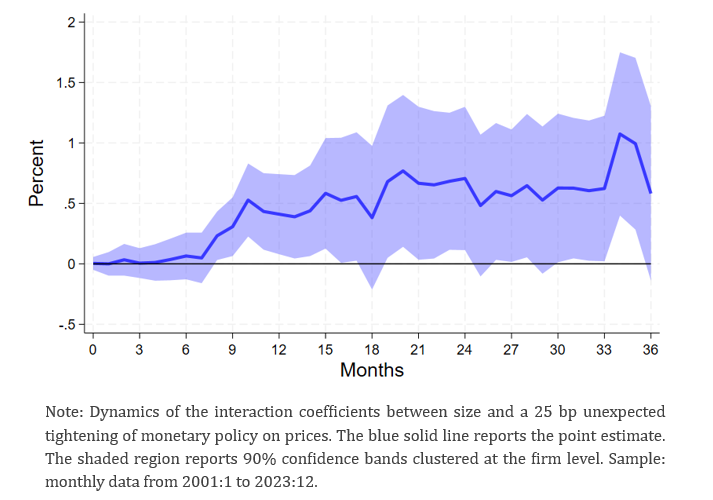
Figure 1 shows how the price response to a 25 basis point unexpected tightening of monetary policy varies depending on the size of the producing firm. Prices of products produced by firms one standard deviation below average size fall by about 0.7 percentage points less than those of the average firm at the two-year horizon, where the average price response reaches its trough, meaning that the response is muted by roughly a quarter. The differential response is statistically significant and also quantitatively meaningful, as we discuss below.
Figure 1. Differential price response of smaller firms to a monetary policy shock
In Figure 2 we split the price observations into quartiles based on the size of the producing firm and estimate the responses for the top and bottom quartiles to an unexpected tightening. The figure shows that prices in the bottom quartile fall about half as much as the prices in the top quartile at the trough. These responses further highlight the economic significance of the role of firm size in shaping the overall price response.
Figure 2. Group-specific impulse response functions to a monetary policy shock
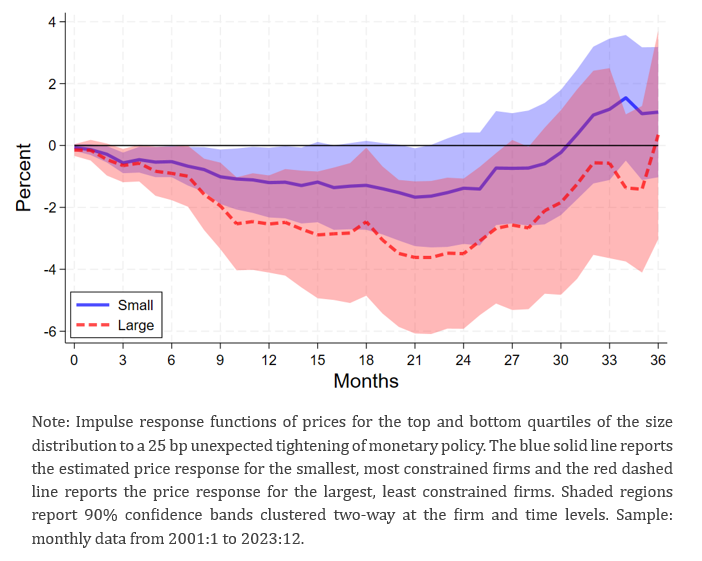
This heterogeneity has important aggregate consequences: monetary transmission to inflation is substantially weakened due to the muted price response of small firms. In a counterfactual exercise in which small firms adjusted prices as strongly as large firms, the aggregate PPI response to monetary policy would be 14 percent larger; if all firms responded like those in the top quartile, it would be 34 percent larger. These calculations are partial-equilibrium and therefore suggestive, but they place the effect in the same range as other studies of how firm heterogeneity shapes macroeconomic transmission.
We interpret the differential price response through the lens of a model with customer markets and financial frictions. In this class of models, the customer base for a given product is sticky—due to deep habits, adjustment costs, or search frictions—and therefore becomes an investment asset for the firm. By setting a lower price today, firms can attract more customers, which translates into an increase in market share and future profits, at the expense of lower profits today. Hence, there is a trade-off between investing in the customer base and maintaining current cash flows. A monetary contraction implies lower demand and higher costs of finance, and both effects reduce current profits for a given price. Smaller, more constrained firms face a larger increase in the external finance premium, reducing their ability to invest in their customer base.
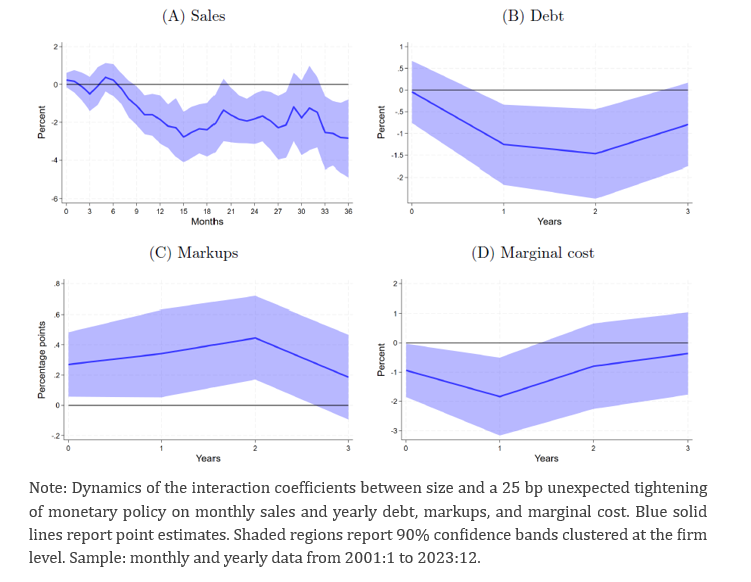
Our interpretation based on customer markets and financial frictions gives rise to three hypotheses on the firm-level response of constrained firms to monetary policy, which we test empirically. First, their sales should fall relatively more following a tightening. Second, they should lower debt relatively more, reflecting a relatively larger increase in the external finance premium. Third, their muted price response should reflect higher markups rather than a relatively smaller reduction in marginal cost.
In Figure 3 we provide cross-sectional evidence analogous to the price response in Figure 1 of monthly real sales of the firms in our PPI sample, their total debt (yearly frequency), and their markups and marginal costs (yearly frequencies).2 The figure shows that sales and debt of smaller firms indeed fall relatively more following an unexpected tightening, and that their markups increase relative to larger firms. Their marginal costs fall by more, which is the opposite of what would be required for a cost-based explanation of the differential price response. This evidence provides additional support for a mechanism with customer markets and financial frictions explaining our main result.3
In addition, we provide descriptive statistics further supporting the interpretation that small firms are financially constrained. Small firms in our sample have a higher share of bank debt, which is generally subject to stronger information asymmetries and a larger external finance premium, pledge more collateral per unit of debt, are closer to their borrowing limits on credit lines, and have marginally higher default probabilities.
Finally, we rule out several alternative explanations. We show that the differential price responses are robust to including sector-by-time fixed effects instead of time fixed effects and to ending the sample in December 2020. This indicates that neither industry-level differences in demand elasticity, cost pass-through, or exposure to sector-specific shocks nor the extreme movements in prices during the high-inflation period are driving our results. The significant differential price response of smaller firms is also robust to including the interaction between the monetary policy shocks and firms’ market share, export share, and working capital. Since these firm characteristics are likely to be correlated with size, we can plausibly rule out that differences across these distributions are driving our results. We also show that the average monthly inflation rate as well as the frequency and the size of price changes are stable across the size distribution, indicating that differences in unconditional price-setting behavior are an unlikely driver of our results.
Figure 3. Differential sales, debt, markups, and marginal cost responses
of smaller firms to a monetary policy shock
Our findings imply that the strength of monetary transmission to inflation depends on the degree and distribution of financial constraints across firms. Financial constraints also worsen the inflation-output trade-off, since constrained firms exhibit a weaker price response but a stronger quantity response, raising the sacrifice ratio, meaning the output loss per unit of disinflation. Combining the muted price response with the larger sales decline, the sacrifice ratio is roughly five times as large for small firms as for large firms. An economy with a larger share of financially constrained firms therefore faces a materially less favorable output-inflation trade-off.
The channel we document is likely state-dependent and especially relevant during periods of financial stress, when the external finance premium rises and the dampening effect on prices becomes more pronounced. The converse also applies: when financial stress is muted, the dampening of the price response should be more limited, and monetary transmission to inflation more effective. The post-pandemic tightening, during which the banking system remained well-capitalized and credit continued to flow, may represent such an episode, consistent with the swift disinflation achieved without a recession.
Our results can be viewed as the flipside of existing results on firms’ investment response to monetary policy, which tends to be amplified by financial constraints (Cloyne et al., 2023; Jeenas, forthcoming). But the mechanism we emphasize reconciles the seemingly conflicting results: since the response of investment into the customer base is also amplified, the price response is correspondingly muted. In short, monetary transmission to quantities is strengthened but the transmission to prices is weakened by financial constraints.
Bauer, Michael, Alexander Czarnota, and Mathias Klein. 2026. “Prices and Monetary Policy: The Role of Financial Constraints. ” Federal Reserve Bank of San Francisco Working Paper 2026-13. https://doi.org/10.24148/wp2026-13
Cloyne, James, Clodomiro Ferreira, Maren Froemel, and Paolo Surico. 2023. “Monetary Policy, Corporate Finance, and Investment”, Journal of the European Economic Association 21(6): 2586–2634. https://doi.org/10.1093/jeea/jvad009
Gilchrist, Simon, Raphael Schoenle, Jae Sim, and Egon Zakrajšek. 2017. “Inflation Dynamics during the Financial Crisis.” American Economic Review 107 (3): 785–823.
Jeenas, Priit. Forthcoming. “Firm Balance Sheet Liquidity, Monetary Policy Shocks, and Investment Dynamics.” Journal of Political Economy.
In Bauer, Czarnota and Klein (2026), we also consider age, leverage, and liquidity as proxies for financial constraints. As we find no significant heterogeneity across any of these distributions for prices or any of the other outcome variables, we omit these results from this note.
We use the gross profit margin (defined as total nominal sales net of total variable costs over total nominal sales) as a proxy for markups and average cost (defined as total variable cost over total real sales) as a proxy for marginal cost.
As mentioned above, we find no such evidence across the age, leverage, or liquidity distributions. Together with the insignificant price responses across these distributions, this suggests that size is a superior proxy for financial constraints in our sample.