

This policy brief is based on Danmarks Nationalbank Working Paper No. 220. The views expressed are those of the authors and not necessarily those of the institutions the authors are affiliated with.
Abstract
Parents are widely known to help their children buy a first home. Far less is known about how they finance this help. Using Danish administrative data that link every first-time home purchase from 2000 to 2023 to the balance sheets of the buyers’ biological parents, we study purchases where the down payment cannot be reconciled with the buyer’s own liquid resources. Intra-family transfers are not recorded in the data, but such purchases coincide with a clear fall in parents’ liquid wealth and a clear rise in parents’ debt in the purchase year. Support is therefore not only a drawdown of accumulated family wealth – part of it is borrowed, which raises leverage in the household sector rather than reallocating existing assets. The parents involved start from strong balance sheets and remain moderately leveraged, so this is a channel to monitor, not an imminent stability risk.
A first-time home buyer faces two key constraints when purchasing a home. The first is income-based. Lending guidelines state that borrowers must demonstrate the ability to service their debt while maintaining sufficient disposable income to cover everyday living expenses, with requirements varying by household size and fixed expenditures. In addition, total debt is generally capped at 4–5 times annual gross income, and access to specific mortgage products depends on the borrower’s income and financial situation.
The second constraint concerns the size of the down payment. Purchasing more expensive homes, e.g. in the capital region, often requires substantially larger down payments than the regulatory minimum of five per cent. Once borrowing capacity is constrained by income, increasing the down payment becomes the main way to finance a more expensive purchase.
This is where parents enter the picture. They could exactly add to a down payment in their children’s home purchase allowing the buyers to access more expensive properties.
In Copenhagen, the capital of Denmark, apartment prices have increased by more than 40 per cent over the past two years, far outpacing income growth. As a result, the amount of cash required upfront has risen much faster than households’ ability to save from current income. For many first-time buyers, the down payment has therefore become the binding constraint, separating those who can enter the housing market from those who cannot. In 2024, the median first-time buyer in Denmark put down 9 per cent of the purchase price, as shown in Figure 1. In Copenhagen, the median was 18 per cent, and more importantly, in the capital, actual paid down payments now exceed what first-time buyers themselves have in liquid assets.
Figure 1. Down payments exceed first-time buyers’ liquid wealth in Copenhagen
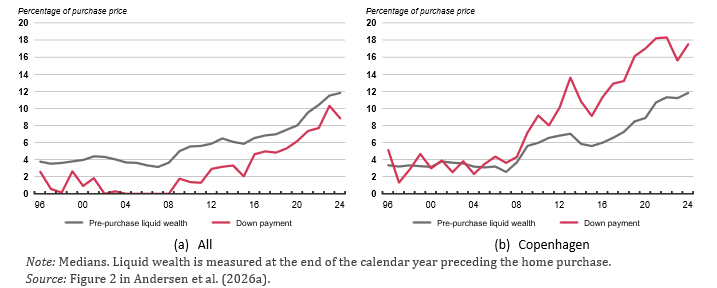
When the down payment made at purchase exceeds the liquid assets available to the buyer prior to the transaction, we infer that additional capital was provided from outside the household. We define the difference between the actual down payment and what can be explained by the change in the buyers’ own liquid wealth as the down payment residual. We classify purchases as involving substantial external funding as high-residual buyers when this residual exceeds 15 per cent of the purchase price. In a series of robustness checks, we show that our main results are not sensitive to the choice of this threshold.
High-residual buyers in Copenhagen purchase more expensive homes than the overall Copenhagen sample (DKK 2.1 million versus DKK 1.9 million) despite having lower median incomes (DKK 343,000 versus DKK 436,000). Their housing cost burden, measured as the share of income devoted to housing services, is nearly identical to that of the overall Copenhagen sample (24 per cent versus 25 per cent). This finding suggests that family support relaxes binding down payment constraints, enabling households to access more expensive homes without a corresponding increase in ongoing housing costs.
The residual identifies purchases in which funds appear to have come from outside the household. It does not identify the source. Danish registers do not record gifts or private transfers between family members, so the origin of the money cannot be read directly from the data.
What the registers do contain is the annual balance sheet of every individual, assets and liabilities, together with a link from each buyer to their biological parents. A transfer should leave a trace across two balance sheets: resources leaving one in the same year as they arrive on another. We therefore follow the parents of first-time buyers for five years either side of the purchase and compare parents of high-residual buyers to parents of all other first-time buyers.
Two movements in the data support this approach. High-residual buyers record a marked increase in their own net wealth in the purchase year. A reallocation of existing assets cannot produce such an increase, so the funds must originate outside the household. In the same year, the net wealth of their parents falls sharply, while the net wealth of other parents does not. Resources leave one generation’s balance sheet and arrive on the next.
The analysis covers first-time purchases between 2000 and 2023. We include purchases only if they are financed at least partly by debt. Buyers who purchase outright, without any borrowing, are not identifiable in the data and are therefore excluded. This leaves 275,589 purchases in which the buyer could also be linked to biological parents in the registers. Purchases in which the parents themselves sold property in the same year are excluded, as property sales constitute a distinct financing channel that this analysis is not designed to measure.
A key question of interest is how parents finance support for their children’s home purchases. We focus on two primary channels: drawing down accumulated liquid wealth or taking on additional debt, most notably through home-equity extraction. The data point to both. Figure 2 shows how parents’ balance sheets develop around the year in which their children buy their first home. Among high-residual buyers, parental liquid wealth falls sharply in the purchase year while parental debt rises at the same time. Both responses are substantially larger than for parents of first-time buyers in general.
The magnitudes are economically meaningful. High-residual buyers have an average residual of around DKK 570,000. The observed change in parental balance sheets corresponds to roughly DKK 170,000 when combining the decline in liquid wealth and the increase in debt. The estimated response should not be interpreted as a complete measure of parental support. Intra-family transfers may be financed through other channels that are only imperfectly captured in the balance-sheet data, and some support may come from individuals who are not observed in the registers. In addition, balance sheets are observed only at annual frequency, which introduces measurement noise into the residual down-payment measure. For example, savings accumulated within the purchase year may lead to an overstatement of external funding, while transaction-related expenditures such as registration fees and moving costs may lead to an understatement. The key result is nevertheless clear: parents finance support for their children’s home purchases both by drawing down wealth and by increasing debt.
Figure 2. Change in parents’ liquid wealth and debt in nominal values
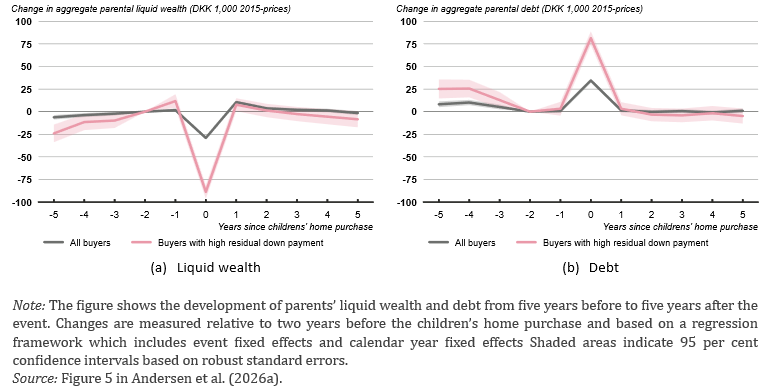
Parental support is often viewed as a transfer of existing wealth from one generation to the next. Our results suggest that this is only part of the story. While some parents finance support by drawing down liquid assets, others increase borrowing.
From a financial stability perspective, the distinction is important. Wealth-financed support reallocates existing resources across generations, whereas debt-financed support raises leverage in the household sector. Higher leverage can make economic downturns more severe and persistent, as households may need to cut consumption to reduce debt. Parental support can therefore contribute to the build-up of vulnerabilities not only through higher house prices, but also through higher household indebtedness.
An obvious question is whether parents who borrow to support their children’s home purchase become materially more vulnerable themselves. The evidence suggests that the parents who borrow to support generally come from a robust starting point. Before the purchase, they have lower loan-to-value ratios than both parents of first-time buyers in general and parents who primarily finance support through liquid wealth. Following the purchase and the debt-financed support, their leverage increases, but remains at moderate levels.
This is an important nuance. Debt-financed parental support increases leverage in the household sector, but the additional debt appears to be concentrated among households that initially have substantial borrowing capacity and housing equity. The results therefore point to a mechanism that is relevant from a financial stability perspective, but which is as of now not an imminent threat. It is, however, a channel worth monitoring, especially if housing affordability pressure continues to increase.
Lending standards and financial regulation play an important role in this regard. While these measures constrain home buyers’ borrowing, they also limit parents’ ability to extract housing equity and finance support through additional debt.
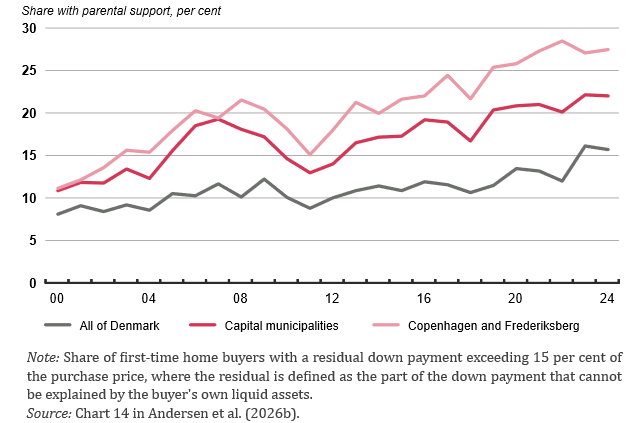
A unique feature of the analysis is that it allows us to track how the prevalence of parental support has evolved over time and across geographical areas. Figure 3 shows the share of high-residual first-time buyers in Denmark as a whole, the municipalities in and around the capital, and Copenhagen (incl. Frederiksberg municipality).
Parental support is consistently more prevalent in the capital area and has become increasingly common in Copenhagen, where the identified share reached around one quarter of all first-time purchases in 2024. The increase has coincided with periods of elevated housing affordability pressure, including the years leading up to the global financial crisis in 2008 and the recent period of strong house-price growth, especially in and around Copenhagen. This pattern is consistent with parental support becoming more important when buyers’ own resources are insufficient relative to prevailing house prices.
The relationship may also operate as a feedback loop. Rising house prices increase the need for parental support, but parental support may also contribute to further house price growth. By easing financial constraints, parental transfers allow some buyers to purchase more expensive homes and compete for housing that would otherwise be out of reach. In supply-constrained housing markets, this can add to upward pressure on house prices and worsen affordability challenges.
Figure 3. The share of first-time buyer with parental support tend to increase with affordability pressures
Andersen, Henrik Yde, Cecilie Holmstrøm Gaarskær, Rikke Rhode Nissen, and Emil Toft Vestergaard (2026a), Wealth Drawdowns or Borrowing? How Parents Fund Financial Support for Their Children’s First Home, Danmarks Nationalbank Working Paper no. 220, June 2026.
Andersen, Henrik Yde, Cecilie Holmstrøm Gaarskær, Rikke Rhode Nissen, and Emil Toft Vestergaard (2026b), Strong house price growth in the capital area underscores the need for sound credit standards, Danmarks Nationalbank Analysis no. 11, June 2026.