This policy brief is based on Ortiz et al. (2025) BBVA Research Working Paper 25/03. The views expressed here are those of the author and do not represent those of BBVA, its management or executive directors.
Abstract
Using a large-scale and high-frequency firm-level dataset that links public procurement awards with daily new lending transactions and employing a panel data local projections model that controls for firm characteristics, procurement bid attributes, and macroeconomic conditions, the study estimates the dynamic effects of procurement awards on new lending, a more precise measure than the change in the stock of credit. The analysis exploits the granularity of more than 240,000 new credit transactions to examine heterogeneity in credit responses based on firm size, industry, credit maturity, and value chain position of the firms. The empirical evidence confirms that public procurement awards significantly increase new lending, with NGEU-funded contracts generating stronger credit expansion than traditional procurement during the recent period. Moreover, NGEU-funded tenders elicit firm investment multipliers substantially larger than the rest of tenders. Overall, the integration of administrative procurement records with high-frequency bank-level financial data highlights the potential of Big Data to refine the evaluation and design of public policy.
Public procurement has long been recognized as a key driver of economic activity, facilitating firm growth, financial stability, and investment. As governments allocate a significant portion of GDP to procurement – more than 14% in the EU – it serves as a crucial policy tool to support businesses, particularly small and medium companies (SMEs) that rely on government contracts for stability and expansion. By financing infrastructure projects, industrial modernization, and digitalization efforts, procurement injects liquidity into the private sector, influencing firm credit behavior and overall economic resilience. However, the extent to which procurement awards translate into increased credit availability remains an open question, especially when focusing on new lending flows rather than outstanding credit stocks, which are affected by amortization and legacy debt dynamics.
This study investigates how public procurement – particularly NGEU-funded tenders in Spain, one of the largest recipients of the EU’s Recovery and Resilience Facility (RRF) – affects firm-level credit expansion, using a novel firm-level dataset that combines administrative procurement data with new lending data at daily frequency from BBVA, one of Spain’s major lenders. Employing a panel Local Projections framework, we compare the credit response of firms winning NGEU contracts versus traditional procurement awards, examining heterogeneity across sectors, firm size, credit maturity, and value-chain position. By focusing on new lending rather than outstanding credit, the study isolates the immediate liquidity effects of procurement and evaluates whether NGEU’s targeted recovery design amplifies firms’ access to finance. We also estimate the investment multiplier of public procurement by leveraging novel high-frequency investment indicators by sector of activity, assessing how each euro of public tendering translates into private investment.
We build a novel and large-scale dataset that combines information on public procurement awards with detailed firm-level credit data in Spain between August 2019 and July 2024. To do so, we merge three main sources: (i) public procurement records from the Spanish Ministry of Finance, which identify both NGEU-funded and traditional tenders; (ii) BBVA’s internal database of new corporate lending, comprising more than 5 million credit transactions at daily frequency, which allows us to precisely measure the timing, amount, and maturity of firms’ borrowing decisions; and (iii) firm characteristics from the SABI database, which offers rich balance-sheet and structural information for Spanish companies. By matching firms across these datasets, we construct an integrated panel that allows us to study how procurement – particularly NGEU-funded contracts – affects firms’ access to credit.
By estimating Panel Local matterson regressions we find that public procurement (any type of public tenders, both NGEU-funded and different from NGEU) generates heterogeneous credit responses across firms, with the magnitude and timing of effects varying systematically by sector, firm size, value-chain position, and credit maturity. As presented in Figure 1, public procurement awards lead to a significant increase in firm-level new lending, with a cumulative increase of 0.75% in new credit operations within one year. Firms in government-dependent sectors – especially manufacturing and construction – experience the strongest and most persistent increases in new lending, while wholesale/retail and professional services show smaller or short-lived effects. Smaller firms, which face tighter financing constraints, exhibit substantially larger credit boosts than larger firms, suggesting that procurement helps relax liquidity limitations disproportionately for SMEs. Value-chain position also matters: downstream firms (closer to final demand) display an immediate but less persistent rise in credit, whereas upstream firms experience a delayed yet more sustained expansion, indicating that procurement effects propagate gradually through production networks. Finally, the granularity of the credit data reveals that procurement primarily stimulates short-term lending, reflecting working-capital needs during project execution, while long-term credit responds more modestly—except in the case of NGEU-funded contracts, which trigger stronger long-term financing.
Figure 1. Response of New Credit Operations to Public Procurement Bids
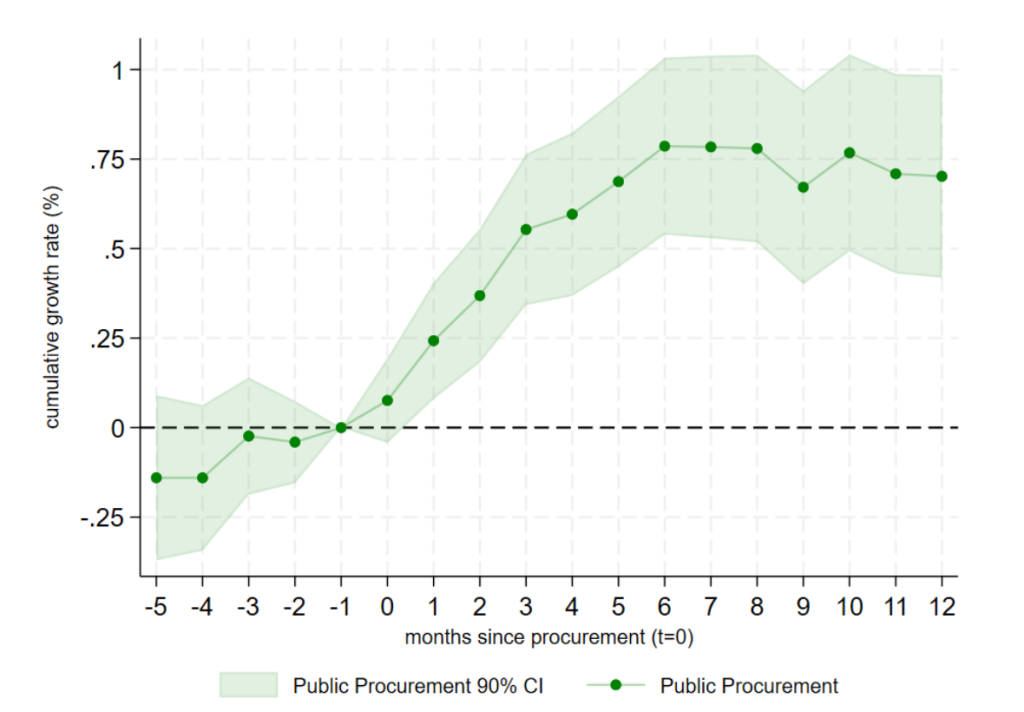
Notes: The plot displays the estimated coefficient β (green points) from regressions of equation 1 for each horizon h relative to 1 month before public procurement awards, as well as its 90% confidence bands (green shaded area). The estimated coefficient β is interpreted as the cumulative growth rate of new credit operations h months before or after procurement awards. The estimation includes firm and sector×time fixed effects, and all standard errors are clustered at the firm level.
Figure 2 shows that NGEU-funded procurement contracts generate a substantially stronger credit response than traditional (no-NGEU) awards, revealing a clear asymmetry in how firms adjust their borrowing after each type of tender. One year after receiving an NGEU contract, firms’ new lending increases by around 3% in cumulative terms, compared with only 0.75% following no-NGEU procurement – an effect similar in magnitude to the baseline procurement impact. Importantly, neither type of tender exhibits anticipatory borrowing, confirming that firms expand credit only once contracts are secured. Overall, the figure demonstrates that NGEU tenders – designed to accelerate recovery and transformation – have been far more effective in stimulating firm-level credit expansion than conventional procurement programs.
Figure 2. Response of New Credit Operations to Public Procurement Bids: NGEU vs no-NGEU
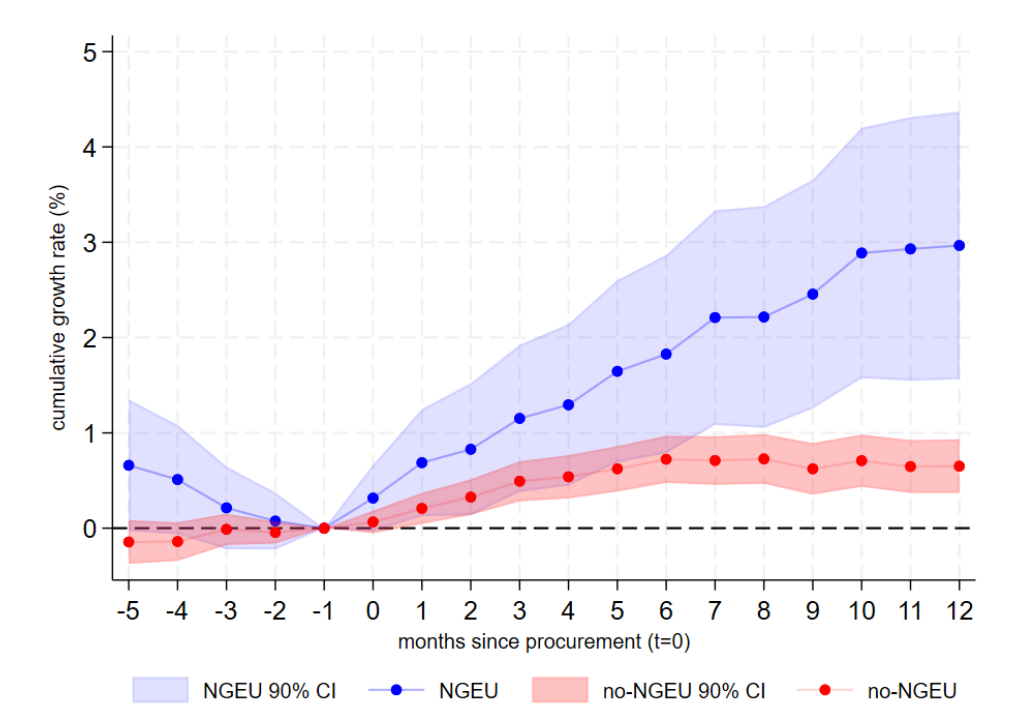
Notes: the plot displays the estimated coefficients β (blue points) and γ (red points) from regressions of equation 2 for each horizon h relative to 1 month before NGEU and no-NGEU public procurement awards, respectively, as well as their 90% confidence bands (blue and red shaded areas for NGEU and no-NGEU, respectively). Estimated coefficients β and γ are interpreted as the cumulative growth rate of new credit operations h months before or after NGEU and no-NGEU procurement awards, respectively. Note that no-NGEU public procurement bids refer to those different from NGEU-funded bids. The estimation includes firm and sector×time fixed effects, and all standard errors are clustered at the firm level.
Finally, we find that public procurement awards generate a positive but heterogeneous investment multiplier, with the strength of the effect varying sharply between NGEU-funded and traditional tenders (Figure 3). At the aggregate level, each euro of procurement leads to a modest increase in sectoral investment over the following months. However, when distinguishing by funding source, the results show that NGEU-funded contracts produce a much stronger investment response, with roughly 33 cents of additional investment per euro of NGEU procurement after one year. In contrast, no-NGEU procurement does not yield a statistically significant investment response, exhibiting only mild and delayed effects.
Figure 3. Responses of Investment to Public Procurement Bids: All, NGEU & non-NGEU
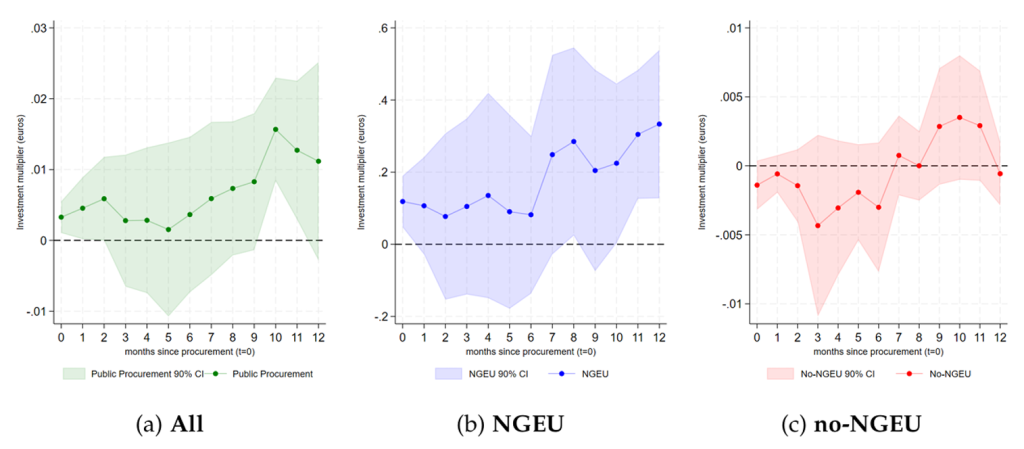
Notes: the plot displays the estimated coefficients β from regressions of equation 3 for each horizon h relative to 1 month before public procurement awards, as well as their 90% confidence bands (shaded areas). Panel (a), (b) and (c) represent the dynamic investment multiplier (measured in euros) after all public procurement (both NGEU and no-NGEU), NGEU and no-NGEU procurement, respectively. The impact on investment is evaluated at the sectoral level, thus aggregating tender value and investment accordingly. Note that coefficients from panel (b) and (c) have been estimated simultaneously in the same set of regression. Note that no-NGEU public procurement bids refer to those different from NGEU-funded bids. The estimation includes sector and time fixed effects, and all standard errors are clustered at the sectoral level.
From a policy standpoint, the availability of high-frequency, granular firm-level data is crucial for refining economic interventions – particularly procurement strategies. By closely tracking firm-level credit responses, policymakers can more accurately identify which businesses or sectors are most sensitive or vulnerable, thereby informing more targeted and impactful contract designs. Thus, the evidence presented in this policy brief indicates that NGEU-funded tenders have elicited stronger firm new credit and investment impulses, underscoring the value of data-driven policy design in enhancing the effectiveness of large-scale recovery programs.