

This policy brief is based on analysis in Aguilar García et al. (2026a). The views expressed are those of the authors and do not necessarily reflect those of the Deutsche Bundesbank, the European Central Bank or the Eurosystem.
Abstract
How do US import tariffs affect the euro area, whether as a direct target or as a third country? This policy brief draws on a suite of five models used at the ECB to disentangle the main transmission channels. In harmonised, stylised scenarios, tariffs on euro area goods sharply reduce bilateral trade but have much smaller effects on aggregate euro area GDP. The moderate aggregate effects conceal sizeable losses in exposed manufacturing industries. Tariffs on Chinese goods provide little aggregate benefit to euro area production, as export opportunities are offset by weaker world demand and stronger import competition. Production network linkages and substitution possibilities determine where losses concentrate. Retaliation does not necessarily reduce output losses. Overall, the results highlight the value of monitoring sectoral vulnerabilities and carefully assessing market diversification and deeper trade integration as alternatives to escalation.
Repeated increases, pauses and revisions to US import tariffs in 2025 and 2026 have brought the consequences of tariff shocks to the forefront of policy debates.1 For Europe, the key questions go beyond lost sales to the US: How are euro area output and inflation affected by higher US tariffs, which industries bear the adjustment, and can trade diversion in third-party conflicts or tariff retaliation provide relief?
Much of the tariff literature focuses on the country imposing the duty (see Georgiadis et al. 2026, Section E, for a review). We look instead at the exporting economy. In Aguilar García et al. (2026a), we examine the euro area both as a direct target of US import tariffs and as a third country when US tariffs are imposed on China. The aim is to shed light on the main transmission mechanisms behind trading-partner import tariffs, rather than to estimate the impact of the specific tariff measures announced.
In practice, the transmission of tariffs is rather complex. Tariffs change relative prices and demand, influence exchange rates and generate government revenue. They also redirect trade and transmit changes in costs and demand through supply chains. The adjustment depends on how readily buyers can switch suppliers and how quickly prices, wages and production respond.
To trace the key channels, we compare five complementary models used at the ECB, studying harmonised, stylised tariff scenarios.2 No single model captures all relevant channels equally. Comparing results across models helps identify common conclusions and shows which conclusions depend on specific assumptions.
We use two semi-structural models, which combine economic relationships with empirically fitted dynamics: ECB-Global (Jouvanceau et al., 2025) and ECB-BASE (Angelini et al., 2019). ECB-Global links the euro area, the US, China and other major regions; ECB-BASE focuses on euro area dynamics and takes the exchange-rate and oil-price paths from ECB-Global in this exercise. Two dynamic stochastic general equilibrium (DSGE) models add sectoral production networks: the model of Aguilar et al. (2026b) covers several world regions, while that of Gnocato et al. (2025) represents the EU and the rest of the world. Finally, a calibrated version of the multi-country, multi-sector model of Baqaee and Farhi (2024) provides granular trade and production linkages in a static setting.
We consider two separate tariff scenarios without retaliation: a 10 percentage point increase in US tariffs on EU goods, and a 20 percentage point increase on Chinese goods. Tariffs cover goods other than mining and exclude services.3
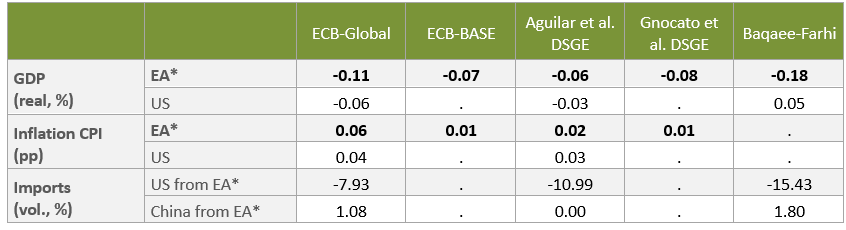
In scenario 1, US purchases from the euro area fall sharply in every model that reports bilateral trade. While the decline in euro area exports to the US is substantial, output repercussions in the euro area remain comparatively modest (Table 1).
Weaker export demand tends to ease domestic price pressures, but this is not the only force at work. In the four models that report inflation, US tariffs on EU goods are mildly inflationary for the euro area. Tighter US monetary policy in response to higher US inflation strengthens the dollar against the euro, raising euro area import prices.4
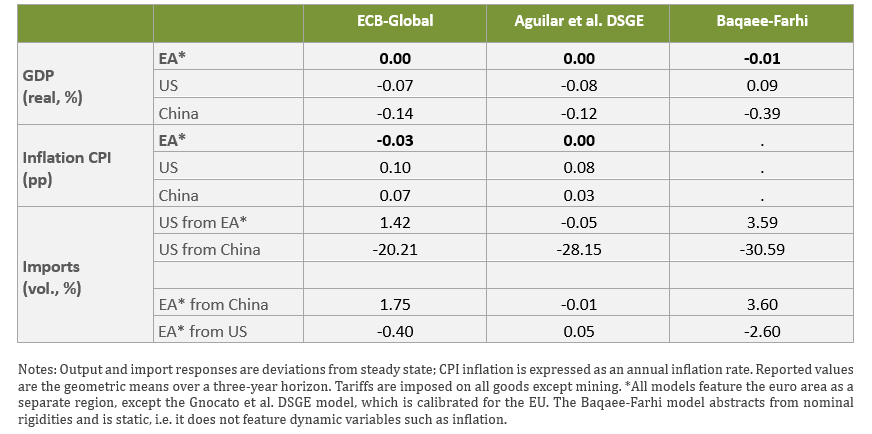
Table 1. Baseline scenario: US import tariffs on the euro area (EA) and China
Scenario 1. 10 pp US import tariff on EU goods
Scenario 2. 20 pp US import tariff on Chinese goods
Aggregate figures conceal large adjustments across industries. This is revealed by the sectoral models featuring input-output linkages. In the Gnocato et al. model, EU manufacturing value added falls by 0.33%, more than four times the decline in GDP, while services expand slightly as labour and consumption shift towards them. Even within euro area manufacturing, the effect is markedly heterogeneous. The Baqaee-Farhi model points to output losses of roughly 5% in pharmaceuticals and around 1% in electronics, cars, aircraft and chemicals5. Germany is the most affected euro area economy in that simulation.
US tariffs on China, studied in scenario 2, produce little net gain for the euro area: GDP effects of such tariffs are close to zero. European firms can become more competitive in the US relative to Chinese exporters facing tariffs and US producers relying on tariffed Chinese inputs. But these opportunities are offset by weaker global demand and, where trade diversion is strong, increased competition from Chinese goods redirected to Europe. Lower prices help Chinese exporters find alternative markets. Trade diversion is particularly material in ECB-Global and the calibrated Baqaee-Farhi model, which both show sizeable shifts in trade flows between the US, China and the euro area.6
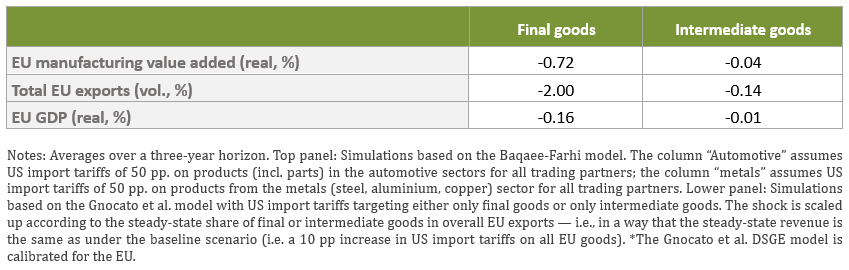
Where a tariff falls within a production network matters alongside its headline rate. Table 2 compares two sets of targeted experiments. In Baqaee-Farhi, a 50 percentage point US tariff increase on automotive products from all trading partners reduces total euro area exports to the US by around 4.5% and manufacturing production by 0.5%. The same increase on metals, however, lowers exports by only around 0.5% while barely affecting manufacturing production. This difference reflects the relatively higher direct exposure of the automotive sector to the US market, owing to the large US share in its exports and its strong sectoral value-chain linkages with the US.7
The second experiment isolates the role of final versus intermediate goods by scaling tariff increases to generate the same steady-state revenue as the baseline tariff in scenario 1. Targeting EU final goods reduces total EU exports by 2% and results in a pronounced drop in manufacturing value added. Targeting intermediate goods produces much smaller declines. The reason is that US buyers can more readily replace European final goods in this model.
Overall, these results point to euro area vulnerabilities in export-intensive final-goods industries and, consequently, in the domestic suppliers of these exporting industries.
Table 2. Alternative scenarios: Targeted US tariffs on euro area exports
50 pp US import tariff on EA metals vs. automotive exports (Baqaee-Farhi model)

Revenue-equivalent US import tariffs on EU* final goods vs. intermediate goods exports (Gnocato et al. DSGE model)
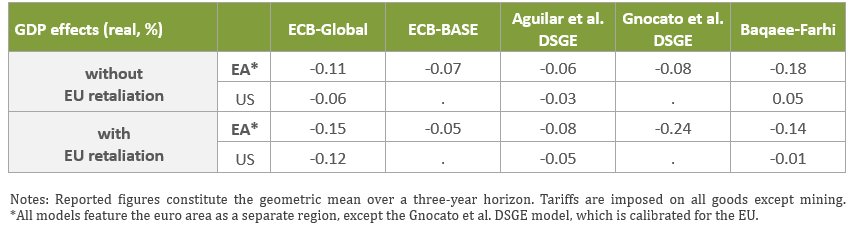
Counter-tariffs raise fiscal revenue and can improve the terms of trade, but they also make imported goods more expensive and risk further escalation. Table 3 studies scenario 1 under 10 pp retaliatory tariffs of the EU on goods imported from the US, providing no general case for retaliation. Retaliation is particularly harmful in models with intermediate inputs in production, since retaliatory import tariffs give rise to cost-push type effects. Euro area GDP losses increase compared to the no-retaliation case in ECB-Global, Aguilar et al. and, most sharply, Gnocato et al. Losses decrease slightly in ECB-BASE and Baqaee-Farhi. In the latter, terms-of-trade and tariff-revenue gains outweigh the additional input-cost pressures.8
For the US, EU retaliation worsens GDP outcomes in each model that reports them: the ECB-Global loss doubles, the Aguilar et al. loss increases, and the small Baqaee-Farhi gain becomes a loss. These results make the case for assessing retaliation alongside alternatives, while recognising that further escalation could compound losses. In a related vein, Rotunno and Ruta (2025) argue that deeper integration with third countries delivers a better welfare outcome than retaliation.
Table 3. The role of tariff retaliation
GDP effects of a 10 pp US import tariff on EU goods (with and without equal EU retaliation)
Understanding the transmission of trading-partner import tariffs is essential for assessing Europe’s economic exposure and the scope for policy responses. From our comparison across models, at least three results stand out as particularly relevant for European policymakers. First, sharp falls in bilateral trade can coexist with modest aggregate GDP losses, suggesting that any adjustment support should take account of sectoral exposure and vulnerabilities rather than rely on headline GDP alone. Second, in the case of third-party conflicts, trade diversion is no automatic windfall for the euro area, because new export opportunities can be offset by weaker global demand and stronger import competition. Third, retaliation can induce substantially larger losses, mainly due to supply-chain linkages. For Europe, these findings support close monitoring of exposed sectors and critical inputs, and careful assessment of market diversification and deeper trade integration with a broad range of trading partners as possible alternatives to escalation in bilateral trade conflicts.
Aguilar García, P., A. Dieppe, N. Gnocato, M. Khalil, B. Meunier and C. Montes-Galdón (2026a), “Effects of US import tariffs: Insights from ECB models“, Box E.1 in Georgiadis et al. (2026), pp. 55-60.
Aguilar García, R., Darracq Pariès, M., Dieppe, A., Domínguez-Díaz, R., Antonio, E., Gallegos, J.-E. and Quintana, J. (2026b), “Tariffs, production networks, and spillovers: the case of a US-China trade war”, ECB Working Paper No. 3254.
Angelini, E., N. Bokan, K. Christoffel, M. Ciccarelli and S. Zimic (2019), “Introducing ECB-BASE: The blueprint of the new ECB semi-structural model for the euro area“, ECB Working Paper No. 2315.
Baqaee, D. and E. Farhi (2024), “Networks, barriers, and trade”, Econometrica, 92(2), 505-541.
Darracq Pariès, M., Eyquem, A. and Jouvanceau, V. (2026), “The third-country effects of trade wars”, ECB Working Paper No. 3213.
Jouvanceau, V, M. Darracq Pariès, A. Dieppe, T. Kockerols (2025), ” Trade wars and global spillovers. A quantitative assessment with ECB-global “, ECB Working Paper No. 3117.
Georgiadis, G., M. Khalil, G. Strasser and F. Teti (2026), “Geoeconomics and trade“, ECB Discussion Paper No. 31.
Gnocato, N., C. Montes-Galdón and G. Stamato (2025), “Tariffs across the supply chain”, ECB Working Paper No. 3081.
Hassan, T. A., T. M. Mertens, J. Wang and T. Zhang (2025), “Trade war and the dollar anchor“, Brookings Papers on Economic Activity, Fall, 65-113.
Jiang, Z., A. Krishnamurthy, H. Lustig, R. Richmond and C. Xu (2025), “Dollar upheaval: This time is different“, Stanford Graduate School of Business Working Paper No. 4241.
Lane, P. R. (2026), “Europe and the world economy“, Keynote Address at the Asian Monetary Policy Forum, Singapore, 22 May.
Ostry, D., S. Lloyd and G. Corsetti (2025), “Trading blows: The exchange-rate response to tariffs and retaliations“, Bank of England Staff Working Paper No. 1139.
Rotunno, L. and M. Ruta (2025), “Trade partners’ responses to US tariffs”, IMF Working Paper No. 25/147.
Import tariffs are not only used as instruments of industrial protection: they can also serve as geoeconomic bargaining tools (cf. Georgiadis et al. 2026). President Trump’s tariff threats against European countries in early 2026, aimed at putting pressure on Denmark to cede Greenland to the US, illustrate this approach.
Operational ECB applications use richer model features and more detailed calibrations than those used in this comparison, which deliberately isolates tariff shocks and their transmission mechanism. As an example beyond tariff analysis, Lane (2026) illustrates how ECB models support projections and scenario analysis for energy-price shocks.
Tariffs persist beyond the three-year reporting horizon considered. The results are changes relative to an unchanged-tariff baseline, not projections of the measures announced in 2025–26. The static Baqaee-Farhi model is calibrated for comparability with this horizon but does not trace an adjustment path.
This model-based exchange-rate response should not be read as a prediction for every tariff episode. The dollar depreciated vis-à-vis trading-partner currencies, including the euro, after the April 2025 US tariff announcements. Ostry et al. (2025) associate US dollar depreciation following tariff announcements with expected retaliation. Jiang et al. (2025) interpret the combination of dollar depreciation and higher long-term US Treasury yields as consistent with doubts about the dollar’s reserve-currency role. Hassan et al. (2025) show how persistent trade barriers can erode the dollar’s safe-haven premium and raise US interest rates. Changes in the dollar’s safe-haven and reserve-currency role are additional mechanisms not analysed in this policy brief.
The model, however, abstracts from destination-specific pricing and foreign-owned production, which are particularly relevant for pharmaceuticals.
In the Aguilar et al. model, US producers have limited scope to replace Chinese inputs with euro area inputs, limiting trade diversion towards the euro area. Assuming higher trade elasticities in this model, substitution gains can outweigh weaker global demand and raise euro area output. Across models, substitution elasticities are therefore crucial to the strength of trade diversion.
For the US, however, tariffs on metals are less beneficial for output than tariffs on cars. This reflects the fact that tariffs on hard-to-replace upstream metals spread costs through downstream production. For instance, US automotive production declines sharply (-1.2%), and other manufacturing sectors are also markedly hit.
In a related scenario study, Darracq Pariès et al. (2026) find that in a US-Chinese trade war that extends to euro area goods, higher euro area tariffs could be welfare improving.