

This policy brief is based on ESCoE Discussion Paper 2026-02: “The Macroeconomic Effects of AI Uncertainty”. The views expressed are those of the author and should not be attributed to the institutions with which he is affiliated.
Abstract
Using a novel text-based AI Uncertainty (AIU) Index built from newspaper coverage linking artificial intelligence (AI) to economic outcomes, I examine how uncertainty surrounding AI affects the macroeconomy. The results show that higher AI uncertainty is contractionary, but along unusual margins. Equity prices, wages and hours worked decline, while employment and industrial production remain close to baseline. This response differs from conventional uncertainty shocks, which generate broader movements in employment and output. It also differs from existing uncertainty measures, with which the AIU Index is only weakly correlated. Industry-level estimates reveal heterogeneous labour market responses, with highly exposed and skill-intensive sectors displaying wage gains even as employment contracts.
The economics of AI is often framed as a debate between two views. One view sees AI as a powerful engine of productivity and growth. Another emphasises displacement, wage pressure, and disruption. Both views focus mainly on the expected level of AI’s eventual effects, or the first moment of the distribution.
The sharp disagreement about AI’s possible economic effects points to another dimension that also matters for the economy, namely uncertainty around those effects. This uncertainty concerns not only whether AI will raise productivity or displace workers, but also when these effects will occur and who will bear the gains and losses. In this sense, the economic impact of AI depends not only on the expected outcome but also on the dispersion of possible outcomes around it.
Such uncertainty can influence behaviour before the effects of the technology are fully realised. Firms, workers and investors do not need to observe the final impact of AI before adjusting their decisions. A long line of research shows that uncertainty can affect the economy independently of the outcomes it concerns, and often in advance of those outcomes (Bloom, 2009, 2014; Jurado et al., 2015). In the case of AI, firms may delay decisions, asset prices may adjust, and labour market bargaining conditions may shift as agents try to anticipate which economic future will materialise.
AI is therefore not only a potential productivity shock. It could also be an uncertainty shock, with effects that arrive before its realised productivity gains or labour market consequences can be measured. This study provides evidence on that channel for the United States (US).
The central measurement problem is that uncertainty about AI, like most forms of uncertainty, is not directly observed. It must be inferred from sources that reveal how economic agents discuss and interpret new developments. Newspaper coverage is useful for this purpose because it records, in real time, how AI developments are linked to jobs, wages, investment, regulation and broader economic outcomes. Therefore, I use this coverage to construct a monthly measure of uncertainty about AI, which I refer to as the AI Uncertainty (AIU) Index. This follows the news-based approach used in the Economic Policy Uncertainty Index (Baker et al., 2016), the Trade Policy Uncertainty Index (Caldara et al., 2020), and the Geopolitical Risk Index (Caldara and Iacoviello, 2022), among others. The index measures the share of articles in leading US, United Kingdom (UK), and selected European news outlets that jointly discuss AI, the economy, and uncertainty.1
The index draws on more than 34,000 AI-related articles from leading news outlets, including The Wall Street Journal, The New York Times, The Financial Times, and Reuters News. Using widely circulated sources keeps the measure stable and comparable, while coverage across countries reflects how AI developments spread through model releases, regulation, and commercial applications rather than through a single national policy process.
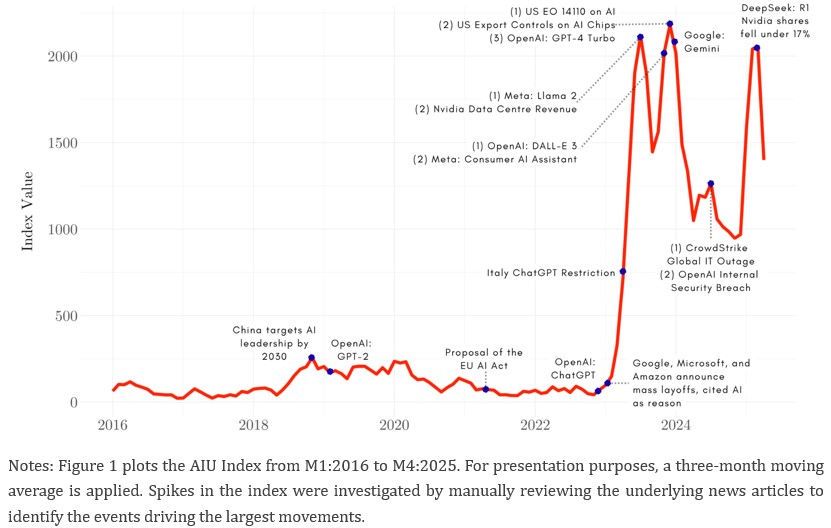
Figure 1 shows that the AIU Index rises around major AI events associated with heightened uncertainty about the economic consequences of AI. These include the public release of GPT-4 by OpenAI in March 2023, the US Executive Order 14110 on AI in October 2023, and the arrival of DeepSeek-R1 in January 2025.
A natural question is whether the AIU Index captures a distinct source of uncertainty or simply reflects broader economic and financial uncertainty. I assess this by comparing the index with existing conventional measures, including the EPU Index, the Real Economic Uncertainty (REU) Index (Jurado et al., 2015), the S&P 500 Volatility Index (VIX) and the NASDAQ 100 Volatility Index (VXN).
Figure 1. AIU Index (3-Month Moving Average)
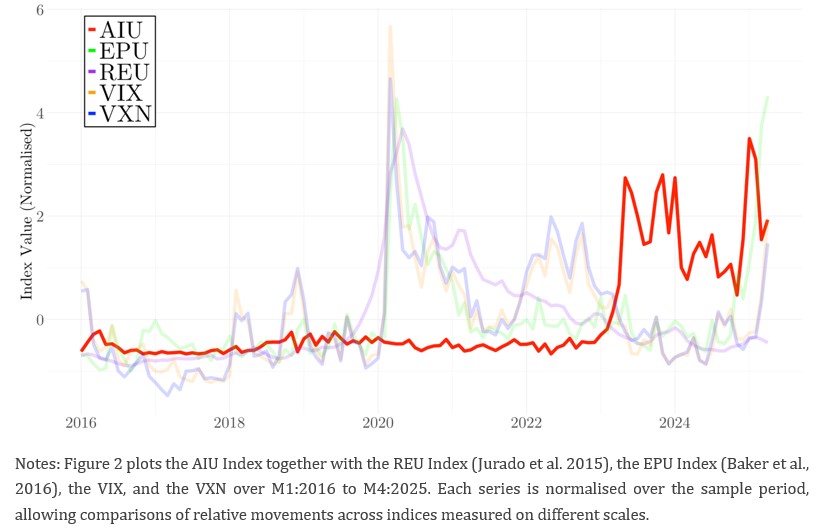
The comparison shows that AI uncertainty behaves differently. The AIU Index is weakly correlated with these measures, suggesting that it captures a dimension of uncertainty not already reflected in policy, macroeconomic, or financial market indicators.
Figure 2 illustrates this divergence. During the COVID-19 pandemic, conventional uncertainty measures rose sharply as macroeconomic and financial stress increased, while the AIU Index remained relatively stable. From late 2022 onward, after the release of ChatGPT in November 2022, the AIU Index increased substantially while conventional measures remained comparatively muted.
Having established that the AIU Index captures a distinct form of uncertainty, I now turn to its macroeconomic effects. Estimating them, however, cleanly requires separating uncertainty from the broader information contained in AI news. The difficulty is that the same AI episode can contain two distinct signals. One signal is favourable news about future productivity. The other is uncertainty about disruption, adjustment and the distribution of gains and losses.
This distinction matters because these two signals can push the economy in different directions. News that raises expected productivity may increase equity prices and support investment expectations. Uncertainty about how AI will affect jobs, wages, regulation and competition may instead weigh on valuations, bargaining conditions, and labour demand. If these components are combined in a single shock, the estimated response may not reveal the effect of uncertainty itself.
This identification challenge is well recognised in the uncertainty literature. Studies by Piffer and Podstawski (2018) and by Cascaldi-Garcia and Galvão (2021) show that uncertainty shocks can be correlated with news shocks that revise expectations about future productivity. When uncertainty and productivity news move together, it becomes difficult to determine whether the economy is responding to uncertainty itself or to revised expectations about future growth.
I address this issue in two steps. First, I remove the part of AI-related coverage that moves with broader AI-economy news. This step strips out the component of the index that is more likely to reflect general optimism or pessimism about AI and economic growth. What remains is the variation in uncertainty-related AI coverage that is unusually high compared to general AI news.
Figure 2. AIU Index and Selected Uncertainty Measures
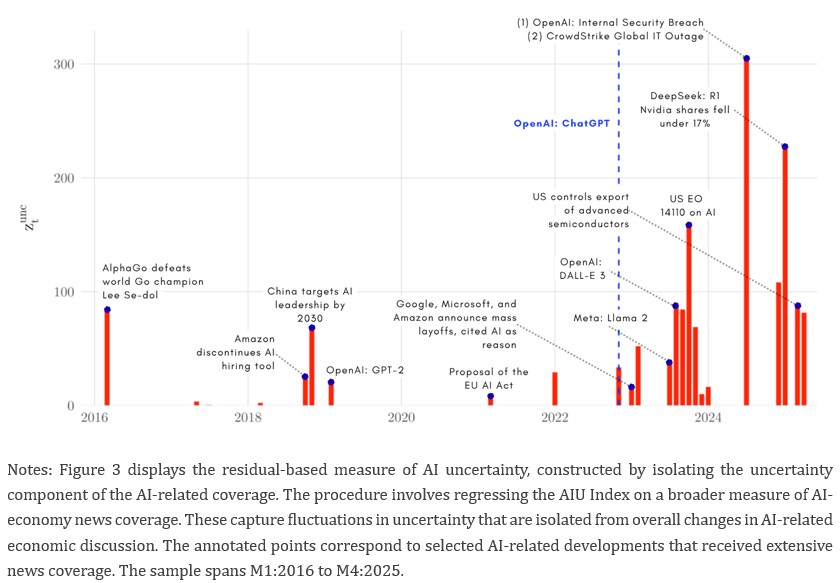
Second, I retain this remaining variation only when it coincides with independently dated AI developments. These include major model releases, regulatory actions, safety concerns, labour market disputes, and market disruptions. This event requirement ensures that the identifying variation is tied to observable AI developments, rather than to unexplained movements in the index. The resulting measure, shown in Figure 3, is used to identify unexpected increases in AI uncertainty in a structural vector autoregressive model with instrumental variables (SVAR-IV).2
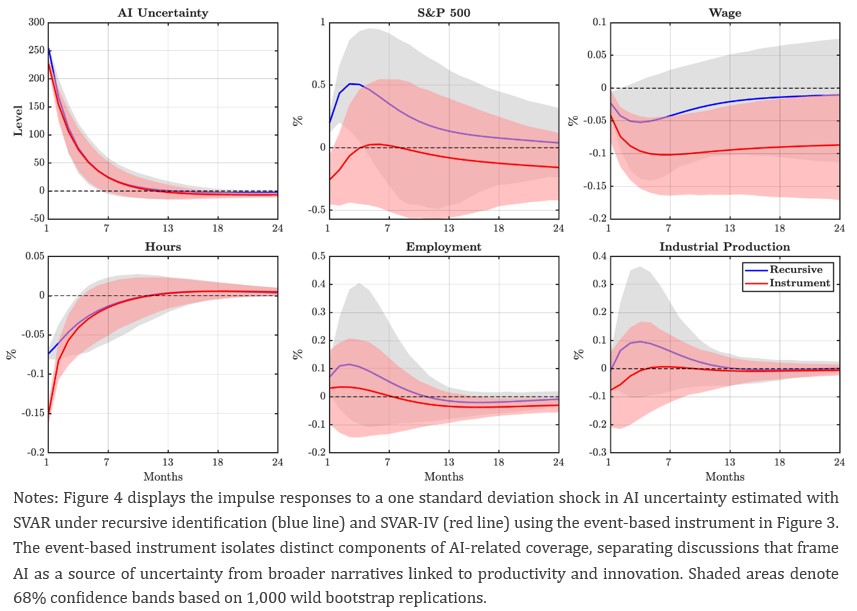
Figure 4 shows how key US macroeconomic indicators respond to an unexpected increase in AI uncertainty. The response is contractionary, but along unusual margins. Wages and hours worked decline, while employment and industrial production remain close to baseline. The contraction, therefore, appears mainly in labour pricing and utilisation rather than in jobs or output.
Wages. The clearest response is in wages. Average hourly earnings decline by about 0.1% on impact and remain below baseline throughout the horizon. The persistence matters as much as the initial decline. Rather than a short-lived wage response, uncertainty about AI is associated with sustained downward pressure on labour compensation.
Figure 3. Event-Based Instrument
Hours. Hours worked fall by nearly 0.2% on impact and recover after around ten months. Together with the wage response, this suggests that firms adjust the intensity and price of labour before making substantial changes to employment. The adjustment occurs mainly through hours and compensation, rather than through the number of workers employed.
Equity Prices. Equity prices fall by about 0.3% on impact before returning towards baseline. This negative response appears only in the SVAR-IV specification, which uses the event-based instrument to isolate AI uncertainty. Under recursive identification, where AIU innovations can also reflect favourable AI news, equity prices rise instead. The contrast indicates that, once separated from productivity optimism, AI uncertainty weighs on valuations.3
Employment and Output. The striking result is the muted response of employment and output. Employment remains close to baseline, while industrial production declines only slightly on impact before returning towards baseline. This differs from conventional uncertainty shocks, which typically generate more sustained contractions in employment and output.
The variance decomposition supports this interpretation. At a two-year horizon, AI uncertainty accounts for 21.8% of the forecast error variance in wages and 18.5% in hours worked, but only 2.2% in equity prices, 1.9% in employment and 0.7% in industrial production. The shock, therefore, transmits mainly through the pricing and utilisation of labour, rather than through job losses or a sustained contraction in output.
These impact responses may look modest in percentage terms, but two features make them economically meaningful. First, AI uncertainty explains a sizeable share of the medium-term variation in wages and hours worked, especially for a narrowly defined shock. Second, the wage response is persistent rather than transitory. Wages remain below baseline throughout the horizon, indicating sustained pressure on labour compensation rather than a short-lived adjustment.
Figure 4. Impulse Responses to AI Uncertainty Shock
The economic significance of these responses lies in the margin of adjustment. Uncertainty about AI does not primarily generate a broad contraction in employment or output. Its effects are concentrated in labour pricing and labour utilisation. This differs from conventional uncertainty shocks. In the paper, I compare responses to AI uncertainty with those to shocks identified using the EPU Index and the VIX, which generate larger declines in equity prices, employment and output.
Two mechanisms help explain the impulse response.
The first is an automation threat channel (Leduc and Liu, 2024; Firooz et al., 2025). When firms face uncertainty about which tasks could eventually be automated, the prospect of substitution can affect wage bargaining even before any worker is replaced. This helps explain why wages fall more persistently than employment. The second is the quasi-fixed nature of labour (Oi, 1962). When hiring and training costs are partly sunk, firms may prefer to adjust hours before changing employment. This is consistent with the short-lived decline in hours and the muted employment response.
These mechanisms imply that AI uncertainty differs from the classic real options channel of uncertainty. It is not mainly about firms postponing costly hiring or investment. Instead, it operates through anticipated changes in how tasks are divided between workers and machines, with adjustments concentrated in wages and hours.
This also helps explain why the wage effect is persistent. Many sources of uncertainty resolve at identifiable moments. A policy is enacted, an election is decided, or a regulatory ruling is announced, and uncertainty declines. Technological uncertainty behaves differently. Each advancement can open new questions rather than settle existing ones. Therefore, the uncertainty it generates is cumulative rather than self-resolving (Rosenberg, 1996). AI fits this pattern closely. New developments raise questions about future applications, the pace of adoption, regulatory responses and competitive effects. The bargaining pressure on wages may therefore persist beyond any single episode. This is why the underlying measure treats increases in uncertainty-related coverage as informative, while not assuming that quieter coverage necessarily signals genuine resolution.
Important differences across industries lie beneath the aggregate labour market response. The aggregate wage decline can reflect more than one force. It may arise from lower pay for workers who remain employed, consistent with a bargaining channel, or from changes in the composition of employment across higher- and lower-paid sectors. Industry-level estimates help identify where these adjustments are concentrated.
I examine these differences using industry-level estimates for wages, hours worked and employment.4 The results show that the aggregate response does not operate uniformly across sectors. Its strength depends on each industry’s task composition and on whether AI exposure is more likely to substitute for labour or complement workers who use the technology.5
Following an AI uncertainty shock, employment declines are largest and most persistent in Information, followed by Financial Activities and Professional and Business Services. These sectors account for a limited share of total employment. Their contractions are visible in the industry-level estimates, but they are not large enough to generate a sizeable decline in aggregate employment.
Wage responses also differ across sectors. Most industries experience wage declines after the shock, but Financial Activities is a clear exception, with wages rising even as employment falls. This pattern may reflect compositional adjustment within the sector. If employment losses are concentrated among lower-paid or more easily automated roles, while higher-skill roles are retained, average wages can rise even as employment declines. The pattern is consistent with skill-biased technological change (Acemoglu, 2002). In highly exposed and skill-intensive sectors, AI may raise the value of workers who design, manage or apply the technology, while reducing employment in roles whose tasks are more easily automated.
These sectoral patterns clarify why stable aggregate employment can be misleading. AI uncertainty does not generate a uniform labour market contraction. Instead, it reallocates employment and wage pressures across industries, with part of the adjustment obscured by aggregation.
The results suggest that the economic effects of AI extend beyond employment and productivity. Uncertainty about AI can affect the economy before any large job losses or measurable productivity gains appear in the data, working through margins that headline employment and output figures do not capture. Monitoring AI therefore requires a broader framework than realised outcomes alone, organised around three priorities.
Look Beyond the First-Moment Effects. The impact of AI is often evaluated through realised productivity gains, output growth or employment losses. The results show that uncertainty about AI can also affect the economy before these outcomes are observed. In particular, AI uncertainty affects labour income and utilisation, even when employment remains close to baseline. This matters because adjustments through pay and hours are less visible than those through jobs. Standard policy triggers often respond to unemployment or output weakness, so wage- and hours-based adjustments can build up before they are fully reflected in the indicators policymakers monitor most closely.
Measure AI Uncertainty Directly. Looking beyond these realised outcomes also requires a measure of the uncertainty surrounding AI itself. Conventional uncertainty indicators, including the REU Index, EPU Index, VIX and VXN, are designed to capture broader macroeconomic, policy or financial uncertainty. The AIU Index behaves differently from these measures and rises around AI-specific episodes. A dedicated news-based measure is useful because it captures uncertainty about AI that would otherwise be hidden inside broader indicators.
Track Industry Adjustment. Aggregate stability can conceal uneven sectoral responses. Employment declines are concentrated in Information, Financial Activities, and Professional and Business Services, even though aggregate employment remains close to baseline. Policy monitoring should also track wages, hours worked, and employment by sector, not only at the aggregate level. Where adjustment pressures are concentrated, support should focus on affected workers and tasks rather than on broad economy-wide measures.
AI may or may not deliver the productivity transformation its proponents expect. Either way, uncertainty surrounding that transformation already has measurable macroeconomic effects. The evidence shows that AI uncertainty operates before productivity gains are visible in the data, with effects running through wages and hours worked rather than through immediate job losses or a sustained contraction in output.
This has an important implication. Employment and output may remain close to baseline while workers bear the adjustment through lower pay and reduced hours. Since this adjustment occurs along margins that headline figures do not fully reveal, and since it differs from the broader contractions produced by conventional uncertainty shocks, its macroeconomic importance may be overlooked. As AI continues to evolve, each new development may reopen questions rather than settle them. Directly monitoring AI uncertainty, alongside the employment and output indicators policymakers already track, will therefore become increasingly important. It can help policymakers, firms, and workers anticipate adjustment pressures before they appear in productivity or employment statistics.
Acemoglu, D. (2002). Directed Technical Change. The Review of Economic Studies, 69:781–809.
Baker, S. R., Bloom, N., and Davis, S. J. (2016). Measuring Economic Policy Uncertainty. Quarterly Journal of Economics, 131(4):1593–1636.
Bloom, N. (2009). The Impact of Uncertainty Shocks. Econometrica, 77(3):623–685.
Bloom, N. (2014). Fluctuations in Uncertainty. Journal of Economic Perspectives, 28(2):153–176.
Caldara, D. and Iacoviello, M. (2022). Measuring Geopolitical Risk. American Economic Review, 112(4):1194–1225.
Caldara, D., Iacoviello, M., Molligo, P., Prestipino, A., and Raffo, A. (2020). The Economic Effects of Trade Policy Uncertainty. Journal of Monetary Economics, 109:38–59.
Cascaldi-Garcia, D. and Galvão, A. B. (2021). News and Uncertainty Shocks. Journal of Money, Credit and Banking, 53(4):779–811.
Felten, E., Raj, M., and Seamans, R. (2021). Occupational, industry, and geographic exposure to artificial intelligence: A novel dataset and its potential uses. Strategic Management Journal, 42:2195–2217.
Firooz, H., Leduc, S., and Liu, Z. (2025). Reshoring, Automation, and Labor Markets under Trade Uncertainty. Journal of International Economics, 156.
Gavriilidis, K., Känzig, D., Raghavan, R., and Stock, J. (2026). The Macroeconomic Effects of Climate Policy Uncertainty. NBER Working Paper 34762, National Bureau of Economic Research.
Jordà, O. (2005). Estimation and Inference of Impulse Responses by Local Projections. American Economic Review, 95(1):161–182.
Jurado, K., Ludvigson, S. C., and Ng, S. (2015). Measuring Uncertainty. American Economic Review, 105(3):1177–1216.
Leduc, S. and Liu, Z. (2024). Automation, Bargaining Power, and Labor Market Fluctuations. American Economic Journal: Macroeconomics, 16:311–349.
Oi, W. Y. (1962). Labor as a Quasi-Fixed Factor. Journal of Political Economy, 70:538–555.
Piffer, M. and Podstawski, M. (2018). Identifying Uncertainty Shocks Using the Price of Gold. The Economic Journal, 128(616):3266–3284.
Reyes, J. (2026). The Macroeconomic Effects of AI Uncertainty. ESCoE Discussion Paper No. 2026-02. Economic Statistics Centre of Excellence.
Rosenberg, N. (1996). Uncertainty and Technological Change. In Landau, R., Taylor, T., and Wright, G., editors, The Mosaic of Economic Growth. Stanford University Press.
The AIU Index is constructed using the Factiva database. Available at a daily frequency, the underlying news corpus covers January 1979 to April 2025. See Appendix A of Reyes (2026) for details.
The event restriction approach follows Gavriilidis et al. (2026), who identify climate policy uncertainty (CPU) by focusing on movements that coincide with independently dated policy events. I apply the same logic to AI uncertainty. I first remove the part of the AIU Index that moves with broader AI-economy news, leaving the component more closely associated with uncertainty. I then retain this component only in months that coincide with a recorded AI development.
Recursive identification orders the AIU Index first in a Cholesky decomposition. This means that unexpected movements in the index are treated as AIU shocks, without distinguishing whether they reflect uncertainty, favourable AI news or other information contained in AI-related coverage. The SVAR-IV specification addresses this limitation by using the event-based instrument to more directly isolate the AI uncertainty shock, without relying on the recursive ordering of the variables. The results are robust to alternative instruments, lag lengths and the exclusion of outliers. Full details are reported in Reyes (2026).
The industry-level responses are estimated using local projections (Jordà, 2005), with the identified AI uncertainty shock identified in the SVAR-IV as the impulse variable. This allows the dynamic response of each labour market outcome to be traced separately by industry.
AI exposure is measured using the AI Industry Exposure (AIIE) Index of Felten et al. (2021), which measures the overlap between the occupational task composition of an industry and the current capabilities of AI. The original 4-digit NAICS measure is aggregated to 2-digit industries to match the labour market data used in the local projections and then standardised across industries to have a mean of zero. Positive values indicate greater exposure to AI-related change relative to the average industry.