

This policy brief is based on BCL Working Paper N° 205. This paper should not be reported as representing the views of the BCL or the Eurosystem. The views expressed are those of the authors and may not be shared by other research staff or policymakers in the BCL or the Eurosystem.
Abstract
Recent empirical evidence reveals an income gradient in support for climate action: individuals in wealthier countries are less willing to pay than those in poorer ones. What explains this gradient, and what does it imply for international cooperation to protect the Earth’s climate? We answer these questions using a heterogeneous-country integrated assessment model formulated as a mean field game and calibrated to historical economic and climate data. Poorer countries, facing higher marginal utility of consumption, cut consumption less to cushion the decline in capital accumulation caused by climate damages. As a result, they suffer larger relative losses from climate change and gain more from mitigation, making them more inclined to accept a global carbon tax. This gradient has stark implications for cooperation: even when a carbon tax large enough to contain temperature increases benefits most countries, the richest might oppose. Redistributing global carbon tax proceeds uniformly across countries or recycling them as green investment subsidies need not overcome this reluctance.
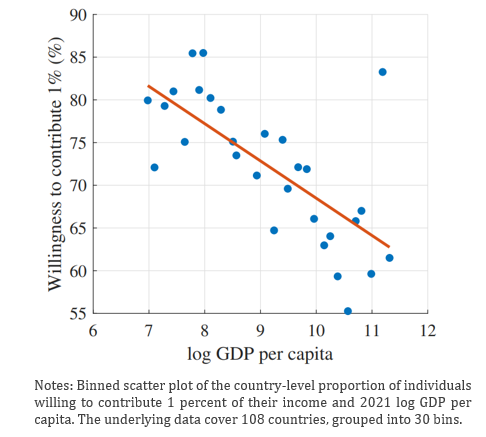
Individuals in wealthier countries are less willing to pay a given share of income to fight climate change than those in poorer countries (Andre et al., 2024). This pattern is not limited to the extremes of rich and poor nations but forms a gradient with per capita income (see Figure 1). Two questions arise. First, what drives this gradient? Second, how does it shape (the lack of) international cooperation to address climate change?
Figure 1. Willingness to contribute 1% of income by GDP
Our recent work (Garcia Sanchez and Pierrard, 2026) addresses these questions using a heterogeneous-country integrated assessment model, in the spirit of Hassler and Krusell (2012) and Hillebrand and Hillebrand (2019). The model combines a neoclassical growth structure with a climate block in which production generates CO2 that accumulates in the atmosphere and hinders output growth. We write the model in continuous time with a continuum of countries that differ in their initial capital stocks. This structure yields a mean field game (MFG) system with four equations. A backward Hamilton-Jacobi-Bellman equation governs optimal consumption and saving choices, a forward transport equation describes the cross-sectional distribution of countries, and two ordinary differential equations determine atmospheric CO2 and the global growth rate of labor and labor-augmenting productivity. Framing the model as a MFG condenses an otherwise high-dimensional problem, enhances computational tractability and clarifies the underlying economic mechanisms. We calibrate the model using data for 134 countries from 1990 to 2021 on production, capital stocks, and energy use, as well as global variables such as energy prices and atmospheric CO2.
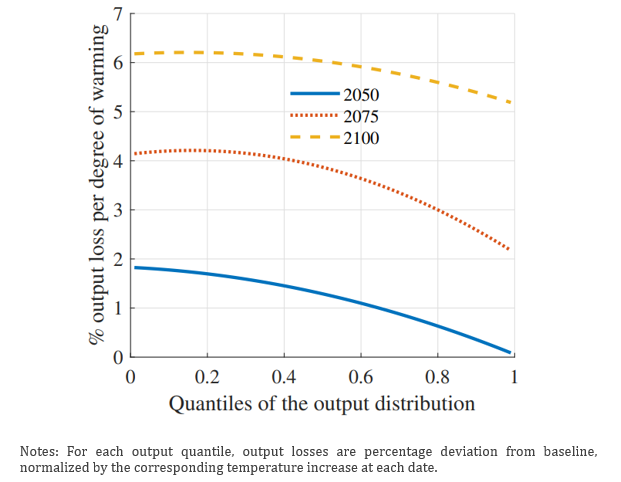
Figure 2 shows that our setup predicts a negative cross-country correlation between the economic costs of climate change and national income levels, consistent with empirical evidence (Nath et al., 2024). Although rising atmospheric CO2 concentrations lower the common growth rate of labor and labor-augmenting productivity, countries respond differently to this decline. High-income countries, which have a lower marginal utility of consumption, reduce current consumption to sustain capital accumulation. Lower-income countries, by contrast, have a higher marginal utility of consumption and are less willing to cut current consumption. As a result, capital accumulation declines more sharply in poorer countries, generating a negative gradient in the economic costs of climate change across income levels.
Figure 2. Output losses per degree Celsius across the output distribution
We use our model as a quantitative laboratory to evaluate the effects of a global carbon tax and countries’ willingness to accept it. We anchor the carbon tax to the social cost of carbon estimates in Rennert et al. (2022), who report a point estimate of $157 (2010 prices) per ton of CO2, with a 95% confidence interval from $37 to $351. Keeping temperature increases within widely accepted bounds requires a carbon tax at the upper end of this range. A tax of $351/tCO2 limits the temperature increase since 2021 to about 0.25°C by 2050 and 1.2°C by 2100.1 Instead, a low tax of $37/tCO2 allows substantially higher warming, around 0.7°C by 2050 and 3°C by 2100.
In line with Figure 1, an income gradient in the willingness to accept climate action emerges. When the effects of a $351/tCO2 carbon tax are evaluated over a horizon corresponding to the remaining lifetime of today’s young adults, countries in the 5th percentile of the income per capita distribution (e.g., Madagascar) would be willing to forgo 0.9% of their consumption every instant to move from the baseline to the tax scenario. By contrast, countries in the 95th percentile (e.g., the United States) would require a 2.2% increase in their consumption to accept the same policy. This gradient arises because poorer countries face larger economic damages from atmospheric CO2 and therefore benefit more from protecting the Earth’s climate. Figure 3 illustrates the income gradient for all countries in our sample.
Our work, moreover, cast doubt on a common explanation for the income gradient in Figure 1, namely that it reflects higher adaptation costs in richer countries because they have higher CO2 emissions (Andre et al., 2024). In our setup, richer countries do emit more CO2, but emissions per unit of output are identical across countries, consistent with the almost flat relationship between carbon intensity and output in the data. Ceteris paribus, a given carbon tax entails the same output cost across countries. Hence, the income gradient in the willingness to accept climate action need not stem from higher mitigation or adaptation costs in rich countries, but from greater climate damages in poorer ones. Needless to say, we focus on economic mechanisms; other factors, such as geographic exposure to climate risks or political economy considerations, may also contribute to the observed gradient.
Figure 3. Willingness to pay for a global carbon tax over a 60-year horizon
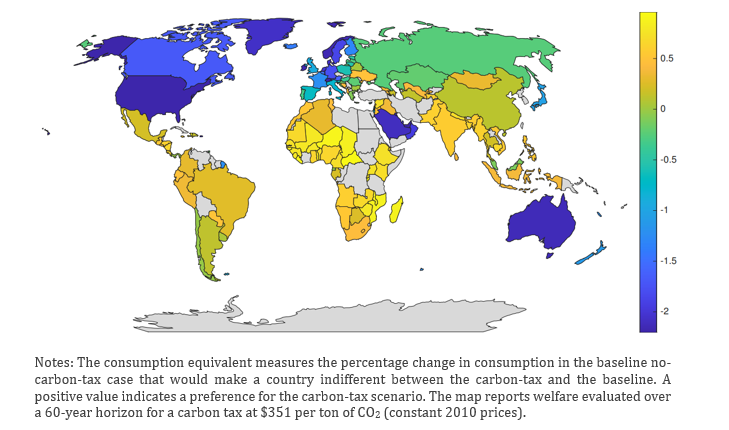
In addition, our policy experiments show that a country’s willingness to adopt the carbon tax depends on its evaluation horizon. The tax has a non-monotonic effect on output growth, initially slowing it but boosting it over longer horizons. This results from two opposing forces. The tax raises fossil fuel prices, slowing capital accumulation similar to a negative productivity shock. Over time, however, it reduces global CO2 emissions, accelerating the growth rate of labor and labor-augmenting productivity and eventually outweighing the initial drag. For example, over a 10-year horizon, no country would accept the $351/tCO2 tax, whereas over a 60-year horizon, all countries up to the 65th percentile would. As the horizon extends toward infinity, even the richest countries benefit: far-sighted countries at the top of the income distribution would forgo about 10% of their consumption to move from the baseline to the $351/tCO2 tax scenario.
The income gradient shapes international cooperation on climate policy, explaining inaction by rich countries. Carbon tax schemes often discussed in public debates struggle to overcome this reluctance. For example, a widespread idea in policy debates consists on redistributing global carbon tax revenues uniformly across countries rather than returning them to domestic households. However, this scheme would steepen the income gradient and weaken rich countries’ incentives to adopt the tax. Another common proposal recycles carbon tax revenues into subsidies for green capital investment. Although this increases support over long horizons, it reduces it in the short run by lowering consumption and utility. Overall, no simple policy design eliminates the short-run costs of abandoning fossil fuels across the income distribution. This tension suggests a role for communication: climate policy does entail short-run utility losses, but these are small relative to the long-run damages of inaction. Making this intertemporal trade-off transparent is itself a worthwhile policy objective.
Andre, P., Boneva, T., Chopra, F., and Falk, A. (2024). Globally representative evidence on the actual and perceived support for climate action. Nature Climate Change, 14(3): 253–259.
Garcia Sanchez, P. and Pierrard, O. (2025). The Rich, the Poor, and the Carbon Tax. BCL Working Paper 205.
Hassler, J. and Krusell, P. (2012). Economics and climate change: Integrated assessment in a multi-region world. Journal of the European Economic Association, 10(5): 974–1000.
Hillebrand, E. and Hillebrand, M. (2019). Optimal climate policies in a dynamic multicountry equilibrium model. Journal of Economic Theory, 179: 200–239.
Nath, I. B., Ramey, V. A., and Klenow, P. J. (2024). How much will global warming cool global growth? NBER Working Papers 32761, National Bureau of Economic Research Inc.
Rennert, K., Errickson, F., Prest, B. C., et al. (2022). Comprehensive evidence implies a higher social cost of CO2. Nature, 610: 687–692.
Relative to 1850-1900 pre-industrial levels, these correspond roughly to 1.3°C and 2.2°C.