

This policy brief is based on ECB Working Paper 3172 A monetary policy perspective on the euro area fiscal reaction function. The views expressed in this SUERF Policy Brief are those of the author and should not be reported as representing the views of the European Central Bank (ECB) or the Eurosystem.
Abstract
Taking a monetary policy perspective on euro area fiscal developments, this paper examines how fiscal policy responds to ECB monetary policy. Moreover, the fiscal reaction to government debt and the business cycle are considered, also being relevant to monetary policy. Estimating fiscal policy reaction functions, fiscal policy is found to act as a substitute to monetary policy in the short term, with the fiscal stance moving in the opposite direction of monetary policy. However, this substitutive role appears to have ceased operating at the time of ECB’s quantitative easing. Beyond the short term, the substitution effect intensifies before returning to a broadly neutral reaction in the medium term. The paper moreover finds that high debt levels induce budgetary surpluses, thus supporting fiscal sustainability and reducing fears of fiscal dominance. Finally, fiscal policy appears to act countercyclically but only during recessions.
Following several crises and periods of both very low and very high inflation, interest in the interactions between fiscal and monetary policies in the euro area has grown. Discussions about fiscal policy responses are often normative in nature, focusing on how fiscal policy should react, rather than examining the extent to which fiscal policies already respond to monetary policy actions. This paper therefore adopts a monetary policy perspective to examine fiscal behaviour, analysing whether and how fiscal authorities react to ECB monetary policy decisions. In other words, it seeks to analyse the fiscal transmission channel of monetary policy.
The reaction of fiscal policies to monetary policy is a priori uncertain, as it also depends on government priorities. Assuming an accommodative monetary policy, a loose fiscal could be induced, facilitated by low borrowing costs, thereby complementing monetary policy. Fiscal gains from higher economic growth after monetary policy loosening may also spur additional spending. A contrary, substitutive fiscal policy reaction, i.e. tighter budget balances, could arise if governments prioritise using the fiscal space created by monetary loosening to lower deficits and debt to foster fiscal sustainability. Empirical analysis is therefore required to shed light on this. Information on the sign and size of the systematic fiscal policy reaction should be taken into account when calibrating monetary policy to achieve price stability.
The fiscal policy response to monetary policy is a main, but not the only, relevant fiscal factor in the conduct of monetary policy. Government responses to elevated debt levels are also important for a central bank as unsustainable public finances may raise fears that monetary policy could divert from its primary objective of price stability. As shown by Bohn (1998), a necessary condition for fiscal sustainability is that the budget balance reacts positively to government debt, i.e., elevated debt levels prompt high primary surpluses. Moreover, the fiscal policy response to the business cycle is also considered here as a strong countercyclical fiscal stance, with fiscal policy expanding during downturns and contracting during upturns, may help to smooth out fluctuations in economic activity and inflation. Such may require a less intensive employment of monetary policy instruments to keep inflation at target, also depending on the type of shock.
To address these issues, fiscal policy reaction functions for a panel of euro area countries are estimated, focusing on budgetary responses to key economic and financial variables, including the monetary policy stance, government debt and the output gap. The structural budget balance is used as the fiscal policy measure, defined as the general government budget balance excluding cyclical effects, interest payments and one-off measures, providing a clearer picture of underlying fiscal policy stance.
Adding a monetary policy indicator is a relatively novel aspect in the domain of fiscal policy reaction functions. Just few studies have done so but often rely on incomplete measures such as the ECB policy rate (e.g. Afonso and Sousa, 2024). However, the ECB policy rate does not fully capture the monetary policy stance as the ECB employed other instruments to provide additional accommodation when policy interest rates approached their lower bound. These include asset purchases, targeted long-term refinancing operations and forward guidance. To account for these measures, shadow rates are used, which translate non-interest rate measures into interest rate equivalents, offering a more comprehensive measure of the monetary policy stance.
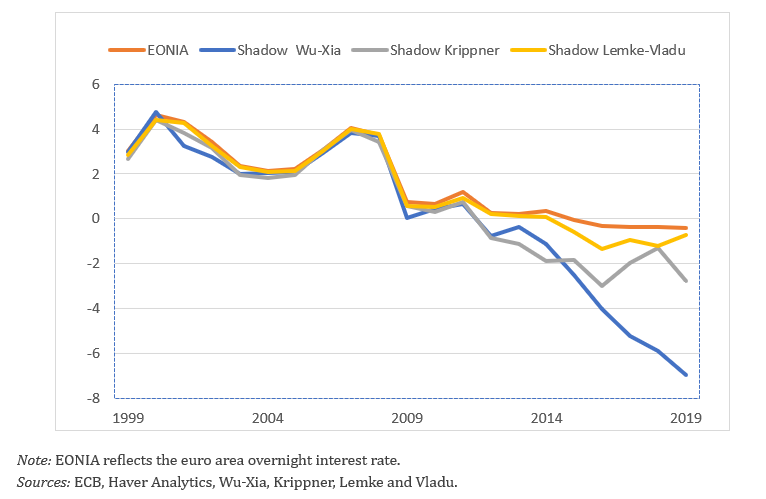
The estimates here primarily rely on the Wu-Xia ECB shadow rate (Wu-Xia, 2016), being used widely in economic research. As shown in Figure 1, this shadow rate initially closely follows the euro area overnight interest rate (EONIA), which is strongly influenced by ECB key interest rates. However, it begins to deviate around 2010, with the difference growing to more than 6 percent-point in 2019. As shadow rate estimates vary substantially, depending on the assumed effectiveness of non-interest rate central bank measures, other estimates, as calculated by Krippner (2019), and by Lemke-and Vladu (2017), and shown in Figure 1, are used for robustness checks.
Figure 1. Shadow rate estimates and EONIA
(percent)
Next to the government debt ratio (as for instance in Checherita-Westphal and Žďárek, 2017), and the output gap (Heimberger, 2023), other factors relevant for budgetary decisions are included as well. Building on the rich literature on fiscal policy reaction functions, this includes long-term interest rates (Klaassen et al, 2023), inflation rates (Briodeau and Checherita-Westphal, 2023), the strength of fiscal rules (Elsener and Brändle, 2023), current account balances, and national election dates (Tujula and Wolswijk, 2007).
Two-Stage Least Squares (2SLS) estimations are applied to account for expected interdependencies of variables, with the shadow rate, long-term rates and the output gap considered as endogenous variables. These variables are instrumented and enter the estimation-equation with a lag. The estimates are based on a panel of ten euro area countries over the period 1999-2019, using annual data. Panel data are utilised as for the central bank the overall fiscal response is what matters most when setting the single monetary policy. The estimation period starts in 1999, with the introduction of the single monetary policy in the euro area, and ends in 2019, as the Covid-19 pandemic crisis starting in 2020 was different in kind, being exceptionally adverse, not “home-grown”, and hitting all euro area countries.
The estimates suggest a substitutive role of fiscal policy to monetary policy in the short term. Thus, tight (loose) monetary policy leads to loose (tight) fiscal policies. This finding is robust across alternative specifications of the monetary policy stance. This substitutive fiscal role may – for instance in the case of monetary tightening- reflect government efforts to counter the adverse impact of monetary policy on economic growth, prioritising growth over debt sustainability.
However, this substitutive role appears to dissipate at the time of ECB’s large-scale purchases of government debt via its Asset Purchase Programme (quantitative easing, QE). Thus, QE has a complementary effect that, by and large, offsets the substitutive effect of other monetary policy measures. While the estimates do not reveal the underlying mechanism, QE’s complementary effect may reflect governments’ perception of central bank purchases of government debt as providing a monetary backstop to public finances. With a significant part of debt taken ‘out of the market’ for a considerable time, fiscal sustainability concerns may have eased, giving more room for additional spending. Another possible explanation is that, by flattening the yield curve, asset purchases led governments to lengthen the maturity of new debt. The reduced short-term exposure of public spending to interest rates may have induced higher spending (Afonso et al. 2024). Yet, some alternative specifications of the monetary policy stance measure do not support QE’s complementary effect, warranting caution when interpreting this finding.
Figure 2. Structural balance response to a policy rate shock
(% of GDP)
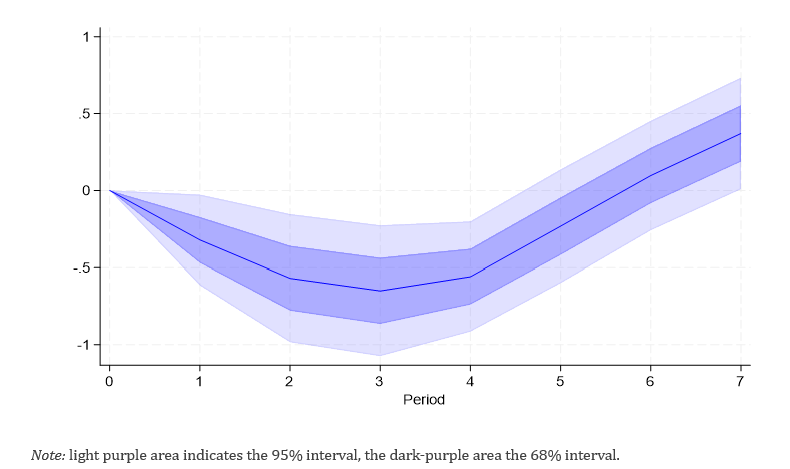
These results on the short-term fiscal response to monetary policy are complemented by analysis of the response over the medium term. To that end, local projection estimates are used, presenting a useful alternative to VARs to estimate impulse responses (Jordà, 2005). As Figure 2 illustrates, the substitutive effect of a one-time 1 percentage-point increase in the shadow rate – excluding QE’s potential complementary effect – initially intensifies (i.e., the budget balance becomes more negative, indicating a higher, more expansionary fiscal deficit) but, by and large, fades out in the medium term.
As to the other variables in the short-term fiscal policy reaction function that are relevant to monetary policy, governments with elevated debt levels pursue high budgetary surpluses to maintain longer-run fiscal sustainability. This finding somewhat mitigates concerns about fiscal dominance, although sometimes with low statistical confidence. Moreover, some evidence of countercyclical fiscal behaviour is found; fiscal policy tends to be expansionary during recessions but takes a neutral stance when output exceeds potential.
Other common outcomes across the estimates include fiscal policymakers responding to market forces -reducing fiscal deficits if long-term rates are high- expanding budgets during election years (suggesting a political business cycle), and fiscal balances moving in tandem with current account balances.
Concluding, there is a negative fiscal policy transmission channel of monetary policy: fiscal policy in the euro area operates as a substitute for monetary policy in the short term. This countering effect needs to be taken into account when setting monetary policy to achieve price stability. In times of large-scale purchases of government bonds, however, the overall impact on fiscal policy appears to be broadly neutral. Future research could further substantiate these results and explore the precise mechanisms though which fiscal policy responds to monetary policy.
Afonso, António, José Alves, Oļegs Matvejevs and Oļegs Tkačevs (2024), “Impact of sovereign debt maturity on fiscal sustainability”, Latvijas Banka Working Paper, No 5/2024. https://datnes.latvijasbanka.lv/papers/WP_5-2024.pdf.
Afonso, António, and Francisco Gomes-Pereira (2025), “Does monetary policy influence euro area fiscal sustainability?” Economic Modelling. Doi: https://doi.org/10.1016/j.econmod.2025.107273.
Bohn, Henning (1998), “The behavior of U.S. public debt and deficits”, The Quarterly Journal of Economics, 113 (3), pp. 949-963. Doi: https://doi.org/10.1162/003355398555793
Briodeau, Clémence, and Cristina Checherita-Westphal (2023), “Inflation and fiscal policy: is there a threshold effect in the fiscal reaction function?”, ECB working paper series, No 2880. Doi: 10.2139/ssrn.4655581.
Checherita-Westphal, Cristina and Václav Žďárek (2017), “Fiscal reaction function and fiscal fatigue: evidence for the euro area”, ECB working paper series, No. 2036. Doi: https://doi.org/10.2866/827938
Elsener, Marc, and Thomas Brändle (2023), “Do fiscal rules matter? A survey on recent evidence”, WWZ Working Papers, 2023/07. Do fiscal rules matter? A survey on recent evidence.
Heimberger, Philipp (2023), “The cyclical behaviour of fiscal policy: A meta-analysis”, Economic Modelling, 123 (6). Doi: https://doi.org/10.1016/j.econmod.2023.106259
Jordà, Òscar (2005), “Estimation and Inference of impulse responses by local projections”, American Economic Review, 95 (1), pp. 161-182. Doi: https://doi.org/10.1257/0002828053828518.
Klaassen, Franc, Roel Beetsma and Joao Tovar Jalles (2023), “How do governments respond to interest rates?”, CEPR Press Discussion Paper, 18257. https://cepr.org/publications/dp18257
Krippner, Leo (2019), “A note of caution on shadow rate estimates”, Journal of Money, Credit and Banking, Blackwell Publishing, vol. 52(4), June, pp. 951-962. Doi: https://doi.org/10.1111/jmcb.12613
Lemke, Wolfgang, and Andreea Vladu (2017), “Below the zero lower bound: a shadow-rate term structure model for the euro area”, ECB Working Paper, No. 1991. ECB Working Paper No. 1991.
Tujula, Mika, and Guido Wolswijk (2007), “Budget balances in OECD countries: what makes them change” (2007), Empirica, 34, pp. 1-14. Doi: 10.1007/s10663-006-9015-y
Wolswijk, Guido (2026), “A monetary policy perspective on the euro area fiscal reaction function”, ECB Working Paper Series, No. 3172: ECB Working Paper No. 3172.
Wu, Jing Cynthia, and Fan Dora Xia (2016), “Measuring the macroeconomic impact of monetary policy at the zero lower bound”, Journal of Money, Credit, and Banking, 48, pp. 253-291. Doi: 10.1111/jmcb.12300