

This policy note is based on “Understanding the Inflation-Output Relationship Across Business Cycle Phases”, ECB Working Paper Nr. 3175. The views expressed are those of the authors and not necessarily those of the institutions the authors are affiliated with.
Abstract
This paper studies how the effects of monetary policy change depending on the state of the economy. Central banks such as the Federal Reserve typically adjust interest rates in response to inflation and economic activity. Standard economic models often assume that these relationships are stable over time. In those models, a given interest rate change is expected to have roughly similar effects regardless of whether the economy is booming or weak, or whether inflation is high or low. This paper shows that this assumption is too restrictive. Instead, the impact of monetary policy varies substantially across different economic conditions.
An influential earlier study by Baumeister and Hamilton (2018) found monetary policy shocks — unexpected changes in interest rates — have only small and short-lived effects on inflation and output. That result raised doubts about how powerful monetary policy really is in stabilizing the economy. The paper revisits this conclusion using a richer framework that allows economic relationships to change across different states of the business cycle.
Cardamone and De Santis (2026) use a model that combines core elements of modern macroeconomics with a flexible statistical approach. The framework includes three key building blocks: how inflation responds to economic pressure, how demand responds to interest rates, and how the central bank sets policy rates.
A central feature of the analysis is that the economy is divided into four regimes based on two simple indicators: whether inflation is above or below the central bank’s target, and whether output is above or below its potential level. These two dimensions generate four recognizable phases of the business cycle: weak economic activity with low inflation (e.g. disinflationary slack), weak economic activity with high inflation (e.g. inflationary slack), strong economic activity with low inflation (e.g. disinflationary boom), and strong economic activity with high inflation (e.g. inflationary boom). Instead of assuming one single set of relationships for all periods, the model allows behavior, policy responses, and shock transmission to differ across these regimes.
By analyzing four distinct economic regimes, we assess how the slopes of the Phillips curve and the Dynamic Investment-Savings (DIS) curves, the Federal Reserve’s policy response, and the impact of economic shocks differ across economic states.
Taylor rule. Their findings reveal significant differences across regimes. The Taylor rule, which describes how the Federal Reserve adjusts its policy rate in response to inflation and the output gap, remains consistent with economic theory across all regimes. This ensures that the real interest rate rises when inflation increases, thereby helping to stabilize the economy by controlling inflationary pressures.
Monetary policy responses to the output gap weaken when inflation is below target and output is above potential, while reactions to inflation is broadly similar across regimes.
They also show that the Federal Reserve is more data dependent during periods of inflationary slack. Moreover, they find that the size of monetary policy shocks is significantly larger when inflation exceeds its target, reflecting the Federal Reserve’s attention to high inflation.
Phillips curve. The Phillips curve, which describes the positive relationship between inflation and the output gap, is relatively steeper when inflation is above target and output is above potential. Therefore, demand and monetary policy shocks have much more pronounced effects on the macroeconomy during inflationary booms.
The investment-savings curve. The DIS curve, which measures the relationship between output, inflation, and interest rates, also exhibits state dependence. The sensitivity of the output gap to the interest rate in the DIS curve is flatter when inflation is above target and output is below potential. Consequently, monetary policy shocks have muted responses on the macroeconomy only in the inflationary slack regime.
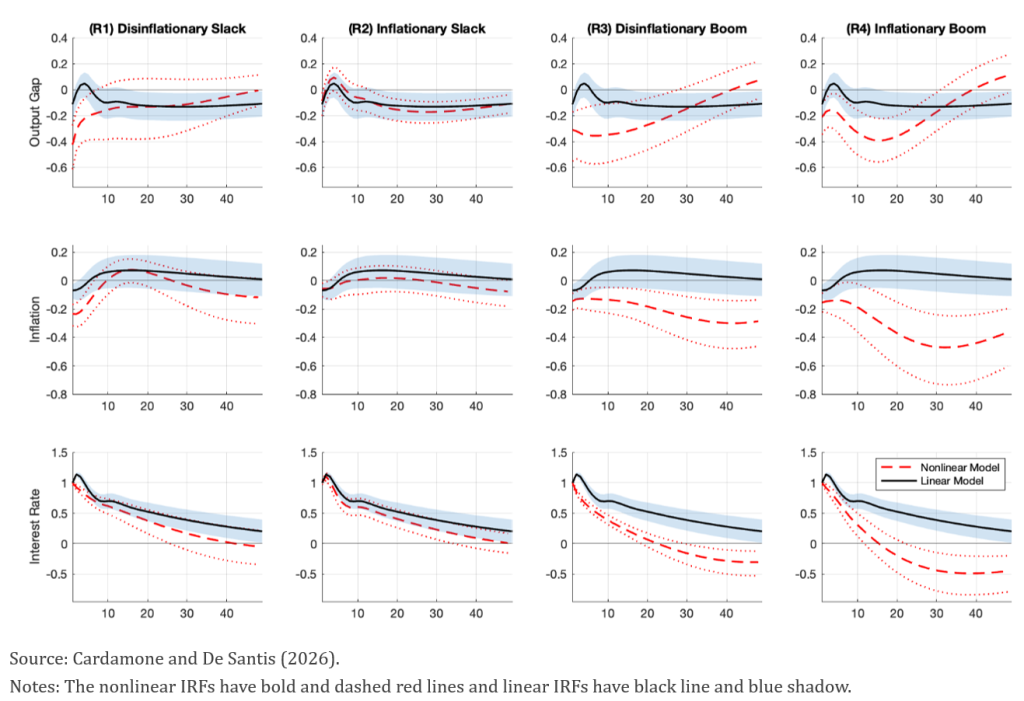
Monetary policy shocks. Monetary policy has its weakest effect when inflation is high but the economy is weak (see Figure 1). In that environment, households and firms appear less responsive to interest rate changes. Possible reasons include tighter financial constraints, precautionary saving behavior, and erosion of real purchasing power due to inflation. In practical terms, raising rates in such a regime produces only modest reductions in spending and inflation. This is precisely the state that dominates the historical sample (this regime accounts for 44% of the observations), which helps explain why simpler linear models tend to find small average policy effects.
By contrast, in economic booms and in low-inflation slowdowns, monetary policy is much more powerful. An unexpected increase in interest rates produces a significantly larger and more persistent decline in output and inflation. The estimated effects in these regimes are several times larger than those found in linear models. This means that the average results reported in earlier studies mask important variation across conditions.
Specifically, an unexpected 1-percentage-point exogenous increase in the policy rate reduces the output gap by approximately 0.4% at through in these three regimes, a response three to four times greater than that observed in the inflationary slack regime, with the effect remaining persistent throughout economic booms. Similarly, year-on-year inflation initially declines by 0.1-0.2 percentage points, with a more sustained peak response ranging from -0.2 to -0.4 percentage points during economic booms. The effect is long lasting.
Figure 1. Response to a monetary policy shock
The paper demonstrates that monetary policy effectiveness is state-dependent. The same interest rate change can have very different consequences depending on inflation and business cycle conditions. These insights are particularly relevant for policymakers, as they suggest that the effectiveness of monetary policy depends on the prevailing economic regime. For example, during inflationary booms, restrictive monetary policy can effectively reduce inflation and close the output gap, while during inflationary slack, policy changes may have a more limited impact. This might imply a stronger determination to fight inflation.