

This policy brief is based on the EIB investment report 2025/2026. The views expressed are those of the authors and not necessarily those of the institutions the authors are affiliated with.
Abstract
The global race for leadership in digital technologies and artificial intelligence (AI) is reshaping economic competitiveness. US tech companies lead in areas such as cloud computing, AI and digital platforms, while China has developed its own digital ecosystems. The European Union has been catching up by investing heavily in digital infrastructure, but it remains reliant on imported technologies, including software developed by US companies. Nonetheless, with its strong industrial base and growing share of digital adopters, Europe is well positioned to capture substantial productivity gains from technology diffusion. Drawing on the findings from the recent EIB Investment Report 2025/2026, this policy brief provides an overview of the global digital landscape and sets out guidelines for maximising the EU’s productivity dividend from AI while strengthening its digital sovereignty.
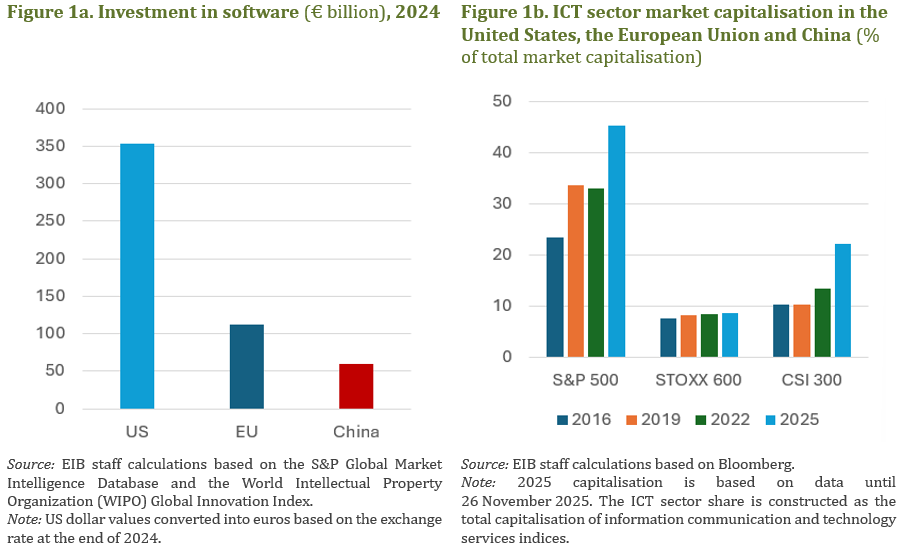
More than €350 billion were invested in software in the US in 2024, compared to €110 billion in the EU and €60 billion in China (Figure 1a). Germany is ranked third among individual countries, with approximately €20 billion invested in 2024. The boom in ICT strongly contributed to the GDP growth in the United States in 2025, reflecting strong demand for investment in data centres, cloud computing and AI (EIB, 2026). Global stock markets have also become more dependent on the performance of the ICT companies. Between 2016 and 2025, the share of the sector in total market capitalisation doubled in both the United States and China, reaching 45% and 22% of the main stock market indices in 2025, respectively (Figure 1b). During the same period, the weight of the ICT sector in the main European stock market indices remained relatively stable, at around 9%.
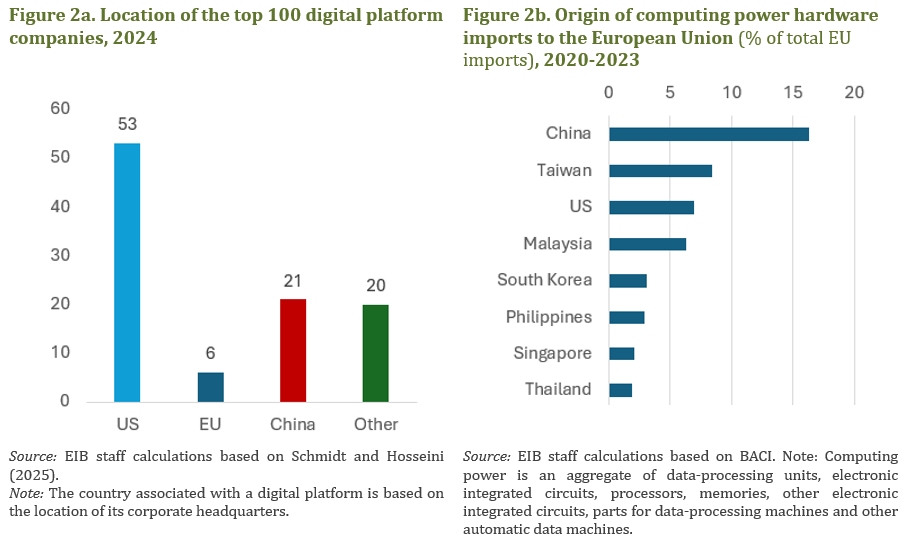
US has become the global digital powerhouse, with limited competition from other countries. For example, the majority of top 100 digital platform companies are located in the US, with only a few domiciled in the EU (Figure 2a). Beyond digital platforms, dependence on US firms may constrain Europe’s strategic autonomy in critical software, cloud computing and the development of new large language models (LLMs). At the same time, the hardware underpinning Europe’s digital infrastructure is predominantly imported from East Asia (Figure 2b). For the European Union, this creates two key vulnerabilities. First, dependence on US firms may constrain Europe’s strategic autonomy in critical software and cloud computing. Second, sudden shifts in US corporate strategy, regulation or geopolitics could expose the EU tech sector to external decisions beyond its control, potentially undermining the European Union’s ability to shape its own digital future.
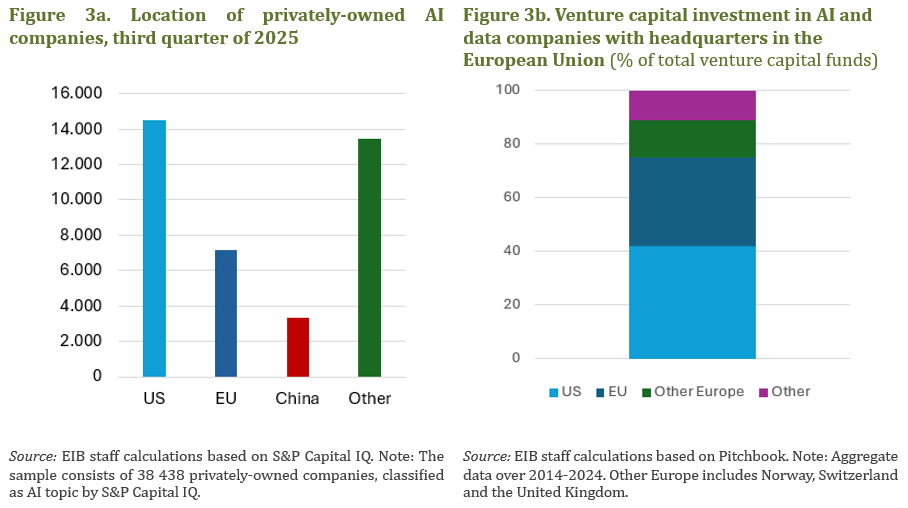
Europe has the potential to expand its digital capacity yet it needs to leverage the power of its single market and accelerate the integration of its capital markets. The EU houses more than 7,000 companies actively participating in the global AI race (Figure 3a). EU startups tend to focus on applied AI solutions, industrial AI, and specialised domains where Europe has comparative advantages, such as manufacturing, healthcare, and regulatory-compliant AI applications. However, financing for early-stage AI innovation in the European Union remains dependent on US venture capital (42% of total VC funding for EU firms over the past decade; Figure 3b). While the EU has a growing AI startup base, bridging the gap from financing private innovation to large-scale, globally competitive firms remains a challenge.
EU firms are accelerating the adoption of digital technologies. For example, 46% of EU firms used big data analytics and AI in 2025, compared to 40% in the US (EIB, 2025). However, adoption rates remain lower among SMEs, which underscores the need for enabling conditions and targeted support for broad-based digital transformation. Around 85% of EU firms with more than 250 employees use digital technologies, compared with about 54% of EU firms with fewer than ten employees (Figure 4a). This gap is likely to slow Europe’s digital transformation, as businesses in the region are on average smaller than those in the United States (Revoltella et al., 2020).
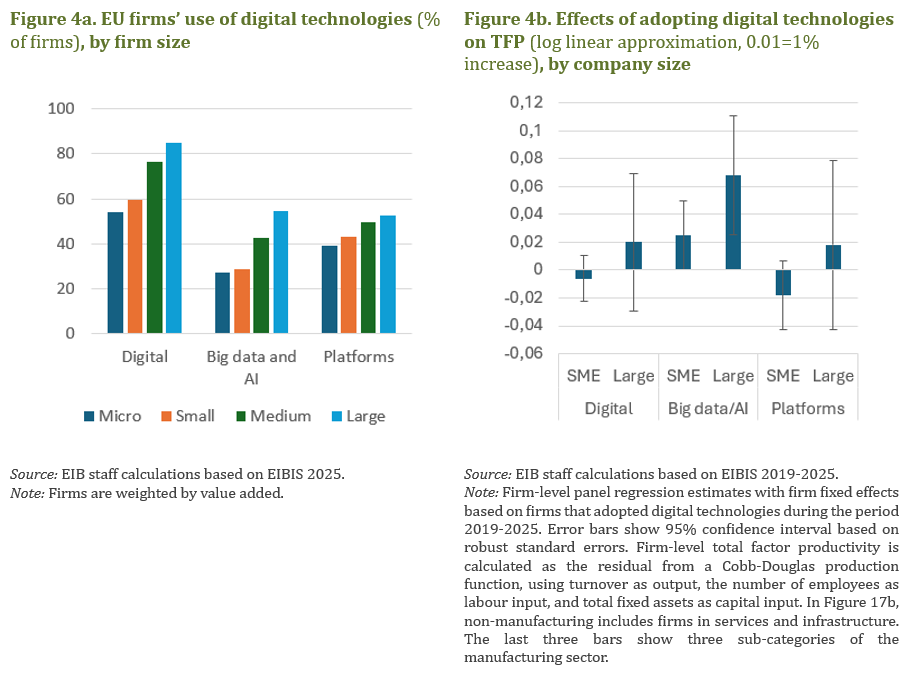
The adoption of big data analytics and AI is associated with higher productivity levels, unlike other digital technologies (Figure 4b). While larger firms currently capture the bulk of the benefits of AI adoption, SMEs also stand to gain in terms of TFP (Aldaroso et al., 2026). The productivity effects are already visible on the macro scale. Using weighted firm-level panel regressions we estimate that the realised average TFP growth between 2019 and 2025 was 0.34 percentage points higher than the growth rate under the counterfactual scenario of no adoption. This suggests that the rollout of big data and AI accounted for some 12% of aggregate TFP gains between 2019 and 2025.
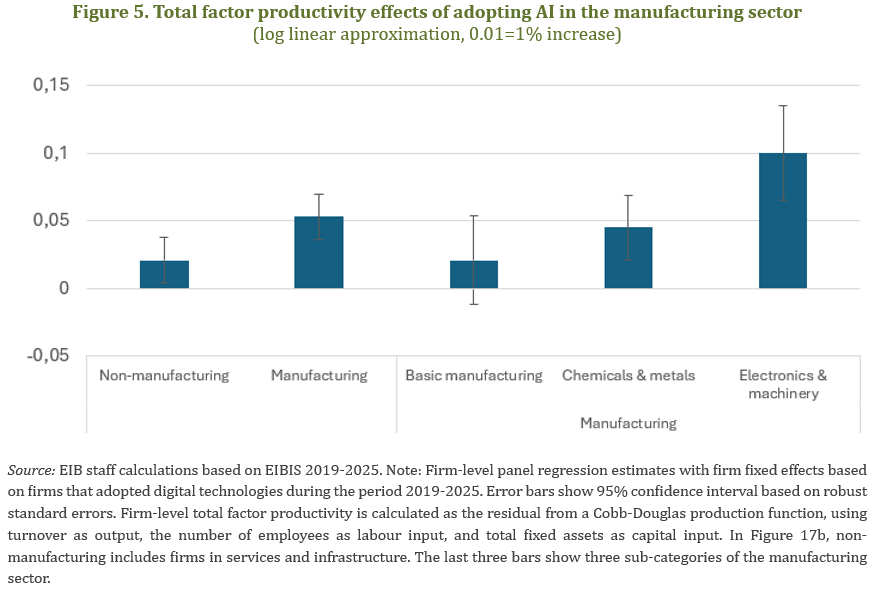
Although the European Union is not a global leader in AI technology development, its strong industrial base means that the potential benefits of adopting and adapting AI to business needs are substantial. EU firms – particularly in manufacturing (Figure 5) – can use AI to optimise processes, improve quality control, reduce downtime and strengthen supply chain management. Productivity gains from big data and AI adoption are greater in high-tech manufacturing, where digital transformation complements capital-intensive production and structured operational processes. This demonstrates that Europe’s industrial environment and technological capabilities enable EU companies to capture the productivity benefits of AI and reinforce their position in global value chains, even without leading in cutting-edge AI research.
The new digital and AI era presents opportunities and challenges for Europe. As innovation accelerates, the EU continues to invest to remain a global player, while leveraging its scale and market opportunities to build resilience against external dependencies. A long-term strategy should combine effective regulation measures to strengthen research and innovation. Priorities include boosting public and private R&D investment, fostering cooperation between academia, industry and public institutions and creating incentives for high-risk, high-reward innovation. Scaling up cross-border research initiatives – such as Horizon Europe – will accelerate breakthroughs in AI, robotics and digital manufacturing. Cultivating a pipeline of skilled talent through education, training and international cooperation is equally vital to ensure that Europe remains a hub for cutting-edge research and a magnet for global talent.
In the current geopolitical landscape there is a clear advantage of taking up the digitalisation challenge through a pan‑European perspective. A unified approach enables Europe to mobilise the scale needed to compete globally in AI and digital technologies. Coordinated investment in frontier compute infrastructure — bringing together HPC, AI accelerators, energy systems, cooling and secure data environments — allows Member States to share fixed costs, improve utilisation and lower unit costs for both training and inference. Likewise, EU‑wide data spaces transform fragmented national datasets into a strategic collective asset, providing the breadth and diversity essential for training next‑generation AI models while ensuring adherence to European governance standards. By pooling resources, demand and regulatory frameworks, the EU can act as a genuine force multiplier, accelerating innovation and reinforcing its competitive position relative to the United States and China.
A pan‑European approach is also indispensable for strengthening digital security and fostering a resilient innovation ecosystem. Cyber threats and digital vulnerabilities are inherently cross‑border, and Europe’s interconnected economies mean that weaknesses in one Member State can quickly propagate across the European Union. Common cybersecurity frameworks and integrated capabilities help reduce systemic risk, protect critical infrastructure and bolster Europe’s strategic autonomy by supporting the emergence of trusted EU-based solutions. At the same time, EU‑level venture capital instruments ensure that funding is channelled efficiently into priority areas such as AI and deep tech, avoiding fragmentation and enabling firms to scale across borders. By aggregating resources, these instruments expand the availability of risk capital, attract private investment and support innovative companies throughout their growth cycle— addressing Europe’s historical under‑financing of high‑potential technology firms.
Aldasoro, I., Gambacorta, L., Pal, R, Revoltella, D., Weiss, C. & Wolski, M. (2026). AI adoption, productivity and employment: Evidence from European firms. EIB Working Paper No. 2026/02. https://www.eib.org/en/publications/20250383-economics-working-paper-2026-02
EIB (2025). EIB Investment Survey 2025: European Union overview. European Investment Bank. https://www.eib.org/en/publications/20250216-econ-eibis-2025-eu
EIB (2026). EIB Investment Report 2025/2026: Capitalising on Europe’s Strength. European Investment Bank. https://www.eib.org/en/publications/20250379-investment-report-2025
Revoltella, D., Rückert, D., & Weiss, C. (2020). Adoption of digital technologies by firms in Europe and the US: Evidence from the EIB Investment Survey. VoxEU.org, 18 March 2020. https://cepr.org/voxeu/columns/adoption-digital-technologies-firms-europe-and-us-evidence-eib-investment-survey