

This policy brief is based on Deutsche Bundesbank, Discussion Paper No 31/2025 “Do capital requirements and their international differences affect banks‘ profitability?”. The views expressed in this brief are those of the authors and do not necessarily reflect the views of the Deutsche Bundesbank or the Eurosystem.
Abstract
Do stricter capital requirements hinder bank profitability? This question has been a key topic in debates on financial regulation since at least the global financial crisis. Most recently, discussions on regulatory burdens have resurfaced internationally. For example, in the US and Europe, a lively discussion on potential reforms of banks’ capital requirements is currently underway. In our paper, we find no evidence that higher capital requirements are associated with lower bank profitability. However, differences in the level of capital requirements across jurisdictions can create competitive advantages for certain banks. The findings challenge the notion that stricter capital requirements harm profitability and highlight the nuanced effects of regulatory differences on globally active banks. Based on our findings, we assert that lowering capital requirements is not an effective strategy for improving profitability and poses the risk of an international regulatory “race-to-the-bottom”.
In the aftermath of the 2007‑09 global financial crisis, the Basel III reforms introduced stricter capital requirements to enhance the resilience of the banking sector. However, these requirements have been implemented differently across jurisdictions, raising concerns about their impact on banks’ profitability and international competitiveness. This paper examines whether stricter capital requirements and their international differences influence banks’ profitability, with a focus on large banks in the US and Europe. We find no negative impact of higher capital requirements on bank profitability within these regions. However, for (some) internationally active banks, regional differences in capital requirements may have a marginal effect on their profitability.
The empirical study uses a comprehensive dataset of large banks in the US and the European Economic Area (EEA), covering the period from 2019 to 2024. To assess the impact of capital requirements, voluntary capital buffers, and international regulatory differences on banks’ profitability, the study employs panel regression models. Key variables include profitability measured as return on assets (RoA), bank-specific capital requirements under Basel III, and macroeconomic controls like GDP growth and interest rates. The study also explores potential spillover effects by examining how differences in capital requirements between jurisdictions influence the profitability of banks with cross-border exposures.
The paper builds on three strands of literature: the relationship between capital ratios and banks’ profitability, the impact of capital requirements on bank profitability, and international spillovers of regulatory policies. One key theoretical argument is that higher capital requirements could increase banks’ refinancing costs, potentially reducing competitiveness and consequently, their profitability. However, well-capitalized banks may also benefit from lower cost of debt through decreased default risk and improved operational efficiency, which could offset these costs. This study expands on the existing literature by focusing on capital requirements – rather than solely on capital ratios – and by analyzing the effects of international regulatory differences on banks’ profitability across a broad sample of US and EEA banks.
The study finds no evidence that higher requirements negatively affect banks’ profitability (Figure 1). Notably, banks that hold higher voluntary capital buffers above the regulatory minimum tend to exhibit higher profitability. This suggests that well-capitalized banks may benefit from enhanced stability and efficiency, and it underscores the importance of excess capital as a strategic tool for banks for managing risks and seizing market opportunities.
Figure 1. Estimated effect of CET1 capital requirements on banks’ RoA
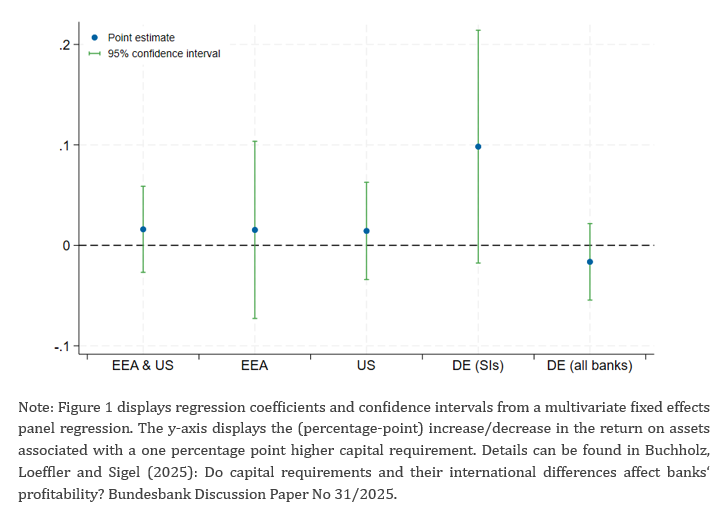
Since capital requirements in a jurisdiction apply only to domestic banks and foreign subsidiaries, foreign banks operating through cross-border or branch-based activities may gain a competitive advantage if differences in capital requirements between regions are substantial. However, we only find an effect in the subsample of German banks with large US exposure. In contrast, we do not find similar effects for US or other EEA banks operating abroad. Overall, this suggests only a minor role of capital requirements and their international differences in determining bank profitability.
Based on the estimated spillover effects, the study considers two policy scenarios. In a unilateral scenario where only the home country reduces requirements, German SIs with substantial US exposure experience a modest profitability boost. However, in a reciprocal scenario where both the home and foreign jurisdictions lower requirements, the potential profitability gains disappear, and the overall effect turns negative. This highlights the risks of a “race to the bottom” in regulatory standards.
The findings challenge the argument that capital requirements harm banks’ profitability. Instead, higher requirements either have no significant effect or are positively associated with profitability in the sample. However, international differences in capital requirements can create competitive imbalances, benefiting banks operating abroad. The study offers two take-aways from a regulatory policy perspective. First, harmonizing capital regulation across jurisdictions can mitigate regulatory spillovers and ensure a level playing field. For instance, the EU’s countercyclical capital buffer, which applies uniformly to all exposures in each country, could serve as a model for international coordination. Second, reducing capital requirements is not an effective way of enhancing banks’ profitability in a sustainable fashion. In fact, it could undermine the resilience of the banking sector, and therefore financial stability, by triggering a regulatory race to the bottom.