

This policy brief is based on the recent IFC Bulletin no 68, in particular Barnava et al (2026). The views expressed in this brief are those of the authors and do not necessarily reflect those of the Banque de France, the Bank for International Settlements, the Central Bank of the Republic of Türkiye, De Nederlandsche Bank, the Deutsche Bundesbank, the Irving Fisher Committee on Central Bank Statistics, the Organisation for Economic Co-operation and Development or any of the other institutions mentioned.
Abstract
Modern societies face acute sustainability challenges that encompass economic, financial, environmental, social and governance dimensions. Ensuring sustainability – commonly referred to as sustainable development, that is, the capacity to meet current generations’ needs without compromising those of future ones – calls for comprehensive statistics accounting for the preservation of well being, often going beyond traditional economic indicators (i.e., GDP). For their part, central banks have actively engaged with these issues, both as data users and producers, to support their core mandates in areas such as monetary and financial stability, asset and reserve management and, increasingly, the development of sustainable finance. Yet significant information gaps persist, reflecting both the conceptual and practical complexity of measuring sustainability. Addressing these gaps requires improving the current statistical offering in terms of data relevance, accessibility, reliability and cross-border harmonisation. Central banks, along with statistical offices and international organisations, can play a decisive role in advancing this agenda to better inform policies and the public.
In recent decades, there has been an increased focus on addressing a wide range of sustainability issues, from poverty and food insecurity to social and health inequalities, the impact of climate change and biodiversity loss. While not new, these topics have been receiving growing public attention in the wake of recent global crises, including the Covid-19 pandemic and recurrent extreme climate-related events. For their part, central banks have also increasingly paid attention to sustainability indicators, reflecting their relevance to better inform decisions related to monetary and financial stability, statistics, supervision, reserve management and payment oversight.
Despite the active policy demand for better and more insights related to sustainability, important information gaps currently persist. These are the result of both still scarce data availability – despite growing interest – and the sheer complexity of measuring sustainability issues, which cannot always be measured in monetary terms. Specifically, its measurement involves the assessment of a wide range of economic and non-economic capitals, such as human, social and natural. Ultimately, there is a case to establish new metrics going beyond those traditional economic indicators that are already relatively well captured in the current statistical apparatus.
Drawing on a recent IFC Bulletin, this policy brief discusses the policy relevance of sustainability issues in the context of central banks and the associated data needs. After taking stock of the various conceptual and measurement issues (section 1), it highlights the key factors that make sustainable data instrumental to better inform central banks’ policies (section 2). It then suggests four key aspects to enhance their quality, focusing on data relevance, availability and accessibility, reliability and comparability (section 3).
As a broad and complex concept, sustainability can be defined as the capacity to satisfy the needs of today’s population while ensuring that future generations can also satisfy theirs (WCED (1987); UN (2015); UN et al (2025)). From this perspective, the current level of human well-being is sustainable if it can be maintained, or improved, in the future (Stiglitz et al (2009)). This assessment should be done based on relevant measurement concepts, especially economic, social and environmental (ESG) considerations, with both a dynamic – from the present situation to the future – and holistic perspective – encompassing both local and global levels as well as individuals and societies.
Below the surface, measuring the various types of resources supporting well-being entails a number of difficulties. First, it demands achieving coherence across various existing statistical frameworks, particularly between environmental, economic and social accounts, which, however, are often de facto fragmented (MacFeely (2025)). Second, the measurement of non-economic types of capital is much less developed, not least because of the difficulty of expressing them in monetary terms. Finally, while most produced assets can be renewed relatively rapidly to maintain or improve well-being over time, this can be much more difficult for other resources – such as biodiversity and institutional factors – that can be irreversibly damaged or not easily regenerated. For example, the exhaustion of natural resources (or the accumulation of CO2 in the atmosphere) has proved to be quasi-irreversible.
A number of advances have been made to have a better grasp on sustainability factors, especially those related to financial activities. In particular, “sustainability-related” data (or “sustainability data”) are commonly proxied through a broad range of (non-economic) metrics based on the ESG framework and the recent development of internationally recognised definitions in the context of the G20 Data Gaps Initiative (DGI), as well as the new 2025 System of National Accounts (SNA). Noteworthy milestones are the formal introduction of the concept of sustainable finance – ie the financing of projects or activities that sustain or improve the condition of the environment or society or governance practices – and green finance – ie a subset of sustainable finance that captures its environmental (“E”) dimension only.
These international advances are certainly instrumental to adequately respond to the demand for reliable sustainability data to support public policies in general and those pursued in the area of central banking more particularly. At the same time, persistent information gaps persist, especially as regards non-economic sustainability data. First, acute methodological challenges remain, beginning with the still limited availability of harmonised taxonomies, vocabularies and classifications (IFC (2021)). Second, ESG data often originate from poorly standardised, unstructured or novel sources, making their integration with existing statistical information particularly challenging. Such gaps call for further strengthening ongoing major statistical initiatives, including the G20 DGI and UN Sustainable Development Goals (SDGs).
Central banks’ interest in sustainability data beyond the “traditional” focus on economic development is both demand- and supply-driven.
As users, they look for reliable sustainability-related metrics to support their functions, with a primary focus on the consequences of climate- and nature-related events on the financial system (Gardes-Landolfini et al (2024)). They have also been looking for more diversified sustainability indicators beyond those related to climate and the environment, including to cover topics such as social resilience, governance factors and wealth and income effects in the population (IFC (2021)). All these insights have proved relevant for many of their tasks, spanning the areas of monetary and financial stability, supervision, research, statistics, payments and portfolio management (NGFS (2026a, 2026b, 2026c)). In practice, central banks often reuse and link the various types of data sources available. Often, their primary source is the official statistics produced by NSOs, which mainly bear the primary responsibility for collecting and disseminating sustainability-related indicators, reflecting their well-established role as coordinators of the national statistical system and the SDGs agenda (UNECE (2014, 2025a); UN (2015, 2017); UNSC (2017)).
As producers, central banks have also been increasingly compiling novel indicators to assess sustainability-related impacts on the economy and the financial system. This has typically been done as a complement to the information already available in the sustainability data ecosystem and often on an exploratory basis – for instance to monitor the development of sustainable finance and assess banks’ climate-related risks. They have also actively contributed to the development of new statistical concepts, methods and sources to address previously unmet data needs in the sustainability area (Aurouet et al (2023)). A noteworthy case is the DGI-3 fourth recommendation, co-led by the BIS and the European Central Bank, which is a testimony to the collaboration of central banks, NSOs and international organisations to classify and measure sustainable financial instruments including debt securities and listed shares. Central banks have also been capitalising on their close synergies with financial stakeholders beyond the statistical community, including accountants, standard setters, regulators and supervisors, such as in the area of carbon content measurement (Alfieri et al (2024)).
Among the wide range of sustainability issues, central banks have been primarily and closely monitoring the impact of climate change on the financial system in recent years. A key reason for this is that climate-related events can affect financial stability through multiple and interconnected channels, for example ranging from fluctuations in credit and market risks to broader, systemic threats to the global financial system (Bolton et al (2020)). Additionally, climate hazards are also relevant when making, implementing and assessing monetary policy, for example to adequately incorporate climate-related inflationary impacts or conduct liability-side operations. Finally, they are also increasingly important for assessing central banks’ own financial exposures.
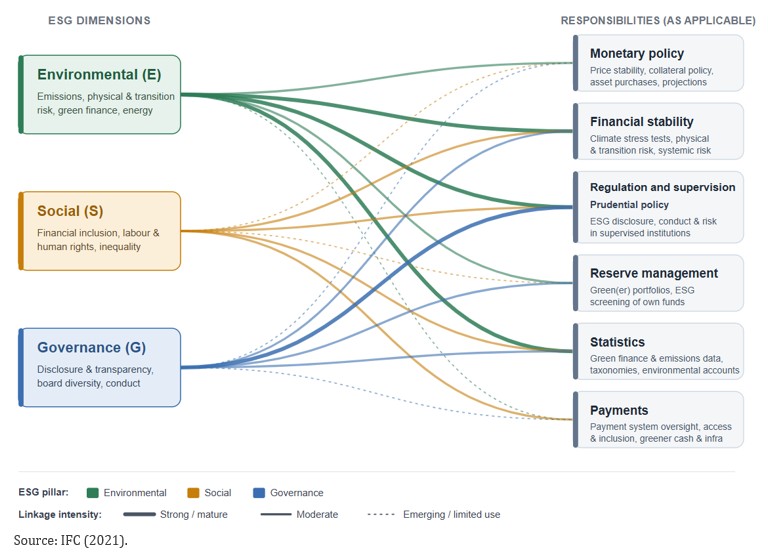
The supply of sustainable and, specifically, climate-related data to central banks has increased steadily in recent years. Advances include publicly disseminated ESG bonds’ categories and greater methodological harmonisation, for example in terms of classifications and definitions related to green finance (IFC (2025a)). This progress has clearly benefited from enhanced corporate disclosures, more precise emissions inventories, the development of integrated energy and environmental accounts as well as of novel techniques to integrate alternative data with official statistics for better evidence-based policy (Sirello and Tissot (2026)). It has also been spurred by central banks’ increasing demand for those indicators directly relevant for the assessment of the physical and transition risks posed by climate change (Figure 1).
Making further progress in addressing sustainability data gaps is key to better inform central bank policies, especially with a focus on four main quality priorities.
The first priority is that sustainable data have to be relevant and fit for policy use, for instance by focussing on producing the right data rather than merely collecting more. Prioritising quality over quantity reflects the importance to secure information that is meaningful and closely aligned with various users’ needs, including analytical, statistical, policy and prudential tasks. Operationally, there are various solutions to achieve this goal. One option is to clearly document the relationships between sustainability factors and economic and financial outcomes relevant for policy. Another one is to adequately balance granular sustainability information – which can reveal specific patterns at entity level – with more aggregated, higher-level insights – that can be easier to process and communicate. A third way is to balance additional sustainability data collections against associated reporting costs. There can be indeed value in focusing on a limited yet policy-relevant set of indicators rather than having an excessive volume of heterogeneous and noisy data, such as too detailed or complex ESG corporate reports which could lose their analytical relevance (Elgg et al (2025)).
A second priority is to make sustainability data more widely available and accessible, including ensuring adequate timeliness and granularity. Too often, sustainability information faces limitations, such as incomplete reporting, uneven coverage, inconsistent quality, limited timeliness and difficulties in combining data sources. One way to address these challenges could be to promote better sharing and governance, including through technical solutions, contractual agreements and legal frameworks to access and link granular data (IFC (2025b)). Another action is to develop comprehensive (meta)data inventories, for instance through collaborative platforms to crowdsource, integrate and curate databases provided by various stakeholders. A further possibility is to leverage innovation, including AI, to improve data accessibility and timeliness, for example to integrate novel and heterogeneous information sources and extract new insights in almost real-time (IFC (2025c)). Finally, and perhaps more importantly, addressing these challenges calls for significant improvement in the global statistical infrastructure, including in terms of adoption of common identifiers, information standardisation (including through the Standard for Data and Metadata; SDMx) and greater cooperation among stakeholders in the data ecosystem (IFC (2025d)).
The third aspect to prioritise is reliability of the information, which is essential for feeding decision-making with robust evidence and in a meaningful and trustworthy way. Reliability is particularly important in the area of sustainability given the tight interdependencies of scientific, policy and social considerations. Making sure that the information produced is accurate, objective, impartial as well as complete requires in practice rigorous validation procedures following scientific standards, for example to ensure that measurements are systematically grounded on solid evidence. It also demands transparent acknowledgement of both data and methodological limitations, accompanied by clear communication to users. Finally, it builds on data transparency efforts, not least to reduce the likelihood of having indicators based on opaque, unverified or unsubstantiated hypotheses or models which can potentially lead to mis- or even disinformation (OECD (2024a)). In fact, enforcing and monitoring transparency is key when dealing with ESG data, especially when they are self-reported, for example to ensure responsible business conduct and actionable assurance levels for auditing to prevent misleading behaviours such as greenwashing (de Freitas Netto et al (2020); OECD (2023, 2024b)).
Finally, because of their global nature, sustainability issues need to be addressed comprehensively, requiring comparable data across sectors and jurisdictions. The lack of harmonised definitions can prevent temporal and/or spatial comparability, thereby further constraining analytical value. Addressing these issues calls for greater support and coordination among national and international stakeholders, including non-governmental, academic and private actors. Fortunately, several global statistical initiatives are underway to improve the harmonised collection of sustainable statistics, including the G20 DGI, the newly updated statistical manuals (eg 2025 SNA), the revision of the System of Environmental Economic Accounting Central Framework (SEEA CF) and the ongoing intergovernmental process on “beyond GDP”. Central banks can play an active role, along with NSOs and international organisations, in spurring the development of high-quality sustainability data to better inform policies and the public at large.
Figure 1. Environmental aspects are particularly important ESG elements for central banks
Alfieri, A, L Holloway, U von Kalckreuth, S Moll, C Schmieder and B Tissot (2024): “Empowering carbon accounting: from data to action”, IFC Report, no 16.
Aurouet, D, A De Sanctis, D Giudice, J Franke, J Herzberg, M Osiewicz, R Peronaci and C Willeke (2023): “Indicators of granular exposures to climate-related physical risks for central banks’ analytical purposes”, in S Arslanalp, K Kostial and G Quirós-Romero (eds), Data for a greener world: a guide for practitioners and policymakers, IMF, Chapter 4.
Barnava, A, P Duijm, J Noels, C Schmieder, Ü Seven, Ö K Seyhun, O Sirello, B Tissot and E Triebskorn (2026): “The quest for policy-relevant sustainability data in central banking”, IFC Bulletin, no 68, September.
Bolton, P, M Després, L Pereira da Silva, F Samama, R Svartzman (2020): The green swan – central banking and financial stability in the age of climate change, BIS.
de Freitas Netto, S, M Falcão Sobral, A Bezerra Ribeiro and G da Luz Soares (2020): “Concepts and forms of greenwashing: a systematic review”, Environmental Sciences Europe, vol 32, no 19.
Elgg, D, T Park, O Sirello, B Tissot and J M Vidal Pastor (2025): “Leveraging corporate financial statements for policy insights”, IFC Bulletin, no 65.
Gardes-Landolfini, C, W Oman, J Fraser, M Montes de Oca Leon and B Yao (2024): “Embedded in nature: nature-related economic and financial risks and policy considerations”, IMF Staff Climate Notes, no 2024/002.
Irving Fisher Committee on Central Bank Statistics (IFC) (2021): “Sustainable finance data for central banks”, IFC Report, no 14.
——— (2025a): “Addressing climate change data needs: the global debate and central banks’ contribution”, IFC Bulletin, no 63.
——— (2025b): “Data science in central banking: enhancing the access to and sharing of data”, IFC Bulletin, no 64.
——— (2025c): “Governance and implementation of artificial intelligence in central banks”, IFC Report, no 18.
——— (2025d): “SDMX adoption and use of open source tools”, IFC Report, no 17, February.
MacFeely, S (2025): “GDP and beyond: dilemmas and heresies”, Journal of Official Statistics, vol 41, no 3.
Network for Greening the Financial System (NGFS) (2026a): Climate change and monetary policy strategy: a guide for central banks.
——— (2026b): Navigating nature-related data: metrics, sources and uses.
——— (2026c): Note on the economic and financial impacts of extreme weather events.
Organisation for Economic Co-operation and Development (OECD) (2023): OECD guidelines for multinational enterprises on responsible business conduct.
——— (2024a): Facts not fakes: tackling disinformation, strengthening information integrity.
——— (2024b): “OECD review on aligning finance with climate goals: assessing progress to net zero and preventing greenwashing”, Green Finance and Investment.
Sirello, O and B Tissot (2026): “Linking data for better evidence-based policy”, Data & Policy, vol 8, no e28.
Stiglitz, J, A Sen and J-P Fitoussi (2009): Report by the commission on the measurement of economic performance and social progress.
United Nations (UN) (2015): Transforming our world: the 2030 agenda for sustainable development, A/RES/70/1.
——— (2017): Work of the Statistical Commission pertaining to the 2030 Agenda for Sustainable Development, resolution adopted by the General Assembly, A/RES/71/313.
United Nations Economic Commission for Europe (UNECE) (2014): Conference of European Statisticians recommendations on climate change-related statistics, ECE/CES/STAT/2014/2.
——— (2025a): Data for climate action: how national statistical offices can contribute, ECE/CES/STAT/2024/4.
United Nations, European Commission, IMF, OECD and World Bank (2025): System of National Accounts, ST/ESA/STAT/SER.F/2/Rev.6.
United Nations Statistical Commission (UNSC) (2017): Cape Town action plan for sustainable development data.
World Commission on Environment and Development (WCED) (1987): Our common future (the Brundtland Report), UN Digital Library System.