

This policy note is based on Cîrjă, M.-V. and Romeu Granados, J. (2026), Transparency and Accountability as Drivers of Cultural Change: A Comparative Analysis of Central Banks and National Competent Authorities, Banco de España Occasional Paper No. 2617. The views expressed are those of the authors and do not necessarily reflect those of Banco de España or any other institutions with which the authors are affiliated.
Abstract
This policy note examines how central banks and financial supervisory authorities embed transparency and accountability beyond formal legal requirements. Drawing on 35 institutions—30 from the EU and five from non-EU countries — it finds that 29 of the 30 EU participants voluntarily disclose additional information, while only 37% of the institutions surveyed have independently evaluated their transparency practices. It also identifies differing understandings of accountability and challenges related to AI, misinformation and digital communication. Five non-EU case studies illustrate practices in legal accountability, financial literacy, citizen participation, independent evaluation and strategic planning. The note proposes a good-practice framework, the Governance, Accountability and Transparency Index (GATI), and six recommendations for the European System of Central Banks and the Single Supervisory Mechanism.
Central-bank independence is a fundamental feature of modern monetary and financial governance. It protects decision-making from short-term political pressures and supports the credibility of monetary and supervisory institutions. Yet independence does not mean freedom from scrutiny.
The greater the autonomy entrusted to an institution, the greater the importance of mechanisms through which it can explain and justify how that autonomy is exercised. Recent research has also sought to develop more comprehensive measures of de jure central-bank independence, reflecting the range of legal and institutional arrangements underpinning independent decision-making (Adrian et al., 2024).
Transparency and accountability should therefore not be regarded as constraints imposed on institutional independence. Rather, they form part of the governance framework within which independent powers are exercised, alongside the broader governance arrangements that support central banks’ legitimacy and effective performance (BIS Central Bank Governance Group, 2009; Oritani, 2010).
Transparency makes institutional actions and decisions visible and understandable. Accountability goes further: it requires institutions to explain and justify their actions and creates mechanisms through which those actions can be scrutinised, including judicial review (Goodhart and Lastra, 2018; Lastra, 1996).
The study therefore approaches transparency and accountability not simply as disclosure and reporting obligations, but as components of institutional governance and culture.
Figure 1. Independence, transparency and accountability
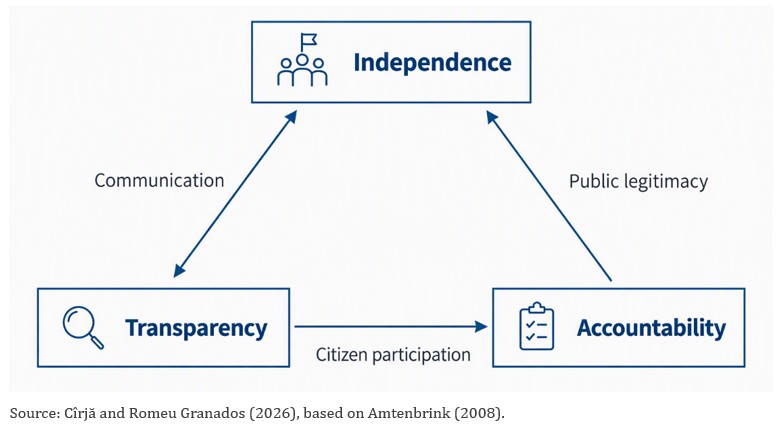
The relationship illustrated in Figure 1 is central to the study. Independence provides the autonomy necessary to perform public functions; transparency makes the exercise of institutional powers visible; and accountability creates mechanisms for explanation, scrutiny and justification.
The question is therefore not simply how much information an institution should publish. It is how transparency and accountability become embedded in the way an institution operates.
The study was designed as a cross-sectional institutional survey combining quantitative indicators with qualitative analysis. The empirical exercise comprised:
35 institutions · 30 EU institutions · 5 non-EU institutions · 46 questionnaire items
The EU group covered central banks within the ESCB and national competent authorities. The five non-EU institutions were selected to provide an external comparative perspective on emerging practices in central banking and financial supervision.
The unit of analysis was the institution, rather than individual staff members. The questionnaire comprised three broad modules covering the general transparency and accountability framework, transparency practices and organisational accountability. Unless otherwise indicated, percentages reported below refer to the institutions responding to the relevant question; the applicable denominator may therefore vary across items.
The 46 questionnaire items combined structured and qualitative elements. Closed-ended questions were used to establish whether practices or mechanisms existed, while open-ended questions gathered information on implementation, institutional context and challenges. Multiple-choice questions allowed institutions to identify several practices where appropriate. Targeted follow-up questions were used where clarification was required.
The methodology was deliberately practice-oriented. The objective was not to produce a ranking of institutions, but to identify how transparency and accountability are organised, which practices have become embedded, where significant variation remains and where institutional cooperation or common principles could add value.
Transparency and accountability operate within different national legal and institutional frameworks. The legal baseline remains essential because it establishes minimum obligations and protects rights of access, scrutiny and review.
At the same time, the comparative evidence suggests that legal requirements do not capture the full range of institutional practices.
At constitutional level, 83% of respondents reported that transparency and accountability were recognised primarily in an indirect or derivative manner, for example through access-to-information rights, parliamentary oversight, judicial review or independent oversight mechanisms.
A further distinction emerges when looking at evaluation. While transparency obligations are widespread, only 37% of institutions reported having conducted an independent evaluation of institutional transparency.
This suggests an important asymmetry: the institutional capacity to disclose information is more developed than the institutional capacity to systematically evaluate whether transparency works.
The distinction is significant, since a mature transparency framework should not only ask whether information has been published. It should also ask whether it is accessible, understandable, timely and useful, and whether institutions learn from experience.
Compliance is therefore necessary, but it is only the starting point for institutional transparency.
The evidence from EU institutions provides particularly strong support for the idea that transparency is becoming an institutional practice rather than merely a legal obligation. Of the 30 EU institutions participating in the study, 29 voluntarily publish information beyond their formal legal requirements. This additional information covers a broad range of areas, including governance and institutional information, analytical and statistical outputs, educational materials, sustainability information, stakeholder engagement and consolidated transparency portals.
The study also identified substantial variation in the types of information published. For example, 90% of institutions reported annual accounts as a required disclosure item, while procurement information was reported by 57%, remuneration information concerning governing bodies and senior management by 53%, and budget-management information by 40%.
Transparency is also increasingly prospective. 97% of institutions reported disclosure concerning some future activities or decisions, 80% disclosed their vision, strategic objectives or long-term priorities, and 93% published periodic reports on previous-year activities.
These figures suggest that transparency increasingly operates across the institutional cycle:
planning → decision-making → implementation → reporting → evaluation
The legal framework remains the baseline. But the scale of voluntary disclosure indicates that many institutions already regard transparency as part of good governance and institutional accountability.
The policy question therefore increasingly concerns how such practices can be structured, evaluated and continuously improved, rather than simply whether additional information should be disclosed.
The underlying study presents Banco de España as a good-practice example of how transparency can move from compliance towards institutional practice. Its dedicated Transparency Division supports transparency and access-to-information functions and contributes to the development of accountability-related work under the Bank’s Strategic Plan 2030, including institutional commitments, benchmarking, portal accessibility and citizen feedback. The example is therefore used not as a stand-alone model, but as an illustration of how voluntary transparency can become part of an ongoing governance function.
Transparency is traditionally associated with the availability and publication of information. In central banking, the literature has long emphasised the importance of communication for policy effectiveness and credibility (Blinder et al., 2008). The comparative evidence suggests, however, that transparency increasingly involves much more than the publication of documents.
Institutions communicate with highly differentiated audiences: financial markets, regulated entities, governments, parliaments, journalists, researchers, civil society and citizens. The study identifies a broader transparency ecosystem involving accessibility, audience adaptation, communication, financial literacy, participation and feedback.
The importance of prospective communication is particularly notable. The figures presented above — 97%, 80% and 93% — demonstrate that institutions increasingly communicate not only what they have done, but also what they intend to do and how they plan to pursue their mandates. This creates an important link between transparency and accountability. Publishing strategic objectives or future activities creates an ex ante basis against which subsequent institutional action can be assessed.
The study also identifies examples of good practice in financial education and stakeholder engagement. These practices can help institutions make complex decisions more understandable and create channels through which external perspectives can inform institutional communication. Transparency therefore increasingly becomes a two-way institutional function: providing information while also creating the conditions for understanding and engagement.
Figure 2. Key elements of transparency and accountability
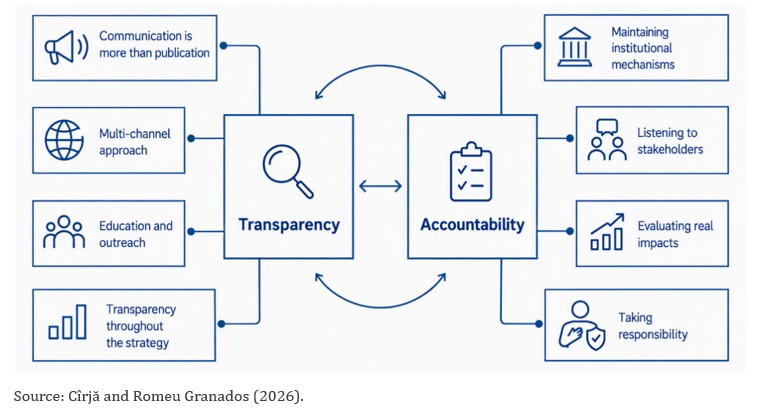
The survey responses reveal significant variation in how accountability is understood. Some institutions associate accountability primarily with judicial review and legal responsibility. Others adopt a broader conception encompassing explanation, justification, parliamentary scrutiny, audit, complaints, public engagement, reputational consequences and feedback. This broader conception is consistent with approaches that treat central-bank accountability as a multidimensional institutional relationship capable of being analysed and assessed (de Haan et al., 2012).
This conceptual variation matters because accountability is not simply another term for transparency. Transparency concerns information. Accountability concerns relationships. An institution is accountable when it is required to explain and justify its actions to a forum or audience capable of asking questions, assessing performance or requiring a response.
Figure 3. Accountability framework
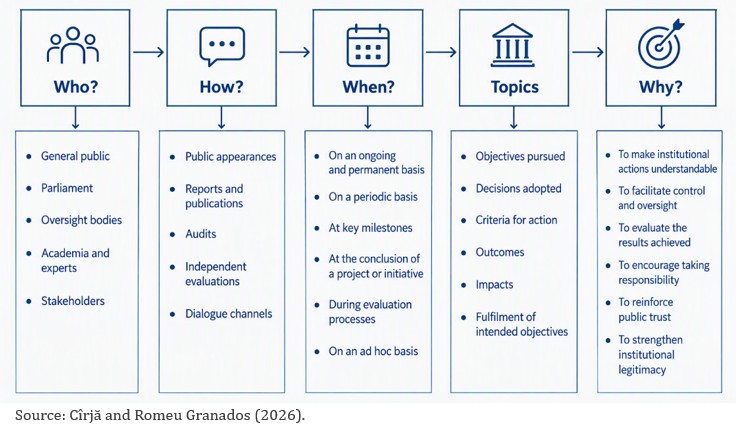
The framework developed in the study identifies procedural, substantive, legal, reputational and technological dimensions of accountability, together with evaluation. These dimensions demonstrate why accountability cannot be reduced to a single mechanism. Parliamentary scrutiny, judicial review, internal oversight, public communication, reputational effects and technological governance can all contribute to the broader accountability architecture.
The study therefore identifies the necessity of a functional definition of accountability tailored to independent central banks and supervisory authorities. Its purpose is not to replace national legal concepts or impose a uniform model, but to provide a shared conceptual anchor that can improve comparability and institutional design, particularly as expanding central-bank mandates raise new questions about democratic accountability and institutional independence (Lastra, 2024).
Digitalisation introduces a new layer of transparency and accountability challenges. The study examined both the use of artificial intelligence in institutional processes and the external communication environment in which institutions increasingly operate. Among institutions responding to the relevant AI questions, the three categories reported below account for 93% of responses; the remaining 7% corresponds to responses not captured by those categories:
• 53% reported that AI was not used in ways influencing decision-making;
• 23% reported AI use with public disclosure; and
• 17% reported AI use without public disclosure.
These figures do not imply that AI systems independently make institutional decisions. In most cases, AI was described as a support tool for activities such as data processing, monitoring, predictive analysis, screening, triage or communication.
Nevertheless, support tools may influence prioritisation, risk assessment or the information presented to decision-makers.
Figure 4. Transparency and accountability in the digital environment
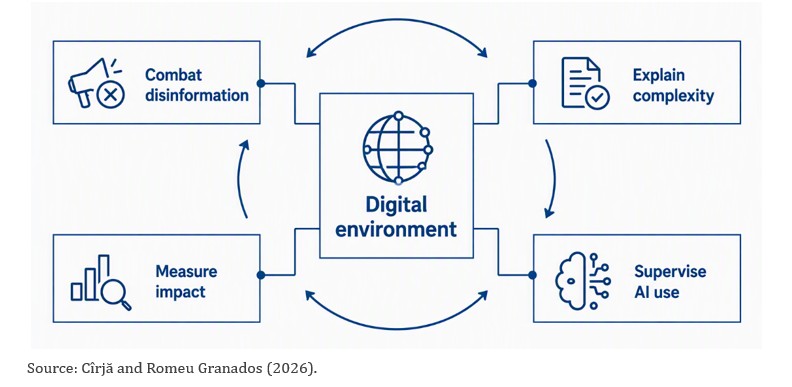
This creates a new accountability question: not simply who took the final decision?, but also how did technological systems influence the information and reasoning underlying that decision?
The digital environment also creates external risks. Institutions increasingly face misinformation, impersonation and deepfakes that can affect public trust even when the underlying institutional decision-making is sound.
The study therefore treats digitalisation as both a communication challenge and a governance challenge.
The study complemented the 30 EU institutions with five non-EU case studies: Canada, Chile, Colombia, Moldova and the United Kingdom. These cases were not intended to create a second statistical sample. Instead, they were selected to identify practices that could provide useful external reference points around five themes: accountability as a legal institution, financial literacy, citizen participation, independent evaluation and strategic planning.
Colombia illustrates how accountability can be transformed into a legal institution. Article 48 of Statutory Law 1757 of 2015 on the Promotion and Protection of the Right to Democratic Participation defines accountability (rendición de cuentas) as a process through which public entities and public servants inform, explain and account for their management and results to citizens, civil society, other public entities and oversight bodies (Congress of Colombia, 2015). Its framework combines information, explanation, public disclosure and dialogue. For the Banco de la República, this includes twice-yearly reporting to Congress, public presentation of the Monetary Policy Report and stakeholder engagement. The case provides a concrete example of how accountability can acquire legal and operational substance without eliminating institutional independence.
Chile illustrates the development of financial literacy as a structured institutional function. Its “Central en tu Vida” programme combines national competitions, financial-education Olympiads, teacher training, guided visits and international seminars, supported by educational materials and digital tools (Banco Central de Chile, n.d.). This demonstrates how financial literacy can extend the reach of institutional transparency by making economic concepts and central-bank functions more accessible.
The United Kingdom provides examples of structured citizen participation. The Bank of England’s Youth Voice, Citizens’ Forum and Community Forum initiatives create direct channels between the institution and different segments of society. Community Forum meetings typically involve eight to ten organisations and a senior Bank official, while anonymised summaries of Citizens’ Forum events are subsequently produced to help close the feedback loop (Bank of England, n.d.).
Moldova demonstrates the potential of independent evaluation to generate institutional change. The National Bank of Moldova’s IMF Central Bank Transparency Code review involved approximately 20 business units and produced an Action Plan containing 59 actions, of which 37 had been implemented at the time covered by the study (International Monetary Fund, 2025). The case illustrates how evaluation becomes more consequential when linked to assigned responsibilities, measurable actions and follow-up.
Canada illustrates the role of strategic planning as an accountability instrument. Its 2025–27 strategic plan sets objectives, priorities and measurable success criteria (Bank of Canada, 2025), while its Digital First strategy links digital transformation with internal governance and organisational responsibility (Bank of Canada, 2020). The case demonstrates how prospective commitments can create a basis for subsequent evaluation.
Taken together, these cases show that institutional learning can be embedded through legal definition, financial education, participation, independent evaluation and strategic planning. Their value for EU institutions lies not in providing models to be copied, but in demonstrating adaptable practices linked to recurring routines, assigned responsibilities, follow-up and learning. This comparative evidence supports the broader conclusion that transparency and accountability mature when institutions organise information, explain decisions, create channels for response and evaluate whether those arrangements improve understanding, trust and legitimacy.
One of the objectives of the study was not simply to map differences between institutions, but to identify practices that could help central banks and supervisory authorities strengthen their own transparency, accountability and governance arrangements. The study therefore develops a framework of good practices based on the comparative evidence gathered from the 35 institutions.
The framework does not establish a ranking or prescribe a single institutional model. Its purpose is to provide a structured set of practices that institutions can consider and adapt to their own legal mandates, governance structures and institutional cultures.
The practices identified cover the principal dimensions examined in the study, including:
The comparative exercise shows that good practices can exist at different levels of institutional maturity.
Some practices correspond to the legal baseline. Others represent voluntary initiatives extending beyond formal obligations. More advanced practices integrate transparency and accountability into strategic planning, organisational responsibilities, evaluation and institutional learning.
The framework therefore provides a bridge between comparative evidence and institutional change.
It can help institutions identify existing strengths, recognise gaps and consider which practices may be adapted to their own institutional environment.
The international cases reinforce this point by illustrating complementary routes from broad principles to operational practice: legal accountability, financial literacy, citizen engagement, independent evaluation and strategic planning.
The objective is not harmonisation for its own sake. It is to facilitate institutional learning through the identification and adaptation of practices that have proved useful in different contexts.
Identifying good practices is only one part of strengthening institutional governance. A second question is how institutions can assess their existing arrangements and identify areas for further development. To address this question, the study proposes the Governance, Accountability and Transparency Index (GATI).
GATI translates the comparative framework developed through the study into an analytical and evaluation tool that can support:
Its purpose is not primarily to produce a numerical ranking of central banks or supervisory authorities. Rather, GATI provides a structured basis for asking:
Where are we now? What practices are already established? Where are the gaps? What could be developed further?
The framework brings together the principal dimensions identified through the study and assesses institutional arrangements according to different levels of maturity. The architecture gives particular weight to dimensions such as the Communication Ecosystem (25%) and Citizen Participation (20%), reflecting the study’s broader conception of transparency and accountability.
Figure 5. Pillar architecture and weighting of GATI
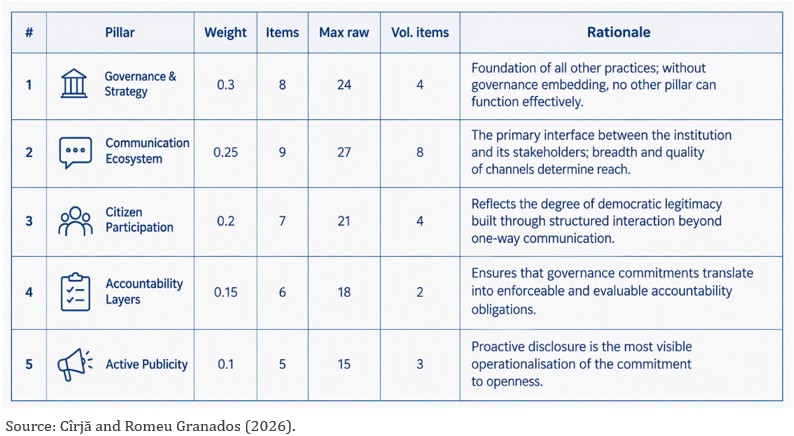
GATI complements the framework of good practices in a straightforward way. The framework identifies what institutions can do; GATI provides a mechanism for assessing where institutions stand and how they can improve.
Applied over time, GATI could facilitate structured self-assessment across the ESCB and SSM and provide a common basis for institutional learning.
The tool could also support future academic and institutional research. The study proposes that GATI could eventually be examined alongside variables such as central-bank independence, regulatory quality, public trust, legitimacy, inflation, GDP per capita and financial stability.
This would allow future research to move beyond descriptive comparisons and examine whether and how transparency, accountability and governance arrangements are associated with broader institutional performance.
The comparative findings provide the basis for six practical recommendations.
The study involved 35 institutions, requiring cooperation from contacts working across legal services, communication departments, general secretariats, international relations and other functions.
The exercise nevertheless revealed the absence, in some cases, of formally appointed transparency and accountability contacts and of a structured network dedicated specifically to these issues.
The ESCB could therefore establish either an Institutional Transparency and Accountability Committee, with extended SSM participation, or a more flexible network-based structure drawing on existing Eurosystem/ESCB examples. The choice should reflect the desired degree of formality, while ensuring continuity and clear ownership.
The objective would be to provide a structured forum for exchanging information and practices, developing internal expertise, supporting thematic working groups and facilitating joint initiatives.
The finding that 29 of 30 EU institutions voluntarily go beyond their formal legal transparency requirements provides favourable conditions for a more structured framework. The study therefore recommends the creation of an ESCB Framework on Transparency and Accountability, potentially through an ESCB Code on Transparency and Accountability.
The framework could establish:
It should preserve flexibility for institutions to adapt implementation to their respective legal and institutional contexts. The objective would not be to create a uniform communications policy or a single accountability model, but to establish a common reference framework for institutional learning and improvement.
The survey identified significant variation in how accountability is understood. The ESCB should adopt a functional definition of accountability tailored to independent central banks and supervisory authorities, clearly distinguishing accountability from legal liability. The definition should recognise the dimensions identified in the study:
procedural · substantive · legal · reputational · technological · evaluation
It should be embedded in the framework proposed under Recommendation 2. The purpose would not be to replace national legal concepts, but to provide a common conceptual anchor that improves comparability, supports internalisation and facilitates institutional design.
The 53% / 23% / 17% distribution concerning AI use and disclosure points to an emerging and varied governance landscape. Combined with the capacity of AI support tools to influence prioritisation, risk assessment and the information presented to decision-makers, this variation supports the development of common minimum principles for AI transparency and accountability, proportionate to the use case and associated risks.
At a minimum, institutions should maintain:
For higher-impact applications, the framework should encourage proportionate assurance mechanisms, including model review and, where appropriate, AI-specific audit practices. The objective is to ensure that the use of technology does not dilute institutional responsibility.
The study found that institutions monitor and respond to misinformation, fraud schemes, impersonation and deepfakes, but that practices vary in intensity, thresholds and internal governance. The ESCB should treat this area as part of institutional trust protection.
This would not require a uniform communications policy. Instead, it would provide institutions with a common minimum architecture for responding rapidly and consistently to high-risk incidents affecting institutional trust and consumer protection.
The Governance, Accountability and Transparency Index (GATI) developed in the study should be further developed for use across the ESCB and SSM as a maturity-oriented tool for self-assessment, institutional learning and continuous improvement.
Its maturity-oriented approach means that the tool can distinguish between formal compliance, established practices and more advanced forms of institutionalisation.
Over time, GATI could support maturity-based classifications and, subject to appropriate methodological safeguards, broader comparative research.
It could also provide a foundation for examining relationships between transparency, accountability and variables such as independence, regulatory quality, public trust, legitimacy and institutional performance.
GATI should therefore be understood not as an end in itself, but as an instrument through which institutions can evaluate their current arrangements and identify pathways for improvement.
The study started from a relatively simple question: how do independent central banks and supervisory authorities translate transparency and accountability from formal principles into institutional practice?
The evidence from 35 institutions suggests that the answer cannot be reduced to legal compliance.
The finding that 29 of 30 EU institutions voluntarily publish information beyond their formal legal requirements illustrates the extent to which transparency has already moved beyond the legal minimum.
At the same time, the fact that only 37% reported having conducted an independent evaluation of institutional transparency indicates that institutionalisation is incomplete. Institutions have developed extensive mechanisms for providing information, but systematic assessment of their effectiveness remains less widespread.
The study therefore points towards a broader understanding of transparency and accountability as components of institutional governance and culture.
The framework of good practices and GATI represent two complementary outputs of this approach. The first identifies practices that institutions can consider and adapt. The second provides an analytical and evaluation tool through which institutions can assess their arrangements and support continuous learning.
The international cases demonstrate that institutional innovation can take different forms, but also that good practices can travel across institutional boundaries when adapted to different legal and organisational environments.
The central message is therefore not that independent institutions should simply disclose more information. It is that they should develop governance arrangements that make their actions understandable, explainable, reviewable and capable of improvement.
The trajectory identified by the study can be expressed as:
Compliance → Voluntary adoption → Institutionalisation → Evaluation and learning
This is how transparency and accountability can become embedded in institutional culture.
Adrian, T., Khan, A. and Menand, L. (2024), “A New Measure of Central Bank Independence,” IMF Working Paper No. 24/35, International Monetary Fund.
Amtenbrink, F. (2008), “Chapter 6 The Three Pillars of Central Bank Governance: Toward a Model Central Bank Law or a Code of Good Governance?”, in Current Developments in Monetary and Financial Law, Vol. 4, USA: International Monetary Fund. https://www.elibrary.imf.org/display/book/9781589065079/ch006.xml
BIS Central Bank Governance Group (2009), Issues in the Governance of Central Banks, Bank for International Settlements.
Blinder, A. S., Ehrmann, M., Fratzscher, M., de Haan, J. and Jansen, D.-J. (2008), “Central Bank Communication and Monetary Policy: A Survey of Theory and Evidence,” Journal of Economic Literature, 46(4), pp. 910–945.
Cîrjă, M.-V. and Romeu Granados, J. (2026), Transparency and Accountability as Drivers of Cultural Change: A Comparative Analysis of Central Banks and National Competent Authorities, Banco de España Occasional Paper No. 2617. https://www.bde.es/wbe/es/publicaciones/analisis-economico-investigacion/documentos-ocasionales/transparency-and-accountability-as-drivers-of-cultural-change-a-comparative-analysis-of-central-banks-and-national-competent-authorities.html
de Haan, J., Amtenbrink, F. and Eijffinger, S. C. W. (2012), “Accountability of Central Banks: Aspects and Quantification,” PSL Quarterly Review, 65(261).
Goodhart, C. A. E. and Lastra, R. M. (2018), “Central Bank Accountability and Judicial Review,” SUERF Policy Note, No. 32.
Lastra, R. M. (1996), Central Banking and Banking Regulation, Financial Markets Group, London School of Economics.
Lastra, R. M. (2024), “Mission Creep, Democratic Accountability and Central Bank Independence,” SUERF Policy Note, No. 351.
Bank of Canada (2020), Digital First: A Central Bank for a Digital Canada, digital transformation strategy.
Bank of Canada (2025), Canadians Count on Us: The Bank of Canada’s 2025–27 Strategic Plan. https://www.bankofcanada.ca/about/governance-documents/the-bank-of-canadas2025-27-strategic-plan/
Bank of England (n.d.), Get Involved: Citizens’ Forum, Community Forum and Youth Voice.
Congress of Colombia (2015), Statutory Law 1757 of 2015 on the Promotion and Protection of the Right to Democratic Participation, art. 48.
International Monetary Fund, Monetary and Capital Markets Department (2025), Republic of Moldova: Central Bank Transparency Code Review, IMF Staff Country Report No. 2025/084. https://doi.org/10.5089/9798229007382.002
Banco Central de Chile (n.d.), Central en tu Vida. https://www.centralentuvida.cl/banco-central
Oritani, Y. (2010), Public Governance of Central Banks: An Approach from New Institutional Economics, BIS Working Paper No. 299.