

The views expressed in this publication are those of the authors and do not necessarily reflect the views of the BIS, its member central banks or the Basel-based standard-setting bodies. The authors are grateful to Jonathan Beissinger and Ludovica De Paola for their contribution to the analysis, to Rodrigo Coelho and Ruth Walters for their helpful comments and to Claire Rowley for administrative support.
Abstract
We compare the fully phased in implementation of the final Basel III reforms in the European Union (EU) with a counterfactual application of the March 2026 proposed banking rules in the United States (US) to the seven EU global systemically important banks (G-SIBs). Using public end-2025 disclosures, we assess differences in prudential and resolution requirements arising from capital ratios, risk-weighted asset (RWA) methodologies, leverage constraints and loss-absorbing capacity requirements. The proposed US framework would generally lower capital ratio requirements but materially increase RWA by restricting the use of internal models for credit risk. This restriction on internal models more than offsets the absence of the Basel III output floor in the US proposed rules. Overall, we estimate that on average, nominal prudential and resolution requirements for EU G-SIBs would be higher under US rules than under EU rules, although effects vary across banks.
The Basel III reforms, developed as a response to the Great Financial Crisis, set global prudential standards for internationally active banks; as a minimum standard, the goal of Basel III is to support global financial stability and a level playing field for internationally active banks.
The final Basel III framework, issued in 2017, addresses concerns about excessive variability and insufficient comparability in model-based risk weighted assets (RWA) through several complementary measures. In particular, the new framework enhances the standardised approaches for credit risk, operational risk and credit valuation adjustment (CVA) risk, introduces a buffer for the leverage ratio requirements for global systemically important banks (G-SIBs) and establishes an output floor, which limits the extent to which a bank’s internally modelled RWA can fall below those calculated under standardised approaches.1
When implementing Basel III, jurisdictions can choose to set stricter rules above the minimum requirements (known as Pillar 1), for example with more conservative calibrations or with additional requirements. Moreover, the framework also includes additional provisions (known as Pillar 2) which enable authorities to set additional constraints or add-ons based on their own supervisory findings.
This flexibility, while legitimate, has resulted in material differences in both the level and composition of capital requirements across jurisdictions which have implemented Basel III.2 These differences have fuelled perceptions of an uneven playing field, prompting debate about bank competitiveness across jurisdictions and affecting the implementation of the final Basel III standards in some jurisdictions.3 In particular, recent reforms and proposals in the United States (US) are expected to reduce overall capital requirements and contain deviations from the Basel standards, including the decision to exclude the output floor, a key element of the Basel III reforms. In the European Union (EU), the European Commission plans to revise the EU regulatory framework, which implemented the final Basel III standards in 2025, to strike a new balance between the financial stability and competitiveness objectives, also on account of relevant developments in other jurisdictions.4
The real impact of regulation on the competitiveness of different banking sectors could be questioned as other factors including business models, structure of the relevant market, size, and cost-efficiency can often play a more relevant role. In any case, the cross jurisdictional comparisons of capital requirements is a rather complex task. This is so for at least three reasons:
Therefore, any policy-meaningful analysis on the stringency of capital requirements across jurisdictions must take those factors into account to the extent possible.
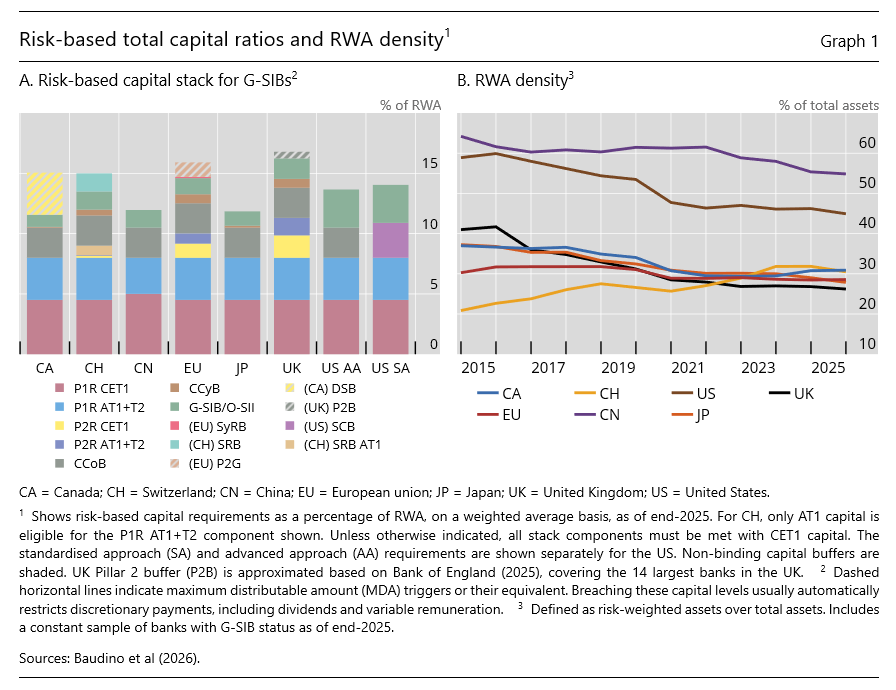
Against that framework, this note contributes to this debate by comparing the capital requirements for EU banks as of end-2025 with a simulated application of the proposed rules in the US to the same banks. As available information does not permit a full application of all relevant US rules to all EU banks, the analysis focuses on what would be the impact on EU G-SIBs of the new minimum capital ratios and the new treatment of internal models (including the non application of the output floor) resulting from the proposed US reforms.7
The US applies a tailored approach to banking regulation, with four distinct categories for large banking organisations. The Basel III framework only applies to the largest, most internationally active banking organisations designated as Category I and II, which include the eight US G SIBs and one additional bank as of end-2025.8 For those banks, US authorities have also introduced in the past supplementary or more conservative requirements (gold-plating) than those prescribed in Pillar 1 of Basel III. They affect risk weights, the treatment of internal models, the minimum leverage ratios and the buffers for G-SIBs. The remaining mid-to-large institutions, designated as Category III and IV, are subject to simpler capital rules.9
Recently, US regulators have taken policy action and proposed revisions to banks’ capital requirements. For Category I and II banks, these measures can be grouped into three categories:10
Reduce or remove requirements beyond Basel III minima: these include revisions to:
Reduce the Stress Capital Buffer (Pillar 2 requirements)
Implement final Basel III standards while introducing deviations from minima
Under the US proposals, Category III and IV banks would instead be subject to a revised standardised approach, which is expected to materially reduce their capital requirements.17
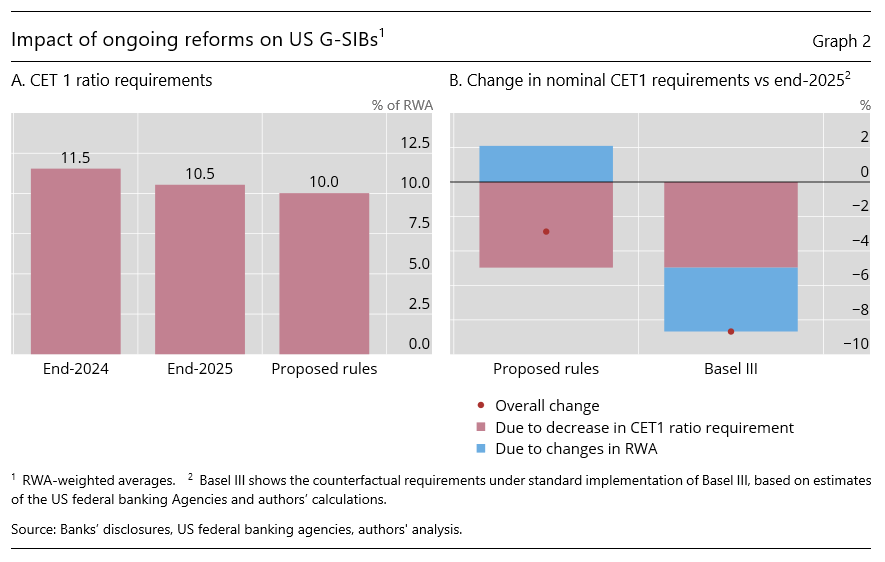
The recent and ongoing reforms reduce capital requirements for US G-SIBs: the average CET1 ratio requirement decreased from 11.5% to 10.5% between end-2024 and end 2025, and it is expected to decrease further to approximately 10% under the proposed rules (Graph 2.A). This is primarily driven by reduced gold-plating of the G SIB add-on and the lower calibration of the Pillar 2 requirements under the SCB. In other words, the reduction in capital requirements is primarily attributable to the easing of jurisdiction-specific requirements previously imposed in addition to the minimum Pillar 1 requirements under Basel III.
In contrast, the US federal banking agencies estimate that aggregate G-SIB RWA under the US ERBA would increase by 2.2% compared to the current US rules. They also estimate that the proposed removal of internal models for credit risk more than compensates for the lack of the output floor and the other downward deviations included in the US ERBA, producing RWA for US G SIBs that are, in aggregate, more than 6% higher than under the standard Basel III framework.18
Altogether, nominal CET1 capital requirements for US G-SIBs would be cut on average by 3% against end 2025 requirements, but they would still be above those corresponding to the minimum Basel III standards, since both the minimum capital ratio requirements and the RWA are above the Basel III minima (Graph 2.B). At the same time, the proposed deviations imply lower requirements for certain categories of exposures. In particular, the proposed changes to the market risk framework may lead to competitive distortions in the trading activity conducted by internationally active banks.
This section estimates what capital requirements the seven EU G-SIBs would face if they were subject to the proposed US rules rather than the fully phased-in EU rules. The analysis uses public end-2025 Pillar 3 disclosures and assumes unchanged balance sheets.
The counterfactual analysis is intended to provide an informative comparison, rather than to predict the effects of regulatory reforms. Banks would likely adjust their portfolios, funding structures, internal risk-management practices and capital-management policies if they were subject to a different regulatory framework. Moreover, public disclosures do not permit a full replication of supervisory calculations or every jurisdiction specific feature of the EU and US regimes. Therefore, the analysis focuses on differences in nominal requirements derived from differences in capital ratio requirements and the combined impact on RWA of the prohibition of internal models to calculate credit risk and the removal of the output floor.19
The EU implemented the final Basel III reforms through the Capital Requirements Regulation III (CRR3), applicable from January 2025. The output floor is being phased in gradually, from 50% in 2025 to 72.5% from 2030, and with some temporary adjustments to limit its impact during the transition.20 While the output floor was not binding for any of the EU G-SIBs as of end-2025, it is expected to bite for several after the phase-in period under static balance-sheet assumptions. Moreover, the revisions to the calculation of RWA for market risk have been postponed to January 2027. The EU rules also contain some deviations from the Basel standards, primarily grandfathered from the first implementation of Basel III in 2013.21
To calculate the baseline EU requirements, we calibrate the output floor to its final level and remove the transitional adjustments to its calculation. On average, the RWA of EU G-SIBs under fully phased-in EU rules would increase by 12.8% relative to the transitional requirements at end-2025; nominal requirements increase in line with RWA since capital ratio requirements remain unchanged (CET1 ratio requirements stood at 10.35% at end-2025, complemented by 1.2% of non binding Pillar 2 Guidance).22
One limitation of using Pillar 3 disclosures is that they do not yet reflect the revised rules for market risk, which will come into force only in 2027, and which may materially increase market risk RWA. However, the impact of differences in market risk rules on total RWA would be limited, since market risk RWA made up less than 4% of EU G SIBs’ total RWA at end-2025.23
The counterfactual application of proposed US rules involves three broad steps. First, RWA are recalculated using the proposed US approach to risk measurement by removing the output floor requirement but replacing internally modelled RWA with standardised RWA for all exposures except market risk.
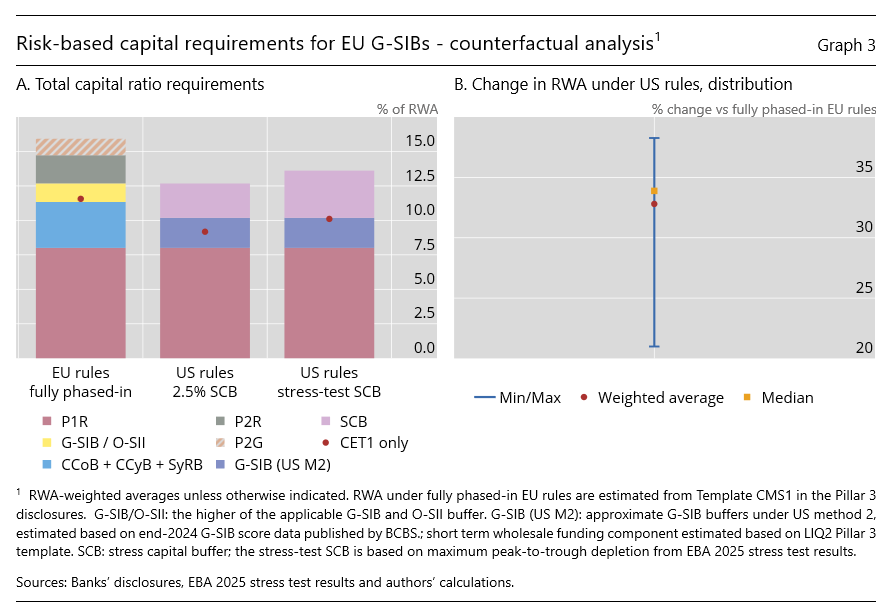
Second, capital buffers, Pillar 2 requirements and Pillar 2 guidance are replaced with the relevant components of the US capital stack under US ERBA (Graph 3.A). This includes an estimated US G-SIB surcharge under the revised Method 2, which replaces the European surcharges for systemically important institutions,24 and raises the average surcharge from 1.3% to 2%;25 and a Stress Capital Buffer which, by being floored at 2.5%, embeds the Capital Conservation Buffer.
Because EU G-SIBs are not subject to the US stress test, two alternative SCB assumptions are considered:
The two assumptions provide useful lower and higher reference points for the SCB, but neither is a perfect proxy for the US stress-test process. While the stress-test SCB approach is aligned with the way the SCB is set in the US, a closer proxy would recalculate each bank’s stressed CET1 path and RWA under the counterfactual US ERBA framework, using the US stress test methodology and scenario, which is not possible using public data. In practice, SCB for US banks are on average relatively close to the 2.5% SCB floor (2.9 percentage points (pp) at end-2025), while the estimated SCB for EU banks is 3.4 pp on average. Moreover, the countercyclical capital buffer, which has never been activated in the US since its implementation, is set to zero for all EU G-SIBs under the counterfactual exercise.
Third, the recalculated RWA are multiplied by the US-based capital ratio requirements to obtain nominal risk-based requirements. An equivalent approach is used to determine nominal leverage ratio requirements. The higher of the two requirements is then selected when comparing overall nominal Tier 1 and total capital requirements under EU and US rules.27
The counterfactual US rules produce lower average capital ratio requirements for the EU G-SIB sample, despite materially higher G-SIB surcharges under the US method (Graph 3.A). The estimated US CET1 ratio requirement is between 9.2% and 10.1% depending on the SCB approach used, compared to the 11.5% average requirement and guidance under EU rules.
The lower ratio requirements are accompanied by substantially higher estimated RWA, which are approximately 33% higher on average under the US ERBA approach than under fully phased-in EU rules. Under our assumptions, removing internal models for credit risk RWA more than compensates for the lack of the output floor for all EU G-SIBs (Graph 3.B). This result is consistent with the US authorities’ own assessment for US G-SIBs that the RWA under the ERBA would be higher on average than RWA under the Basel III floor. At the same time, our analysis does not account for the other deviations from the Basel III framework described in Section 2 which, cumulatively, may affect the distance between the US and the EU approaches.
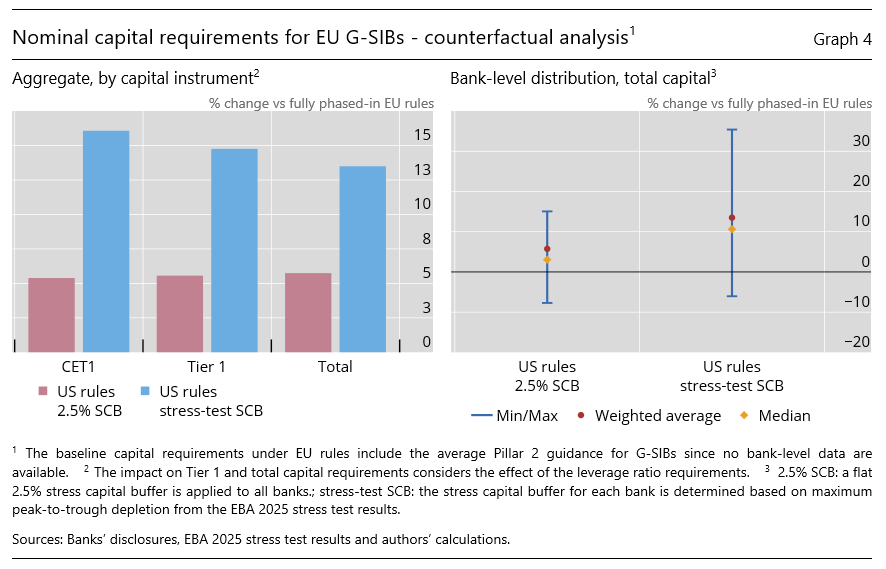
The combined effect of lower ratio requirements and higher RWA is generally higher nominal capital requirements under the US counterfactual. On average, nominal CET1 requirements for EU G-SIBs would be between 5% and 16% higher than under fully phased-in EU rules, depending on the approach used for determining the SCB. When considering Tier 1 or total capital requirements, the distance reduces somewhat, on account of additional EU Pillar 2 requirements that can be met with AT1 and Tier 2 capital (Graph 4.A).
The results are heterogeneous across banks, and are affected by a number of factors, including each bank’s distance between (i) modelled RWA and fully standardised RWA, (ii) existing Pillar 2 requirements and guidance and estimated SCB under US rules, and (iii) current G-SIB/O-SII requirements and G SIB surcharge under the US method. Under the 2.5% approach for the SCB, three banks could face similar or lower requirements under US rules. For those banks, the effective removal of Pillar 2 charges compensates a relatively modest increase in RWA between the fully phased-in output floor and the removal of credit risk; additionally, two of those banks benefit from a US G-SIB surcharge which is lower than their O-SII surcharges (which exceeds their G-SIB surcharge under EU rules). For the other banks, the increase in RWA under US ERBA more than offsets the overall decrease in capital ratio requirements. We observe a similar ranking when considering the US rules with the SCB based on the EBA stress test results, even though the increase in requirements is significantly higher for some banks (Graph 4.B).
In addition to the prudential capital requirements discussed in the previous section, banks may also be subject to resolution requirements. All G-SIBs face total loss-absorbing capacity (TLAC) requirements, to be met with equity and eligible debt. In the EU, banks are also subject to minimum requirements for own funds and eligible liabilities (MREL), which are more stringent than the TLAC requirements in scope and calibration. Approximately 150 banks in the banking union and 300 banks in the EU are subject to MREL requirements.28 While resolution requirements for non G SIBs are not a unique feature of the EU framework (the UK has similar requirements) there is no directly comparable requirement for non-G-SIBs in the US.
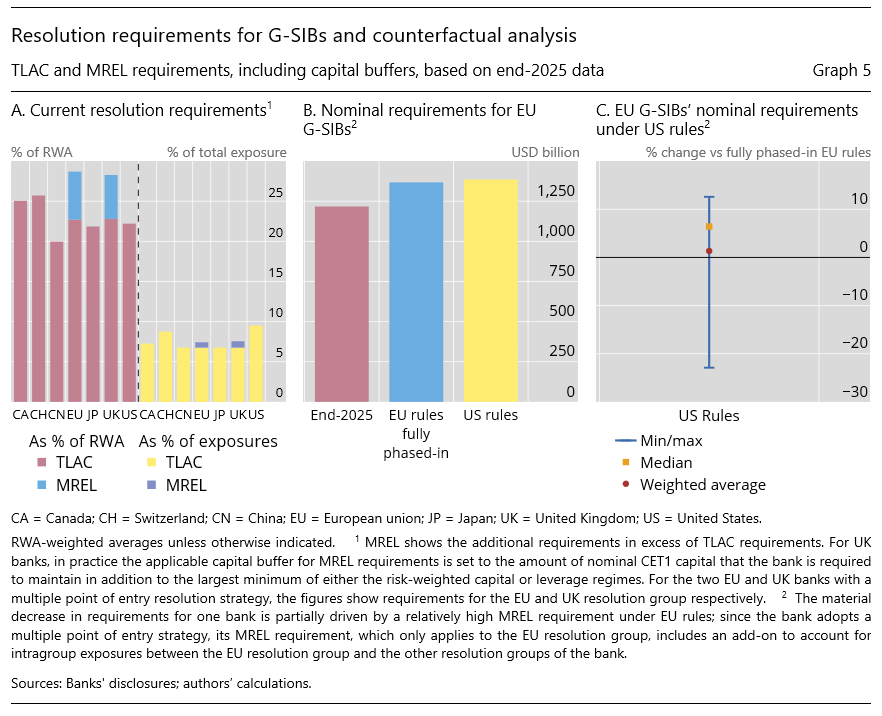
Both TLAC and MREL requirements are expressed as ratios of RWA and total exposure measure.29 Available evidence suggests that RWA-based loss-absorbing capacity requirements are, on average, calibrated higher for EU G-SIBs, partly reflecting MREL requirements above the global TLAC minimum; while total exposure-based requirements are on average higher for US G-SIBs (Graph 5.A). Cross-jurisdictional comparisons between MREL and TLAC requirements should nonetheless be interpreted with caution. MREL and TLAC differ in the range of eligible instruments, their application to groups and subsidiaries, and the role of internal versus external loss-absorbing capacity. Moreover, as for prudential requirements, differences in the measurement of RWA can materially affect nominal requirements, making cross jurisdictional comparisons based only on headline ratios potentially incomplete.
To compare nominal resolution requirements under the EU and the US regimes, we run a counterfactual analysis as done for the prudential requirements in the previous section, using the same assumptions for the derivation of RWA and capital buffers. Moving from end-2025 requirements to fully phased-in EU rules would increase nominal TLAC/MREL requirements of EU G-SIBs by 12% on average, driven by higher RWA resulting from the full application of the output floor (Graph 5.B).
To produce counterfactual figures under US rules, we apply the estimated RWA under ERBA, remove the MREL requirements, and align the TLAC ratio requirements to the US framework.30 This results in an average increase in nominal resolution requirements of around 1.3% relative to fully phased-in EU rules, driven by the higher RWA under US ERBA, which are partially compensated by the removal of the MREL requirements (Graph 5.B).
The effects vary across banks (Graph 5.C). Most EU G-SIBs would see an increase in nominal resolution requirements under US rules, while two banks would face lower requirements. For both banks the lower applicable ratios under US resolution rules outweigh the RWA effect, which is more modest than for other EU G-SIBs. One of the two banks would particularly benefit from the US framework since it currently receives a relatively high MREL requirement compared to the other EU G-SIBs, due in part to its multiple point of entry resolution strategy.31
Revising the current regulatory framework in the EU to improve its efficiency, reduce complexity and unnecessary regulatory burden and facilitate financial integration among member states is a highly relevant objective. Yet, the current debate on bank competitiveness should be based on sound data and analysis, particularly when considering the comparison of regulatory requirements across jurisdictions. Minimum regulatory capital ratios are informative, but they are not sufficient. The amount of capital a bank must hold depends on the interaction between regulatory ratios, RWA methodologies, leverage requirements and resolution requirements.
The evidence provided in this paper does not support the view that the largest EU banks face a general competitive disadvantage relative to US banks because of significantly more stringent capital requirements, even when the proposed US reforms are taken into account. For the seven EU G SIBs, the illustrative counterfactual exercise finds that the proposed US rules would, on average, lower prudential and resolution ratio requirements but materially increase RWA. More specifically, the proposed US restriction on internal models for credit risk appears significantly more restrictive than the Basel III output floor and therefore implies higher RWA. This largely explains why, under the assumptions used, nominal capital requirements for EU G-SIBs would, on average, be higher under the proposed US approach than under fully phased-in EU rules. The results are, however, heterogeneous across banks.
That said, regulation can lead to competitive distortions even when they do not imply substantially different capital requirements in aggregate. For example, the proposed material deviations for the market risk rules in the US may generate competitive distortions for internationally active institutions that compete in capital markets and trading businesses and can have material consequences for individual banks or activities even where their aggregate effect on total RWA is limited. Potential deficiencies in the market risk rules should be addressed in a coordinated way in international fora, to avoid a race to the bottom and regulatory fragmentation.
Finally, the results for EU G-SIBs should not be generalised to the broader banking sector. Recent analysis by the ECB finds that the comparison between EU and US requirements differs substantially across categories of banks, and that while the current US framework can imply higher requirements for the largest EU banks, it tends to result in lower requirements for medium-sized and smaller EU banks.32 The proposed US reforms for Category III and IV banks, which are expected to materially reduce capital requirements, may widen the difference between the requirements faced by those banks and comparable institutions in the EU. This provides support for extending the analyses in this paper for a larger sample of banks in different jurisdictions. Such analysis should also consider differences in loss absorbing requirements in resolution across jurisdictions.
Basel Committee on Banking Supervision (2017): Basel III: Finalising post-crisis reforms, December.
Baudino, P, J Beissinger, R Corrias, M Drehmann, E Eren, B Erik and N Tarashev (2026): “On the comparison of capital requirements for global systemically important banks”, FSI Insights on policy implementation, no 76, July.
Beissinger, J, R Coelho and R Zamil (2026): “Simple, resilient and proportional: revisiting regulation for small banks”, FSI Insights on policy implementation, no 78, September.
Benhamed, R (2024): “Resolution of banking crises: what are the loss absorbency requirements in Europe and the United States?”, Bulletin de la Banque de France, May-June.
Chatterjee, J (2026): “Calm Waters, Rising Tide | FRTB and Capital Pressure”, Lighthouse Canton Fixed Income Insights, May.
Dzezulskis S, M Libertucci and S McPhilemy (2026): “Understanding the banking sector capital framework in the European Union”, ECB Occasional Paper Series, no 387, April.
European Banking Authority (2025): 2025 EU-wide Stress Test – Results, August.
European Central Bank (2024): Aggregated results of the 2024 SREP, December.
European Commission (2026a): Commission adopts temporary adjustments to Basel III Market Risk Rules to safeguard EU banks’ competitiveness, June.
European Commission (2026b): Competitiveness of the Banking Sector and the Single Market in Banking, July.
Federal Register (2026a): Regulatory capital rule (Regulation Q): Risk-based capital surcharges for global systemically important bank holding companies; Systemic risk report (FR Y-15), March.
——— (2026b): Regulatory capital rule: Category I and II banking organizations, banking organizations with significant trading activity, and optional adoption for other banking organizations, March.
——— (2026c): Regulatory Capital Rules: Regulatory Capital and Standardized Approach for Risk-Weighted Assets, March.
Federal Reserve Board (2019): Federal Reserve Board finalizes rules that tailor its regulations for domestic and foreign banks to more closely match their risk profiles, Press Release, October.
——— (2025): Large bank capital requirements, August.
——— (2026a): “Federal Reserve Board finalizes hypothetical scenarios for its annual stress test and votes to maintain the current stress test-related capital requirements until public feedback can be considered,” press release, February.
——— (2026b): “Federal Reserve Board finalizes changes to enhance the transparency and public accountability of its stress test and reduce volatility in its stress test-related capital requirements”, Federal Reserve Board press release, 30 September.
Mazzocchi, R and K Spitzer (2026): “US implementation of Basel III”, briefing of the European Parliament Economic Governance and EMU Scrutiny Unit, April.
Office of the Comptroller of the Currency (2025): “Modifications to the enhanced supplementary leverage ratio standards for US global systemically important bank holding companies: final rule”, OCC Bulletin, no 2025-41.
Office of the Superintendent of Financial Institutions (2025): “Statement from the Superintendent of Financial Institutions on the Basel III standardized capital floor level”, statement, 12 February.
Prudential Regulation Authority (2026): “CP9/26 – Basel 3.1: Adjustments to the internal model approach (IMA) for market risk”, PRA consultation paper, no 9/26, June.
Treasury Management International (2026): “EU to Delay FRTB Regulation Amid Concerns Over EU Bank Competitiveness”, Treasury Management International, 19 March.
See BCBS (2017). In addition, a revised framework for market risk, known as The Fundamental Review of the Trading Book (FRTB), was published in 2016.
See Baudino et al (2026).
See Box C in Baudino et al (2026) for ongoing initiatives to revise some elements of the local implementation of the Basel III standards.
See European Commission (2026b). In addition, in June 2026 the European Commission introduced time-limited amendments to the EU’s implementation of the new market risk capital framework to address concerns of competitive distortions caused by delays in the implementation in other jurisdictions (European Commission (2026b)). Similarly, authorities in the UK have delayed the implementation of the Basel III package, and are consulting on revisions to soften the requirements for market risk exposures (PRA (2026)); in Canada, the gradual phase-in of the output floor has been put on indefinite hold since February 2025 (OSFI (2025)).
RWA density, defined as RWA to total assets, provides a measure of the average riskiness of a bank’s exposures.
See Box B and Annex 5 of Baudino et al (2026).
The seven EU G-SIBs are BNP Paribas, Crédit Agricole, Deutsche Bank, Groupe BPCE, ING, Banco Santander and Société Générale.
Category I banks are the eight US banks designated as G-SIBs by the Financial Stability Board (Bank of America, Bank of New York Mellon, Citigroup, Goldman Sachs, JPMorgan Chase, Morgan Stanley, State Street and Wells Fargo). Category II banks are banks with at least USD 700 bn in total assets or at least USD 75 bn in cross-jurisdictional activity (only Northern Trust as of end-2025).
Category III banks are banks with at least USD 250 bn in total assets or at least USD 75 bn in nonbank assets, weighted short-term wholesale funding, or off-balance sheet exposures. Category IV banks are other banks with USD 100 bn to USD 250 bn in total assets. For more information, see Federal Reserve Board (2019).
See Federal Register (2026a, 2026b) and OCC (2025).
The proposal modifies fixed coefficients to reflect economic growth and relaxes the measurement and weighting of the short‑term wholesale funding indicator.
For example, the US ERBA would replace the current relatively coarse 50% and 100% risk weight treatment of residential mortgages with a more granular LTV-based framework, whereby residential mortgage exposures not materially dependent on property cash flows would receive risk weights ranging from 20% to 70%, according to the LTV ratio.
See Federal Reserve Board (2025).
The Federal Reserve Board estimates a 0.41 pp reduction relative to the 2024 SCB, and a 0.05 pp reduction relative to the 2025 SCB. These changes would be introduced as part of a wider proposal to enhance the transparency and public accountability of the Federal Reserve Board’s stress testing framework (Federal Reserve Board (2026b)); SCB requirements have been put on hold until feedback can be considered and hypothetical scenarios for the annual stress tests are finalised (Federal Reserve Board (2026a)).
In the US, large banks using internal models have long been subject to the “Collins floor”, using a dual stack framework that requires calculating capital requirements under both standardised and internal models approaches (using different capital stacks) and applying the more binding result.
See Mazzocchi and Spitzer (2026) for a detailed description of the deviations in the US proposals.
See Federal Register (2026c). Under the revised standardized approach, Category III and IV banks would be subject to the same capital ratio requirements as Category II banks, but would not be required to calculate RWA under the ERBA framework. Instead, applicable RWA would be the sum of standardised credit risk RWA and, where applicable, standardised market risk RWA (with no separate RWA for operational risk or CVA). Moreover, the proposal would require Category III and IV banks to include elements of Adjusted Other Comprehensive Income when calculating regulatory capital, which generally reduces a bank’s CET1 capital and is currently only required for Category I and II banks.
See Table VIII.2 of Federal Register (2026).
Following this approach, we do not attempt to reverse the current EU deviations from Basel III or implement the proposed US deviations, which would require confidential supervisory data.
In particular, lower standardised risk weights for unrated corporates, real estate and securitisation exposures, and a cap on the overall surcharge implied by the output floor. These transitional arrangements are set to be in place until 2033. See Article 465 of the EU CRR3.
See Dzezulskis et al (2026). These include, in particular, (i) lower capital requirements to credit risk associated with exposures to small and medium enterprises, to certain infrastructure project entities; (ii) exemption of banks’ transactions with non‑financial counterparties and certain other entities from capital charges for risks related to credit valuation adjustments (CVA); and (iii) exemption from the requirement to deduct banks’ investments in capital instruments issued by their insurance subsidiaries from regulatory capital. These deviations are estimated to decrease the CET1 minimum required capital of the 113 Significant Institutions in the European banking union by more than 8%.
In the analysis, we treat Pillar 2 guidance, which is a non-binding supervisory expectation, the same way as the other, binding requirements. Since Pillar 2 guidance is not publicly disclosed at bank level, we apply the average Pillar 2 guidance applicable to the EU G‑SIBs, as disclosed by the European Central Bank in Chart 9 of ECB (2024), to all banks.
Industry estimates point to an average 30% increase in market risk RWA for EU banks under CRR3, with increases up to 80% for some banks (Chatterjee (2026), Treasury Management International (2026)); under the US ERBA, US G-SIBs are expected to see their market risk RWA increase by 20% on average. Scaling the market risk RWA of EU G-SIBs by 20% and 80% would increase their total nominal capital requirements under fully phased-in EU rules by approximately 1% and 3.6% respectively. Similarly, applying the same scaling to the counterfactual analysis would increase the nominal requirements of EU G-SIBs under the proposed US rules by approximately 0.5% and 1.9% respectively.
Those are the surcharges for global systemically important institutions (G-SII), which apply to EU G-SIBs, and surcharges for other systemically important institutions (O-SII) which apply to EU institutions whose systemic importance is primarily domestic. An EU G-SII may also be designated an O-SII. In this case, the higher of the G-SII and O-SII buffers applies.
The most recent data available. The G-SIB charges under Method 2 are approximations, since exact surcharges for EU banks cannot be estimated based only on publicly available data.
Using CET1 ratios on a fully loaded basis, ie excluding CRR3 transitional arrangements. See EBA (2025).
Note that the scope of capital deductions differs between the EU and the US frameworks. Adjusting for those differences leaves capital requirements unchanged but affects actual capital ratios and any excess capital above requirements, which are not discussed in this paper.
Based on the European Banking Authority’s MREL dashboard.
For a discussion of EU and US resolution requirements under current rules, see Benhamed (2024).
As done in Section 2, the countercyclical capital buffer, which has never been activated in the US, is set to zero for all EU G-SIBs when calculating the TLAC requirements under US rules.
All the other EU G-SIBs have a single point of entry resolution strategy, Since the bank adopted a multiple point of entry resolution strategy, the EU MREL requirement applies only to the EU resolution group, while the other resolution groups are subject to the resolution requirements applicable in their jurisdictions. Differently from the other EU G-SIBs, its EU MREL requirement includes an add-on to account for intragroup exposures between the EU resolution group and the other resolution groups.
See Figure 14 of Dzezulskis et al (2026).