

Abstract
This note explores the seigniorage implications of the GENIUS Act, the proposed U.S. framework for the issuance of dollar-backed stablecoins, as part of the emerging contest for monetary influence in the digital age. It argues that GENIUS 1) effectively deepens the internationalization of the U.S. dollar through private-sector channels and 2) generates the internal macrofinancial conditions in the US for the capture of seigniorage and quasi-seigniorage from GENIUS stablecoins exports. By requiring a 1:1 backing of stablecoins with cash or U.S. Treasuries, the Act creates a mechanism akin to other US exports, whereby global demand for dollars strengthens the USD and moves the internal macro picture of the United States beyond its ideal macrofinancial conditions, leaving space for the Fed to expand dollar reserves and generating seigniorage profits for the Treasury. The note situates this process within the broader context of a revived Triffin dilemma. It concludes that the GENIUS Act may trigger a new phase of “deep dollarization,” particularly across emerging markets.
It is possible that by the end of 2025 we may be experiencing the deepest change in the nature of money since Scottish banks started issuing notes backed by a fraction of their value in gold and silver held at their vaults.
The unexpected emergence of digital monies – cryptos, stablecoins, CBDCs – triggered by technology advances, ICO speculative issuance and the aim of States to control this new form of money and the power that it encompasses may change substantially key arrangements of the international financial system that have long been established – for example the level of dollarization of the world economy.
The political economy element is crucial: as States realized the importance of joint stock banks operating in a fractional reserve system to finance big industrial projects – i.e. railroads, chemical industry, automobile – they progressively extended control over the sector during the 19th and 20th centuries through the consolidation of thousands of small lenders into a handful of bigger institutions, the nationalization of central banks and extensive regulation.
Equally, as States realize the political economy implications of digital money, an increasing intrusion of the State may be expected in this nascent world and in its relationship with the traditional banking system. This may be currently happening with opposite goals in mind: in the case of the United States, the capture of seigniorage and the expansion of the national currency beyond national boundaries further via USD backed stablecoins; in the case of the Eurozone, amongst other objectives, the autonomy of the internal payments system from companies and organizations out of the reach of its component States via their own CBDC “rails”.
Indeed, the GENIUS Act is designed to create a robust stablecoin standard for US issuers that lets them spread their digital money around the world. This digital money issued under GENIUS standards must be backed by cash dollars or US Treasuries, in this case 1:1.
Given that around 80% of current stablecoins are US issued and that US companies hold a dominant position in the stablecoin industry GENIUS seems to have designed a world leading standard for the export of US stablecoins backed with USD denominated assets.
Why should anybody use stablecoins? This is the pertinent question that Angeloni and Gros ask themselves in their recent “Money in Crisis: the return of instability and the myth of digital cash”.
After all they do not seem to currently offer from the viewpoint of the final user a critical advantage when compared with more traditional means – bank transfer, credit cards – in well-developed payments systems1.
The challenge, according to the authors, is for fintech entrepreneurs to invent the “killer app” that makes stablecoins so useful that users prefer them to today’s vast array of alternatives.
This might precisely be the case, if big US technology companies decide to use USD-backed stablecoins for example for payments for some of the services they offer or, if US global banks decide to develop financial services that make the use of US backed stablecoins attractive. It is not impossible that a scenario such as this develops in the near future when the first GENIUS stablecoins are launched to the market.
In that case, US tech companies and US global banks would act as a spearhead for US-backed stablecoins – issued by themselves or by third parties – to spread them through the world economy.
Stablecoins do not create new base-money dollars, they readjust the current stocks to back digital currency. Nevertheless the successful export of USD backed stablecoins issued under the GENIUS Act would generate upside pressure on the USD price in terms of other currencies driven 1) directly by the demand for dollars by foreigners to purchase GENIUS stablecoins denominated in USD or 2) indirectly by the demand for dollars from USD-backed stablecoins issuers that are paid in foreign currency and need dollars in order to either back directly the digital money just issued or to buy USD denominated treasuries for the same end. This would on its turn tighten the internal macrofinancial conditions of the American economy beyond what the Fed might consider “optimal” hence generating monetary space for the central bank to print new base-money dollars via reserves creation.
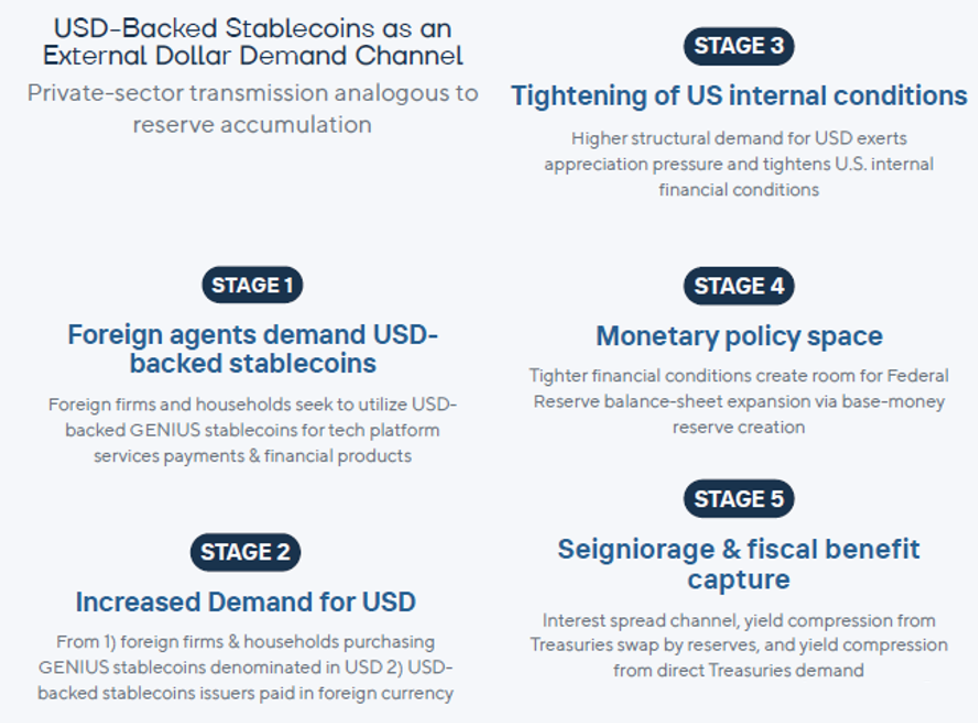
Summarizing, exports of Stablecoins do not create directly new base-money dollars but if they are significant enough, they may shift the internal macrofinancial conditions of the American economy generating monetary space – or making necessary – for the Fed to print new dollars through banks’ reserves creation.
When foreign central banks accumulate U.S. reserves they buy Treasuries or Fed deposits in USD; this pushes up the dollar and lowers U.S. yields. To maintain domestic monetary and macro conditions the Fed expands its balance sheet and prints new money via banks’ reserves creation.
Stablecoins replicate this process through the private sector:
As a consequence global stablecoin demand might act as a quasi-reserve accumulation. Instead of foreign central banks holding U.S. dollars, private stablecoins holders do it indirectly. The macro effect is similar and the Fed gains room to expand the amount of dollars without devaluing.
Finally – and key to understanding a potential key incentive of the GENIUS Act, GENIUS generates two monetary seigniorage2 or quasi-seigniorage channels and one direct fiscal demand channel:
To these two seigniorage channels, a separate fiscal benefit arises in the form of lower US sovereign yields as a consequence of the direct 1:1 collateralization of stablecoins with U.S. Treasuries5.
Should USD backed stablecoins become globally dominant the profits from their exports in terms of seigniorage for the United States could be remarkable.
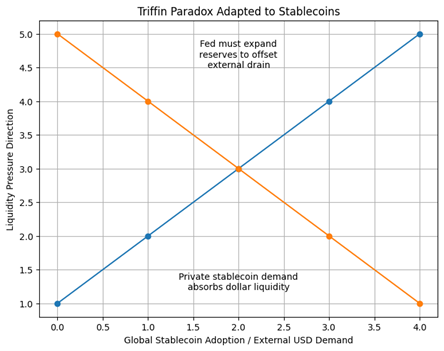
A sort of a Triffin paradox reinvented: global demand for safe dollar assets-backed stablecoins forces the U.S. to supply more USD, this time indirectly via money creation to keep the optimal internal conditions of the US economy stable. The mechanism simply changed from Bretton Woods gold convertibility to USD assets backed stablecoins. In other words, each new dollar asset backed stablecoin exported is another dollar of global demand that legitimises Fed balance-sheet expansion and potentially generates seigniorage profits for the issuer.
Figure 1.
Summarizing, the GENIUS Act may have the effect of spreading the US dollar even further and deeper into the world economy – potentially reaching SMEs, retail payments in an indirect fashion – and consequently inducing the world to finance US deficits – trade deficit through USD issuance, budget deficit through Treasuries issuance – further.
Should GENIUS stablecoins become globally dominant, the benefits for the United States in terms of seigniorage and extra borrowing capacity might be very substantial, on top of the current “exorbitant privilege”.
Can other monetary zones stop this “deep dive dollarization”?
The big European digital money project, the Euro CBDC, an ECB high tech centralized project due to be deployed by 2029, might have been designed, amongst other goals, to place the digital Euro firmly in charge of intra Eurozone payments while facing the competition of foreign monies.
The Euro CBDC is expected to be released by 2029 though. The market of monies offered to the private sector at that point – coins and metallic, traditional banking money, GENIUS American based stablecoins, MICA based European stablecoins, tokenized deposits, cryptos, etc. – is expected to be very competitive and maybe quite crowded. In this context, the biggest embarrassment for the Euro CBDC would be that after a big investment in a centralized, programmable, single, payments-oriented high-performing money, nobody wants to use it.
Maybe for this reason the European Union seems to be hedging its bets with the approval of the MICA Act, setting the regulatory playground for the development of a Euro backed stablecoin; based on this statute several projects of European stablecoins are currently being developed.
If the Eurozone seems to be well protected from the potential GENIUS stablecoins invasion, which areas of the world are most at risk of being dollarized through the back door and forced to finance US twin budget and trade deficits? Likely candidates include those with weak currencies and inefficient payments systems in which even an external payments network – the “rails” of the stablecoin – works better than the national one. This is of course the case for many Emerging Markets; under these conditions, the level of dollarization that certain Emerging Market economies might face in the future could reach levels never seen before.
Our take on their thesis.
Seigniorage is understood here in the broad macroeconomic sense as a resource transfer from the private sector to the state arising from the issuance of money and money-like liabilities. See Buiter Seigniorage (NBER Working Paper No. 12919).
This transfer depends on the spread between asset yields and interest on reserves, which varies over the monetary cycle and tends to be strongly positive in a low interest rates context.
This effect constitutes a resource transfer from the private sector to the state arising indirectly from monetary issuance. It can therefore be characterized as quasi-seigniorage.
The yield compression arising from private stablecoin reserve holdings constitutes a safe-asset demand effect rather than seigniorage in the strict monetary sense.