

This policy brief is based on “ECB Monetary Policy Amid Shifts and Breaks: Navigating the 2026 energy shock”. The views expressed are those of the authors and not necessarily those of the institutions the authors are affiliated with.
Abstract
Four years after the inflation surge triggered by the energy crisis of 2021–22, the euro area faces a new energy shock originating from the conflict in Iran. While the scale and duration of the shock are highly uncertain as we write, the questions are the same as in 2022: Will rising energy prices remain contained, or will they spread through wages, expectations, and pricing decisions into a broader and persistent inflation process? And relatedly, what should the monetary policy response be – how forceful, how frontloaded?
After the 2021-22 shock, the European Central Bank (ECB) ultimately succeeded in bringing inflation back to target, but only after a substantial tightening cycle and at a high economic and social cost. According to many, the inflation danger then was initially underestimated and the policy response delayed. This view was also shared by outgoing Vice President De Guindos in a recent interview.
This piece argues that three lessons from the previous episode deserve particular attention. First, energy shocks can generate more persistent inflation than standard models predict. Second, fiscal measures that shield consumers from higher energy costs increase inflation persistence and complicate the task of monetary policy. Third, in a world characterised by geopolitical disruptions and structural change, policymakers should complement traditional forecasting models with simpler indicators capable of providing early warning signals.
The conventional view has long been that central banks should largely “look through” supply shocks. Because monetary policy affects inflation only with a lag, reacting aggressively to temporary increases in oil or gas prices risks weakening economic activity without materially affecting the source of inflation.
The events of 2021–22 showed the limits of this reasoning. Inflation in the euro area began to rise well before Russia invaded Ukraine, driven by the post-pandemic recovery, supply bottlenecks and rising energy prices. The war amplified an inflationary process that was already underway.
More importantly, the energy shock did not remain confined to the energy component of consumer prices. Rising energy costs spread through production chains, affecting transport, food, manufactured goods and services. Once prices of energy and food – goods that everybody must consume every day – have risen significantly, the transmission to the rest of the price chain is inevitable. As a result, not only is core inflation a leading indicator of headline inflation, but the opposite is also true. In the 2021-22 experience, core inflation continued to rise even after energy inflation had started to decline. Modern economies appear particularly vulnerable to these propagation mechanisms. Once energy costs spread across sectors, inflation expectations, wage negotiations and firms’ pricing decisions transform a temporary shock into a persistent inflation process. While central banks cannot influence oil and gas prices directly, they play a crucial role in reining in second-round effects and preventing them from becoming entrenched.
The current energy shock differs from that of 2021–22 in three important respects.
First, the starting point is different. In 2022, energy prices and inflation had already been rising for several quarters before the invasion of Ukraine. The economy was booming, boosted by the post-pandemic rebound and protracted policy support. By contrast, in the current experience, inflation was around the target before the conflict in the Middle East created a new increase in energy prices. And the cyclical position of the euro area economy is much weaker.
Second, the ECB interest rates are no longer extraordinarily low as they were then (the deposit rate was still negative in early 2022). Monetary policy is no longer engaged in large-scale asset purchases. The monetary stance is much more balanced, hence the ECB is in a better position to respond than it was four years ago.
Third, energy prices have not yet reached the levels observed during the peak of the previous crisis. Gas prices, in particular, remain well below the extraordinary levels reached after the disruption of Russian supplies. However, oil prices have increased significantly and fertiliser prices — an important input into agricultural production — have risen by amounts comparable to those observed in the earlier episode.
The current shock is linked to disruptions in the Middle East and uncertainty surrounding the Strait of Hormuz, through which a substantial share of global oil and liquefied natural gas trade passes. The duration and intensity of the energy shock will therefore depend on geopolitical developments that remain highly uncertain. Although the US and Iran reached a ceasefire peace agreement in June, tensions between the two countries remain elevated, making a full reopening of the Strait unlikely in the near term. For the time being, transit remains restricted, and vessels continue to face heightened security risks and very high insurance costs.
These differences argue against drawing mechanical parallels with 2022. At the same time, the risk that a temporary energy shock evolves into broader inflation appears very high.
Fiscal policy played a major role during the previous energy crisis and is likely to do so again. When energy prices rise, to compensate for the loss of purchasing power experienced by households and firms, governments often respond with subsidies, tax reductions, price caps or income support measures designed to cushion the impact. Such measures, while politically understandable and (if properly targeted) also justified on distributional grounds, affect inflation dynamics.
Measures that directly reduce energy prices mechanically lower headline inflation. At the same time, income support sustains household spending and aggregate demand, reducing the adjustment that would otherwise follow a deterioration in the terms of trade.
This creates a tension between fiscal and monetary policy. Fiscal authorities seek to smooth the economic impact of the shock, while monetary authorities seek to prevent inflation from becoming persistent.
The 2022 experience suggests that broad-based support measures contributed to inflation persistence and increased the burden on monetary policy. The cumulative fiscal cost of energy-related support in Europe exceeded 2% of GDP, and many measures were insufficiently targeted.
Fiscal support measures have been introduced in several countries already in March, but their scale remains considerably smaller so far. If this remains the case, the inflationary consequences should also be more limited. However, the duration of the shock will affect fiscal policy. The longer the closure, the higher the risk of greater and prolonged fiscal responses. The broader and more open-ended fiscal support becomes, the greater the risk that monetary policy will eventually need to respond more forcefully.
The evidence presented in Figure 1 suggests that consumer price developments during the first three months (through May) following the closure of the Strait of Hormuz resemble those observed after the outbreak of the Ukraine crisis (see Figure 1). Headline inflation jumped very fast above the 2% target: the total HICP rose by an equivalent percentage (2.4%) in both episodes (panel 1a). The core HICP, however, has increased more sharply in the current episode. Energy and food price indices (panel 1b) both eased somewhat in May, and the June flash estimate seems to reinforce this: the energy and food components have declined further, and the broader indices appear to be returning under control. Nevertheless, the increase in core prices in June (compared to February) remains higher than at the corresponding point in 2022, and headline HICP, despite the June decline, is still above the ECB’s 2% target.
In a recent speech, Lagarde emphasised that the euro area is operating in an environment characterised by more frequent supply shocks and greater uncertainty than in the past. It is more difficult to interpret inflation developments during periods characterised by structural change, supply disruptions and geopolitical uncertainty. These challenges are also highly relevant today. As forecasting models are estimated on historical relationships, when geopolitical events fundamentally alter those relationships, their predictions become less reliable.
Increased uncertainty and complexity suggest complementing sophisticated econometric models with simpler indicators that not only provide independent and potentially valid signals but are also more intuitive and easier to communicate.
Without pretence of generality or perfection, by way of example, we feel that the following rule of thumb could constitute a useful benchmark at the present time: Three consecutive readings of annual HICP inflation that are both rising and above the ECB’s 2% target should trigger a reassessment of the monetary policy stance, with a presumption in favour of tightening unless compelling evidence suggests otherwise.
The rule focuses on headline inflation rather than core inflation, reflecting the important lesson from 2021–22, as discussed previously.
The rule relies on three consecutive observations, which suggest a pattern while remaining sufficiently timely to influence policy deliberations. The rule is intended as a warning signal, not a mechanical decision device. Its signal should be evaluated alongside other indicators and model results, and as always, filtered by policymaker judgement.
Figure 1. Monthly price developments after the 2022 and 2026 (through June) energy shocks
(% deviations from February=0)
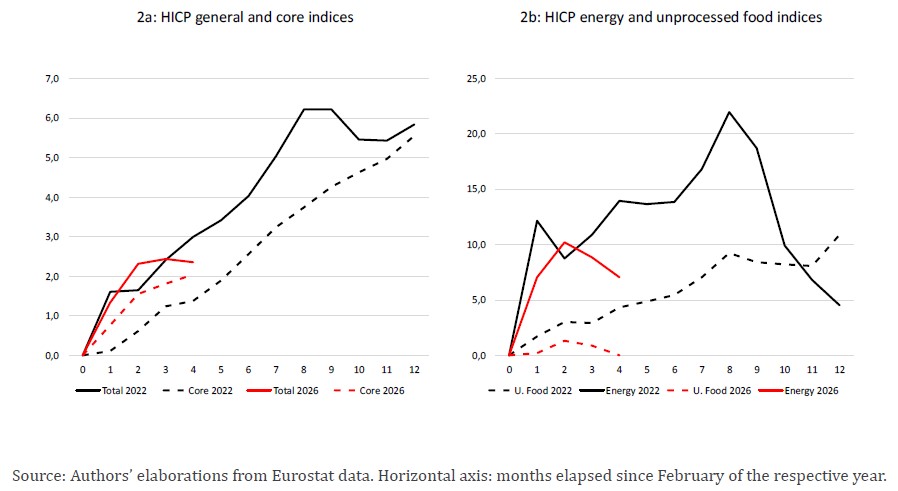
Applied retrospectively, the rule would have flashed red during the second half of 2021, several months before the ECB began raising interest rates. While hindsight must always be treated cautiously, the exercise suggests that a simple indicator could have encouraged an earlier reassessment of the prevailing narrative that inflation would remain temporary.
Turning to the present: the three consecutive inflation readings available through May 2026 satisfied the conditions of the rule and are consistent with the decision taken in June to raise the three policy rates by a quarter percentage point. The June flash estimate introduces a more nuanced picture. Though fragile (it has been repeatedly violated on both sides), the ceasefire agreed by the US and Iran has given financial markets sufficient assurance that hostilities are not escalating further and that trade and energy flows will gradually resume. Oil markets now trade at around $70 per barrel, against close to $120 at the peak, and stock market valuations are near historical highs.
These developments increase the probability that the shock will reverse, lifting near-term pressure on the ECB. The June price data are consistent with this assessment: the energy and food components show a decline, and the signal from our rule is no longer pointing unambiguously toward further tightening. However, this indication is tentative and subject to multiple caveats. Diplomatic and military scenarios remain volatile, and abrupt reversals cannot be excluded. The lagged effects of past price increases are still working through the system and will continue to affect inflation dynamics in the coming months. And headline inflation remains above target even after the June decline.
The euro area is once again confronting an energy-driven inflation shock. The ECB is better positioned entering this shock than it was in 2022, with inflation around the target and rates at a neutral level, while the balance sheet is unwinding. Recent developments in the Middle East seem to have reduced the tail risk of a prolonged supply disruption and translated into an easing of inflation pressures in the June data.
Yet the situation warrants continued vigilance. The mechanisms through which energy prices affect broader inflation have not changed. The ceasefire remains fragile, the lagged effects of past price increases are still in the pipeline, and headline inflation is still above the ECB’s 2% target
In sum, the situation seems to be improving but leaves no space for complacency. Developments need to be carefully monitored in the months ahead and further readings in July and August should inform the policy assessment in September.