This Policy Brief is based on ECB Working Paper No. 3178. Views expressed in this Policy Brief are those of the authors and do not necessarily reflect those of the European Central Bank, Deutsche Bundesbank, the Eurosystem, or any other institution.
Abstract
Deposit markets are commonly viewed as local and segmented. Digital social networks weaken these geographic boundaries. In fact, US county-level data analysis reveals that small banks raise deposit rates in response to competitive shocks occurring in socially connected — but geographically distant — markets. These spillovers are economically meaningful and strongest where households are more financially sophisticated. Over time, higher social connectedness also accelerates the convergence of deposit rates across markets. Deposit competition is therefore less local than regulators often assume.
Retail deposit markets are typically analyzed through a geographic lens. Physical proximity, customer inertia, and limited attention allow banks – especially small banks – to retain pricing power within local markets. Households tend to compare offers within their immediate environment, and switching across regions is uncommon. As a result, deposit competition is often treated as fundamentally local (Drechsler, Savov and Schnabl, 2017).
Our recent research (Anyfantaki, Avramidis and Martynova, 2026) suggests that this view is incomplete. It stands to reason that banks’ pricing decisions are affected by consumer interactions, now increasingly mediated through digital social networks. When peer influence is strong, local market concentration changes may have amplified effects on deposit rates, transmitted through social ties. While banks operate locally, households are socially connected across space (Kuchler, Li, Peng, Stroebel and Zhou 2022). Competitive shocks in one market can therefore influence deposit pricing decisions elsewhere.
To examine whether information transmitted through online social networks alters deposit pricing across markets and to formalize the mechanism driving social spillovers in deposit pricing, we develop a stylized model of deposit rate competition across socially connected counties. Social ties can make financial opportunities salient to inattentive households, and in this setting, they expose depositors to rate changes occurring elsewhere, triggering search for better offers. This search response increases deposit-market elasticity and induces small banks to adjust prices even in markets with no geographic connection to the original shock.
We use US county level deposit-rate data and the Social Connectedness Index (SCI) developed by Bailey, Cao, Kuchler & Stroebel (2018), which captures the intensity of Facebook friendship links between US counties, to empirically examine how small banks in one county respond to competitive shocks occurring in socially connected – but geographically distinct – counties. When deposit rates increase in one local market—often following a merger-induced branch closure – small banks in socially connected markets raise their own rates, even if they are geographically distant. The mechanism operates through increased awareness. Social networks make rate changes in other markets salient to otherwise inattentive depositors, prompting local search and increasing the elasticity of deposit demand. As a result, small banks face stronger competitive pressure.
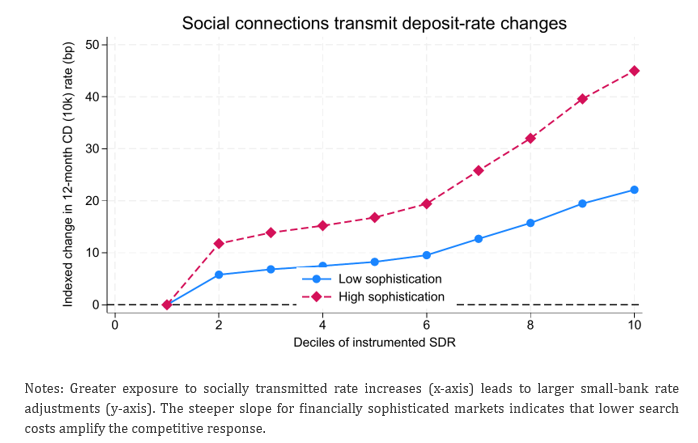
The spillover effect is stronger in markets with higher financial sophistication. Financially sophisticated households typically face lower effective search costs: they are more likely to compare offers, understand rate differences, and switch banks when better opportunities arise. As a result, the awareness generated through social networks translates into active search and competitive pressure more directly and more strongly in the markets with higher share of financially sophisticated households.
Figure 1 visualizes this result. It shows that stronger social exposure is associated with larger local rate increases. However, the effect is more pronounced for financially sophisticated markets, indicating a stronger competitive response when households are more likely to search and switch.
Figure 1. Social exposure and deposit-rate responses by financial sophistication
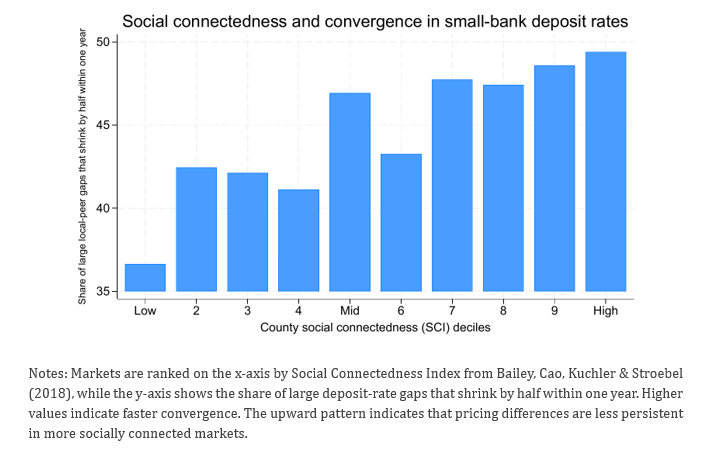
Beyond short-run spillovers, social connectedness also affects longer-run pricing dynamics. Figure 2 shows that deposit-rate disparities narrow more readily in more socially connected markets. The upward relationship shows that deposit-rate differences close more quickly in more socially connected markets. Social networks therefore reduce persistent pricing gaps and compress local market power over time.
Figure 2. Social connectedness and deposit-rate convergence
Overall, we find that:
Our findings underscore the growing importance of online social networks in shaping deposit rate policies and offer new insights into the behavioral forces driving local banking competition. Social networks emerge as a complementary and increasingly powerful dimension of deposit market dynamics. This highlights the need to account for new informational channels when assessing the pass-through of rate changes. In socially connected regions, deposit rate changes, whether driven by policy changes or competitive dynamics, might ripple across geographically distant markets, amplifying the reach of monetary interventions. As social connectedness increases, small banks’ deposit rates converge across connected markets and this convergence, accelerated by digital technologies, suggests that geographic barriers to monetary transmission are diminishing.
Anyfantaki, S., Avramidis, P., and Martynova, N. (2026). Do banks respond to their friends’ markets? Social spillovers in deposit pricing. ECB Working Paper No. 3178.
Bailey, M., Cao, R., Kuchler, T. & Stroebel, J. (2018), ‘The economic effects of social networks: Evidence from the housing market’, Journal of Political Economy 126(6), 2224–2276.
Drechsler, I., Savov, A., and Schnabl, P. (2017). The deposits channel of monetary policy. Quarterly Journal of Economics 132(4), 1819–1876.
Kuchler, T., Li, Y., Peng, L., Stroebel, J. & Zhou, D. (2022), ‘Social proximity to capital: Implications for investors and firms’, The Review of Financial Studies 35(6), 2743–2789.