

This policy is based on the paper “Shaping the financial cycle through monetary policy”, Deutsche Bundesbank Discussion Paper (No 33/2025). The views expressed are those of the authors and do not necessarily reflect those of the Deutsche Bundesbank.
Abstract
Financial cycles refer to fluctuations in credit and house prices that extend beyond typical business cycles. Despite its significance for both monetary and macroprudential policy, the question of how monetary policy shapes financial cycles remains largely unanswered. We extract innovations from a vector autoregression that account for most of the cyclical co-movement between credit and house price growth at medium frequencies, showing that they resemble monetary policy shocks. Additionally, systematic monetary policy plays a crucial role and can significantly dampen financial cycles, particularly when counteracting house price movements. These stabilizing effects could have substantially mitigated the U.S. financial cycle during the 2000s.
A growing number of scientific studies highlight how having a deeper understanding of financial cycles is important for financial stability (Borio, 2014; Aikmann et al., 2015). These medium to longer-term co-movements between credit aggregates and real estate prices typically last between 8 and 20 years and are thus significantly longer than traditional business cycles. Financial cycles are a crucial consideration for central banks, in particular when designing macroprudential measures such as the countercyclical capital buffer – and, due to interactions that could arise, they are also of interest to monetary policy. However, it remains unclear to what extent the central bank itself – through its interest rate policy – shapes these cycles. This paper seeks to address this gap by investigating the primary drivers of financial cycles and examining the extent to which monetary policy influences and interacts with these cycles– and therefore can have a stabilising effect in periods of financial turmoil.
The paper employs a vector autoregressive (VAR) model to analyze US data from 1969 to 2019. This model identifies the primary “innovation” or shock driving the co-movement of credit and house prices at medium frequencies (8 – 20 years). In particular, we extract the innovations that maximize the sum of variance shares of credit growth and house price growth between 8 and 20 years, using a variant of the method by Doyle and Faust (2005) and Angeletos et al. (2020). We find that financial-cycle innovations account for 60 % of the variation in credit growth and 86 % of the variation in house price growth at medium frequencies. By isolating this financial-cycle innovation, the study examines its propagation through the economy as illustrated in Figure 1. A contractionary financial-cycle innovation leads to decreases in credit, house prices, output, and inflation, while the short-term interest rate increases (black dashed line).
Figure 1. Impulse responses to a financial-cycle innovation
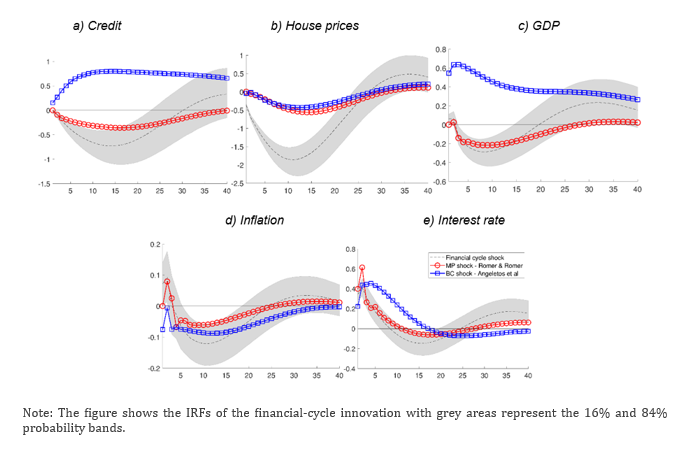
The effects of the financial-cycle innovation differ qualitatively and quantitatively from those of a main business-cycle shock as extracted from Angeletos et al. (2020): Credit and house prices move in opposite directions after a business-cycle shock, and output displays a positive and sustained response to this shock (blue-line). In contrast, when comparing the impulse responses of a financial-cycle innovation with those of a monetary policy shock (red line), by using the monetary policy shock series from Romer and Romer (2004), we find stronger similarities. For example, output, inflation, credit, and house prices decrease after a contractionary monetary policy shock associated with a rise in the interest rate., While the effects on output, inflation, and the interest rate are comparable in magnitude to those of a financial-cycle innovation, the response of credit and house prices to a monetary policy shock is significantly weaker than to a financial-cycle innovation. Although this innovation is identified on purely statistical grounds and likely reflects a combination of several underlying structural shocks, it exhibits features consistent with monetary policy shocks. This finding suggests that monetary policy shocks have historically contributed to the buildup of the financial cycle.
Thus, the question arises as to what role the response of monetary policy plays in how macro-financial aggregates respond to financial cycle innovations. Put differently, we ask how the systematic behaviour of monetary policy shapes the financial cycle. To this end, the study conducts counterfactual exercises under different monetary policy rules, using the approach proposed by McKay and Wolf (2023), i.e. how financial and real economic variables would have moved had US monetary policy taken a different path. The focus is on three different optimised monetary policy reaction functions, each based on minimising a central bank’s loss function. First, we analyze what is known as a dual mandate: in this scenario, monetary policy aims to minimise inflation and output gap fluctuations. This scenario thus takes into account comparable target variables such as the US Federal Reserve’s current monetary policy strategy. Another subject of analysis is how optimal monetary policy changes when either the credit gap or house prices are additionally included into the loss function. The output gap and credit gap are the deviation of GDP and credit from their respective trends. In this way, it is possible to assess the effectiveness of monetary policy strategies that directly counteract financial market developments – known as leaning-against-the-wind policies.
As expected, the dual mandate policy stabilizes inflation and the output gap but has limited impact on the standard deviations of the credit gap and house prices, reducing them by only about 4%. As intended, both augmented policies have a strong stabilizing impact on the targeted financial variable. The volatility of the credit gap is around 20% lower under the credit targeting rule, while the volatility of house prices is around 20% lower under the house price targeting rule than under the observed policy rule. However, the credit targeting rule does not have a stabilizing effect on any of the other variables. By contrast, the house price targeting rule additionally reduces the volatility of inflation by around 10% and the volatility of the credit gap and the output gap by between 3-5%.
These results underscore the fact that monetary policy can have not only medium-term effects but also influence longer-term dynamics in financial markets. It thus acts at the point of intersection between the real economy and the financial sector and can ultimately help increase an economy’s resilience to financial crises. At the same time, our results also indicate that it is preferable to focus on asset prices instead of credit aggregates.
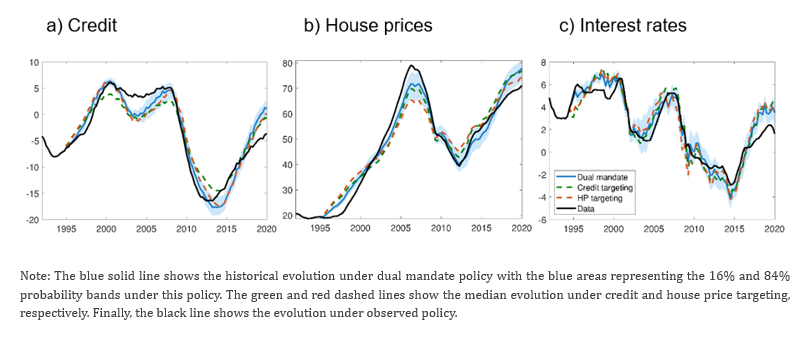
The study also looks at the much-discussed question of whether the Federal Reserve’s monetary policy contributed to the US housing boom of the 2000s. Using counterfactuals, the study shows that each of the monetary policy rules analysed would have stabilised the US housing market much more effectively than historically observed monetary policy. Figure 2 presents the historical counterfactuals. Specifically, a policy that systematically leans against house prices (red dashed line) would have significantly softened both the boom and the subsequent bust, resulting in real house prices rising 20 percentage points less during the boom and falling by only 18% instead of 33% during the crisis. These findings align with those of Adam and Woodford (2021), indicating that monetary policy can effectively counteract house price fluctuations. However, this approach involves trade-offs, as our results indicate that a policy leaning against house prices would have resulted in an output gap and inflation approximately one percentage point lower than the actual figures during the 2000s housing boom. As panel c of figure 2 illustrates, all counterfactual monetary policies would have suggested an earlier and stronger tightening to dampen the financial cycle.
Figure 2. Counterfactual evolution of selected variables under different counterfactual policies starting from 1995:q1 onward
The study suggests that monetary policy has an important impact on the financial cycle. This contributes to the existing literature on the influence of monetary policy on global financial variables (Miranda-Agrippino and Rey, 2020) and its effects at frequencies beyond the business cycle (Jorda et al., 2024). we show that systematic monetary policy has persistent effects, particularly on financial variables, well beyond the business cycle. As a result, it can either mitigate or amplify the vulnerability of the real economy and financial system to disturbances, shaping the interdependence between the two. This contributes to the ongoing debate on the long-run effects of monetary policy and its implications for financial stability. Finally, our findings provide valuable insights into the ongoing debate about the costs and benefits of coordinating monetary and macroprudential policies (e.g., Stein, 2012).
Adam, Klaus and Michael Woodford (2021). “Robustly optimal monetary policy in a new Keynesian model with housing”. Journal of Economic Theory 198.
Aikman, David, Andrew G. Haldane and Benjamin D. Nelson (2015). “Curbing the Credit Cycle”. Economic Journal 125 (585), 1072-1109.
Angeletos, George-Marios, Fabrice Collard, and Harris Dellas (2020). “Business-cycle anatomy”. American Economic Review 110 (10), 3030–70.
Borio, Claudio (2014). “The financial cycle and macroeconomics: what have we learnt?” Journal of Banking & Finance 45, 182-198.
Doyle, Brian M. and Jon Faust (2005). “Breaks in the variability and comovement of g-7 economic growth”. Review of Economics and Statistics 87 (4), 721–740.
Jorda, Oscar, S. R. Sing, and A. M. Taylor (2024). “The long-run effects of monetary policy”. Review of Economics and Statistics, forthcoming.
McKay, Alisdair and Christian K. Wolf (2023). “What can time-series regressions tell us about policy counterfactuals?” Econometrica 91 (5), 1695-1725.
Miranda-Agrippino, Silvia and Hélène Rey (2020). “U.S. Monetary Policy and the Global Financial Cycle”. The Review of Economic Studies 87 (6), 2754–2776.
Romer, Christina D. and David H. Romer (2004). “A new measure of monetary shocks: derivation and implications”. American Economic Review 94 (4), 1055–1084.
Stein, Jeremy C. (2012). “Monetary policy as financial-stability regulation”. Quarterly Journal of Economics 127 (1), 57–95.