

This Policy Brief is based on Fornari, F., Pianeselli, D. and Zaghini, A. (2026), ‘Environmental score and bond pricing: It better be good, it better be green’, Journal of International Money and Finance, 161, 103498. The views expressed are those of the authors and not necessarily those of the institutions the authors are affiliated with.
Abstract
We provide empirical evidence that the pricing of green bonds follows a two-tiered approach, based on both the green label of the bond and the environmental quality of the issuer. Using a matched sample of green and conventional bonds issued globally between 2014 and 2023, we show that the green label alone commands a yield discount of 16 basis points; this premium (greenium) doubles for issuers in the top tercile of the environmental score distribution. External certification and periods of heightened climate uncertainty further amplify the greenium, with the latter giving rise to a ‘dash for green’ that temporarily extends pricing advantages to mid-tier issuers as well. The findings suggest that strengthening environmental disclosure and harmonising certification standards, alongside credible climate policy frameworks, can reinforce market incentives and support an orderly transition to a low-carbon economy.
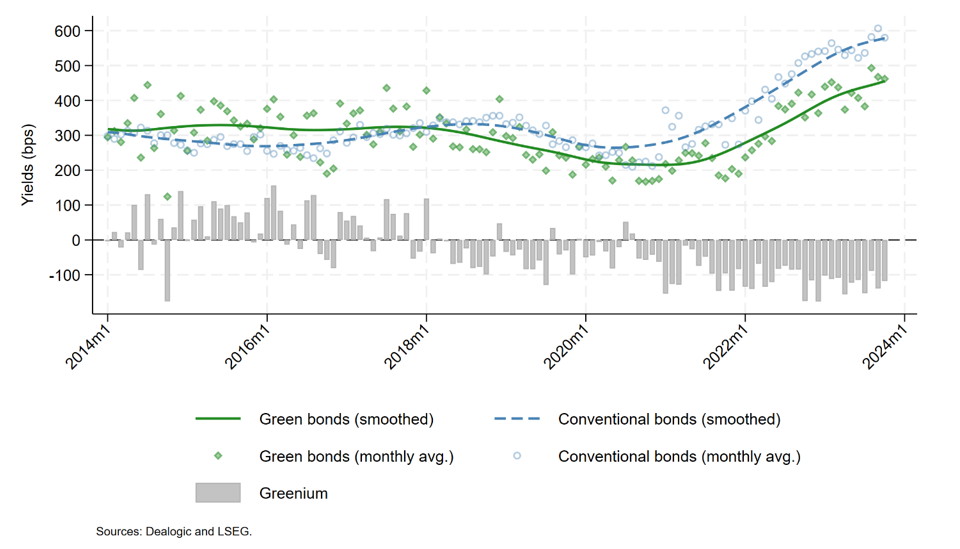
Driven by the increasing need to mobilize capital for the transition toward a low‑carbon economy, green bonds have evolved from a niche segment into a core component of sustainable finance. Global issuance has grown dramatically, rising from fewer than 200 securities of small volume in 2014 to a cumulative volume of over 3 trillion US dollars in 2025, with European issuers alone accounting for nearly half of global placements in recent years. Their rapid expansion has ignited a debate around the existence and magnitude of a yield discount that green bonds may enjoy compared with conventional bonds, the so-called greenium. Figure 1 plots the monthly average yield at issuance for green and conventional bonds over the period January 2014–October 2023. The two series broadly co-move, reflecting the influence of global monetary policy and risk-taking conditions. Between 2014 and 2017, conventional bonds exhibited a lower yield than their green counterparts; since around 2018, however, a reversal occurred, with green bonds beginning to be priced below conventional ones. This gap widened further after 2020, with the raw yield differential exceeding 100 basis points. However, it is important to note that this unconditional differential is a naïve measure of the greenium, as it reflects differences in bond characteristics and issuer profiles across time and geographic areas.
Much of the early literature has tried to quantify an average greenium, but the results have been heterogeneous and often contradictory. Fornari, Pianeselli and Zaghini (2026) show that these inconsistencies stem from an oversimplified view of green bond pricing. Investors do not reward the green label in isolation; instead, they rely on a two‑tiered process that combines the greenness of the instrument with the environmental quality of the issuer.
Figure 1. Yields at issuance of green and conventional bonds
The empirical analysis is based on a rigorous matching procedure designed to ensure the comparability of green and conventional bonds. Specifically, it employs Coarsened Exact Matching (CEM, Iacus et al., 2012) that constructs comparable groups of green and conventional bonds by directly balancing their observable characteristics, such as maturity, rating, currency, coupon type, and issuer sector, eliminating selection biases that would otherwise distort the measured greenium. Regressions run on the matched sample, controlling for bond‑level, issuer‑level, and global financial conditions, yield robust estimates of the pricing discount. The results confirm that green bonds enjoy a baseline yield advantage of 16 basis points relative to comparable conventional bonds. This baseline premium is, however, only the first layer.
Once the environmental score of the issuer – the E component of the traditional ESG rating – is introduced, the greenium becomes highly dependent on where the issuer stands in the cross‑sectional distribution of that score. Issuers in the top tercile benefit from markedly larger discounts, with the greenium doubling. This reveals that investors are not simply paying for green‑labelled projects; they are also pricing the climate commitment of the issuer.
These results are robust to alternative matching procedures, including Propensity Score Matching and entropy balancing, as well as to variations in sample composition.
Beyond the green label and issuer’s environmental quality, external certification further enhances the greenium. Certified bonds, those carrying a third-party opinion verifying alignment with widely recognised standards such as the Green Bond Principles or the Climate Bond Standard, command a greenium of around 25 basis points, compared with 16 basis points for non-certified green bonds. The additional premium of roughly 10 basis points is particularly important for issuers lacking formal environmental disclosure, for whom certification serves as the primary assurance mechanism. Indeed, while also to certified bonds applies the additional discount due to the environmental quality of the issuer, by reducing informational asymmetries between issuers and investors, certification helps signal the environmental soundness of the underlying project and the credibility of green claims.
A relevant feature of the pricing mechanism is its strong non‑linearity. Only issuers at the top of the environmental score distribution receive an additional discount beyond the baseline greenium; middle‑ and lower‑tier issuers exhibit no statistically significant incremental benefit. Figure 2 illustrates this pattern. The blue bars show the total greenium by E-score tercile for the full sample: the additional premium is statistically significant only for top-tercile issuers, where it amounts to around 33 basis points. This implies that while green bond investors are open to all issuers, the most cost‑effective financing terms accrue to those already demonstrating leadership in environmental performance. Robustness checks confirm that it is environmental performance specifically, not general ESG attributes, which drives these pricing effects: the social and governance components do not meaningfully affect green bond yields once the E-score is accounted for.
Figure 2. Greenium by environmental score tercile: full sample and high climate stress periods
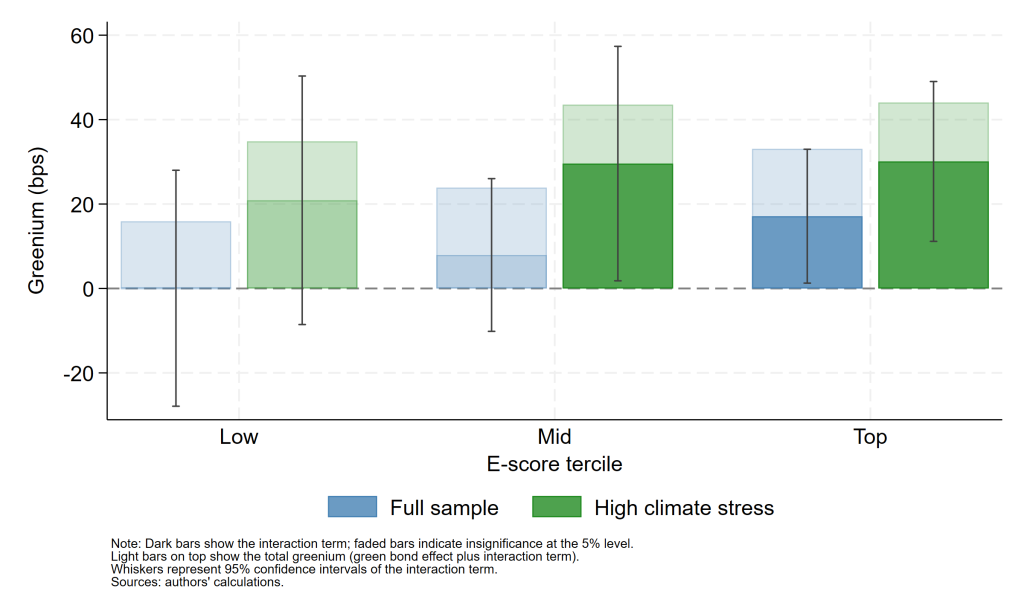
A second important feature of the pricing mechanism is its sensitivity to climate uncertainty. Periods in which climate concerns intensify, whether due to policy developments, media narratives, or physical climate events, correspond to a substantial widening of the greenium. The green bars in Figure 2 reveal this pattern clearly: during episodes of heightened climate stress (measured by three different indexes), the additional premium for top-tercile issuers reaches 44 basis points in total, and mid-tier issuers, previously receiving no significant additional discount, attract a yield advantage of comparable magnitude. This “dash for green” phenomenon demonstrates that green bond pricing is state‑dependent: it responds not only to issuer and bond characteristics, but also to fluctuations in climate‑related sentiment and risk perception. Green bonds thus become even more advantageous financing instruments when climate issues command greater attention on global markets, reinforcing their role as a transition-financing tool.
The economic significance of these pricing differentials is considerable. The baseline greenium of 16 basis points alone corresponds to a reduction in financing costs of roughly one‑tenth of the average yield at issuance. For top‑tercile environmental performers, the advantage is substantially larger, reaching around 33 basis points over the whole period, and 44 basis points during periods of heightened climate stress. These figures imply that green bonds can materially reduce the cost of capital for environmental investments, reinforcing their importance as a transition‑financing tool and providing a tangible financial incentive for issuers to improve their environmental performance.
Several policy implications emerge from the analysis. First, environmental disclosure plays a pivotal role in green bond pricing. Investors systematically reward the availability of issuer‑level environmental information, and strengthening disclosure frameworks would enhance market transparency, reduce information gaps, and support more efficient pricing of environmental risk. Regulators and standard‑setting bodies could leverage this dynamic to promote higher‑quality environmental reporting, ensuring that investors can reliably differentiate between issuers.
Second, the results highlight the importance of credible transition pathways. While top environmental performers are rewarded by the largest premia, even lower‑tier firms benefit from the baseline greenium when issuing green bonds. This finding may reduce the concerns raised by Hartzmark and Shue (2023) and Angelini (2024), that stress how higher financing costs for brown firms, if imposed indiscriminately, risk being counterproductive by discouraging investment in cleaner technologies and prolonging the use of polluting assets.
Third, investors place substantial value on external certification. Certification strengthens investor confidence and helps align market expectations about the environmental soundness of green claims. Public authorities and financial institutions should therefore continue developing robust and comparable taxonomies and verification standards, reducing the risk of greenwashing and upholding the credibility of the market as it scales.
Finally, the sensitivity of green bond pricing to climate‑related uncertainty underscores the need for stable and credible climate policy frameworks. Markets respond strongly to signals about climate risk, and policy uncertainty can amplify or compress green incentives. A predictable climate policy environment would contribute to pricing stability, allowing green instruments to operate more effectively in supporting long‑term investment planning.
Taken together, the findings show that the green bond market is both economically meaningful and internally disciplined. The layered pricing mechanism linking the green label, the environmental quality of the issuer, and external certification makes green bonds powerful instruments for steering capital toward sustainable activities. Through targeted disclosure policies, credible certification frameworks, and stable climate governance, policymakers can reinforce these incentives and strengthen the ability of green bonds to support an efficient and orderly transition to a low‑carbon economy.
Angelini, P., 2024. Portfolio decarbonisation strategies: questions and suggestions. Banca d’Italia, Occasional Paper 840.
Fornari, F., Pianeselli, D., Zaghini, A., 2026. Environmental score and bond pricing: it better be good, it better be green. Journal of International Money and Finance, 161, 103498.
Hartzmark, S.M., Shue, K., 2023. Counterproductive sustainable investing: the impact elasticity of brown and green firms. SSRN Working Paper 4359282.
Iacus, S., King, G., Porro, G., 2012. Causal inference without balance checking: coarsened exact matching. Political Analysis, 20, 1–24.