This policy brief is based on Bredl (2025), Deutsche Bundesbank Discussion Paper No 30/2025. This paper is part of the ChaMP Research Network. The views expressed in this policy brief represent the author’s personal opinions and do not necessarily reflect the views of the Deutsche Bundesbank or the Eurosystem.
Abstract
Is the concentration of the banking market relevant for the pass-through of monetary policy measures to interest rates on loans to enterprises? Granular loan-level data are particularly well-suited for addressing this question, as they enable concentration to be measured at the regional level. Using loan-level data from the euro area, I find that regional banking market concentration did not significantly influence the pass-through of monetary policy to lending rates during the period of monetary tightening in 2022 and 2023.
The pass-through of monetary policy measures and market rates to lending rates represents an important step in the monetary transmission process. Interest rates on loans to enterprises are particularly relevant in this context, as they influence investment decisions that, in turn, impact overall economic developments. Understanding the factors that shape interest rate pass-through for loans to enterprises is therefore essential from a monetary policy perspective.
One potential factor is the concentration of the banking market. According to the structure-conduct-performance paradigm, higher concentration leads to reduced competition. In turn, the degree of competition may affect how banks pass on monetary policy measures to their borrowers (Deutsche Bundesbank, 2025). If this causal chain holds, changes in banking market concentration over time could result in variations in the degree of interest rate pass-through over time. Additionally, differing levels of concentration between regions within a monetary union may lead to geographic variation.
Measures of banking market concentration are derived by aggregating the market shares of individual banks. For instance, the Herfindahl-Hirschman Index (HHI) is defined as the sum of the squared market shares of all banks within a market. National market shares are typically used in this context (Corvoisier and Gropp, 2002). For many banks, however, the national market may not be the most relevant one if their operations are confined to a smaller region. These banks might have a negligible market share at the national level, but a significant share in the region in which they operate. Consequently, while the national banking market may appear fragmented, indicating low concentration, each bank could function as a regional monopolist, resulting in high concentration from a regional perspective (Deutsche Bundesbank, 2025).
Calculating regional measures of market concentration requires granular data that provide information on loan volumes at the bank-region level. Loan-level data from the Eurosystem’s AnaCredit database fulfils this requirement. I utilise this data to calculate regional concentration measures for the market of loans to enterprises. More specifically, I calculate bank-specific market shares and regional HHIs for NUTS-3 regions across the euro area.
The core of my analysis assesses the relationship between lending rates – particularly interest rate pass-through – and the measures of regional lending market concentration. I focus on the monetary tightening period of 2022 and 2023 and on lending to small enterprises, as any potential impact of regional loan market concentration on interest rates is likely to manifest most strongly in this segment. By contrast, larger firms may experience a muted impact, as they are less dependent on the regional banking market and may seek funding from other sources, such as the capital market or banks in different regions or countries.
My findings indicate that the transmission of monetary policy to lending rates during the period of monetary tightening in 2022 and 2023 was not significantly influenced by regional market concentration. Figure 1 illustrates the relationship between regional market concentration and the responsiveness of lending rates to monetary policy surprises. These surprises are measured by the immediate reactions of market rates to announcements from the ECB Governing Council (Altavilla et al., 2019). As shown in Figure 1, the lending rates of banks with large regional market shares in high-HHI markets did not respond to monetary policy surprises systematically differently to those of banks with small market shares in low-HHI markets.
Figure 1. Relative response of lending rates to a monetary policy surprise
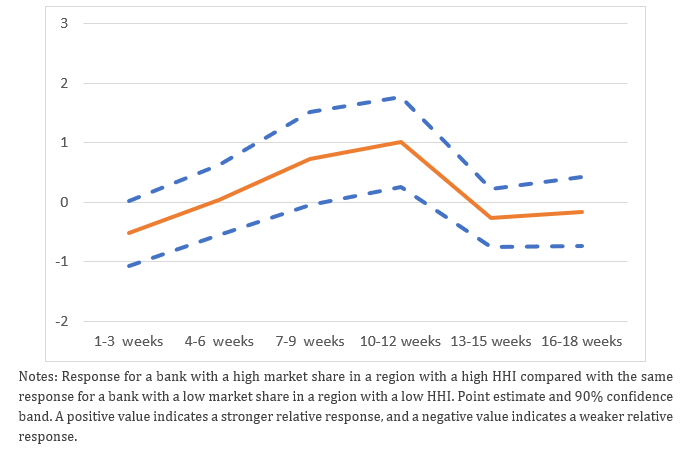
Regional loan market concentration does not systematically impact the degree of interest rate pass-through for loans to enterprises in the euro area. This finding is significant from a monetary policy perspective, suggesting that changes in loan market concentration over time do not induce variations in the degree of interest rate pass-through. Furthermore, heterogeneity in concentration across regions does not lead to geographic variation.
Altavilla, C., L. Brugnolini, R. S. Gürkaynak, R. Motto and G. Ragusa. 2019. “Measuring euro area monetary policy.”Journal of Monetary Economics, 108: 162‑179.
Bredl, S. 2025. “Regional loan market structure, bank lending rates and monetary transmission.” Deutsche Bundesbank Discussion Paper No 30/2025.
Corvoisier, S. and R. Gropp. 2002. “Bank concentration and retail interest rates.” Journal of Banking & Finance, 26: 2155‑2189.
Deutsche Bundesbank. 2026. “Does increased concentration in the banking market in the euro area cause a change in interest rate pass-through?” Monthly Report, January 2026.