

This policy brief is based on European Central Bank, Occasional Paper No. 384. The views expressed are those of the authors and not necessarily those of the institutions the authors are affiliated with.
Abstract
Rare earth elements are tiny inputs with outsized strategic importance as they are essential for technological products like electric vehicles, wind turbines, semiconductors, medical equipment and defence systems. China dominates the rare earth supply chain, especially the critical stage of refining. Recent Chinese export controls, albeit short-lived, showed how rare earths can be used for geopolitical leverage. This brief assesses what could happen under more persistent, though still partial, restrictions on Chinese rare earth exports. Leveraging three complementary models, our analysis suggests that such a shock would reduce output and raise inflation in importing economies. For the United States, estimated output losses range between 0.3% and 0.6% with automotive and electronics sectors among the most affected. Nevertheless, the impact would be larger if substitution possibilities are more limited or restrictions more severe.
Rare earths are essential to a wide range of technological products of strategic importance. Rare earths possess unique magnetic, catalytic, and luminescent properties which make them indispensable inputs for advanced products such as magnets (e.g. for electric vehicles, wind turbines, and defence systems), polishing powders (e.g. for semiconductors), specialized optical glass (e.g. for lasers), and high-performance alloys (e.g. for aerospace). Owing to their unique capacities, rare earths are difficult to replace, particularly in high-performance applications like automotive, semiconductors or defence.
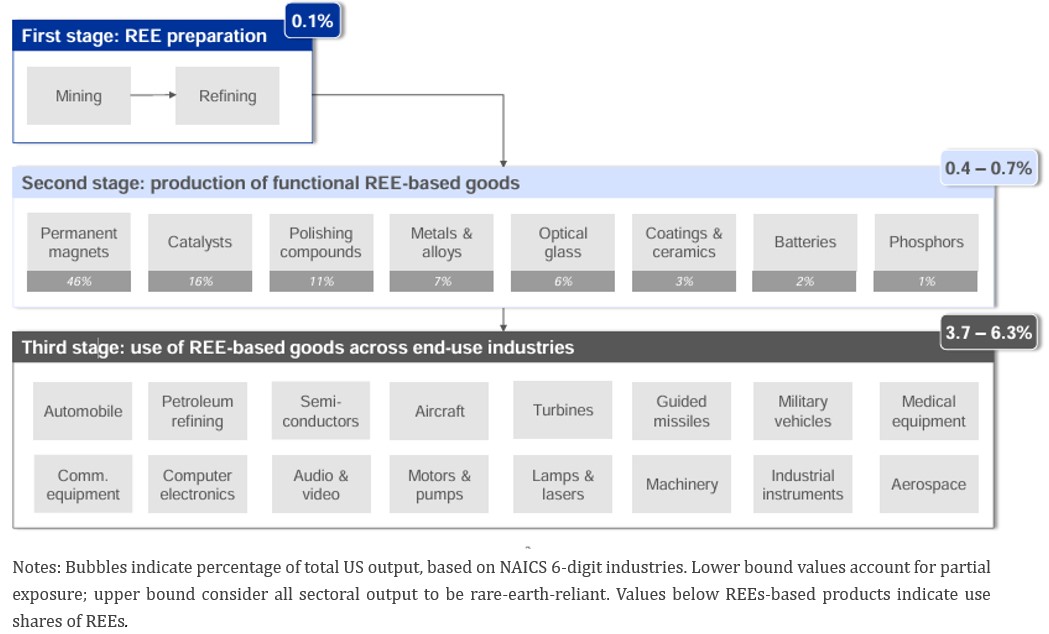
This creates a classic bottleneck problem. The value of rare earth inputs is tiny relative to the value of the goods that depend on them, but without them production may be disrupted. In the United States, sectors relying on rare earths account for around 4-7% of total output, but they include some of the most technologically advanced and security-sensitive industries (Figure 1).
Figure 1. Rare earths elements (REEs) are small inputs into strategic downstream industries
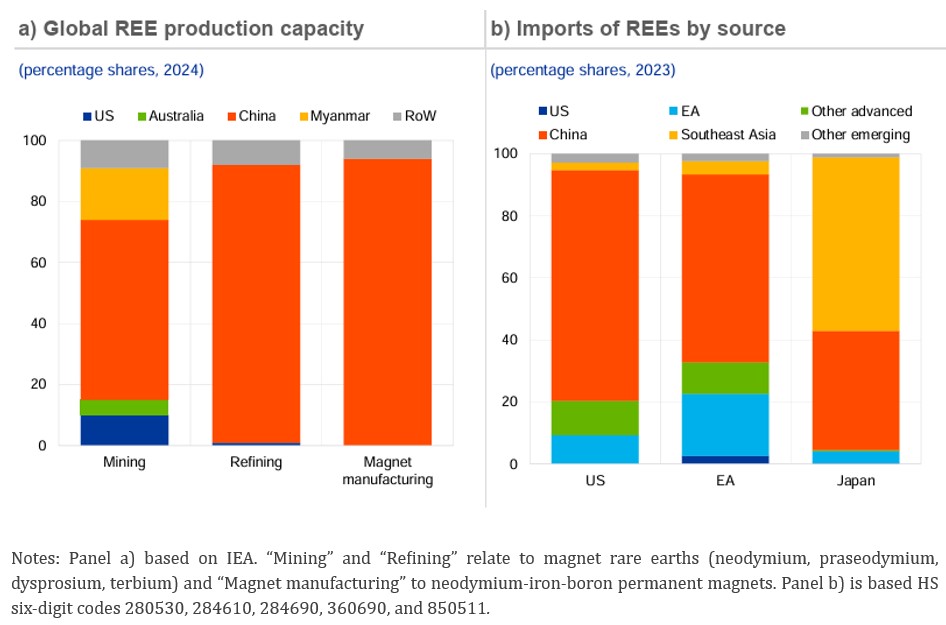
China’s dominance over the rare earth supply chain makes diversification difficult. Although rare earths are relatively abundant in the earth’s crust, separating and refining them is technologically complex, costly and environmentally demanding. China’s strongest position lies in that middle of the value chain, where ores are processed into refined rare earth oxides and then into high-end components such as permanent magnets. China controls around 90% of global refining capacity for magnet rare earths and more than 90% of global permanent magnet manufacturing capacity – making China a primary import source for most countries (Figure 2).
This concentration gives China leverage. Export restrictions can delay deliveries, raise prices, create uncertainty and force firms to ration scarce inputs. They can send a signal in trade negotiations by making access to critical minerals conditional on broader geopolitical considerations. Export controls introduced by China in 2025 were too short-lived to generate significant macroeconomic effects. But they demonstrated how rare earths can become instruments of economic coercion.
Figure 2. China’s footprint looms large over the rare earth supply chain
Nonetheless, past episodes of Chinese restrictions on critical minerals suggest that the economic consequences are not automatic. In 2010, China reportedly halted rare earth exports to Japan. Prices surged and some firms faced disruption, but the macroeconomic impact remained limited. Similarly, Chinese restrictions on gallium and germanium exports to the US in 2023-2024 did not materially affect US consumption of these metals.
These past episodes highlighted three main mitigating factors to export bans. First, China has an incentive not to push restrictions too far. A complete and prolonged cut-off could accelerate efforts to substitute away from Chinese supply, reducing China’s leverage over the medium run. Second, trade flows may be re-routed through third countries. Third, firms and governments can respond by drawing down inventories, recycling scarce inputs, redesigning products, or switching to alternative technologies where feasible.
Nevertheless, these past episodes do not mean export controls are harmless – but rather show that the impact depends on the scope, duration and severity. While short-lived restrictions can create price spikes and localised bottlenecks, more persistent export controls could have broader consequences.
Against this background, we assess a hypothetical scenario in which China imposes stringent but partial restrictions on rare earth exports for 18 months. This duration is important. It is long enough to deplete inventories in importing economies – which may only cover a few months of demand – but short enough to limit full-scale substitution away from Chinese supply.
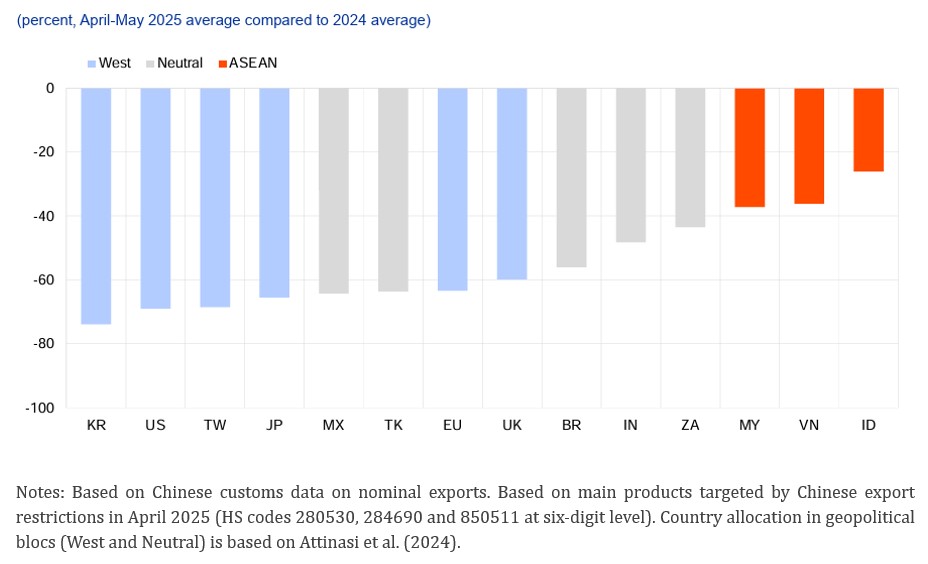
The scenario assumes widespread restrictions. First on products with China not only limiting exports of rare earth ores, but also oxides and rare earth-based products such as alloys or permanent magnets. Second on geographies with export controls affecting all countries. The degree of severity depends on geopolitical distance, assuming that more distant countries are affected more strongly – in line with developments observed during the April-May 2025 episode (Figure 3).
Figure 3. The decline in (reported) Chinese rare earth exports in 2025 reflected geopolitical links
It should be noted that this is not the worst-case scenario of a complete global embargo. It is rather designed as a plausible stress scenario: severe enough to matter economically, but still compatible with China’s incentive to avoid triggering a large-scale diversification of supply chains.
Despite their criticality, the literature analysing the implications of export controls on rare earths remains scarce and the few existing studies generally do not capture the full macroeconomic consequences, notably on inflation. To address this gap, we combine three complementary economic models.
First, a partial equilibrium framework is used to estimate the impact on output, based on a stylised production function with limited substitutability for rare earth inputs. Second, a closed-economy dynamic stochastic general equilibrium (DSGE) model is employed to analyse broader macroeconomic effects on inflation and economic activity. Third, the state-of-the-art multi-country multi-sector (MCMS) model of Aguilar et al. (2026) examines how export restrictions propagate through global supply chains. Taken together, the combined models provide a more complete picture than either approach alone. While the first two models quantify aggregate consequences, the MCMS maps rare earth dependencies across industries and countries, identifying where bottlenecks are most likely to emerge.
The main economic effect of rare earth export controls is a negative supply shock. When firms cannot obtain enough rare earth inputs, production in exposed sectors becomes constrained. This pushes up input costs and limits output in downstream industries.
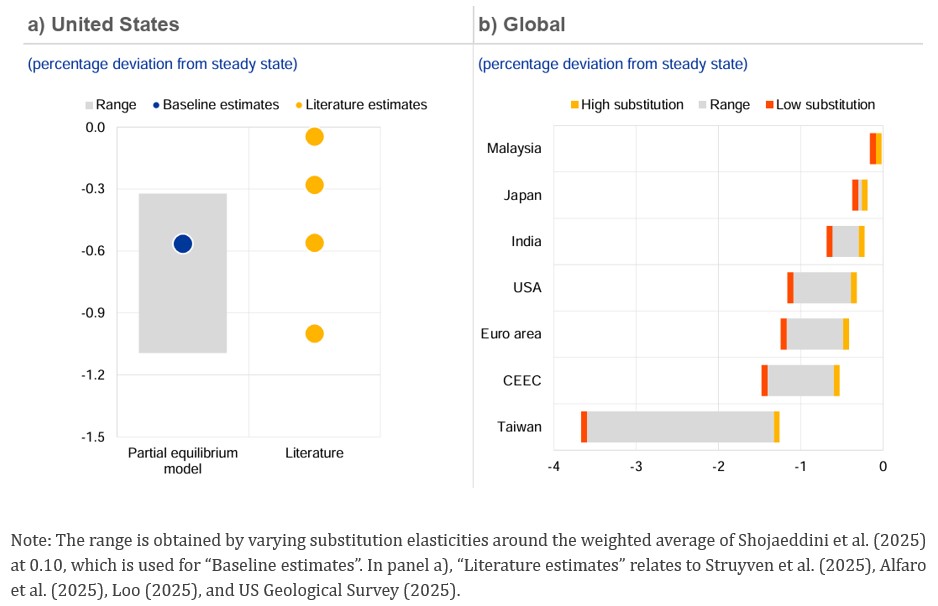
The static partial-equilibrium model points to output losses in the United States between 0.3% and 1.0% – in line with the literature (Figure 4). The range around these estimates highlights the sensitivity of the outcomes to the elasticity of substitution for rare earth inputs, reflecting the dependence of the economic impact to how easily firms can adjust their production lines when rare earths become scarce.
The economic impact of export restrictions would not be evenly distributed, with three factors particularly important. The first is geopolitical distance from China as, in our scenario, countries more geopolitically distant from China face larger reductions in rare earth supply. The second is sectoral structure. Economies with large automotive or electronics, aerospace or defence-related industries are more vulnerable because these sectors rely more on rare earths. The third is dependence on Chinese supply with the US particularly vulnerable because China accounts for around three quarters of its rare earth imports.
Figure 4. Rare earth export controls generate output losses in importing countries
The DSGE model suggests inflationary pressures in importing economies. Export restrictions raise the cost of the inputs, increasing marginal costs and reducing output as firms cannot easily substitute away from rare earths. The resulting surge in input prices feeds into aggregate inflation and triggers general-equilibrium effects.
The inflation effects are primarily quantified using the MCMS model. In this framework, higher input costs feed into producer prices and, gradually, consumer prices. The effect is partly offset by weaker demand as output falls, but the short-run impact remains inflationary for importing economies such as the United States and the euro area. The MCMS results therefore point to a combination of lower activity and temporarily higher inflation, characteristic of an adverse supply shock (Figure 5).
Figure 5. Export controls lower output and raise inflation in importing economies
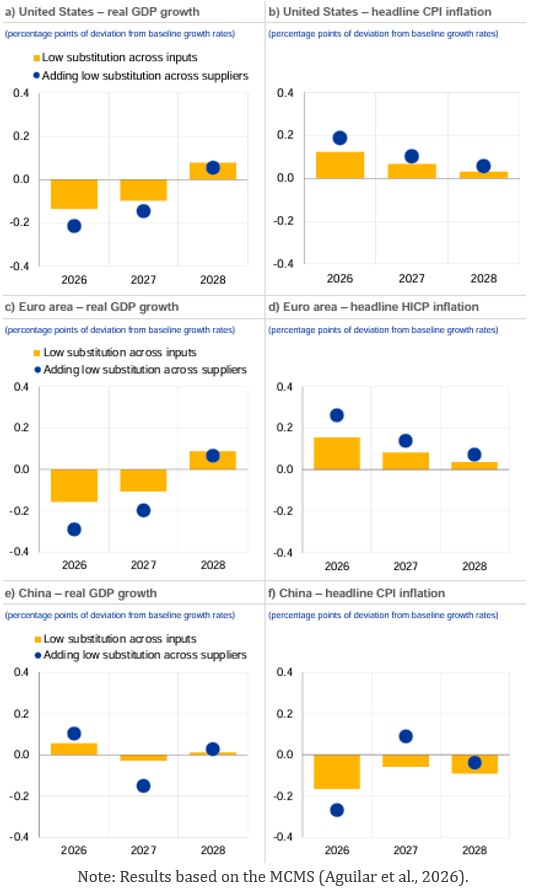
For China, MCMS results suggest that export restrictions generate short-term GDP gains. By limiting foreign access to a globally scarce upstream input while preserving domestic access, China can capture part of the bottleneck rent and temporarily increase domestic value added. However, the model suggests these gains are unlikely to be permanent. Over time, weaker foreign demand, trade re-routing, substitution and investment in alternative supply chains reduce the benefits of export controls.
The MCMS simulations further show that the global consequences remain negative overall. While China may experience limited short-run gains, importing economies (US and EA) face lower output and higher inflation, and global activity weakens as production networks become less efficient. At the global level, therefore, the effect is negative: output falls and inflation rises.
Rare earths illustrate how small inputs can create large strategic vulnerabilities. Their importance stems not from their market value, but from their role in critical supply chains and the difficulty of replacing them in advanced technologies.
Our analysis suggests that persistent but partial restrictions on Chinese rare earth exports could generate meaningful output losses and temporary inflation pressures in importing economies. The effects would be in sectors reliant on rare earth inputs – such as automotive and electronics – but would spill over to the broader economy through higher costs and lower production.
The broader concern is that rare earth export controls may form part of a wider process of geopolitical and technological fragmentation. Restrictions on critical minerals could trigger retaliatory measures in other strategic sectors, increasing uncertainty and reducing the efficiency of global production networks.
Four main policy lessons emerge. First, policymakers should pay close attention to supply-chain bottlenecks, even when the underlying markets are small. Second, inventories and strategic stockpiles can help absorb temporary disruptions. Third, investment in recycling, substitution technologies and alternative suppliers can reduce dependence on concentrated sources of supply. Finally, international cooperation remains essential, as no single country can rapidly replicate the entire rare earth value chain. The objective is not complete self-sufficiency, but greater resilience. Reducing single points of failure in critical supply chains can help limit the economic costs of future disruptions and lessen the scope for strategic leverage through export controls.
Technological Change in Rare Earths”, Working Paper, No 25-059, Harvard Business School.
Aguilar, P., Darracq Pariès, M., Dieppe, A., Eugenelo, A., Gallegos, J-E., Domínguez-Díaz, R. and Quintana, J. (2026), “US-China decoupling and the euro area: assessment from a Global Production Networks Macroeconomic Model”, Working Paper Series, forthcoming, ECB.
Attinasi, M-G., Mancini, M., et al. (2024), “Navigating a fragmenting global trading system: Some lessons for central banks”, Occasional Paper Series, No 365, ECB.
Loo, L. (2025), Beijing flexes its rare earths dominance, again, Research Briefing, Oxford Economics.
Shojaeddini, E., Alonso, E. and Nassar, N.T. (2024), “Estimating price elasticity of demand for mineral commodities used in Lithium-ion batteries in the face of surging demand”, Resources, Conservation and Recycling, 207, 107664.
Struyven, D., Young, P., Thomas, L., Tilton, A., Shan, H., Dinsmore, E. and Bulgin, C. (2025), “Managing Disruption Risk from Rare Earths and Other Critical Minerals”, Commodity Analyst, Goldman Sachs Economics Research.
US Geological Survey (2025), Methodology and Technical Input for the 2025 U.S. List of Critical Minerals – Assessing the Potential Effects of Mineral Commodity Supply Chain Disruptions on the U.S. Economy.