

The views expressed are those of the authors and not necessarily those of the institutions the authors are affiliated with.
Abstract
We study how changes in prudential regulation affect bank competition in two distinct markets: traditional intermediation and fee-based services. Using bank-level data for eight Asian economies for the period 2001–2018, we estimate short-run and long-run competition separately, along with their determinants. We find that banks adjust quickly to regulatory changes in the short run, but that frequent policy changes are costly in the long run: regulatory variability is associated with persistently weaker competition, especially in fee-based activities. Policy instruments also have market-specific effects: stricter capital requirements mainly reduce competition in fee-based services, while stronger supervisory powers mainly reduce competition in lending. The results suggest that prudential frameworks should assess competition across multiple banking markets and avoid unnecessary policy churn.
Prudential and supervisory regulatory reforms are often introduced to strengthen resilience and reduce systemic risk, especially in the aftermath of financial crises. Yet competition is a key part of the transmission from regulation to welfare: it influences credit availability and pricing, incentives to innovate, and the pace at which new entrants and new business models develop. Despite its relevance, the impact of regulation on competition has been largely neglected by academic literature, as interest has focused mainly on its stability implications (Berger and Boot, 2024). A further limitation of extant literature is that it often ignores the multimarket nature of bank production. Alongside the traditional intermediation business (deposit-taking and lending), banks have long expanded into fee-based services such as payments, wealth management, and other non-interest activities. Ignoring this multi-market structure can lead to bias in empirical analyses, and to inaccurate or incomplete policy assessments: reforms that restrict or raise costs in one market may redirect competitive pressures to the other (Shaffer and Spierdijk, 2020).
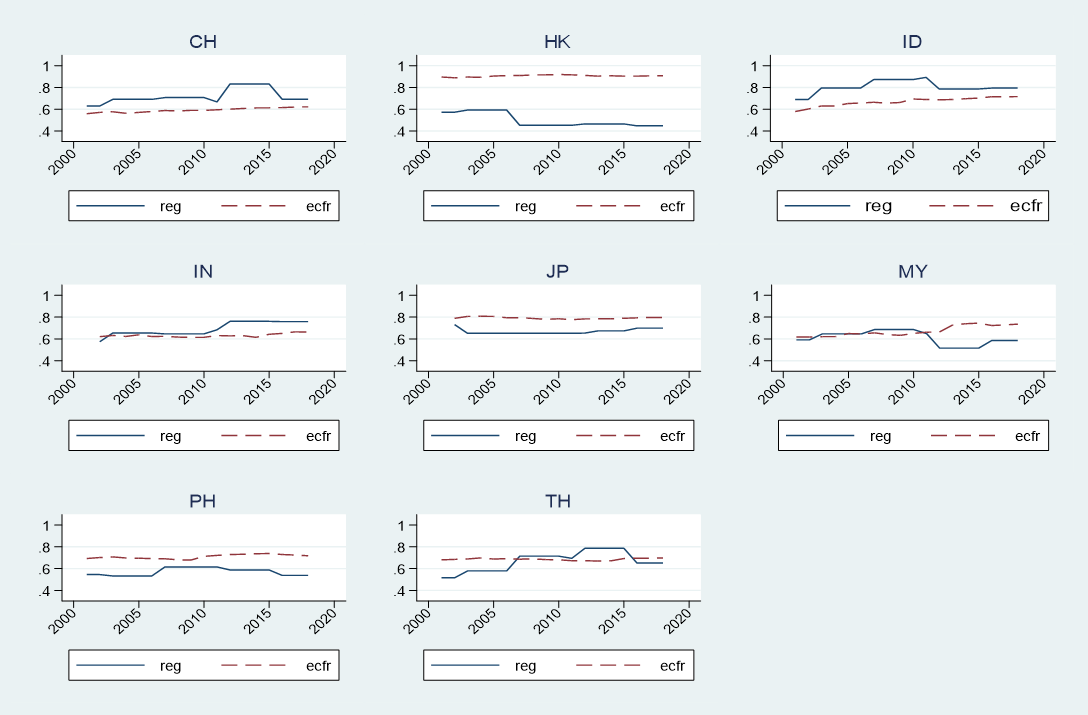
In this work1 we address the above limitations and look at the effect that prudential regulation has on bank competition in separate markets and over different time horizons. Our focus is on the regulatory experience of eight Asian banking systems (China, Hong Kong, India, Indonesia, Japan, Malaysia, the Philippines and Thailand) between 2001 and 2018. The period captures the prudential reforms that followed the Asian Financial Crisis (AFC) and stops with the structural break of the Covid pandemic. The reforms were stability-focused and helped shield the region from the Great Financial Crisis (GFC); competition concerns were not part of the main narrative. While data limitations prevented us from enlarging the analysis to other countries in the region, our sample choice has the advantage of exploiting meaningful cross country variation in development and institutions, while avoiding the extreme heterogeneity of larger global panels and the associated omitted variable risks. Furthermore, since post-AFC key measures were implemented with an explicit stabilization mandate, reverse causality concerns, whereby regulation simply responds to contemporaneous shifts in competition, are mitigated (Kim et al., 2019). Fig 1 shows the aggregate yearly levels of regulatory stringency and economic freedom of the eight countries over the period of observation.
Methodologically we build on recent advances in competition measurement and stochastic frontier methods. Specifically, we adopt the competition-efficiency framework of Bolt and Humphrey (2010, 2015a,b) and extend it to a flexible four component specification (Colombi et al., 2014), which enables us to distinguish short run from long run effects and to model their determinants explicitly: we look at four continuous indices of regulatory stringency from Barth et al. (2001, 2003, 2007, 2013, 2018) – activities restrictions, capital stringency, supervisory powers, and market discipline – and an index of general economic freedom (obtained from the Fraser Institute), along with measures of market structure, bank ownership and an index of output diversification.
In essence, Bolt and Humphrey’s model infers competition indirectly from the composite residual of a net unit revenue equation, after controlling for productivity, risk and other drivers. The composite nature of the error term is what makes it a frontier model, with competition measured as the inefficiency component. This helps avoid the interpretational ambiguity that can arise with mark up measures (e.g., the Lerner index), where price – cost gaps may reflect efficiency or risk differences rather than competitive pressure. A further advantage is that the approach can be implemented separately by output market without being constrained by detailed price or cost data requirements. Finally, our methodological choice of a four component stochastic frontier allows us to separate not only noise from unobserved bank heterogeneity, but also persistent (long run) versus transient (short run) competition, along with their determinants.
Figure. 1. Levels of regulatory stringency (reg) and economic freedom (ecfr) in Asian countries 2001-2018
Competition is lower and more persistent in fee-based services.
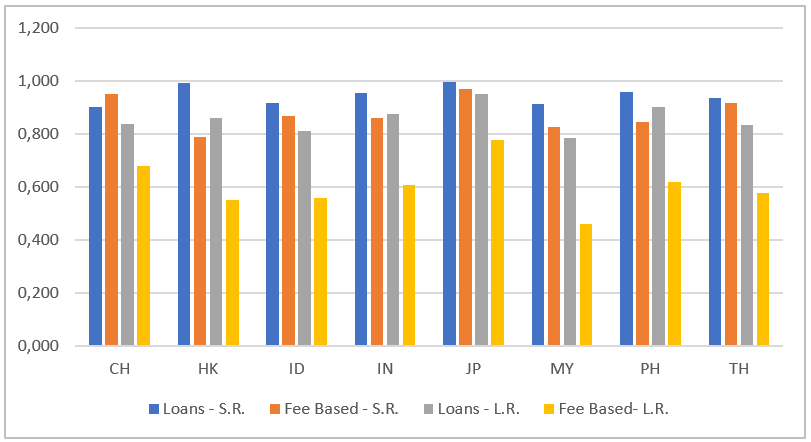
Across countries, we find that competition is typically higher in lending than in fee-based activities. Short-run (transient) competition is relatively high in both markets, but the long-run (persistent) component is notably weaker for fee-based services (see Fig. 2). This is consistent with the idea that banks diversify towards fee income partly because margins are higher and competition is initially lower. Over time, as participation broadens, competition in fee-based services tends to improve, but it remains structurally lower than in lending.
Figure 2. Average short and long run competition in lending and fee-based services
A central finding is that long-run competition responds negatively to regulatory variability. Put simply, banks can adjust operationally to new requirements, but a high frequency of changes (or frequent shifts in the overall stance) increases uncertainty, raises compliance and adjustment costs, and is associated with lower competition over longer horizons. This long-run effect is present in both markets and is stronger for fee-based activities.
We find that in the short run policy tools have directionally similar effects in some, but not all, markets. Fig. 3 shows the relative size and direction of the impact of the main determinants.
Figure 3. Relative size and direction of the main determinants of competition
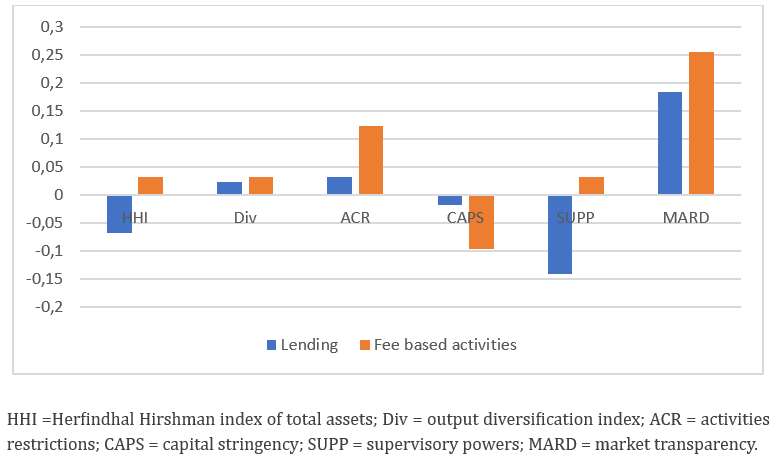
Figure 4. Competitiveness of state and foreign banks relative to domestic private banks
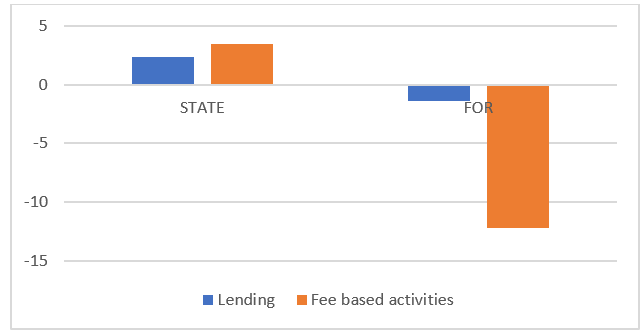
Three main messages emerge from our analysis. First, banks tend to adjust quickly to regulatory change: short run competitive conditions respond promptly and are generally stronger in intermediation than in fee based services. Second, policy volatility matters: frequent or wide ranging regulatory changes are associated with weaker long run competitiveness, with particularly pronounced effects in the newer fee based segment. Third, determinants of competition are market specific. Diversification and broader participation support competition over time; transparency and economic freedom are consistently pro competitive. However, the effects of individual prudential tools diverge: tighter capital requirements curb competition mainly in fee based activities, where banks face competition from non bank providers, while stronger supervisory powers primarily operate through the lending market by shaping credit risk and intermediation discipline. Concentration continues to be associated with weaker competition in lending, and limited foreign bank presence may facilitate selective entry strategies. These findings have clear policy implications. Prudential impact assessments should not focus only on resilience, solvency and credit supply, but also on how reforms reshape competition across banks’ different business lines. A measure that is neutral or desirable from a stability perspective in lending may still weaken banks’ ability to compete in fee-based markets, particularly where non-bank providers face lighter prudential burdens. This argues for a more explicitly multi-market approach to prudential design, together with greater attention to regulatory consistency and predictability over time.
Barth, J. R., Caprio, G., Levine, R. (2001, 2003, 2007, 2013, 2018). The Regulation and Supervision of Banks Around the World: A New Database, World Bank.
Berger A. N., Boot A.W.A. (2024). “Financial intermediation services and competition analysis: review and paths forward for improvements”. Journal of Financial Intermediation, 57, 101072.
Bolt, W., Humphrey, D., (2010). “Bank competition efficiency in Europe: a frontier approach”. Journal of Banking & Finance 34(8), 1808-1817.
Bolt, W., Humphrey, D., (2015a). “A frontier measure of U.S. banking competition”. European Journal of Operational Research, 246(2), 450-461.
Bolt, W., Humphrey, D., (2015b). “Assessing bank competition for consumer loans”. Journal of Banking & Finance 61, 127-141.
Colombi R., Kumbhakar S.C., Martini G., Vittadini G. (2014) “Closed-skew normality in stochastic frontiers with individual effects and long/short run inefficiencies”. Journal of Productivity Analysis, 42, pp. 123-136.
Kim, J., Kim, S., & Mehrotra, A. (2019). “Macroprudential policy in Asia”. Journal of Asian Economics, Vol. 65, p. 101149.
Shaffer, S., Spierdijk, L. (2020). “Measuring multi-product banks market power using the Lerner index”, Journal of Banking and Finance. 117.
The full, detailed version of this paper is available from a.ferrari@lboro.ac.uk.