

This policy brief in based on our paper entitled “Will Payment Innovations Transform the International Monetary System?” Available at SSRN or http://dx.doi.org/10.2139/ssrn.6212980. The views expressed in this paper are those of the authors and do not necessarily reflect the views of the Banque de France.
Abstract
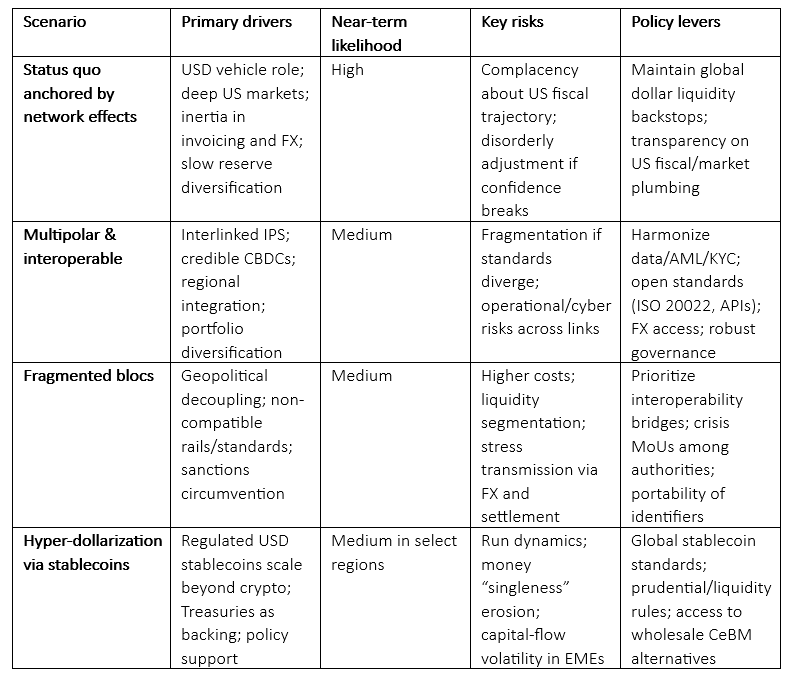
The rise of instant payment systems (IPS), stablecoins and central bank digital currencies (CBDCs) can shift the balance of the international monetary system (IMS). Drawing on recent evidence, we argue that IPS interconnections and regional strategies could gradually reduce the vehicle role of the US dollar by enabling more local‑currency cross‑border payments, provided interoperability avoids financial fragmentation. By contrast, the rapid growth of dollar‑backed stablecoins — enabled by supportive US policy — could entrench or even amplify dollar dominance, including via stronger global demand for US Treasuries. We outline four plausible scenarios: status quo anchored by network externalities; a multipolar system built on interoperable regional rails; a fragmented system of separated blocs; and hyper‑dollarization driven by stablecoins. Factors supporting a significant change in the balance of the IMS nevertheless run up against powerful network externalities, which tend to favour the continued dominance of the dollar, at least in the short run.
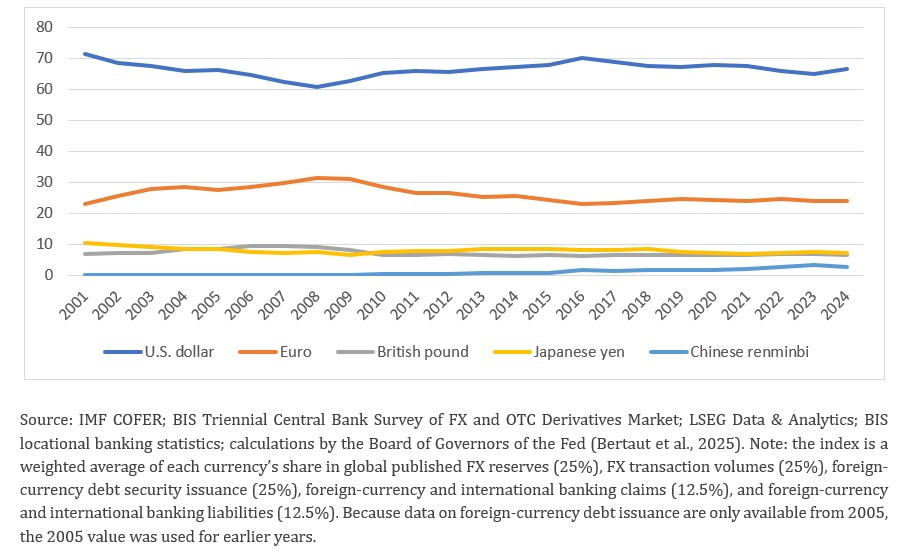
The international monetary system, as we know it today, may undergo major changes driven by technological, economic and geopolitical factors. Some of these changes are structural and may unfold over the long run, while others, potentially abrupt, may operate over a shorter horizon. As of today, cross‑border payments remain too costly, too slow and too opaque in many corridors. But things are rapidly evolving: instant payment systems (IPS) are now operating in most economies and are increasingly being linked across borders, while stablecoins and CBDCs promise alternative rails. Geopolitical tensions and the coercive use of payment infrastructures have intensified the search for greater monetary and digital sovereignty. Meanwhile, the dollar retains outsized roles in invoicing, FX intermediation and reserve portfolios, even as its share in reserves trends down (Figure 1).
Figure 1. Use of currencies (index)
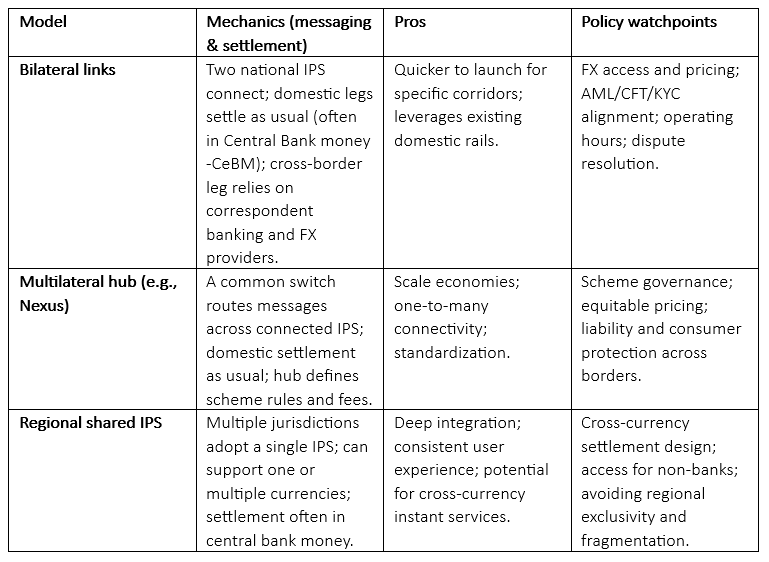
The rise of instant payment systems (IPS) is one of the most striking technological breaks in today’s financial environment. It occurs in a context where regional strategies are emerging that aim to protect or strengthen the monetary sovereignty of these regions or regional alliances. IPS settle retail payments within seconds and have expanded from fewer than 20 jurisdictions a decade ago to well over a hundred today. Interlinking models fall into three families: bilateral links between national IPS; multilateral hubs (e.g., Nexus in Southeast Asia); and shared regional IPS (e.g., TIPS in Europe, PAPSS in Africa).
From a technical standpoint, the expected positive effects of interconnecting these systems stem mainly from simplifying the correspondent banking chain, without necessarily eliminating it. On the so-called “messaging” leg, interconnection projects should make it possible to greatly accelerate the circulation of payment messages between institutions and participants in the interconnected systems, with messages transiting directly between systems and then being subject, domestically, to the rules governing instant payments (i.e., transmission within seconds). The impact on the so-called “settlement” leg of transactions should, however, be more limited: the settlement of cross-border transactions — which involves a foreign-exchange operation and the intervention of settlement banks (including in innovative projects such as Nexus or PAPSS) — will remain largely dependent on existing correspondent banking mechanisms. In theory, these interconnections should reduce transaction costs for institutions, whether directly — via a smaller number of banking intermediaries to remunerate — or indirectly — via reduced liquidity needs to be immobilized with correspondent banks.
Table 1. How IPS interconnection models differ and why it matters
Beyond cost considerations, the development of IPS interconnections is generally driven by a desire to reduce cross-border payment execution times, promote regional financial integration, improve financial inclusion across use cases, but also reduce dependence on the dollar — or even limit dollarization in emerging economies — by curbing the grip of the informal sector on financial flows between countries. One important appeal of these instant payment systems lies in the ability to make payments in local currency, without necessarily passing through a common currency.
The evolution of the international monetary system and the rise of new payment technologies are the result of political choices and strategies in a context marked by geopolitical tensions and a certain questioning of multilateralism. Over the last decade, geopolitical tensions have extended to international payment systems.
These systems are indeed heavily dependent on Western — particularly American — infrastructures. These infrastructures have recently become a powerful instrument of pressure, even of financial coercion, as well as a strong lever for action given the significant extraterritorial powers held by the United States and the central role played by the dollar in international financial transactions.
Tensions that emerged during the tightening of the embargo on Iran in 2018 intensified following sanctions imposed on Russia in response to its military intervention in Ukraine. Beyond these two countries, other countries are now seeking to reduce their dependence on the dollar and on Western payment infrastructures. This is the case of China, supported by other BRICS members (Brazil, Russia, India, China, and South Africa). As an illustration, at the BRICS+ summit hosted by Russia in Kazan in October 2024, BRICS leaders welcomed the increased use of local currencies in international financial transactions and discussed the creation of a new cross-border clearing and depository infrastructure, BRICS Clear. More recently, tensions in the Middle East, due to the war in Iran, have also triggered important decrease in FX reserves in USD, stemming both from FX management to offset the dollar appreciation and, for some countries, the objective of reducing their dollar exposure.
We present four plausible scenarios into a policy‑focused matrix (Table 2). Network externalities, market depth and institutional quality still anchor the dollar today, but payment innovations and geopolitics can push the system along alternative paths, that is, besides the status quo: the emergence of blocks, either organized around several interoperable payment systems or around fragmented regional or politically aligned blocs (for example, the BRICS); the last, by contrast, is hyper dollarization, driven by the rise of dollar-backed stablecoins.
Table 2. IMS scenarios — drivers, near‑term likelihood, risks and policy levers
For central banks and financial regulators, policy priorities include delivering interoperable IPS links; advancing wholesale and retail CBDC with strong singleness, integrity and privacy; ensuring proportionate, globally consistent stablecoin rules; and guarding against financial‑stability externalities. Key aspects to be factored in comprise:
Interconnected IPS can lower costs and speeds for cross‑border payments and support regional integration—but only if interoperability prevents financial fragmentation. Given these advances, A multipolar IMS could emerge over time, even though network effects and depth of US markets still anchor the status quo in the near term. The growing use of Dollar‑backed stablecoins (currently the overwhelming majority of stablecoins) could reinforce the dollar’s international role and demand for US safe assets. Meanwhile, CBDC design and governance — alongside stablecoin regulation — will shape monetary sovereignty, singleness of money and financial stability. However, the development of stablecoins raises many questions. The first concerns their use cases outside the crypto sphere and whether economic agents have an interest in relying on payment instruments that violate the principle of the singleness of money and depend on purely private actors that are little regulated or unregulated. The second concerns risks to financial stability. From this perspective, it is useful to recall the “two-layer market structure” of stablecoins and the reasons for why this complex structure can generate de-pegging risks and run/panic dynamics.
Arslanap S., Eichengreen B., Simpson-Bell C., “The stealth erosion of dollar dominance and the rise of nontraditional reserves”, Journal of International economics, 138, 2022.
Bénassy-Quéré A., “Is tokenization a game-changer for the International Monetary System?”, 15 September 2025.
Bertaut C., Von Beschwitz B., Curcuru S., “The International Role of the Dollar”, FEDS Notes, July 2025.
Eichengreen B., “When the Facts Change: The Future of the Global Monetary System”, CIGI paper No. 321 – June 2025.
Farhi E., Gourinchas P.-O, and Rey H., “Reforming the international monetary system”, CEPR, 2011.
Gopinath, G., Gourinchas, P.-O., Presbitero, A.F. and Topalova, P., “Changing Global Linkages: A new Cold War?”, Journal of International Economics, Vol. 153, 2025
Ma Y., Zeng Y. and Zhang A. L., “Stablecoins Runs and the Centralization of Arbitrage”, NBER Working Paper Series, 33882.
Portes R., Rey H., “The emergence of the euro as an international currency”; Economic Policy, Volume 13, Issue 26, 1 April 1998, Pages 306–343.
Rey H., “Stablecoins, token and global dominance”, Frontiers of Finance Magazine, IMF, September 2025.