

This policy brief is based on ECB Working Paper Series, No 3116. This paper represents the views of the authors. It does not necessarily reflect the views of the European Central Bank.
Abstract
Energy shocks represent major challenges for firm-level investment and economic resilience. Oil supply disruptions, in particular, negatively affect economic activity by increasing inflation and weakening industrial production. Europe’s heavy reliance on imported energy heightens its vulnerability to external shocks, a risk underscored by Russia’s unjustified war against Ukraine.
This policy brief examines how energy shocks impact firm-level investment, comparing EU and US firms’ responses. Using global oil supply news shocks, S&P’s Compustat balance sheet data, and a local projections approach, the analysis reveals that EU firms significantly cut capital expenditures after an oil shock, unlike US firms. The disparity is primarily driven by financially constrained firms in energy-intensive sectors. Additionally, European firms that rely more on market-based financing reduce investment by less: this points to the importance of capital market deepening in Europe, which remains less developed than in the US. The US shale revolution was also a contributing factor in shaping US energy resilience. These findings highlight the importance of policies that secure the energy supply, limit price volatility, and deepen capital markets to enhance EU resilience and future competitiveness.
Energy shocks can pose significant challenges to firm-level investment and broader economic resilience. Among these, oil supply shocks have been extensively studied. A large literature shows that sudden increases in oil prices can slow economic growth, fuel inflation, and weaken industrial activity (e.g., Hamilton, 1996, 2003; Lardic & Mignon, 2006; Zivkov et al., 2019). These effects are particularly relevant for Europe, where dependence on imported fossil fuels remains high and energy-intensive industries play an important role.
By contrast, the United States has reduced its sensitivity to such shocks by boosting self-sufficiency following the shale revolution. Against this background, this policy brief addresses three questions. First, do European firms reduce investment more than US firms after oil price shocks? Second, which mechanisms explain the different responses? And third, what policy measures could mitigate these vulnerabilities?
Using firm-level data from Compustat covering the period 1989–2023, we estimate the dynamic effects of exogenous oil supply news shocks (Känzig, 2021) on corporate investment. The analysis relies on local projections (Jordà, 2005), following recent applications in the corporate finance and macroeconomic literature (e.g. Cloyne et al., 2023; Durante et al., 2022).
The results show a clear contrast between Europe and the United States. European firms respond to oil shocks by significantly cutting investment, while US firms display a much more muted response (Figure 1). For a given oil supply shock, which is calibrated to increase oil prices by 10%, the decline in the investment rate is economically and statistically significant in Europe but insignificant in the US. This suggests that European firms face systematically stronger constraints when adjusting to energy price increases.
Figure 1. Effects of oil price shocks on the investment rate in Europe (left) and the US (right)
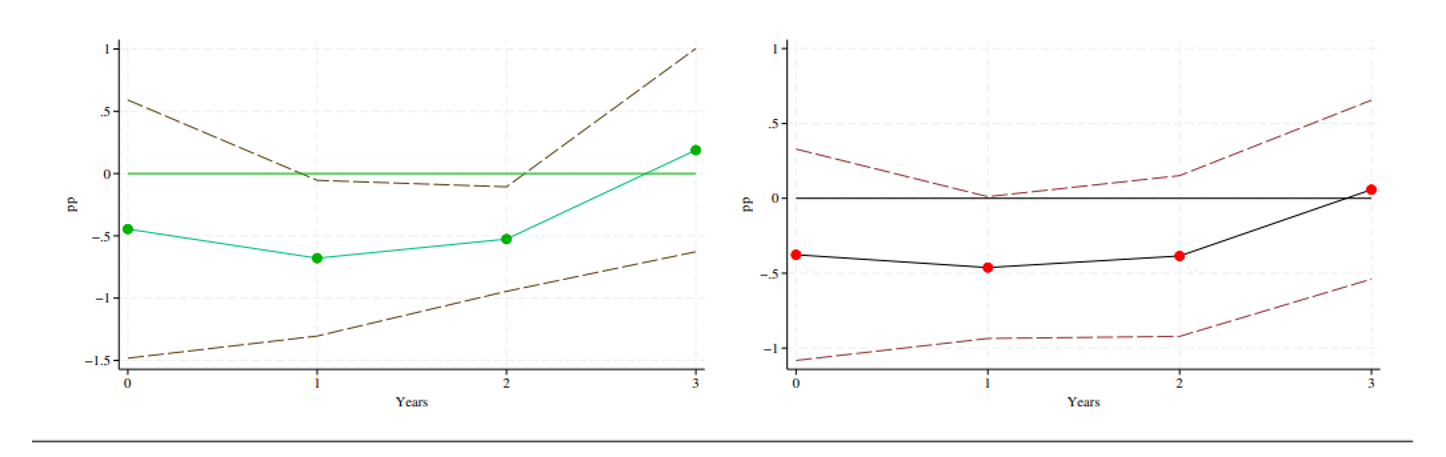
Notes: The dotted lines represent 90% confidence bands, while standard errors are clustered by firm and time following Driscoll & Kraay (1998).
Fixed effects are applied at the firm level.
The asymmetric response is driven by the interaction of energy intensity and financing constraints. European firms, particularly those in energy-intensive sectors, face compounded challenges when energy prices surge. Energy intensity amplifies the impact of price increases, as higher production costs erode profit margins and reduce financial capacity for investment. At the same time, financing constraints limit firms’ ability to react, as many European firms rely heavily on bank-based financing, which tends to tighten during periods of economic uncertainty. This dual vulnerability – high energy intensity coupled with constrained access to capital – explains why in our analysis European firms reduce investment more significantly than their US counterparts when faced with energy shocks (Figure 2).
Figure 2. Impact of oil shock on Investment Rate based on firm characteristics (Europe versus US)
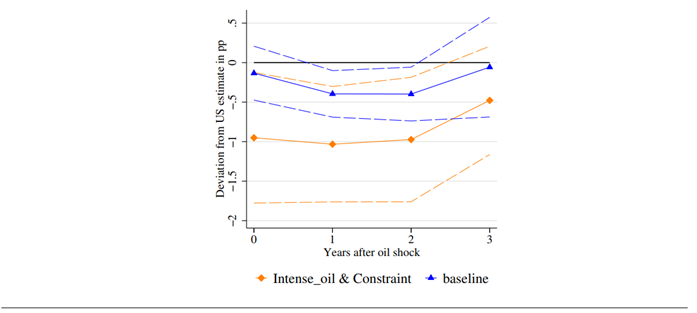
Notes: The dotted lines represent 90% confidence bands, while standard errors are clustered by firm and time following Driscoll & Kraay (1998).
Fixed effects are applied at the firm level.
Consistent with this mechanism, we find that European firms with greater access to market-based financing reduce investment by less following an oil shock (Figure 3). As a result, European firms – that strongly rely on bank loans and private credit – are subject to structural constraints, as banks tend to tighten lending conditions during economic shocks. It is likely that this financing structure amplifies pressures on firms’ investment capacity. Overall, access to market-based finance appears to provide more flexible funding options, allowing firms to smooth investment when costs rise. In the US, where capital markets are deeper and more diversified, firms benefit from this broader set of financing instruments – such as equity and bond issuance – which appears to enhance their resilience to energy price volatility.
Figure 3. Impact of oil shock on European firms’ Capital Expenditure
(based on market vs bank financing)
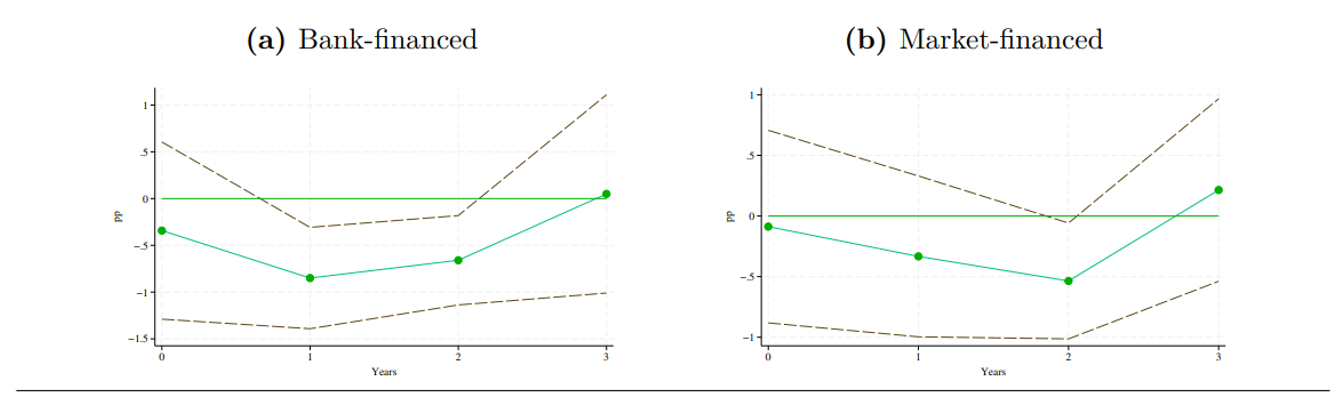
Notes: The dotted lines represent 90% confidence bands, while standard errors are clustered by firm and time following Driscoll & Kraay (1998). Fixed effects are applied at the firm level. Controls applied are the same as in the main text, while due to the merging of Capital IQ with Compustat, the sample of firms is lower by 800 firms in Europe and the US.
While the previous analysis has focused on how European and US firms respond to a given oil price shock, a complementary question is whether firms on the two sides of the Atlantic have been, or are likely to be, exposed to different energy shock environments altogether. In other words, beyond differences in firm behaviour and financing structures, the transmission of global energy price shocks themselves may have diverged across regions.
The US shale revolution represents a fundamental structural break in this respect. By unlocking large-scale domestic oil and gas production, it substantially increased US energy self-sufficiency and reduced reliance on global oil markets. This expansion not only lowered average energy prices, but also dampened their volatility, thereby reducing the sensitivity to adverse energy price shocks faced by US firms. In contrast, Europe remained largely dependent on imported energy, leaving firms more exposed to global oil supply disruptions.
To assess whether the shale boom helps explain differences on the two sides of the Atlantic, we remove from our sample all US firms that could have been affected by post-shale changes. Specifically, we exclude firms in industries that saw a behavioural shift after the shale boom, and firms located in states where economic responsiveness to oil shocks changed significantly. This leaves us with US firms whose shock transmission should reflect pre-shale conditions. Once these restrictions are applied, the main finding – a stronger investment response to oil supply news shocks among European firms – loses statistical significance (Figure 4). While this may partly reflect reduced sample size, it also provides suggestive evidence: the shale revolution likely contributed to the growing gap in how US and European firms react to energy shocks.
Figure 4. Difference EU-US (for the industries and states not affected by the shale revolution)
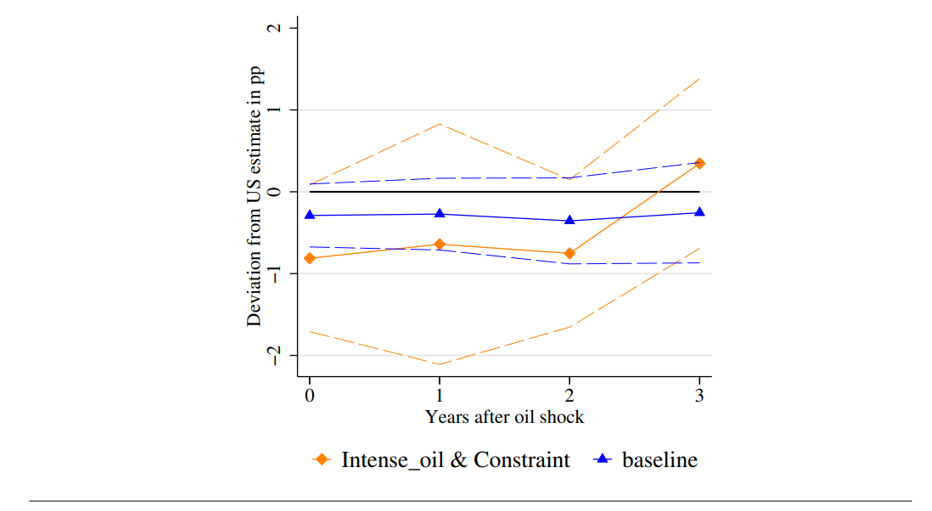
Notes: The dotted lines represent 90% confidence bands, while standard errors are clustered by firm and time following Driscoll & Kraay (1998).
Fixed effects are applied at the firm level
This study shows that European firms remain structurally more vulnerable to oil shocks than US firms. Europe’s reliance on imported energy, together with more shallow and less integrated capital markets, leaves its firms – especially in energy-intensive sectors – more exposed to global energy price swings. These vulnerabilities can be reduced through targeted policy action. Strengthening Europe’s energy resilience, for example through joint EU energy procurement and a faster green transition, would lower dependence on volatile fossil fuel imports. Deepening capital markets through the Savings and Investment Union project would give firms broader access to market-based financing, easing the constraints of bank-dependent credit.
For more details see Anaya Longaric, P., Kostakis, V., Parisi, L., & Vinci, F. (2025).
Anaya Longaric, P., Kostakis, V., Parisi, L., & Vinci, F. (2025). Oil shocks and firm investment on the two sides of the Atlantic. ECB Working Paper N.3116.
Cloyne, J., Ferreira, C., Froemel, M., & Surico, P. (2023, 03). Monetary Policy, Corporate Finance, and Investment. Journal of the European Economic Association, 21(6), 2586-2634.
Durante, E., Ferrando, A., & Vermeulen, P. (2022). Monetary policy, investment and firm heterogeneity. European Economic Review, 148, 104251.
Döttling, R., & Ratnovski, L. (2023). Monetary policy and intangible investment. Journal of Monetary Economics, 134, 53-72.
Hamilton, J. D. (1996). This is what happened to the oil price-macroeconomy relationship. Journal of monetary economics, 38(2), 215-220.
Jordà, O. (2005, March). Estimation and inference of impulse responses by local projections. American Economic Review, 95(1), 161-182.
Känzig, D. R. (2021, April). The Macroeconomic Effects of Oil Supply News: Evidence from OPEC Announcements. American Economic Review, 111(4), 1092-1125.
Lardic, S., & Mignon, V. (2006). The impact of oil prices on GDP in European countries. an empirical investigation based on asymmetric cointegration. Energy Policy, 34(18), 3910-3915.
Zivkov, D., Duraskovic, J., & Manic, S. (2019). How do oil price changes affect inflation in central and eastern European countries? a wavelet-based Markov switching approach. Baltic Journal of Economics, 19(1), 84-104.