

This policy brief is based on Bank of England, Staff Working Paper Nº 1,182 and Banco de España, Documentos de Trabajo Nº 2616. The views expressed are those of the authors and do not necessarily represent those of the Bank of England, the Bank of Spain or the Eurosystem.
Abstract
Consumer and business confidence surveys are widely followed, but what do they actually contain — and does it matter for the macroeconomy? Using firm and household surveys for 22 European countries, we show that unexpected changes in confidence mainly signal future non-technological forces affecting unemployment, rather than future productivity. Positive confidence surprises generate a persistent fall in unemployment, peaking three to four years later, and explain about half of unemployment fluctuations over the business cycle. The shock behaves as a mildly inflationary transitory demand shock, is orthogonal to monetary-policy surprises, and leads professional forecasters to revise unemployment expectations downward. For policy, confidence surveys should be treated as useful early-warning indicators for labour-market conditions.
Consumer and business confidence measures are closely monitored by policymakers, central banks and financial markets because they are published monthly, often ahead of official macroeconomic releases, and directly capture the expectations of firms and households. Yet their interpretation remains contested. Do confidence indicators simply reflect current conditions? Do they contain information about future technological developments? Or do they capture something broader – signals about non-technological forces?
We argue that confidence surveys contain useful and economically large information about future unemployment in Europe. Innovations in confidence – surprises not already explained by current productivity or unemployment – are tightly linked to the forces that drive unemployment over the long run. By contrast, their link to shocks driving long-run productivity is much weaker. This suggests that confidence measures capture news about demand-like conditions and labour market fundamentals, rather than about technology.
The distinction matters for policy. Unemployment adjusts slowly, while survey indicators are available quickly and reflect the real-time expectations of firms and households. If confidence measures embed forward-looking information about labour market conditions, they can help policymakers detect turning points before they appear in unemployment data, offering an early signal of future labour-market pressures.
The analysis draws on five monthly surveys – covering manufacturing, construction, retail trade, services, and consumers – collected by the European Commission for 22 European countries spanning January 2000 to June 2021. Rather than focusing on a single type of agent, as most prior work does, we combine all five surveys into a single confidence factor for each country. This broad-based approach captures a richer picture of confidence across the economy than consumer sentiment or business sentiment alone.
This confidence factor is then studied jointly with unemployment and labour productivity1 in a panel model that extracts a common European picture while still allowing for country-specific dynamics.
A first key result concerns the nature of the information embedded in confidence surveys. We separately identify two types of fundamental shocks — technological and non-technological — from the long-run behaviour of the data, and compare them with innovations in the confidence factor. These confidence innovations are identified as surprises in confidence that are not driven by contemporaneous movements in productivity or unemployment, and they explain most of the forecast-error variance of the confidence factor. Importantly, the correlation between confidence innovations and the long-run shocks is a finding of the analysis, not an assumption.
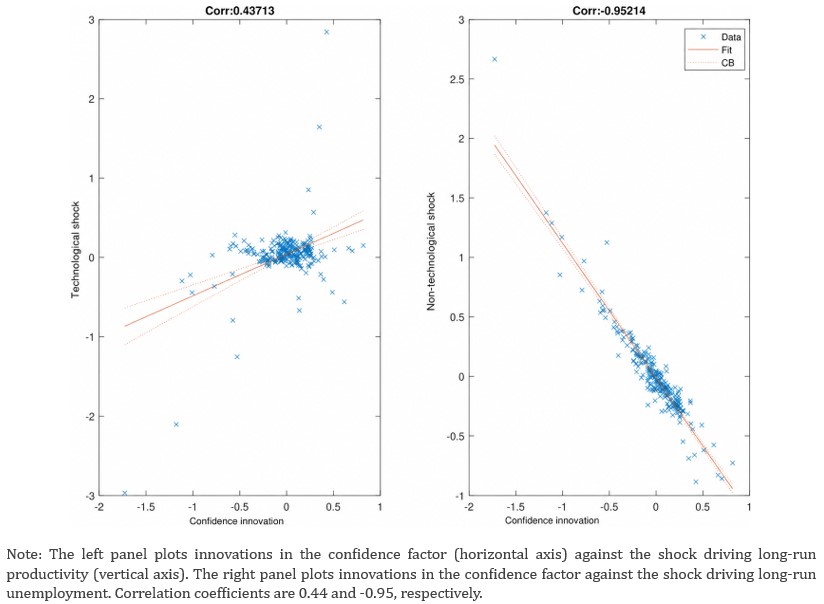
The result is striking. Confidence innovations and the shock driving the long-run behaviour of unemployment are almost perfectly correlated (-0.95), as illustrated in Figure 1. By contrast, the correlation between confidence innovations and the shock driving long-run productivity is much more modest. This means that surprises in confidence surveys closely mirror the non-technological forces that shape labour-market dynamics, while being much less closely related to technological progress.
This finding departs from the focus of most prior news-shock research, which has sought to link forward-looking variables such as stock prices to anticipated technological changes. In our setting, confidence surveys do not mainly capture news about future technology. Instead, they capture news about demand-like conditions and non-technological fundamentals that matter for unemployment.
Figure 1. Confidence innovations and fundamental shocks
The previous section established what confidence measures capture: their innovations are closely aligned with the forces driving persistent movements in unemployment, rather than with those driving long-run productivity. This raises a natural follow-up question: how much of unemployment fluctuations do confidence shocks actually explain, and how does their role compare with other forces in the economy?
To measure the economic importance of confidence shocks, we need to go beyond these correlations. The previous exercise tells us what confidence innovations resemble, but not how much they matter relative to other forces, because the shocks are identified separately using different identification schemes and may partly overlap. We therefore identify technological, non-technological, and confidence shocks together in one framework. This allows us to separate their contributions and compare how much of unemployment fluctuations each one explains.
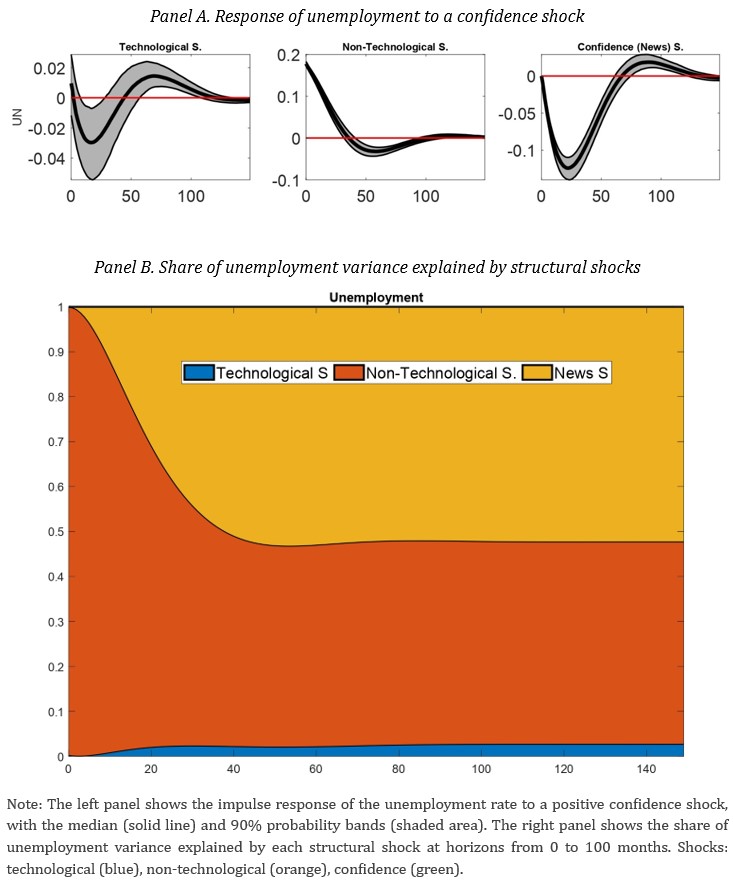
Figure 2 shows how unemployment responds to the different structural shocks we identify. A positive confidence shock — one that raises confidence but does not immediately affect unemployment — is followed by a persistent and significant decline in unemployment. The effect builds gradually, peaks around three to four years after the shock, and remains significant for roughly five years.
The variance decomposition in Figure 2 quantifies how much of unemployment fluctuations each shock explains at different horizons. At horizons below one year, unemployment movements are mainly driven by non-technological shocks: more conventional disturbances already visible in current data. As the horizon extends to business-cycle frequencies, roughly 18 to 96 months, the contribution of confidence shocks rises steadily. Around the three-year mark, confidence shocks become the single largest driver of unemployment fluctuations, accounting for approximately half of its variance. Technological shocks, by contrast, explain only a small share of unemployment fluctuations at business-cycle frequencies, around 4%. This confirms that technologicalimprovements are not the main force moving European unemployment over the business cycle.
Figure 2. Unemployment responses and variance decomposition
Characterising the nature of confidence shocks is important for their policy interpretation. When confidence shocks are studied alongside a broader set of macroeconomic variables – investment, prices, wages, interest rates, vacancies, and fiscal balances – a coherent picture emerges.
A positive confidence shock reduces unemployment persistently while also raising investment, vacancies, wages, prices, and interest rates. The fiscal balance improves on impact, reflecting reduced unemployment-benefit payments and stronger tax revenues. The overall pattern closely resembles a transitory demand shock: one that temporarily boosts labour demand and economic activity without permanently altering the productive capacity of the economy.
Two additional findings help clarify the interpretation. First, confidence shocks are distinct from monetary-policy surprises, suggesting that they are not simply reactions to interest-rate decisions. Second, professional forecasters revise unemployment expectations downward after positive confidence shocks, even though these forecasters play no role in constructing the confidence measures. This provides independent support for the view that confidence shocks contain useful forward-looking information about future labour-market conditions.
How can changes in confidence translate into persistent movements in unemployment? A search-and-matching model of the labour market offers a natural mechanism. When firms receive signals about future labour market tightness, they adjust their vacancy posting today – even before any change in unemployment materialises. This creates a gradual dynamic: improved expectations feed into more vacancies, which translate into lower unemployment over time.
The persistence comes from the way information propagates through belief updating. When firms update their expectations gradually as new information arrives, non-technological news affects vacancy-posting decisions not only on impact, but over time. Under adaptive learning, this belief-updating channel generates persistent unemployment responses similar to those observed in the data.
The results carry three messages for policymakers:
Survey-based confidence measures are often viewed as soft indicators of the current mood of firms and households. The evidence in this work suggests that this view is too narrow. In Europe, broad-based confidence measures seem to contain forward-looking information about the forces that drive unemployment over the medium run. Their innovations are almost perfectly correlated with the non-technological disturbances governing long-run unemployment, while being much less closely related to the productivity shocks emphasised in standard news-shock frameworks.
This information is also economically important. Confidence shocks explain roughly half of unemployment variance at business-cycle frequencies, with effects that peak three to four years after the shock, before the full adjustment is visible in unemployment data. These shocks behave like mildly inflationary transitory demand shocks: they raise vacancies, investment, wages, prices, and interest rates, while reducing unemployment persistently. They also lead professional forecasters to revise unemployment expectations downward, supporting the interpretation that confidence surveys contain useful news about future labour-market conditions.
For policymakers, the implication is clear. Confidence surveys should not be treated merely as descriptive mood indicators. Instead, broad confidence indicators should be used as a timely complement to standard macroeconomic data, particularly for detecting medium-term turning points and emerging labour-market pressures.
Barsky, R. B. and Sims, E. R. (2012). Information, Animal Spirits, and the Meaning of Innovations in Consumer Confidence. American Economic Review, 102(4), 1343-1377.
Beaudry, P. and Portier, F. (2006). Stock Prices, News, and Economic Fluctuations. American Economic Review, 96(4), 1293-1307.
Galí, J. (1999). Technology, Employment, and the Business Cycle: Do Technology Shocks Explain Aggregate Fluctuations? American Economic Review, 89(1), 249-271.
The baseline uses labour productivity because it is available in a harmonised form for all 22 countries. Robustness checks using two alternative TFP measures — a standard Solow residual and utilization-adjusted TFP — deliver similar results for the subset of countries for which these measures are available.