

The views expressed are those of the authors and not necessarily those of the institutions the authors are affiliated with.
Abstract
Central bank digital currencies, tokenised bank deposits, and non-bank stablecoins can offer near-identical payment functionality while resting on very different institutional protections. This column reports evidence from a randomised experiment in France, Germany, and Italy. Even before receiving any information, participants already regard non-bank digital money as substantially riskier than central-bank or commercial-bank alternatives. Precise information about institutional differences in default risk widens this gap further: it lowers perceived central-bank risk, leaves commercial-bank beliefs mostly unchanged, and raises perceived risk for non-bank issuers. All this translates into a sizeable annual interest-rate premium that households require to hold commercial-bank digital money, a premium that rises about three times as much for non-bank private money.
In the ongoing race between new digital currencies, a crucial factor for success will be their relative ability to gain acceptance as a medium of exchange, shaping the demand for money, given their properties as medium of exchanges, store of value and store of information (Masciandaro 2018, Borgonovo et al. 2021, Bindseil et al. 2026).
On the one side, central banks are developing central bank digital currencies (CBDCs) to preserve public access to central-bank money in a digital age (Agur et al. 2022, Auer et al. 2023, Bindseil and Senner 2024, Cipollone 2026). On the other side, the recent wave of innovation in private payment systems has been characterized by the issuance of stablecoins (Danielsson and Macrae 2026, Goel et al. 2026).
CBDCs, tokenised bank deposits, and non-bank stablecoins can be used for the same transactions but they differ materially in issuer default risk. Users are accustomed to the uniformity of cash and bank deposits, and may therefore treat different digital claims as close substitutes even when the protections attached to their issuers differ sharply. In a recent paper (Castagnetti et al. 2026), we test this directly with a randomised survey experiment run in France, Germany, and Italy.
We recruited 800 participants, stratified across the three Euro Area countries. Participants first report their perceived five-year probability of losing part or all of their funds because of issuer default, separately for a CBDC issued by the European Central Bank, a digital currency issued by a European commercial bank, and one issued by a non-bank private company. Even before any information is provided, the ranking is unambiguous: participants assign an average default-risk belief of 10.4% to the central-bank issuer, 20.0% to the commercial-bank issuer, and 36.8% to the non-bank private issuer.
Participants are then randomly assigned to one of three conditions: the Control that discusses digital payments without mentioning default risk; the Institutional Risk Information treatment explains, in general terms, why CBDCs are essentially free of issuer default risk, commercial-bank money carries some risk mitigated by regulation and deposit insurance, and non-bank digital money is generally riskier; and the Salient Risk Examples treatment that adds concrete illustrations – i.e., the collapse of TerraUSD and the failure of Silicon Valley Bank. After the information stage, participants report their beliefs again and complete nine binary choices trading off issuer identity against the annual interest rate offered on each option.
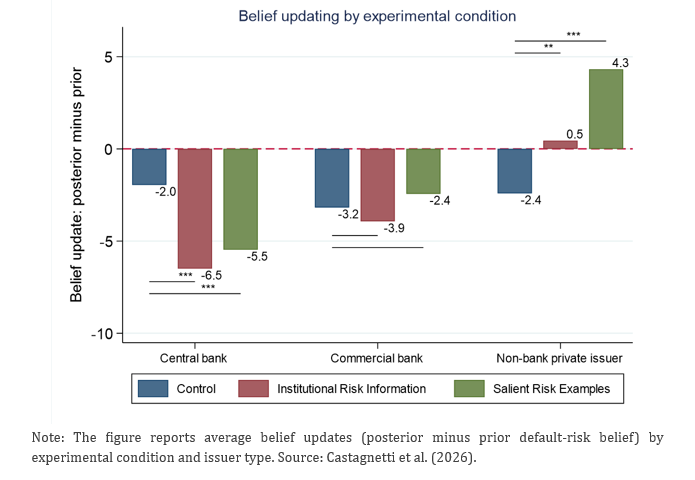
The treatments do not make participants uniformly more pessimistic about digital money. Relative to the active control condition, both treatments produce a significantly larger downward revision in perceived central-bank risk (roughly 4.5 and 3.5 additional percentage points for the institutional-information and salient-examples treatments, respectively), leave commercial-bank beliefs essentially unmoved, and push perceived non-bank risk upward – most strongly under the salient-examples treatment (Figure 1).
Figure 1. Belief updating by experimental condition
Using all nine repeated choices, we estimate a structural random-utility model that converts the trade-off between issuer identity and interest compensation into a willingness-to-accept (WTA) measure: the additional annual interest-rate premium required to select a less-protected issuer. In the active control condition, participants already require a premium of 1.62 percentage points to choose commercial-bank digital money over a CBDC, and a substantially larger premium of 5.24 percentage points to choose non-bank private digital money over a CBDC – an implied additional premium of 3.62 percentage points for a non-bank issuer relative to a commercial bank.
Receiving default-risk information increases every one of these premia. The required premium for commercial-bank digital money rises by 0.42 percentage points, while the premium for non-bank private digital money rises by roughly three times as large an increase. Therefore, the additional compensation required for a non-bank issuer relative to a commercial bank rises by a further 0.87 percentage points. Information does not just move stated beliefs; it moves the price households attach to institutional protection.
Our experiments examined whether information about institutional protection and issuer risk shapes households’ beliefs and choices among digital money issued by central banks, commercial banks, and non-bank private firms. The results show stronger responses among participants who initially perceived non-bank private issuers as relatively safe. Overall, the findings show that information about institutional protection changes beliefs about issuer risk and shapes the acceptance of digital money among European participants.
Taken together, the results indicate that digital monetary claims with similar payment functions are not perceived as economically equivalent. Participants value the institution standing behind the claim and distinguish among central-bank, regulated commercial bank, and non-bank private issuers. This distinction is relevant for financial education, consumer communication, and the European debate on the digital euro. Clear information about issuer identity and the relative ranking of institutional protection may help citizens compare digital monetary claims, while the digital euro could provide a public reference point within a system in which central-bank and regulated private money coexist.
The relevant policy question is not simply whether public digital money should compete with private innovation, but how central-bank money can remain the monetary anchor of an increasingly digital payment system while private institutions continue to provide payment services and credit.
European participants in our experiment distinguish central-bank, regulated commercial-bank, and non-bank private issuers before receiving any information, and information about institutional protection widens this distinction even further, in beliefs and in the interest-rate compensation they demand. For the current European debate around the digital euro, this suggests that its attractiveness will hinge not just on how convenient or well-engineered it is, but on making the institutional safeguards tied to central-bank issuance explicit and clearly communicated.
Agur, I., A.Ari and G.Dell’Ariccia (2022), ”Designing central bank digital currencies”, Journal of Monetary Economics, 12, 62–79.
Auer, R., Cornelli, G., and J. Frost (2023), “Rise of the central bank digital currencies”, International Journal of Central Banking, 19(4):185–214.
Bindseil, U., Brunnermeier, M., Duffie, D., Ingves, S., Scheicher, M. and N. Valla(2026), Money of the Future: Key Policy Issues and Three Scenarios for 2035, SUERF Policy Brief, n. 1507.
Borgonovo, E., Caselli, S., Cillo, A., Masciandaro, D., and G. Rabitti (2021), “Money, Privacy, Anonymity: What Experiments Tell Us?”, Journal of Financial Stability, 56, 100934.
Cipollone, P. (2026), “The future of euro cash: trusted today, designed for tomorrow”, Keynote speech, House of the Euro, Brussels, September, 14.
Castagnetti, A, Cillo, A., Gurrado, G. and D. Masciandaro (2026), “Digital Money, Default Risk, and Financial Information: An Experiment on Europe”, BAFFI Centre Working Paper No. 284, Bocconi University.
Danielsson, J. and R. Macrae (2026), The Geopolitics of Stablecoins, SUERF Policy Brief, n.1440.
Goel, T., Lewrick, U. and I. Agarwal (2026), “Liquidity and Capital Requirements for Stablecoins”, SUERF Policy Brief, n. 1519.
Masciandaro, D. (2018), “Central Bank Digital Cash and Cryptocurrencies: Insights from a New Baumol–Friedman Demand for Money”, Australian Economic Review, 51(4), 540–550.