

The views expressed are those of the authors and do not necessarily reflect those of the institutions with which they are affiliated. There are no conflicts of interest or funding related to this analysis.
Abstract
How strongly are world food prices associated with Greek consumer food prices, and does the direction of the shock matter? Using quarterly data from 2001Q1 to 2026Q1, we find a robust and stable long-run cointegrating relationship between international and Greek food prices, characterised by pronounced asymmetry. Across all nonlinear specifications for aggregate food prices, the long-run elasticity for international price increases exceeds that for decreases and symmetry is rejected at 1% level. Evidence on declining global food prices is mixed, with some specifications even suggesting a negative association with domestic prices. We also find a persistent upward level shift in Greek prices since 2022Q2 and that geopolitical risk intensifies the positive association between global and domestic food prices. These findings suggest that easing world food prices alone may not be sufficient to deliver comparable relief for Greek consumers.
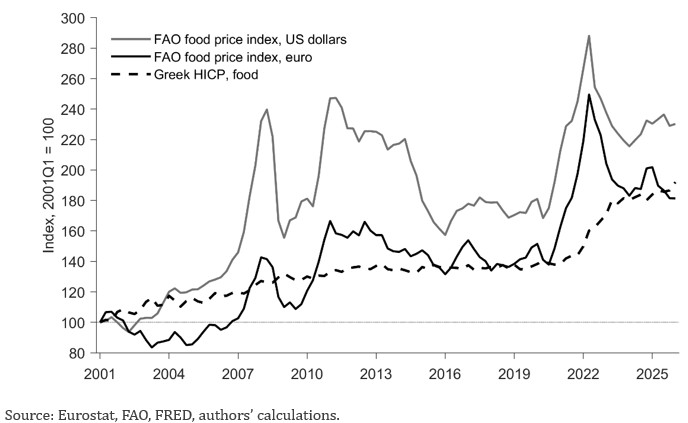
International food prices are highly volatile, while Greek consumer food prices move more smoothly and rarely reverse previous increases (Figure 1). Global food prices skyrocketed from mid-2020 to 2022Q2 and subsequently eased until 2024Q1. Next, they increased, and stabilised at 2024Q4 levels in USD terms, but in euro terms they returned to 2024Q1 levels reflecting the euro’s appreciation against the USD. In Greece, domestic prices have been rising almost without interruption since 2021Q1, and the divergence from international movements became particularly evident during the 2022Q2-2024Q1 period when global food prices plummeted. Between the global peak of 2022Q2 and 2026Q1 the FAO index in euro (USD) fell by about 27% (20%), while Greek food prices rose by 20%.
Figure 1. FAO food price index in USD and in euro, and the Greek food HICP
(2001Q1-2026Q1, 2001Q1 = 100)
The policy question is therefore not simply whether international food prices matter, but whether increases and decreases are correlated the same way, or symmetrically, with domestic food prices, and whether geopolitical upheavals change the relationship’s strength. Consequently, two research questions arise: (RQ1) Do international price increases leave a more pronounced and persistent imprint on domestic prices than decreases? and (RQ2) Does geopolitical risk amplify the channel of international prices?
We match the FAO Food Price Index and its five sub-indices to the corresponding categories of the Greek Harmonised Index of Consumer Prices (HICP), using quarterly observations from 2001Q1 to 2026Q1. FAO series are converted into euro, and the estimated models control for geopolitical risk, shipping costs and domestic demand.
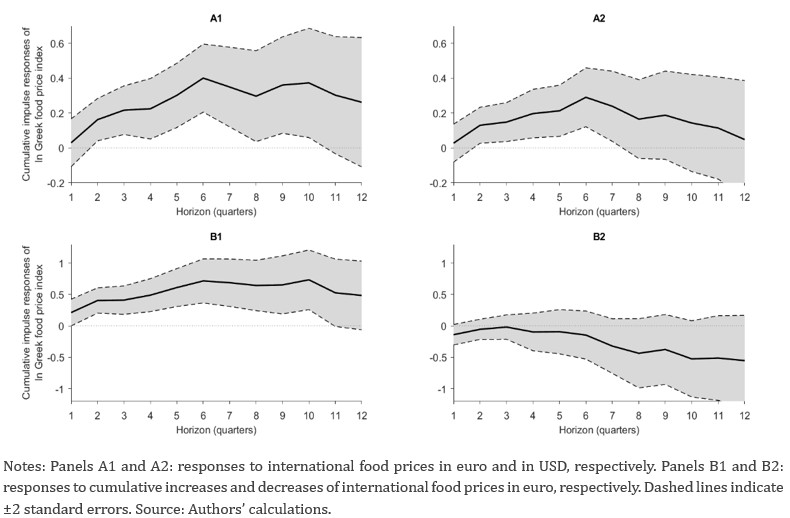
Across the symmetric ARDL specifications, the estimated long-run elasticity of Greek food prices with respect to international food prices is positive and statistically significant at 1% level; in the specification that allows for a permanent level shift from 2022Q2, the elasticity is 0.39, and without that shift it rises to 0.75. Alternative cointegrating estimators (FMOLS, CCR, DOLS) also produce positive and statistically significant long-run elasticities, and lag-augmented local projections -which handle unit roots and cointegration- yield positive cumulative responses (Figure 2, panels A1 and A2) that are jointly significant across the examined horizons. These symmetric results are qualitatively robust to using the FAO index in USD.
Figure 2. Cumulative impulse responses of domestic food prices
(estimates from lag-augmented local projections)
The central result emerges when increases and decreases in international food prices are allowed to have different effects. In the NARDL model with the 2022Q2 step dummy, the long-run elasticity is 0.262 for cumulative increases and 0.151 for cumulative decreases. Both coefficients are statistically significant, but their difference is also highly significant (the null of symmetry is rejected at 1% level). The estimated response to increases is therefore about 74% larger than that to decreases. In the specification without that step dummy, the respective long-run elasticities are 0.430 and 0.282, with their difference being statistically different at 1% level; the estimated effect of increases is about 52% larger than that of decreases. Overall, evidence in favour of the “rockets and feathers” hypothesis is found (e.g. Greenwood-Nimmo & Shin, 2013).
This asymmetric pattern (see also Hukkinen & Virén, 2024, regarding EA inflation asymmetries) survives a broad set of robustness exercises, and it is also confirmed by alternative estimators. DOLS continues to find a positive but smaller response to decreases, whereas FMOLS and CCR estimate negative but statistically insignificant coefficients on the downward component. Lag-augmented local projections likewise confirm statistically significant asymmetry and provide evidence that domestic prices may continue to rise during international downswings; such a pattern is observed during 2022Q2-2024Q1 in Figure 1. The exact response on the way down therefore varies across methods, but the robust result is that the response to international increases is substantially stronger.
Our models also find a permanent upward shift in Greek food prices from 2022Q2. The estimated shift is about 4% (5%) in the (N)ARDL models, over and above what is associated with international food prices, shipping costs, geopolitical risk and domestic demand. This suggests that the post-2022 period cannot be understood solely as a conventional commodity-price shock followed by normal reversal (Peersman, 2026; Kuik et al., 2024).
Based on (N)ARDL models, cereals are the only category for which, in every specification, stable cointegration is established and asymmetry is detected. Regarding meat and dairy, cointegration is established in the ARDLs with the step dummy, while in the NARDLs the evidence is partial. Finally, for sugar and oils the linkage between global and domestic prices is absent or very weak.
The oils result is economically plausible because the Greek HICP category is dominated by olive oil, whose price is driven primarily by Mediterranean production conditions rather than the global vegetable-oil market. The sugar category is also broader than the corresponding raw commodity index, weakening the match between international input and retail basket.
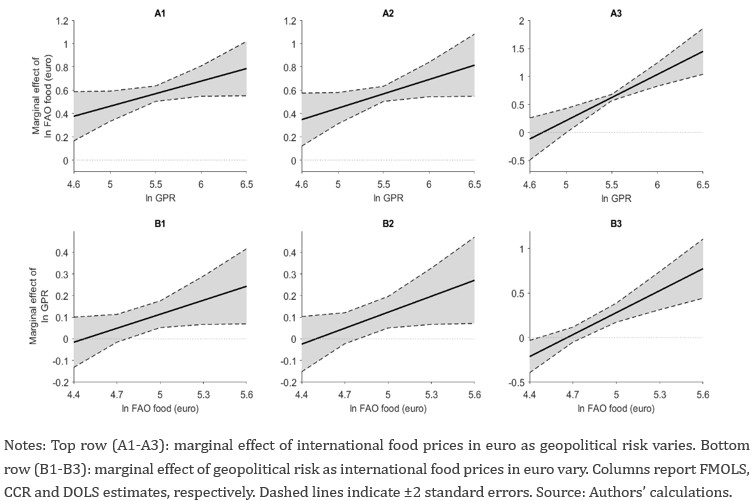
Another central empirical finding is that geopolitical risk alters the strength of the association between global and Greek food prices; this result is robust to using the FAO index in USD. Cointegrating regressions with an interaction of the FAO food price index and the geopolitical risk index show a positive interaction term. Namely, as geopolitical risk rises, the marginal effect of international food prices on Greek food prices becomes larger (Figure 3, panels A1-A3).
With FMOLS and CCR, the long-run elasticity of Greek food prices with respect to the FAO index rises from roughly 0.36 at the minimum observed level of geopolitical risk to approximately 0.80 at its maximum. DOLS produces an even steeper gradient; the elasticity is not significantly different from zero at the lowest observed levels of geopolitical risk, reaches about 0.62 at the midpoint of the observed range and about 1.45 at the maximum. Conversely, the marginal effect of geopolitical risk itself becomes clearly positive especially when global food prices are at moderate or high levels (Figure 3, panels B1-B3).
Figure 3. Long-run effects of international food prices and geopolitical risk on Greek consumer food prices
Empirical results from interaction models imply that geopolitical escalation could amplify the sensitivity of Greek food prices to global food-price developments. This makes the state of geopolitical risk relevant not only as a separate inflationary influence (Boungou et al., 2026; Caldara et al., 2026; Nogueira et al., 2026; Lazaretou & Palaiodimos, 2025; Asadollah et al., 2024; Bertsatos, 2023), but also as a conditioning factor for the association with international food shocks and this is the first time -to the best of our knowledge- that such an interconnection is established.
Our results point to four policy-relevant conclusions. First, all findings from linear models suggest a robust and positive correlation between domestic and international food prices. Moreover, findings from nonlinear models conclude that increases in international food prices are more strongly associated with domestic prices than global decreases (validating the “rockets and feathers” hypothesis), and that soaring movements in global food prices are positively correlated with domestic food prices.
Second, falling international food prices should not be expected to generate a “mirror-image” decline in Greek retail food prices as a series of estimators provide mixed evidence on the direction of the response during international downswings. Estimates from NARDL and DOLS estimators do show some downward effects, but they are markedly weaker than the effects of increases. Next, statistically insignificant effects of decreasing global food prices are supported by FMOLS and CCR estimators and finally, lag-augmented local projections provide evidence that downward international food movements may be related to increasing domestic food prices.
Third, price monitoring should become more intensive during periods of “geopolitical Armageddons”. The estimated sensitivity of Greek food prices to world prices rises materially with geopolitical risk. This makes global tensions a useful signal for domestic inflation surveillance even before the full effect appears in retail prices.
Fourth, aggregate food price levels are too coarse to diagnose precise impacts. The contrast between cereals, meat and dairy on the one hand and oils and sugar on the other shows that the link depends strongly on the distance between the traded commodity and final retail product, as well as on the structure of the relevant domestic or regional market.
Our analysis uses quarterly data for 2001Q1-2026Q1. International food prices are measured by the FAO Food Price Index and five sub-indices, converted into euro (with quarterly averages of daily nominal euro/USD exchange rates) and matched to Greek HICP food categories. The empirical strategy combines linear and nonlinear ARDL models with alternative cointegrating regressions (FMOLS, CCR, DOLS) and lag-augmented local projections. Model specifications include the geopolitical risk index of Caldara and Iacoviello (2022), the Baltic Dry Index and Greece’s real GDP, together with seasonal controls (quarterly dummies); specifications with and without a 2022Q2 step shift, which had previously been selected endogenously, are estimated.
The estimated coefficients of international food prices are reduced-form elasticities rather than structural pass-through rates because consistent data on domestic production, import shares, import prices and market concentration are not available at the required frequency and product detail. The analysis therefore documents the asymmetry robustly but cannot identify whether it reflects market structure and concentration, consumer search, pricing frictions or other mechanisms. More disaggregated ECOICOP data would allow for a closer match between global commodities and Greek food subcategories, but Eurostat provides them only from late 2014, which would drastically shorten the sample.
Asadollah, O., Carmy, L. S., Hoque, M. R. and Yilmazkuday, H. (2024), “Geopolitical risk, supply chains, and global inflation”, The World Economy, 47(8), 3450-3486.
Bertsatos, G. (2023), “International developments on inflation and banks – Market concentration and interest rate policy of the Greek banking system”, Greek Economic Outlook, 51, 87-99.
Boungou, W., Moussavou, S. D. M. and N’Doua, B. D. (2026), “Geopolitical risk and inflation: Does central bank independence matter?”, Economics Letters, 268, 113171.
Caldara, D., Conlisk, S., Iacoviello, M. and Penn, M. (2026), “Do geopolitical risks raise or lower inflation?”, Journal of International Economics, 159, 104188.
Caldara, D. and Iacoviello, M. (2022), “Measuring Geopolitical Risk”, American Economic Review 112(4), 1194-1225.
Greenwood-Nimmo, M. and Shin, Y. (2013), “Taxation and the asymmetric adjustment of selected retail energy prices in the UK”, Economics Letters, 121(3), 411-416.
Hukkinen, J. and Virén, M. (2024), “Does inflation come and go in the same way?”, SUERF Policy Brief No 774.
Kuik, F., Lis, E. M., Paredes, J. and Rubene, I. (2024), “What were the drivers of euro area food price inflation over the last two years?”, ECB Economic Bulletin, Issue 2/2024.
Lazaretou, S. and Palaiodimos, G. (2025), “The long record of inflation shocks in Greece: drivers and impacts”, Bank of Greece, Economic Bulletin, 61, 63-86.
Nogueira, I. L., de Araujo Moxotó, A. C., and da Rocha Oliveira Junior, A. (2026), “Geopolitical Risk and Food Inflation”, Thunderbird International Business Review, 68(2), 165-176.
Peersman, G. (2026), “Understanding Post-Pandemic Inflation Fluctuations: The Commodity Cost Channel”, CESifo Working Paper No. 12415, Munich.