

This policy note is based on P. Wessels (2026) “Understanding Central Bank Profitability” in Journal of Central Banking Theory and Practice.
Abstract
In recent years, a number of central banks have been suffering significant losses following the increases of policy interest rates after COVID19. This raises the question what can be done about central bank profits. Using the Return-on-Equity (RoE) metric and for the case of De Nederlandsche Bank, we study three perspectives of central bank profits, each with its own relevance, i.e. (1) the annual report annual profit (ARAP), (2) the provision-adjusted annual profit (PAAP), and (3) the fully-included annual profit (FIAP). We argue that for central banks, the medium-term average RoE should be larger than the average growth of the Gross Domestic Product (GDP) in order to keep pace with the underlying latent risks. We conclude with recommendations to understand profitability drivers and to include profitability considerations in the management of balance sheet items where possible.
The past decade has shown that central bank profitability is not a given. Large quantitative easing programmes (QE) initially supported profitability to some extent but also locked in low yields on the QE holdings for a long period. And over recent years, a number of central banks have suffered significant losses, as a result of the large increases in policy interest rates following the high inflation period after COVID19. The multibillion losses for a number of central banks have generated significant public attention (Bell, S., Chui, M., Gomes, T., Moser-Boehm, P. and Pierres Tejada, A., 2023; Belhocine, N., Vir Bhatia, A. and Frie, J., 2023; Nordström, A. and Vredin, A., 2022; and DNB, 2022).
In this note, the topic of central bank profitability is revisited. What are central bank profits and why do they matter? And what possibilities do central banks have to influence their profits? The note concludes that central banks can influence their profits – without compromising on the core task of monetary policy implementation. The insights apply to standalone central banks as well as Eurosystem national central banks (NCBs). The topic of a priori influencing central bank profits has received little attention so far but may become more prominent going forward. An extended version of this note has been published in Wessels, P. (2026).
It is sometimes argued that central bank profits, and by extension central bank losses, are of little relevance – usually to calm down public concerns (Carstens, A., 2023). However, although central bank losses can be an accepted consequence of necessary monetary policy (risks), they are regrettable as they constitute public money that could have been otherwise used in government budgets for public purposes such as education and healthcare.
Also, over the years consensus has emerged that financial strength supports the central bank’s independence and effectiveness in the execution of its policy mandate (Stella, P., 1997, 2002; Archer, D. et al., 2013). A financially strong central bank holds sufficient capital and is able to maintain it through retention of its own profits (Wessels, P., 2024, 2026). A recent overview of work on central bank capital is given in Broeders, D., Bonetti, M. and Houben, A. (editors, 2025).
For a central bank, the annual profits are usually the main source of capital growth. In order to keep capital on appropriate levels, it has to grow over time along with the underlying financial risks. For central banks the financial risks consist of both calculable risks and the non-calculable, latent risks. These ‘latent risks’ are financial risks due to contingent policy measures which the central bank may have to deploy on the basis of its mandate, but which are unknown as yet. Examples of such contingent policy measures are a future QE programme or a future lender of last resort programme (LOLR) for a commercial bank. These latent risks develop roughly in line with macroeconomic variables, such as GDP, over a longer period of time (Wessels, P., and Broeders, D., 2022a, 2022b, 2023).
Therefore, in order to remain financially strong, central bank profits should be large enough to grow capital in line with GDP. An important prerequisite is that the central bank has the autonomy to decide how to use its profits, not being restricted by the government as shareholder demanding dividend. Also, capital injections from the government are in principle undesirable as they could raise questions about the standalone effectiveness (and independence) of the central bank.
Apart from the relevance of profits for capital, a central bank is generally also concerned about public perception as a matter of credibility. Years with central bank losses may attract bad publicity with the suspicion of inefficient management or even carelessness. And this may also lead to scrutiny towards the central bank (policy) measures that caused the losses, thereby eroding its credibility. Goncharov, I., Ioannidou, V. and Schmalz, M.C. (2023) show that central banks are concerned with public perception and aim to avoid reporting annual losses.
Generally, central bank objectives do not include profitability. A central bank that would have prominent profitability objectives could be tempted to focus on profits at the expense of price stability or financial stability. Therefore, central bank profits should only be taken into consideration insofar the policy mandate allows (not interfering with the policy objectives), and to the extent that they contribute to a (rather modest) medium-term growth of capital in line with GDP.
In case of central banks there are various perspectives on what constitutes the annual profit. The first is the most straightforward, i.e. the annual result from the income statement (P&L) as reported in the annual report.
The second perspective is a broader definition of the annual profit and includes the change in the General Risk Provision (GRP) in a given year. Many central banks (e.g. those in the Eurosystem) have the possibility to build a GRP that is under the full control of the central bank serving as de facto capital and helping to maintain financial independence from the government.
The third perspective includes the changes in the so-called revaluation reserves (RRs), in addition to the changes in the GRP. These RRs are accounts which keep track of valuation gains linked to specific instruments (like government bonds or FX instruments) or certain holdings (e.g. gold). When the price of gold goes up, the unrealised valuation gains are added to the gold RR. When the gold price goes down, the valuation losses are taken from the RR. When the RR is completely depleted, any additional valuation losses are taken to the income statement, i.e. they are subtracted from annual profit.
Due to many years of historical gold price increases, the RRs for gold in the Eurosystem are exceptionally large. In principle, these RRs are shareholder equity sitting elsewhere on the balance sheet under a different name. As a result, the changes in these RRs are (valuation) profits or losses not included in the official income statement. Only when the asset is sold or matures (for a bond instrument) is the corresponding RR released and taken to the income statement where it ends up in the annual profit.
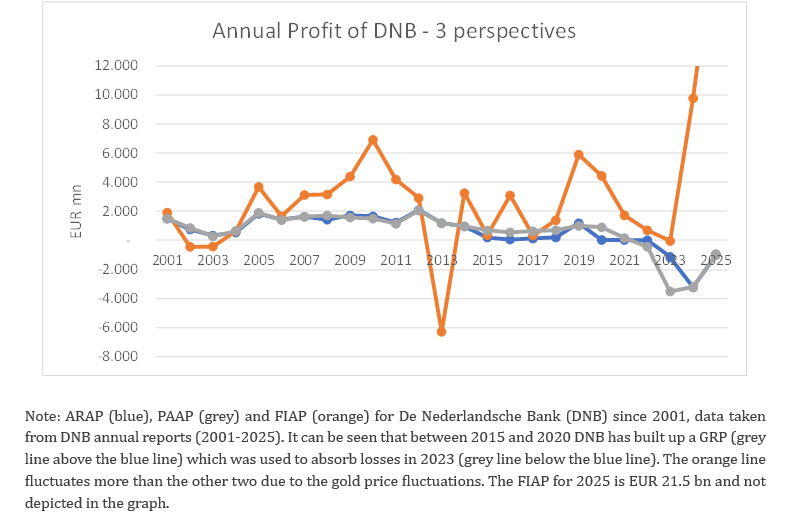
In figure 1, the annual profit of De Nederlandsche Bank (DNB) is shown according to these three perspectives (DNB, 2001-2024):
The FIAP includes the unrealised (valuation) gains and losses of gold and other assets and is in fact the aggregate annual economic profit. At the end of the financial year, the PAAP is the result of the central bank’s policy decisions and other operations over the year. At that point the central bank decides what part of the PAAP will be allocated to the GRP, or alternatively, what part of the GRP will be taken to the PAAP. The result of this decision is the ARAP.
The PAAP and the ARAP of DNB are quite closely aligned in most years. In the years 2015-2020 there was a gradual build-up of the GRP (ARAP below PAAP), with a large extraction from the GRP in 2023 due to the materialisation of interest rate risk (PAAP below ARAP). The FIAP of DNB over the last 24 years is more erratic than the other two, mainly due to the large gold holdings (EUR 72.2 bn at the end of 2025). In a way the use of RRs prevents the transmission of this erraticism and smoothens the PAAP and ARAP profiles over time.
Figure 1.
Profitability can be measured with the Return-on-Equity (RoE) metric, generically defined as follows:

Here, the net income is the annual profit, after costs and losses. Depending on the perspective, this can be ARAP, PAAP or FIAP. The capital figure is the risk buffer corresponding to the relevant profit metric. For ARAP the capital should be shareholder equity. For PAAP the corresponding risk buffer is shareholder equity + GRP. For FIAP, the capital figure should be shareholder equity + GRP + RRs.

Figure 2 and table 1 show the RoEs of DNB according to the three perspectives. Table 1 shows both the full period (2001-2024) as well as three sub-periods, before QE (2001-2013), during QE (2014-2021) and after QE (2022-2025).
Figure 2.
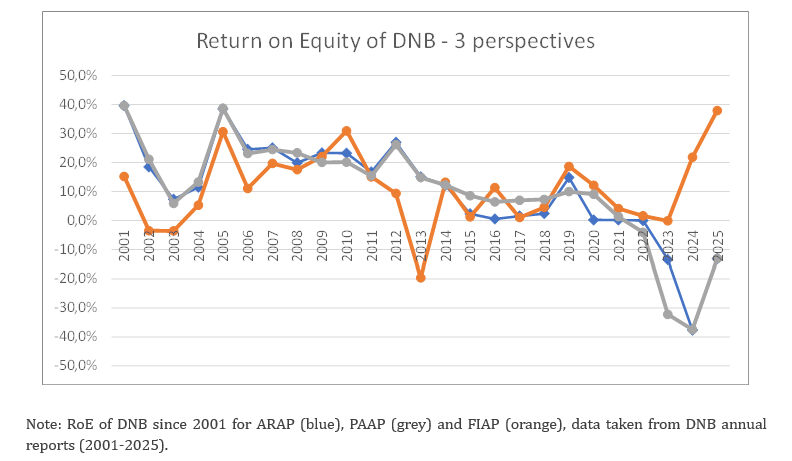
Table 1.
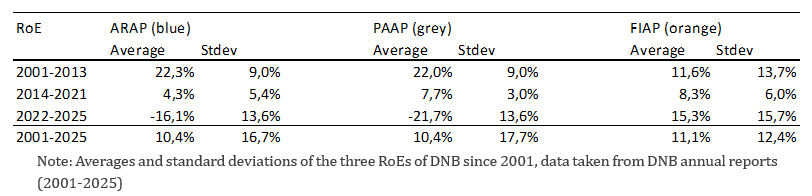
The DNB RoEs over the full period 2001-2025 are quite good, with averages in all three cases (ARAP, PAAP and FIAP) above 10%, although standard deviations are high. For ARAP and PAAP, the years 2014-2021 are worse than those between 2001-2013 due to the low interest rates and large QE programmes. The recent years after 2021 are particularly bad for ARAP and PAAP due to the losses from the materialisation of interest rate risk. For FIAP the average was also lower in the period 2014-2021, but increased again after 2021 due to the large gold price increases.
For the coming years, the DNB RoEs for ARAP and PAAP will probably continue to be negative (or slightly positive), due to the materialisation of interest rate risk (DNB, 2025). Possibly the RoEs will settle on structurally lower levels, underlining the case for understanding and influencing central bank profitability (to the extent possible).
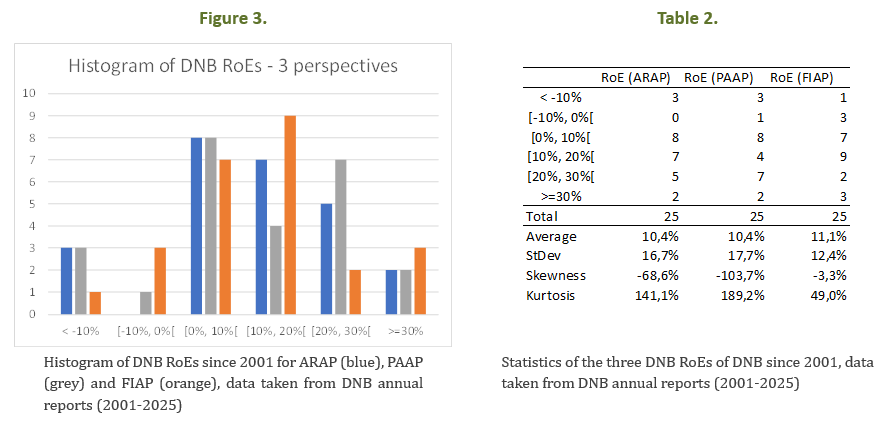
The histogram and statistics of the three RoE perspectives (Figure 3 and Table 2) show that the ARAP and PAAP RoE distribution characteristics are more extreme than the FIAP RoEs, i.e. skewness is more negative (i.e. more left-tailed) and the kurtosis is significantly more positive (i.e. more peaked and more fat-tailed) – even though we should be cautious as there are only 25 data points.
This may seem counterintuitive as the FIAP RoEs are more erratic from a visual standpoint (see Figure 2). However, the FIAP RoEs are dominated by the gold price movements and this source of fluctuations is, although erratic, rather stable over time. In contrast, the ARAP and PAAP RoEs follow a downward trend over 2001-2025, driven by the rest of the balance sheet (without the gold) and reflecting significant changes in the economic environment and policy stances of the Eurosystem.
Visually, it can also be observed that there are no ARAP values just below 0 (in the bucket >= – 10% and < 0%) and only one PAAP value, in contrast to the three FIAP values. This is in line with the conclusion of Goncharov et al. (2023) that central banks aim to avoid showing (slightly) negative annual profits.
As was stated in section 2, central bank profits should be large enough to grow capital in line with GDP in order to keep pace with the underlying development of latent risks. Assuming central bank capital is on an acceptable level, an appropriate target for the central bank RoE would then be preferably higher than the average GDP growth over the medium term of 5-10 years:

As an example, if a country has an average (nominal) GDP growth of 3% over the last 10 years, the central bank would prefer an RoE at least as high. In case of an average, realised RoE of 4%, the central bank could retain 75% of the profits to ensure sufficient capital growth (shareholder equity and/or GRP). The other 1% (i.e. 25% of 4%) could be paid out as dividend to the government as shareholder. This contributes to a positive perception of the central bank by the public.
This target is most relevant for PAAP and ARAP as these are mainly the result of the central bank policies. The case of DNB shows that such a target would seem feasible most of the time (average nominal Dutch GDP growth for 2001-2021 was 3.1% per year), but not for the last four years (GDP growth at 7.5% per year), (CBS, 2025).
Also from an economic perspective, such a (minimum) RoE target would make sense, as central banks provide banking ‘services’ to commercial banks that represent a certain value. Central banks use their balance sheets to perform a number of economic functions such as credit, maturity and size transformation. In their capacity as ‘banks for commercial banks’, central banks are exposed to banking-type financial risks. One could argue that central banks should provide these services at ‘fair’ prices to their ‘clients’ (including appropriate profit margins to cover for financial risks). Here, ‘fair’ means that these prices should be consistent with the prices the commercial banks would have had to pay to other service providers, had these services not been provided by the central bank.
At the upper end, there is no necessary limit for the central bank RoE target. Years of large RoEs may be needed to compensate for years with low RoEs or even losses. However, one could argue that it would not be desirable to have central bank RoEs which structurally (over the medium term) exceed the RoEs of commercial banks significantly. As the central bank has a public task and its profits are paid (in part) from its services to commercial banks, a modest RoE target would seem appropriate. Therefore, a soft upper limit to the central bank RoE target could be around the lower end of the commercial bank RoE targets, e.g. 7-10% (see Daniels, T., Kamalodin, S., 2016; and Freriks, J., Kakes, J., Loman H., 2021).
It is also important to note that any RoE target for a central bank should have a medium-term horizon (e.g. 5–10 years). Profitability is not under firm control of the central bank and depends on the times and economic conditions. For central banks, there may be years when additional policy measures must be taken without additional profits (i.e. with low realised RoEs). In years of low inflation, for instance, QE measures can be deployed with the aim to reduce term spreads, at the cost of low (or even negative) profit margins. But in other years, higher profits may be possible (with higher RoEs) averaging into acceptable medium-term RoE realisations.
So, what can be done to influence central bank profits? For this, two steps are important: (1) understand what drives profitability, and (2) include profitability considerations in decision-making where possible.
There are three main drivers of the central bank annual results:
For the PAAP and ARAP, the first two drivers are the most relevant. The results from the third driver typically lead to changes in the RRs and the FIAP, e.g. appreciation of the gold price leads to a higher gold RR.
An Asset and Liability Management (ALM) model that captures the essential balance sheet dynamics is very useful. Such an ALM model can be used to project the balance sheet items and profitability into the future under different scenarios (e.g. see Bakker, A., Hoorn, H. van der, Zwikker, L., 2011, and Kwapil, C., Meiksner, M. and Stelzer, A., 2023). Using a base case future scenario (e.g. with neutral outlook, in line with market expectations of interest rates and economic indicators), the ALM model can produce an understanding of how the profitability develops under neutral circumstances. Changes to the base case allow for testing the sensitivity of parameters and understanding of stressed scenarios and risks, see e.g. Broeders, D., Loman, H., Toor, J. van (2019). The ALM model can also be used to show the future impact of (possible) monetary policy decisions, e.g. a new QE programme, or a fast rise in policy interest rates (materialisation of interest rate risk).
A good understanding of the profitability drivers and the sensitivity allows for timely consideration of mitigating measures when profits decline and could become negative. In some cases, there may be room to improve profitability of some of the balance sheet items (see next section). Also, the central bank can consider communicating about the risk of declining profitability to the public. DNB uses its ALM model to communicate profitability expectations to the government and public on an annual basis (Rijksoverheid, 2024). Pro-active communication raises awareness with external stakeholders and reduces the likelihood of public discontent when the losses materialise.
An important aspect of a Eurosystem NCB’s profitability is that income and costs of part of the balance sheet are shared with the other Eurosystem NCBs, e.g. see Cesaratto, S., Febrero, E., Pantelopoulos, G. (2025). This has implications for the profitability of the individual Eurosystem NCBs. The annual profit (PAAP) of a random NCB X is the sum three components (a) + (b) + (c), see Wessels, P. (2026):
The third term may appear esoteric, but it has a straightforward origin. Both the non-shared balance sheet of NCB X as well as the aggregate Eurosystem shared balance sheet do not add up, i.e. total assets ≠ total liabilities. This gives rise to a mismatch which can be on asset side (asset mismatch) or on liability side (liability mismatch) depending on the NCB. This mismatch pays or receives the Deposit Facility Rate vis-à-vis the Eurosystem, see Wessels, P., (2026).
There is room for central banks to include profit or efficiency considerations in the management of their balance sheet items. For example, the monetary credit and the monetary bond portfolios primarily serve policy purposes. The initial thought may be that there is not much room to include profitability considerations as the key policy interest rates are driven by inflation and external (economic) conditions. The same holds for the yields of asset purchases under a QE programme – which are likely connected to the policy rates (via the yield curves).
However, upon closer examination, we observe that “efficiency” considerations are already a standard part of monetary policy implementation. Monetary credit is provided against good-quality collateral to minimize credit risk. Similarly, monetary purchases are done using minimum credit ratings and price bandwidths, again to minimize credit risk but also negative carry. Most central banks deploy such risk management measures aimed at preventing large financial losses.
Other measures target the “efficiency” of monetary policy even more directly. In 2023, the Eurosystem set the remuneration of its minimum required reserves to zero (down from 4.5%, in a single step) to “improve the efficiency of monetary policy by reducing the overall amount of interest that needs to be paid on reserves in order to implement the appropriate stance” (ECB, 2023). And the recalibration of TLTRO’s (a type of Eurosystem monetary credit) in November 2022 was communicated to improve the transmission of the increased policy rates to bank lending rates, but also helped to improve Eurosystem profitability (ECB, 2022). In fact, in a recent publication (ECB, 2025a), ECB staff argued what could be interpreted as a ‘principle of profit efficiency’: “Where two alternative instrument designs are judged to deliver the same effectiveness in terms of price stability, the preferred design should be the one that is more efficient including along the (projected) central bank income dimension.”
Finally, there are also balance sheet items that are not primarily used for (monetary) policy purposes, e.g. own investments, the FX portfolio and gold. Here there is even more room for profitability considerations, often at the cost of taking more (financial) risk. Many central banks hold investment portfolios with the specific objective of earning additional income (see e.g. ECB, 2025b). Using an amount of the central bank’s capital as risk budget, together with a target RoE and a RAROC framework, the central bank can determine the size and the risk-return profile of assets in the investment portfolio (see Wessels, 2026).
Gold and FX instruments are typically held by central banks as anchors for extreme scenarios when trust in the currency is at risk. They are assumed to retain (or even increase) their values when many other assets decline. Appreciation of gold prices and FX rates can contribute significantly to profitability (in FIAP, via the RRs). And even though, for many central banks, gold and FX reserves may be at long-term strategic levels, the amounts are large and even small adjustments may have significant impact.
One area where there is no room for profitability considerations are banknotes. The value of banknotes in circulation is generally driven by public demand and cannot be steered by the central bank. So even though banknotes typically contribute well to the central bank profits as they are not remunerated (the so-called seigniorage), their relevance in influencing central bank profits is low.
Central bank profits contribute to credibility and maintaining financial independence from the government. For a central bank, the annual profits are usually the main source of capital growth.
We distinguish three perspectives of central bank profits, each with its own relevance, i.e. (1) the annual report annual profit (ARAP), (2) the provision-adjusted annual profit (PAAP), and (3) the fully-included annual profit (FIAP). The ARAP is reported in the annual report, the PAAP is the annual profit before the central bank has decided on the changes in the General Risk Provision, and the FIAP is the aggregate economic profit, including valuation changes in gold and specific instruments.
We argue that for central banks, the medium-term average RoE should be larger than the average growth of the Gross Domestic Product (GDP) in order to keep pace with the underlying latent risks. We conclude with two recommendations:
With the significant losses of a number of central banks as a result of the higher interest rates, it may be useful to consider profitability more explicitly in the central bank policies. This note attempts to offer input on that question.
Archer, D. and Moser-Boehm, P. (2013) “Central bank finances”, BIS Papers No. 71, August 2013.
Bakker, A., Hoorn, H. van der, and Zwikker, L. (2011), “How ALM techniques can help central banks”, in S. Milton and P. Sinclair (eds), “The Capital Needs of Central Banks”, first edition, Routledge, 185-198.
Belhocine, N., Vir Bhatia, A. and Frie, J. (2023), “Raising Rates with a Large Balance Sheet: The Eurosystem’s Net Income and its Fiscal Implications”, IMF Working Paper WP/23/145, July 2023.
Bell, S., Chui, M., Gomes, T., Moser-Boehm, P. and Pierres Tejada, A. (2023), “Why are central banks reporting losses? Does it matter?”, BIS Bulletin 68, 7 February 2023.
Broeders, D., H. Loman and van Toor, J. (2019), “A methodology for actively managing tail risks and uncertainties”, Journal of Risk Management in Financial Institutions 12(1), 44-56.
Broeders, D., Houben, A., Bonetti, M. (editors, 2025), “Central Bank Capital in Turbulent Times”, Springer (open access), https://link.springer.com/book/10.1007/978-3-031-73549-3 (last checked on 20 August 2025)
Carstens, A. (2023), “Central banks are not here to make profits”, Financial Times op-ed, 7 February 2023, also available on the BIS website (BIS Speech), 9 February 2023.
CBS (2025), website of the Dutch central statistics agency (Centraal Bureau voor de Statistiek) at opendata.cbs.nl/#/CBS/en/ (last accessed on 25 August 2025)
Cesaratto, S., Febrero, E., Pantelopoulos, G. (2025), “Redistributing Central Bank Incomes and Expenses Across the Eurosystem: the Eurosystem’s Monetary Income”, Open Economies Review, 22 April 2025.
Daniels, T. and S. Kamalodin (2016), “The Return on Equity of Large Dutch Banks, DNB Occasional Studies, Volume 14-5, 14 December 2016.
DNB (2001-2025), De Nederlandsche Bank annual reports 2015-2025, (available at www.dnb.nl/en/publications/publications-dnb/, last accessed on 22 July 2026) and De Nederlandsche Bank annual reports 2001-2014 at dnb.archiefweb.eu/#archive (e.g. select date 31 December 2020, last accessed on 13 January 2025).
ECB (2022), ECB Press Release “ECB recalibrates targeted lending operations to help restore price stability over the medium term”, 22 October 2022 (available at www.ecb.europa.eu/press/pr/date/2022/html/ecb.pr221027_1~c8005660b0.en.html, last checked on 15 September 2025)
ECB (2023), ECB Press Release “ECB adjusts remuneration of minimum reserves”, 27 July 2023, (available at www.ecb.europa.eu/press/pr/date/2023/html/ecb.pr230727~7206e9aa48.en.html#:~:text=The%20Governing%20Council%20of%20the%20European%20Central%20Bank,reserve%20maintenance%20period%20starting%20on%2020%20September%202023, last checked on 26 August 2025).
ECB (2025a), Workstream 2: Monetary Policy Tools, Strategy and Communication (Christophe Kamps and many others), “Report on monetary policy tools, strategy and communication”, ECB Occasional Paper Series No 372, 30 June 2025
ECB (2025b), European Central Bank, “Foreign reserves and own funds”, (available at www.ecb.europa.eu/ecb/orga/tasks/reserves/html/index.en.html, last checked on 15 September 2025)
Freriks, J., Kakes, J., Loman, H., Oudshoorn C., and Postma, M. (2021), “Interest rates, resilience and return – A scenario-analysis of the profitability of Dutch banks”, DNB Occasional Study, Volume 19-5, 12 September 2022.
Goncharov, I., Ioannidou, V. and Schmalz, M.C. (2023), “(Why) Do Central Banks Care about Their Profits?”, The Journal of Finance, Volume 78, No. 5, October 2023.
Kwapil, C., Meiksner, M. and Stelzer, A. (2023), “Understanding central bank balance sheets: Drivers, determinants, and projections of the OeNB‘s profits and losses”, SUERF Policy Brief No 1317, November 2025.
Nordström, A. and Vredin, A. (2022), “Does central bank equity matter for monetary policy?”, Sveriges Riksbank staff memo, 12 December 2022.
Rijksoverheid (2024) Jaarlijkse informatiebrief risico’s DNB en de Nederlandse staat als gevolg van ECB beleid | Kamerstuk | Rijksoverheid.nl, (in Dutch, last accessed on 25 August 2025)
Stella, P. (1997), “Do central banks need capital?”, IMF Working Paper WP/97/83, 1 July 1997.
Stella, P. (2002), “Central bank financial strength, transparency and policy credibility”, IMF Working Paper WP/02/137, August 2002.
Wessels, P. and Broeders, D. (2022a), “On the capitalisation of central banks”, DNB Occasional Studies, Volume 20-4, 25 July 2022.
Wessels, P. and Broeders, D. (2022b), “Central Bank Capital”, SUERF Policy Brief No 430, September 2022.
Wessels, P. and Broeders, D. (2023), “Central Bank Capital Management”, Journal of Risk Management in Financial Institutions, 16(3), 1-12, Summer 2023.
Wessels, P. (2024), “On the profitability of central banks”, DNB Occasional Study, Volume 21-3, 1 August 2024
Wessels, P. (2026), “Understanding Central Bank Profitability”, Journal of Central Banking Theory and Practice, 2026(1), 23-52, January 2026.