

This policy brief is based on CEPR Discussion Paper DP21691, “Louder than Rates: The Systematic Nature of Central Bank Communication” (July 2026). The views expressed are those of the authors and not necessarily those of the institutions the authors are affiliated with.
Abstract
Just like they choose the level of the policy rate, Central Banks also choose how much explanation to attach to it. We measure that second choice for every Federal Open Market Committee statement issued since 1994, using the change in the lexical diversity of the language as a measure of communication effort. It follows a stable forward-looking rule: the Federal Reserve elaborates more when inflation is above target and when output is below potential. The rule recovers the Fed’s 2 percent objective from the text alone, without using interest rate data. The same pattern governs the ECB, the Bank of Japan, the Riksbank, the Reserve Bank of Australia and the Bank of Canada, and the coefficients read each mandate back from the words. A New Keynesian model with imperfect information shows what this means for policy design: communication is a second instrument that stabilizes expectations and relaxes the Taylor principle, and, provided it responds to output and not to inflation alone, it keeps the economy determinate at the zero lower bound and can stop the bound from binding.
Since Taylor (1993), the policy rate has been viewed and treated as the systematic response to inflation and output, plus a monetary policy shock. Communication has never been treated that way. The literature reads central bank text for what it says, and for how markets react to it. As Blinder et al. (2024) put it, when central bankers talk, financial markets listen intently.
The supply side of communication has stayed in the background. A statement is a message, and it is also a quantity of explanation that is costly to produce. The FOMC’s default register is templated: phrases like “moderate growth” or “inflation remains subdued” recur with little variation, and staying inside that register is cheap. Saying something genuinely new is not. How much a committee elaborates is an economic decision, and our question is whether it is systematic.
We measure the communication effort behind each statement by the Shannon entropy of its vocabulary, computed over the words in the non-technical part of the statement. Entropy is a standard measure of lexical diversity: a statement that draws on varied, non-repetitive language scores high, one that recycles familiar formulations scores low. Communication effort is the change in that score from one statement to the next. A statement that reproduces an earlier one adds no explanation, and the change correctly records zero.
Two properties matter. Entropy is blind to direction, so it does not inform whether a statement is hawkish or dovish, alarmed or reassuring, which is what a supply-side measure needs. And it is not a measure of quality (Blinder et al. 2008). We measure how much a central bank chooses to elaborate, not how well.
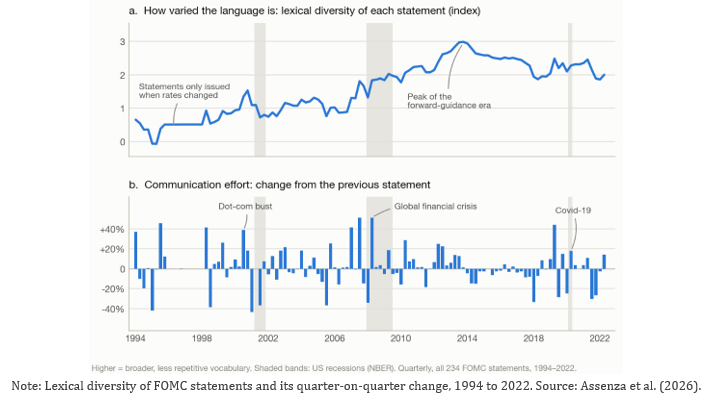
Applied to all 234 FOMC statements released since 1994, each running 311 words on average, the series in Figure 1 behaves the way a resource behaves when it is rationed. Language stays flat through the calm years before 2008, jumps during the global financial crisis when the Committee had to provide more explanation about its policy, peaks in the forward guidance era around 2013, and settles back as policy returns to a recognizable regime. The largest quarter-to-quarter increases cluster at the onset of recessions.
Figure 1. The Federal Reserve rations its explanations
We estimate a forward-looking reaction function in the spirit of Clarida, Galí and Gertler (2000), with communication effort on the left and expected inflation and the expected output gap on the right. The inflation anchor is left free, so the target is recovered from the communication data rather than imposed.
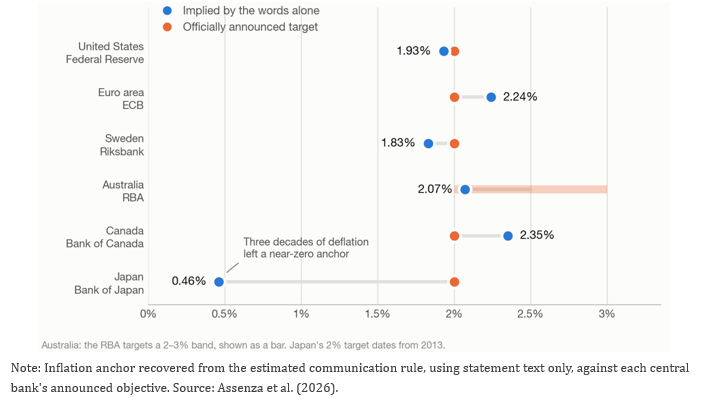
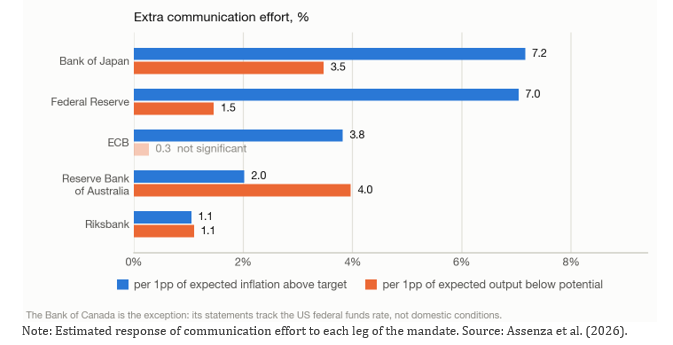
Four results come out of the baseline, estimated on quarterly data for 1994 to 2022. The over-identifying restrictions are not rejected, which is what a systematic rule requires. The recovered inflation anchor is 1.93 percent, statistically indistinguishable from the Fed’s announced 2 percent objective and identified entirely from statement text. A one percentage point upward deviation of expected inflation from target raises communication effort by about 7 percent, and a one percent shortfall of expected output below potential raises it by about 1.5 percent, a coefficient that quadruples on the post-2008 sample. Intrinsic persistence is small and imprecise, so the rule is indeed state-contingent and not the outcome of habit.
The estimates hold up under alternative price indices, output gap measures, forecast horizons, and the Fed staff’s own Tealbook projections in place of statistical expectations. One check does more than check: switching from PCE to CPI inflation moves the recovered anchor from 1.9 to 2.3 percent, the same wedge that separates the two indices. The rule inherits the yardstick of the price measure it is estimated with, as a genuine anchor would.
Using identified shocks as instruments adds a causal reading. When the disturbance originates in supply shocks (Känzig, 2021), the inflation leg is active and the output leg is flat. When it originates in monetary policy surprises (Nakamura and Steinsson, 2018), both legs move. The Fed explains prices when prices are the problem, and explains both when a demand contraction threatens the two halves of its mandate at once.
An obvious objection is that entropy may just be a proxy for length. Longer statements do have higher entropy, and the correlation in levels is 0.97. Re-estimating the rule with the growth rate of statement length in place of the entropy change nonetheless affects the answer: the inflation response falls by nearly half, and the output gap response becomes indistinguishable from zero.
Measured by length alone, the Federal Reserve looks like a strict inflation targeter. The second half of its mandate is carried by how the statement is written rather than by how long it is. When the economy runs below potential the Committee writes differently, reaching for less predictable language, and adds relatively few words.
If this were a Fed peculiarity it would matter less, so we re-estimate the rule for the euro area, Japan, Canada, Australia and Sweden. The over-identifying restrictions pass everywhere, the inflation response is positive in every case except Canada, and the output gap response is negative throughout.
The recovered anchors are the part that surprised us (Figure 2). Estimated from statement text alone, they land close to each central bank’s published objective: 2.24 percent for the ECB, 1.83 for the Riksbank, 2.07 for the Reserve Bank of Australia against a 2 to 3 percent target band, and 2.35 for the Bank of Canada. The Bank of Japan is the exception at 0.46 percent, and the exception is informative. Three decades of fighting deflation left an implicit anchor close to zero, and the BoJ’s inflation response is the largest in the sample.
Figure 2. Read from the words alone: Implied inflation anchors and announced targets
The response coefficients read like institutional fingerprints (Figure 3). The ECB’s output gap response is indistinguishable from zero, matching a mandate in which price stability is primary and output stabilization explicitly secondary. Australia and Sweden respond separately to the expected exchange rate, which small open economies need because one rate decision cannot signal how import prices are being weighed against domestic activity. The text agrees: “exchange rate” appears 137 times in RBA statements and 208 times in Riksbank statements, against six times in ECB statements.
Canada breaks the pattern. Domestic conditions explain almost nothing about the Bank of Canada’s communication effort, while the US federal funds rate explains a great deal. To a first approximation the Bank of Canada is explaining the American monetary environment to a Canadian audience, and an international communication cycle runs alongside the familiar international credit cycle.
Figure 3. Each mandate is written into the statements
In the textbook New Keynesian model none of this would change policy design, because private agents already know what the central bank knows. We therefore model an economy in which households cannot perfectly observe the state of the economy and rely on a noisy public signal whose precision rises with communication effort, with effort following the rule we estimated.
Two channels open up. More precise signals reduce the systematic underreaction of private agents to current shocks. Lower uncertainty about the outlook also cuts precautionary saving, which stimulates demand directly. Both work through aggregate demand, which makes communication and the policy rate local substitutes.
The consequences are sharp. Because the estimated rule is countercyclical on its output leg, expected future output passes through to current demand by less than one for one. This introduces discounting in aggregate demand that relaxes the Taylor principle: the interest rate rule can be less aggressive and still deliver a unique equilibrium. It also dissolves the forward guidance puzzle. Interestingly, while most of the literature obtains discounting through departure from rationality, in our setting this is a direct consequence of systematic communication policy.
At the zero lower bound (ZLB) the result is stronger. Communication substitutes for the exhausted rate instrument by sustaining expectations of future demand, and determinacy at the bound depends on the output leg specifically. A central bank that communicates actively but only about inflation amplifies the deflationary dynamics it is trying to prevent, because a falling inflation outlook tells an inflation-only communicator to say less at the moment when saying more is what breaks the spiral. Active communication shortens the ZLB episode after a large shock; after a shock roughly a quarter smaller, it keeps the bound from binding at all.
The volume of explanation is a signal in its own right. If communication effort obeys a rule, an unusually elaborate statement carries information about the Committee’s reading of the outlook, over and above what the statement says. It also means there is such a thing as a communication shock, the residual from the rule.
Communication frameworks need both halves of the mandate. This is the result we would most like policymakers to take away. Talking only about price stability is not a neutral choice about emphasis; at the ZLB it is destabilizing. The Fed’s move to outcome-based guidance in August 2020, which tied policy to labour market outcomes as well as to inflation, has the structure the model requires.
Communication is worth most before it is needed. Because the mechanism runs through expectations about the future, effort spent while the rate instrument still has room can keep the bound from binding. The case for a consistent communication framework rests on preventing zero lower bound episodes rather than on managing them.
One caveat. We measure how much a central bank elaborates, not how well, and more words in more varied combinations is not automatically better communication. Nothing here says a central bank should talk more. What the evidence says is that the choice of how much to explain is already systematic, already responds to both halves of the mandate, and already does work the policy rate cannot do on its own.
Assenza, T., F. Collard, D. Guney and P. Wangner (2026): “Louder than Rates: The Systematic Nature of Central Bank Communication”, CEPR Discussion Paper No. 21691. https://cepr.org/publications/dp21691
Blinder, A. S., M. Ehrmann, J. de Haan and D.-J. Jansen (2024): “Central Bank Communication with the General Public: Promise or False Hope?”, Journal of Economic Literature, 62(2), 425-457.
Blinder, A. S., M. Ehrmann, M. Fratzscher, J. de Haan and D.-J. Jansen (2008): “Central Bank Communication and Monetary Policy: A Survey of Theory and Evidence”, Journal of Economic Literature, 46(4), 910-945.
Clarida, R., J. Galí and M. Gertler (2000): “Monetary Policy Rules and Macroeconomic Stability: Evidence and Some Theory”, Quarterly Journal of Economics, 115(1), 147-180.
Känzig, D. R. (2021): “The Macroeconomic Effects of Oil Supply News: Evidence from OPEC Announcements”, American Economic Review, 111(4), 1092-1125.
Nakamura, E. and J. Steinsson (2018): “High-Frequency Identification of Monetary Non-Neutrality: The Information Effect”, Quarterly Journal of Economics, 133(3), 1283-1330.
Shannon, C. E. (1948): “A Mathematical Theory of Communication”, Bell System Technical Journal, 27(3), 379-423.
Taylor, J. B. (1993): “Discretion Versus Policy Rules in Practice”, Carnegie-Rochester Conference Series on Public Policy, 39, 195-214.