

This SUERF Policy Brief summarizes Beck et al. (2026). The views expressed in this study are those of the authors and do not necessarily reflect those of the Swiss National Bank. For this study, use was made of media data made available via Swissdox@LiRI by the Linguistic Research Infrastructure of the University of Zurich (see https://www.liri.uzh.ch/en/services/swissdox for more information).
Abstract
We develop a resource-efficient methodology for measuring economic outlook in news text that combines document embeddings with synthetic training data generated by large language models. Applied to 27 million news articles, the resulting indicator significantly improves GDP growth forecast accuracy and captures sentiment shifts weeks before official releases, proving particularly valuable during crises. The indicator outperforms both survey-based benchmarks and traditional dictionary methods and is interpretable, allowing identification of specific drivers of economic sentiment. Our approach addresses key institutional constraints: it performs sentiment classification locally, enabling analyses of proprietary news content without transmission to external services while requiring minimal computational resources compared to direct large language model classification.
Timely information about economic outlook is crucial for policymakers and financial market participants, especially in times of crisis and high uncertainty. Official macroeconomic statistics are indispensable, but they arrive late: GDP is typically released six to eight weeks after quarter-end, and most business surveys are published monthly with at least a week’s delay. Newspaper articles offer a fundamentally different data source. They are published continuously, capture economic developments as they occur, and cover a wide range of topics not limited to specific sectors or markets.
Extracting systematic economic signals from news text at scale, however, poses real challenges. State-of-the-art large language models (LLMs) capture semantic nuances that simpler keyword-counting methods miss, but they are computationally expensive and require transmitting text to external APIs, which most commercial news databases prohibit under their data usage agreements. Manual labelling of training data by human experts is an alternative, but it is slow, costly, and subject to inter-rater inconsistency.
We address these challenges by combining a locally deployable document embedding model with synthetic training data generated by an LLM. All sentiment classification is performed locally, making the approach fully compatible with restrictive data usage agreements and requiring minimal computational resources. We illustrate the methodology by applying it to 27 million Swiss newspaper articles, but the pipeline is designed to be applicable to any data source, language, and economic concept.
Our approach combines machine learning methods and large language models in a five-step pipeline. The core idea is a clean separation: use an LLM only to generate synthetic training data and deploy a locally runnable embedding model to process all proprietary news content. This makes the approach fast, resource-efficient, and fully compatible with restrictive data usage agreements. Figure 1 provides a visual overview.
Figure 1. Overview of the methodology
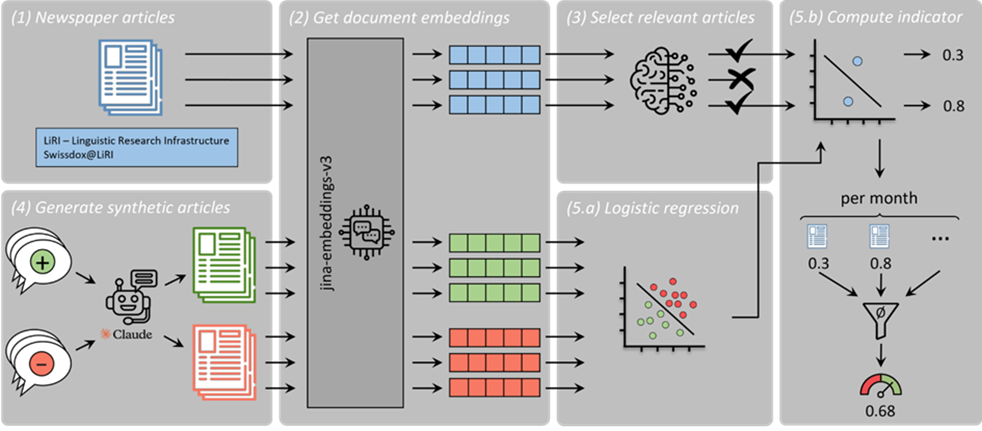
Step 1: Newspaper articles. We use the Swissdox@LiRI database, which contains approximately 27 million German- and French-language articles from 159 Swiss media outlets spanning January 1999 to December 2025. The database is updated continuously, with new articles typically available within two business days of publication.
Step 2: Get document embeddings. We convert each article into a numerical representation called a document embedding. The embedding preserves the semantic meaning of the article — its overall message, topic, and tone. We use the multilingual model jina-embeddings-v3 developed by Sturua et al. (2024), which processes both languages and long documents (up to 9852 tokens) on a single mid-range GPU, with all computation performed locally.
Step 3: Select relevant articles. We train a neural network classifier to identify economics-related articles, exploiting section labels available for a subset of outlets in the database. Applying this classifier to the full corpus reduces it from 27 million to approximately 3.3 million relevant articles, around 13,000 per month in 2025.
Step 4: Generate synthetic articles. Rather than manually labelling real articles, we use Claude 3.5 Sonnet to generate 256 synthetic newspaper articles mimicking the style of Swiss business journalism, half conveying a clearly positive economic outlook, half a clearly negative outlook. Critically, the LLM only processes these non-proprietary synthetic texts; real articles never leave the institution’s systems.
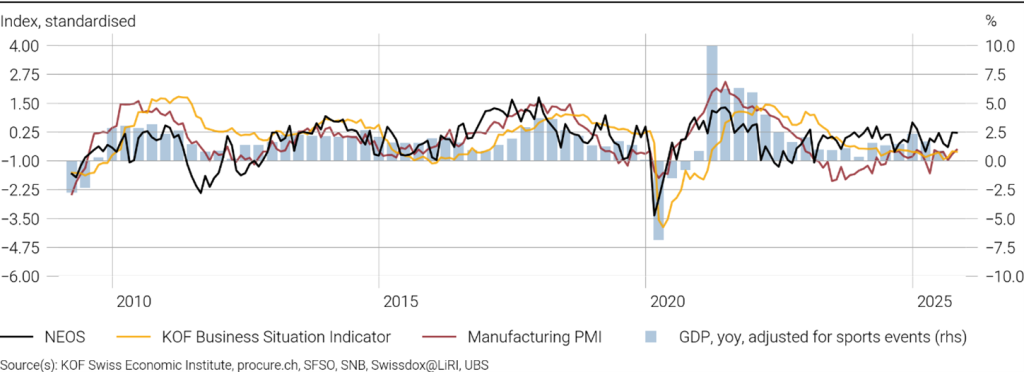
Step 5: Logistic regression and compute indicator. We embed the synthetic articles using the same encoder and fit a regularised logistic regression to the resulting embeddings. This model is then applied to all relevant real articles, yielding a score between zero (negative outlook) and one (positive outlook) per article. We then compute the monthly indicator by averaging all the scores for each month. Applied to Switzerland, we refer to the resulting indicator as the News-based Economic Outlook for Switzerland (NEOS). Figure 2 plots monthly NEOS values alongside year-over-year real GDP growth and two survey-based indicators, illustrating that the indicator tracks economic conditions closely. Daily updates can be generated continuously as new articles arrive.
The total computational cost is several orders of magnitude lower than direct LLM classification. Classifying the full corpus with a commercial LLM would have cost over USD 30,000 at the time of analysis; the proposed methodology can be run for approximately USD 100 on AWS. Crucially, it is also feasible to run the analysis locally on mid-level hardware without exposing data to external services.
Figure 2. News-based Economic Outlook for Switzerland (NEOS)
(Comparison with survey-based indicators and real GDP growth)
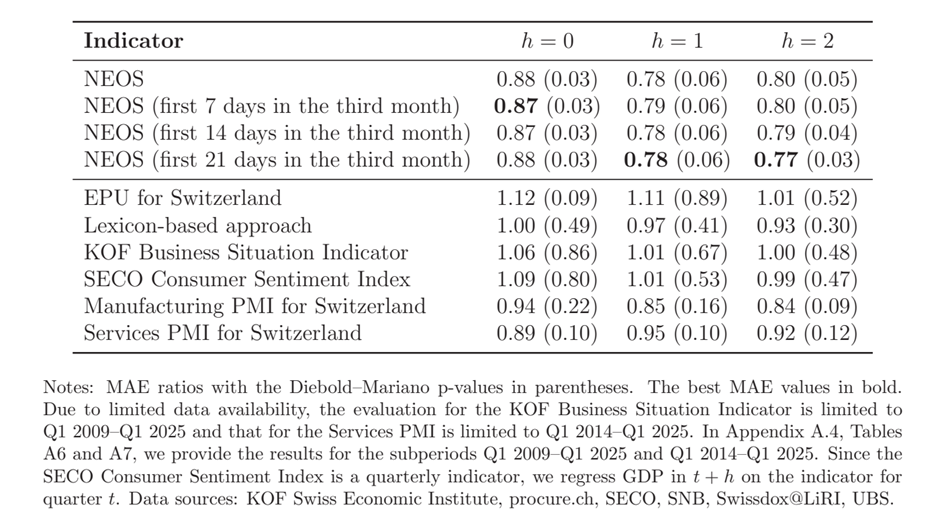
The indicator is evaluated in a pseudo-out-of-sample forecasting exercise for Swiss real GDP growth from Q1 1999 to Q1 2025. In addition to the indicator for the full month, we also evaluate timelier versions, computed from the first 7, 14, or 21 days of a month. We benchmark the indicator against an autoregressive AR(1) model and a range of established alternatives: the KOF Business Situation Indicator, the Manufacturing and Services PMIs, the SECO Consumer Sentiment Index, and two text-based indicators built from the same underlying news data — the Economic Policy Uncertainty (EPU) index and a sophisticated lexicon-based economic sentiment measure.
Table 1 reports mean absolute error (MAE) ratios relative to the AR(1) benchmark across all horizons from nowcast to two quarters ahead. The indicator reduces forecast errors by 12-23%, with statistically significant improvements throughout. None of the survey-based indicators deliver comparable gains. Strikingly, neither lexicon-based text approach significantly outperforms the benchmark, despite drawing on the same underlying news data. The superior performance of the embedding-based method over the lexicon approach highlights the added value of semantic understanding.
Table 1. Forecasting performance for Swiss real GDP growth
A kitchen sink regression that simultaneously controls for all survey- and lexicon-based benchmarks confirms that the news-based indicator retains statistically significant incremental predictive power – an effect that strengthens at longer forecast horizons, suggesting the indicator anticipates future output dynamics rather than simply echoing current conditions already visible in survey data.
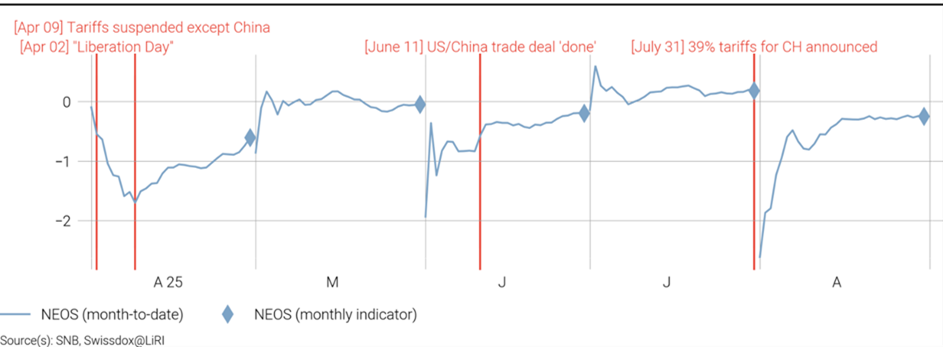
A key advantage of our indicator is its timeliness. Figure 3 illustrates this through events in 2025. When U.S. “Liberation Day” tariffs were announced on 2 April, the daily indicator deteriorated sharply within days – weeks before any survey or GDP release could register the shock. When tariffs were paused a week later, the indicator recovered rapidly. A similarly sharp deterioration followed at the beginning of August, when a 39% additional tariff on Swiss goods was announced; the indicator improved again shortly thereafter as news coverage moderated.
Figure 3. NEOS in real time
(Index, standardised)
These crisis-period gains dominate the overall performance advantage. During tranquil periods of stable growth, the indicator performs roughly on par with the autoregressive benchmark – which is notoriously difficult to beat when GDP is steady. The result is an ideal monitoring profile: the indicator adds most value precisely when conventional data are least informative.
Our indicator is not a black box: the score of each article and its contribution to the indicator can be measured, and the original content of each article can be retrieved directly. We develop three complementary decomposition approaches. A keyword-based method allows rapid investigation of specific themes — for instance, isolating the contribution of tariff-related articles, which began weighing negatively from October 2024 onward and peaked in April 2025. A classification-based approach attributes indicator movements to predefined economic domains such as financial markets, labour markets, trade, and business conditions. An unsupervised clustering approach detects emerging topics automatically, requiring no prior specification (see Beck et al., 2026).
Our approach is modular and flexible: each step is independently upgradeable as better models become available, and the pipeline can be adapted to track other economic indicators or can be applied to other countries and languages.
More broadly, the combination of compatibility with restrictive data usage agreements, low resource requirements, and modularity makes the approach attractive for central banks, international financial institutions, and research organisations working with commercially licensed news data. The key feature, using LLMs to generate synthetic training data rather than to classify proprietary content, resolves the central tension between data confidentiality and state-of-the-art natural language processing, providing a practical and transferable template for news-based economic measurement across institutional settings and geographies.
Beck, E., F. Eckert, L. Kühne, H. Liebert and R. Rosenblatt-Wisch (2026). Measuring economic outlook in the news, Working Papers 2026-04, Swiss National Bank.
Sturua, S., I. Mohr, M.K. Akram, M. Günther, B. Wang, M. Krimmel, F. Wang, G. Mastrapas, A. Koukounas, N. Wang and H. Xiao (2024). jina-embeddings-v3: Multilingual Embeddings With Task LoRA. https://arxiv.org/abs/2409.10173.