This policy brief is based on NBP Working Paper No. 380. The views expressed in this policy brief are those of the authors and do not necessarily reflect those of Narodowy Bank Polski.
Abstract
Global financial integration enables countries to become net creditors or net debtors. This SUERF Policy Brief examines long-run determinants of the net international investment position (NIIP), a key variable in international macroeconomics. The analysis uses a balanced panel of 38 countries covering 1990–2023 and applies a cross-sectionally augmented error correction model estimated with the dynamic common correlated effects estimator. Several theoretical frameworks are examined, including the stages of development hypothesis, the life-cycle hypothesis, and Ricardian equivalence. The results show that an increase in relative GDP per capita and relative central government debt/GDP reduces the NIIP/GDP in the long run, while relative population ageing increases it. We decompose changes in the long-run NIIP/GDP since 1990 for selected economies — the United States and Japan, a large external debtor and creditor, respectively.
The net international investment position (NIIP) is a measure of a country’s net external wealth and an important indicator of its external stock balance. It captures the aggregate net financial position of an economy against the rest of the world, expressed as the difference between its external assets and liabilities.
Despite its importance, the literature on NIIP is relatively scarce compared with the vast literature on current account balances.1 Notable exceptions include Masson et al. (1994), Lane and Milesi-Ferretti (2001), Turrini and Zeugner (2019), and Nieminen and Kuziemska-Pawlak (2024). Nevertheless, focusing solely on current account balances may be insufficient for investigating the long-run determinants of the NIIP, since this approach considers only flow balance and not stock balance.
Our empirical analysis uses a balanced panel of 38 countries covering the period 1990–2023. Based on the cross-sectional dependence test proposed by Pesaran (2015, 2021), we reject the null hypothesis of weak dependence for the NIIP/GDP, relative central government debt as a share of GDP, relative GDP per capita, relative old- and young-age dependency ratios. Furthermore, using panel unit root test proposed by Pesaran (2003), we cannot reject the null hypothesis of non-stationarity for the NIIP as a share of GDP, relative central government debt/GDP, and relative GDP per capita.
Taking these findings into account, we estimate a cross-sectionally augmented error correction model using the dynamic common-correlated effects estimator proposed by Chudik and Pesaran (2015). This estimation strategy allows us to jointly account for three key features of our macroeconomic panel data: dynamics, heterogeneity, and cross-sectional dependence.
First, we find that an increase in relative central government debt as a ratio to GDP lowers the NIIP in the long run. A country that increases its level of central government debt tends to import foreign savings and, consequently, its NIIP declines through a current account deficit. This finding is in line with the twin deficits hypothesis, which posits a positive relationship between fiscal balance and current account balance in the medium term (see, e.g., Chinn and Prasad, 2003; Chinn and Ito, 2007, 2022).
Second, a rise in relative GDP per capita leads to a decline in the NIIP as a share of GDP in the long run. This suggests that countries whose GDP per capita grows faster than that of others tend to attract foreign savings and finance part of their investment through net capital inflows from abroad. These net capital inflows accumulate over time, resulting in a lower NIIP to GDP ratio in the long run.
Third, an increase in the relative old age dependency ratio increases the NIIP in the long run. This indicates that economies experiencing relatively rapid population ageing tend to accumulate net foreign assets. In particular, individuals increase their asset holdings as longevity rises.
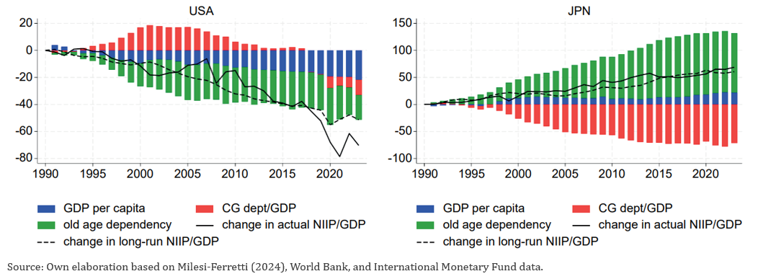
Finally, we decompose the changes in the theoretical long-run values of the NIIP/GDP from 1990 onwards to identify which variables were drivers of the NIIP evolution (see Figure 1). In the United States, the decline in the long-run NIIP/GDP was associated with a decrease in the relative old-age dependency ratio, for most of the sample period (1990-2023) an increase in the relative GDP per capita, and — from 2018 to 2023 — a rise in the relative central government debt. By contrast, the increase in Japan’s long-run NIIP was driven by relative population ageing and, for most of the sample period, a decline in relative GDP per capita.2 However, the rise in relative central government debt throughout most of the sample period contributed to a decline in the long-run NIIP.
Figure 1. Changes in actual and long-run NIIP/GDP (relative to 1990, in percentage points)
This SUERF Policy Brief examines the long-run determinants of the NIIP using a panel of 38 countries over the period 1990–2023. The analysis employs a cross-sectionally augmented error correction model estimated with the dynamic common-correlated effects estimator proposed by Chudik and Pesaran (2015). The results indicate that fiscal policy, economic development, and population ageing play an important role in shaping the evolution of countries’ external positions. In particular, an increase in relative GDP per capita and relative central government debt as a ratio of GDP reduces the NIIP in the long run, whereas a rise in relative old-age dependency ratio increases it. For selected countries, we decompose changes in the long-run NIIP between 1990 and 2023. Overall, the findings underscore the importance of macroeconomic factors and population ageing in explaining the long-run evolution of countries’ external positions.
Ca’ Zorzi, M. and A. Chudik and A. Dieppe. 2012. “Thousands of Models, One Story: Current Account Imbalances in the Global Economy”, Journal of International Money and Finance 31 (6), 1319–1338. https://doi.org/10.1016/j.jimonfin.2012.02.003
Chinn, M. D. and E. S. Prasad. 2003. “Medium-term Determinants of Current Accounts in Industrial and Developing Countries: an Empirical Exploration”, Journal of International Economics, 59(1), 47-76. https://doi.org/10.1016/S0022-1996(02)00089-2
Chinn, M. D. and H. Ito. 2022. “A Requiem for “Blame It on Beijing” interpreting rotating global current account surpluses.” Journal of International Money and Finance, 121. https://doi.org/10.1016/j.jimonfin.2021.102510
Chinn, M. D. and H. Ito. 2007. “Current Account Balances, Financial Development and Institutions: Assaying the World ‘Savings Glut.” Journal of International Money and Finance, 26(4), p. 546-569. https://doi.org/10.1016/j.jimonfin.2007.03.006
Chudik, A. and H. Pesaran. 2015. “Common Correlated Effects Estimation of Heterogeneous Dynamic Panel Data Models with Weakly Exogenous Regressors”, Journal of Econometrics, 188(2), 393-420. https://doi.org/10.1016/j.jeconom.2015.03.007
Debelle, G. and H. Faruqee. 1996. “What Determines the Current Account? A Cross–Sectional and Panel Approach”, IMF Working Paper 96 (58). https://doi.org/10.5089/9781451966701.001
Lane, P. R. and G. M. Milesi-Ferretti. 2001. “Long-Term Capital Movements” In: B.S. Bernanke, K. Rogoff. [ed.], NBER Macroeconomics Annual 2001, 16, 73-136. https://doi.org/10.3386/w8366
Lee, J. and G. M. Milesi-Ferretti and J. D. Ostry and A. Prati and L. A. Ricci. 2008. “Exchange Rate Assessments: CGER Methodologies”, IMF Occasional Paper 261. https://doi.org/10.5089/9781589066380.084
Masson P. R. and J. Kremers and J. Horne. 1994. “Net Foreign Assets and International Adjustment: The United States, Japan and Germany”, Journal of International Money and Finance 13, 27-40. https://doi.org/10.1016/0261-5606(94)90022-1
Milesi-Ferretti, G. M., 2024. “The External Wealth of Nations Database” The Brookings Institution (based on Lane, P.R. and G.M. Milesi-Ferretti. 2018).
Nieminen, M. and K. Kuziemska-Pawlak. 2024. “Cross-Country Variation in Economic Preferences and the Asset Composition of International Investment Positions”, Journal of International Money and Finance 146. https://doi.org/10.1016/j.jimonfin.2024.103130
Pesaran, H. 2003. “A Simple Panel Unit Root Test in the Presence of Cross Section Dependence”, Cambridge Working Papers in Economics 0346, Faculty of Economics (DAE), University of Cambridge.
Pesaran, M. H. 2015. “Testing Weak Cross-Sectional Dependence in Large Panels”, Econometric Reviews 34(6-10), 1089-1117. https://doi.org/10.1080/07474938.2014.956623
Pesaran, M. H. 2021. “General Diagnostic Tests for Cross-Sectional Dependence in Panels”, Empirical Economics 60, 13-50. https://doi.org/10.1007/s00181-020-01875-7
Phillips, S. and L. Catão and L. Ricci and R. Bems and M. Das and J. Di Gionanni and D.F. Unsal and M. Castillo and J. Lee and J. Rodriguez and M. Vargas. 2013. “The External Balance Assessment (EBA) Methodology”, IMF Working Paper 272.
Turrini, A. and S. Zeugner. 2019. “Benchmarks for Net International Investment Positions”, Journal of International Money and Finance 95, 149-164. https://doi.org/10.1016/j.jimonfin.2019.01.017
See e.g., Debelle and Faruqee (1996), Chinn and Prasad (2003), Chinn and Ito (2007), Lee et al. (2008), Ca’ Zorzi et al. (2012), and Phillips et al. (2013).
Even though Japan remains a developed economy, its GDP per capita advantage over much of the rest of the world has gradually diminished. During Japan’s “lost decades,” many other countries narrowed the gap with Japan.