

This SUERF policy brief is based on the BIS working paper titled “Making Stablecoins stable(r): can regulation help?”. The views expressed in this brief are those of the authors and do not necessarily reflect the views of the Bank for International Settlements or its member central banks.
Abstract
Stablecoins have grown rapidly. Their deepening footprint in traditional financial markets has placed a spotlight on one of their main vulnerabilities: liquidity mismatch in reserve management. This creates risks for stablecoin holders and spillovers to money markets. Regulators worldwide are considering prudential tools, such as liquidity and capital requirements, to address these risks. Yet, views on how to calibrate these thresholds and how they interact differ. Using a model of a fiat-backed stablecoin issuer, we show that capital and liquidity thresholds operate through distinct channels and that both are needed when regulators target both microprudential and macroprudential objectives. Thresholds should be introduced as usable buffers rather than hard minima that can paradoxically increase default risk.
Stablecoins have evolved from a niche tool for crypto trading into large players in traditional finance. By June 2026, their market capitalisation exceeded $300 billion, with the largest issuers holding short-dated US Treasury securities in amounts comparable to the world’s largest money market funds.
This growth has placed a spotlight on a fundamental vulnerability of fiat-backed stablecoins – liquidity mismatch. Issuers promise redemption at par on demand. However, they often hold only limited cash buffers while investing much of their reserves in less liquid but interest-bearing securities. When redemptions are large, issuers may be forced to liquidate these securities at fire-sale discounts. The resulting losses can erode capital, increase the risk of issuer distress and transmit pressure to money markets. These issuer-level fragilities and systemic spillovers motivate prudential intervention.
Regulators around the world are implementing frameworks to mitigate risks posed by stablecoin issuers, although emerging regimes differ in design and calibration. For instance, the EU’s Markets in Crypto-Assets Regulation (MiCAR) requires issuers to hold a minimum 30% share of reserves as bank deposits and maintain a minimum ratio of own funds to stablecoin liabilities. In the United States, rules proposed under the GENIUS Act would require issuers to maintain minimum shares of reserve assets that can be liquidated within a day and within a week, respectively, and to satisfy capital requirements that are tailored to the issuer’s risk profile. The Bank of England has proposed that 30% of the reserves should be in the form of central bank reserves, with the remainder invested in short-term gilts.
These approaches share a broad theme: liquidity and capital requirements are becoming central to stablecoin regulation. However, they differ in terms of the specific design and calibration. This variation partly reflects the absence of a common analytical framework for mapping policy targets to regulatory thresholds and for assessing how the tools interact. Our analysis proposes such a framework.
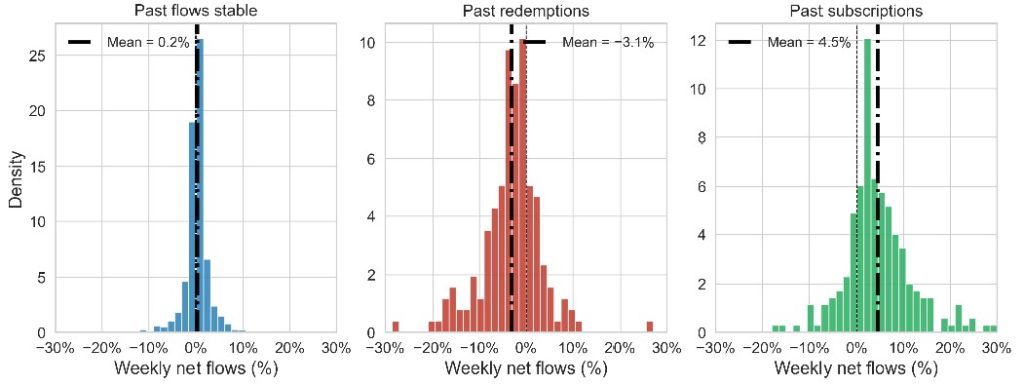
We model a fiat-backed stablecoin issuer that chooses both capital and the composition of reserves between cash and bonds. Cash earns no interest but is available to meet redemptions without liquidation costs. Bonds earn interest but incur increasing liquidation costs when sold, capturing the price impact of fire sales. We calibrate the model parameters to ensure empirical relevance. First, we take account of the serial correlation in coin-holder redemptions observed in the data: a week of redemptions increases the likelihood of redemptions next week (see Figure 1). In addition, we estimate the price impact of forced sales of US Treasury bills, a key reserve asset of stablecoins. Finally, we match the issuer’s balance sheet choices to those observed in practice.
Figure 1. Past stablecoin flows predict future flows
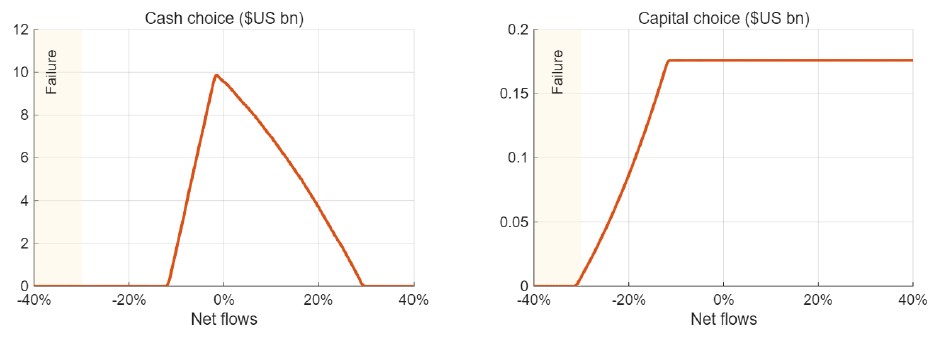
Without regulation, the issuer’s optimal cash policy follows a ‘shark-fin’ profile across flow regimes (see Figure 2):
This sequencing mirrors open-ended fund behaviour (Jiang et al. 2021; Ma et al. 2022): liquid assets absorb shocks; less liquid assets are sold last. However, the privately optimal capital in the unregulated baseline is thin (around 0.11%), making the issuer vulnerable to severe redemptions. For instance, a two-standard-deviation redemption shock results in a weekly default probability (PD) of more than 15 basis points and an expected price impact (EPI) on bonds above 4 basis points. Two wedges make these vulnerabilities socially costly. Limited liability steers issuers to underweight tail losses that are ultimately borne by coin-holders (i.e. risk-shifting). And the price impact of forced bond sales imposes externalities on money markets.
Figure 2. Stablecoin issuer’s cash choice follows a ‘shark-fin’ profile
The two wedges justify prudential intervention. We consider two tools.
We model the thresholds as usable buffers, not hard minima. This accords with the increasing supervisory emphasis on buffer usability (e.g. Bank of England 2025) and also echoes Basel III’s market-discipline logic: usable buffers work better than rigid minima. To this end, we allow the issuer to temporarily breach the threshold, albeit at the cost of more stringent coin-holder discipline, i.e. higher likelihood of redemptions. This induces the issuer to hold ex-ante buffers but also allows it to use them during stress.
By contrast, hard thresholds that must never be breached and that, if violated, lead to sanctions can be counterproductive. For instance, a hard LR threshold – despite improving the issuer’s cash holdings (and reducing expected sales) – can lead to mechanical bond sales when outflows occur. This can erode capital at the worst moment and raise default risk.
We consider two policy objectives. First, the issuer’s PD, a microprudential target capturing the direct impact on coin-holders. Second, the expected price impact of bond sales (EPI), a macroprudential target capturing market spillovers.
Both regulatory thresholds help achieve both policy objectives, but they operate through different pathways (see Figure 3). The LR threshold only increases cash and has no direct impact on capital since the latter does not directly affect the likelihood of breaching the LR threshold. By contrast, the CR threshold not only raises capital but also cash: more cash lowers the need to liquidate bonds and thus mitigates losses that undermine capital, thereby reducing the probability of breaching the CR threshold.
Figure 3. Regulatory tools affect stablecoin issuer’s behaviour through different pathways
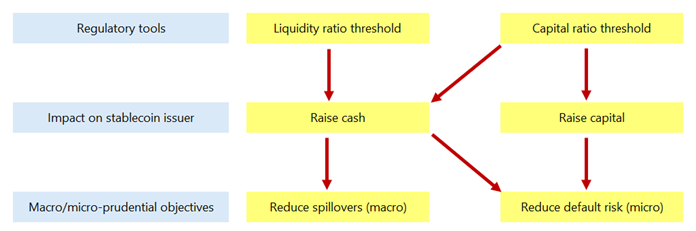
Turning to the impact on objectives, higher cash – irrespective of whether it is induced by a higher LR or CR threshold – reduces both EPI (by curbing bond sales) and PD (by reducing capital erosion). Higher capital – which is only induced by a higher CR threshold – only reduces PD and has no direct effect on EPI. Taken together, both tools help reduce both PD and EPI. This makes the thresholds substitutes because each can – in isolation – help achieve either objective. A regulator focused solely on minimising PD could, for example, adopt a sufficiently high LR or CR threshold. The same is true for an EPI target. This also means that policymakers have some flexibility in choosing which tool to emphasise.
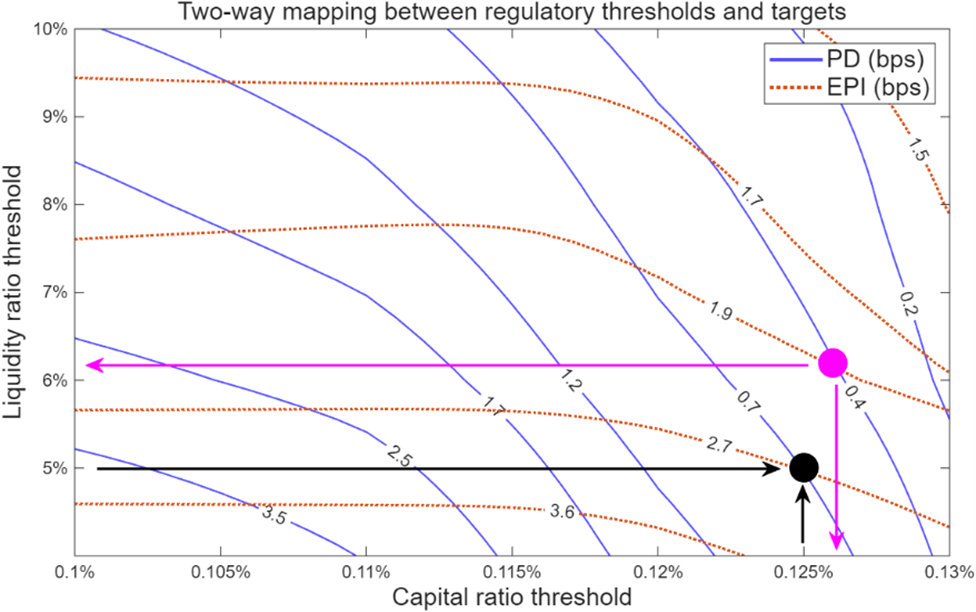
However, this substitutability is limited once the regulator has a dual mandate. When a regulator must meet PD and EPI targets simultaneously, the thresholds become complements. Both are needed in line with the Tinbergen principle – one threshold alone cannot achieve a joint target. Our calibration illustrates the magnitudes involved. For instance, an LR of 5% and a CR of 0.125% reduce weekly PD from 15 basis points (in the unregulated baseline) to less than 1 basis point and EPI from 4 to 2.7 basis points. Higher thresholds further reduce both risks.
The model offers a two-way mapping between thresholds and targets. Policymakers can start with proposed LR and CR thresholds and evaluate the implied PD and EPI outcomes (see black dot in Figure 4). Alternatively, they can specify target levels for PD and EPI and use the model to identify the LR–CR combinations that achieve these targets (pink dot).
Figure 4. Prudential targets can be mapped to regulatory thresholds and vice versa
Stablecoins have grown rapidly, bringing the risks they pose to the fore. Across jurisdictions, regulators are converging on some combination of liquidity and capital thresholds to mitigate these risks. Our analysis supports this dual approach, with three main messages that could inform policy discussions.
First, liquidity and capital thresholds work through different channels – the liquidity threshold only raises cash holdings, while the capital threshold induces both more cash and capital. With a dual mandate to curb both default risk (PD) and bond market spillovers (EPI), regulators need both instruments; one alone cannot hit both targets. Second, hard minima that prevent buffer use in stress can backfire by increasing default risk; buffer usability and market discipline are crucial. Third, numerical thresholds should be calibrated against explicit PD and EPI targets, accounting for issuers’ endogenous responses and the depth of underlying markets. Our two-way mapping between targets and thresholds offers a practical starting point for such calibration.
Bank of England (2025), “Proposed regulatory regime for sterling-denominated systemic stablecoins”, Consultation paper, November.
Financial Stability Board (2023), “High-level recommendations for the regulation, supervision and oversight of global stablecoin arrangements: final report”.
Goel, T, U Lewrick and I Agarwal (2026), “Making stablecoins stable(r): can regulation help?”, BIS Working Papers No 1355, June.
Jiang, H, D Li and A Wang (2021), “Dynamic liquidity management by corporate bond mutual funds”, Journal of Financial and Quantitative Analysis 56(5), 1622–1652.
Ma, Y, K Xiao and Y Zeng (2022), “Mutual fund liquidity transformation and reverse flight to liquidity”, Review of Financial Studies 35(10), 4674–4711.