

This brief draws on O’Neill and Velasco (2026). The views expressed are those of the authors and do not necessarily reflect those of Banco de España, the European Central Bank or the European System of Central Banks.
Abstract
Responses to adverse and favourable oil supply news are not mirror images. In the US economy, adverse news produces contractions in activity that are larger and more persistent than the expansions following comparable favourable news. Transmission also varies with shock size: very small shocks have weak and imprecisely estimated effects, whereas moderate shocks produce meaningful responses. Beyond this range, larger shocks do not systematically generate stronger effects per percentage point of the initial oil-price movement. Aggregate outcomes conceal substantial differences in employment responses across states, including their direction and timing. These findings come from a flexible framework that lets nonlinear relationships emerge from the data.
News about future oil supply can affect the economy before physical supply changes. A deterioration in the supply outlook raises costs for energy users while supporting producers’ revenues; an improvement eases those costs but need not generate an equal and opposite response in activity. For policymakers, the question is how transmission varies with the direction and size of the news, and across regions. We focus on unexpected news about future oil supply. Following Känzig (2021), we use movements in oil futures prices around announcements by the Organization of the Petroleum Exporting Countries (OPEC) as an external instrument to identify oil supply news shocks. Adverse news raises the real price of oil; favourable news lowers it. Oil prices also respond to demand and other developments, so identifying the source of the price movement matters for interpreting its economic effects.
Linear models provide useful benchmarks, but impose proportional and symmetric responses. To allow these relationships to emerge more flexibly, we use FABART (Factor Bayesian Additive Regression Tree). Common factors summarise the information in many indicators, and Bayesian regression trees allow the mapping from these common factors to individual outcomes to be learned without specifying a nonlinear functional form or threshold structure in advance (Chipman, George and McCulloch, 2010). Huber et al. (2023) use Bayesian regression trees to introduce nonlinear flexibility into macroeconomic nowcasting models. Our dataset contains 62 monthly macroeconomic, financial, and state-employment series spanning 46 years of data. In O’Neill and Velasco (2026), we document three patterns in the transmission of oil supply news shocks. Adverse shocks cause larger and more persistent activity contractions than the expansions following comparable favourable shocks, consistent with recent evidence of asymmetric transmission in Forni et al. (2025). Responses do not vary proportionally with shock size, and aggregate outcomes conceal substantial differences in employment responses across US states.
Figure 1 illustrates the asymmetry between adverse and favourable oil supply news shocks. Adverse shocks produce larger and more persistent contractions in activity than the expansions following comparable favourable shocks. The shocks raise or lower the real oil price by 10% on impact. Red lines show adverse shocks; green lines show favourable shocks, with their responses sign-reversed for comparison. If the effects were mirror images, the curves would coincide. Shaded areas show the uncertainty around each response.
Figure 1. Sign asymmetry in oil supply news transmission
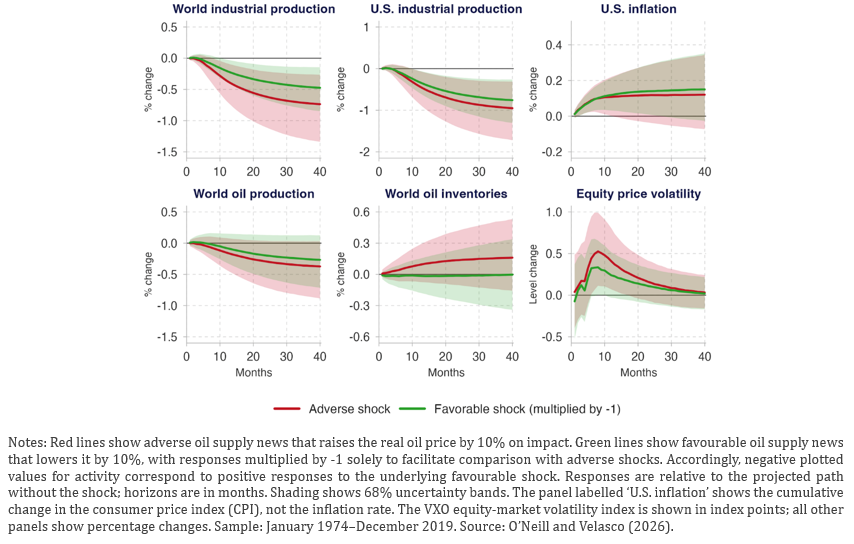
The decline in activity builds over time. Industrial production falls gradually after adverse news and remains below its no-shock path over the horizon shown; favourable news produces a smaller expansion. Consumer prices initially move by similar amounts after shocks of opposite signs, and in contrast their decline following favourable news is somewhat larger at longer horizons. The asymmetry in activity therefore need not be matched by a larger consumer-price response. Adverse oil news shocks raise equity-market volatility and lower equity prices. Favourable shocks generally move these indicators in the opposite direction, although their financial effects are less precisely estimated. Uncertainty, production costs, and demand may all contribute to these responses, but FABART does not separately identify their individual contributions. Oil-production and inventory responses are also imprecise. Expanding the information set to include financial variables changes the estimated transmission: activity contractions are sharper, while consumer-price and inventory responses are smaller. This illustrates the importance of the information set stressed by Mori and Peersman (2024); it does not isolate a separate financial channel.
Shock size also matters, but larger shocks do not simply amplify every response proportionally. We compare shocks generating initial oil-price movements of 1.5%, 5%, and 10%. The main departure from proportional transmission occurs between very small and moderate shocks: the smallest shocks have weak and imprecisely estimated effects, while the 5% calibration already produces meaningful activity and employment responses. After rescaling to a common oil-price movement, larger shocks do not systematically produce larger effects per percentage point of price change. A small-shock estimate therefore cannot simply be multiplied to assess a larger disturbance.
FABART’s ability to model many series jointly also motivates including state employment alongside oil-market, macroeconomic and financial indicators. We choose six states with contrasting industrial structures to illustrate regional heterogeneity. Michigan and Ohio represent manufacturing-intensive economies, Wyoming and North Dakota energy-producing economies, and California and New York more service-oriented economies. Higher oil prices can support energy producers’ revenues while raising manufacturers’ costs and weakening demand for their products. Services can also be affected as the wider economy slows. Figure 2 compares employment responses at six, twelve, and twenty-four months after adverse oil supply news raises the real oil price by 10% on impact.
Figure 2. Uneven regional effects of oil supply news
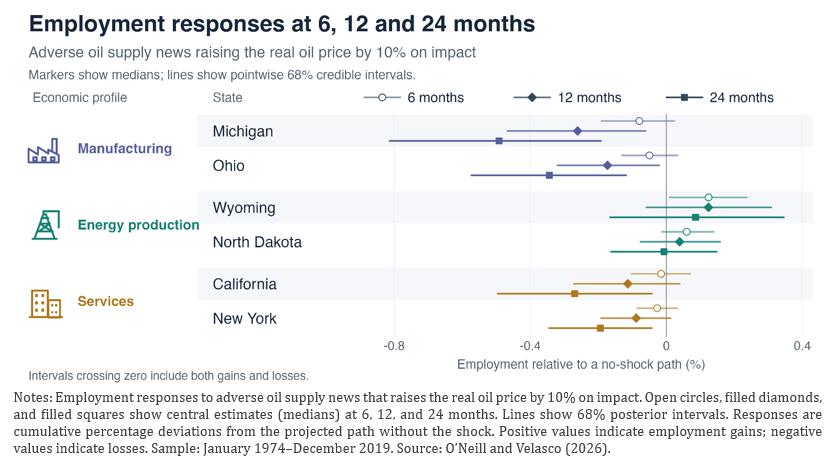
Manufacturing-intensive states such as Michigan and Ohio experience particularly pronounced employment contractions. Energy-producing states show different and partly offsetting responses: Wyoming initially benefits from higher oil prices, while North Dakota’s response is less precisely estimated. The service-oriented examples, California and New York, generally show smaller central estimates of employment losses.1
The findings show that the transmission of oil supply news depends on the direction and size of the shock and differs across US states. Adverse news produces stronger and more persistent contractions than the expansions following comparable favourable news. Responses do not scale proportionally with shock size, and aggregate estimates conceal substantial regional heterogeneity. Accounting for these features can therefore improve the design and interpretation of macroeconomic scenarios involving changes in the oil supply outlook.
Chipman, H. A., E. I. George and R. E. McCulloch (2010). BART: Bayesian additive regression trees. The Annals of Applied Statistics, 4(1), 266–298.
Forni, M., A. Franconi, L. Gambetti and L. Sala (2025). Asymmetric transmission of oil supply news. Quantitative Economics, 16(3), 947–979.
Huber, F., G. Koop, L. Onorante, M. Pfarrhofer and J. Schreiner (2023). Nowcasting in a pandemic using non-parametric mixed frequency VARs. Journal of Econometrics, 232(1), 52–69.
Känzig, D. R. (2021). The macroeconomic effects of oil supply news: Evidence from OPEC announcements. American Economic Review, 111(4), 1092–1125.
Mori, L. and G. Peersman (2024). Estimating the macroeconomic effects of oil supply news. CESifo Working Paper No. 11532.
O’Neill, E. and S. Velasco (2026). Let the tree decide: FABART. A non-parametric factor model for nonlinear oil shock transmission. ECB Working Paper No. 3265; Banco de España Working Paper No. 2627.
These patterns are consistent with differences in industrial structure, but the state-level responses should not be interpreted as causal estimates of specific industry-level mechanisms.