

This policy brief is based on Banco de España, Series: Occasional Papers. 2607. The views expressed are those of the authors and not necessarily those of the institutions the authors are affiliated with.
Abstract
We develop a benchmarking framework to assess the cost of issuing MREL eligible debt, enabling structured comparisons across banks, instruments, and jurisdictions. Using issuance data from banks in the banking union over the 2019Q3-2024Q3 period, we identify how bank characteristics, macroeconomic conditions, and instrument features affect issuance costs. Importantly, the framework accounts for the endogenous nature of issuance decisions. We then showcase the usefulness of the model in two ways: first, we decompose issuance costs for seven Spanish banks, identifying key cost drivers across institutions, and second, we simulate the net income impact of issuing senior non-preferred rather than senior debt for four European banks near the regulatory size threshold that triggers the setup of the so-called subordination requirements.
The Minimum Requirement for own funds and Eligible Liabilities (MREL) was introduced in the EU by the Bank Recovery and Resolution Directive (BRRD), adopted in 2014 and applicable from 2016, to ensure that in the event of bank failure, resolution authorities can use these resources from the bank’s shareholders and creditors to absorb losses and recapitalize the continuing business. This framework reduces the likelihood of governments using public funds to rescue failing banks, mitigates negative effects on credit supply linked to undercapitalized banks, and helps contain contagion to other financial institutions and the broader financial system by providing ex-ante loss-absorbing capacity (EBA, 2016). Beyond its role in bank resolution, the increase in unsecured bank liabilities associated with MREL may also enhance market discipline and, therefore, strengthen financial stability pre-emptively (Walther and White, 2020; Berger et al., 2022; Bernard et al., 2022; Keister and Mitkov, 2023; Restoy, 2023).
Banks can meet MREL requirements with capital and certain eligible liabilities, including fixed-income instruments that are unsecured and have a residual maturity of more than one year. It is thus crucial to understand the cost of MREL‑eligible instruments, including the factors driving it, and the implications of their issuance for banks’ income statements. The cost is likely to vary depending on instrument characteristics, bank-specific fundamentals, and country-level conditions. Quantifying the impact of each of these determinants on the cost of MREL issuances is essential to identify and explain pricing differentials across banks and instruments.
While the existing literature offers extensive insights into the determinants of bank funding costs, most empirical analyses focus on periods prior to the implementation of the BRRD and the MREL requirements. Since these regulatory changes may have modified pricing of bank debt, e.g. by increasing the salience of investor risk perception, we assess drivers of the cost of issuing MREL-eligible debt in the current regulatory environment.
To address this question, we develop a benchmarking framework based exclusively on observable bank, macro-financial, and instrument-specific characteristics. The framework allows for a transparent decomposition of issuance costs and explicitly accounts for the endogenous nature of issuance decisions, which is particularly relevant when comparing funding costs across banks with different market access. This provides a tractable and policy-relevant tool to assess pricing differentials in the post-BRRD environment.
We estimate a two-step model that jointly addresses two related questions: which banks are more likely to issue MREL-eligible debt, and which factors determine the cost of issuance once banks access the market. This is important because banks self-select into issuing debt depending on their characteristics and prevailing market conditions. Our framework relies exclusively on observable explanatory variables and employs weighted regressions to account for differences in issuance size.
The selection stage provides additional insights into market access. Larger and better-rated banks are more likely to issue MREL-eligible debt, whereas banks with stronger capital and profitability ratios tend to issue less frequently. Issuance probability is also shaped by market conditions, becoming more likely when the interest rate environment and broader financial conditions are more supportive.
Our results show that systemic banks, whether global or domestic, benefit from significant cost advantages when issuing MREL instruments relative to banks with assets below €100 billion. Credit quality is also an important determinant: banks with the highest investment-grade ratings face, on average, a lower cost of MREL liabilities than high-yield or unrated banks.
Regarding country-level and macroeconomic variables, we find that the cost of MREL instruments is tightly determined by broader market conditions. In particular, the risk-free rate stands out as one of the most important factors driving the issuance yields, while the slope of the yield curve and sovereign spreads also play a major role. Deeper financial markets tend to ease issuance costs, while GDP growth appears to play a more limited role.
Instrument-specific variables are also relevant. Longer maturities are associated with higher issuance costs, reflecting the greater risk investors bear over longer horizons. Likewise, the degree of subordination is also a key determinant of pricing: instruments that are expected to absorb losses first in resolution are more costly to issue. In other words, the lower an instrument ranks in the creditor hierarchy, the higher the premium investors require. At the same time, heterogeneity is observed across instruments, as the funding advantage associated with a better credit rating is stronger for more subordinated debt, particularly in AT1 and Tier 2 instruments.
Taken together, these results suggest that both market access and issuance pricing are shaped by a common set of bank-specific, macro-financial, and instrument-level factors, highlighting the importance of accounting for selection effects when benchmarking MREL funding costs.
To illustrate the policy-oriented applications of the model, we decompose the cost of MREL-eligible bonds issued by seven Spanish banks, covering their issuances during the period 2024Q1–2024Q3.
The results are shown in Figure 1. The chart shows that the model fits MREL issuance costs well, as the difference between estimated and observed costs is relatively small on average. The decomposition shows that the OIS rate is the main driver of MREL issuance costs across all banks. On average, 41% of the estimated cost is explained by the OIS rate. This is followed by macroeconomic factors (financial markets development, term and sovereign spreads, and GDP growth), bank size and other bank-specific characteristics (bank rating, CET1, ROA and the cost-to-income ratio).
Figure 1. Decomposition of the yield at issuance for MREL instruments issued by Spanish banks from 2024Q1 to 2024Q3
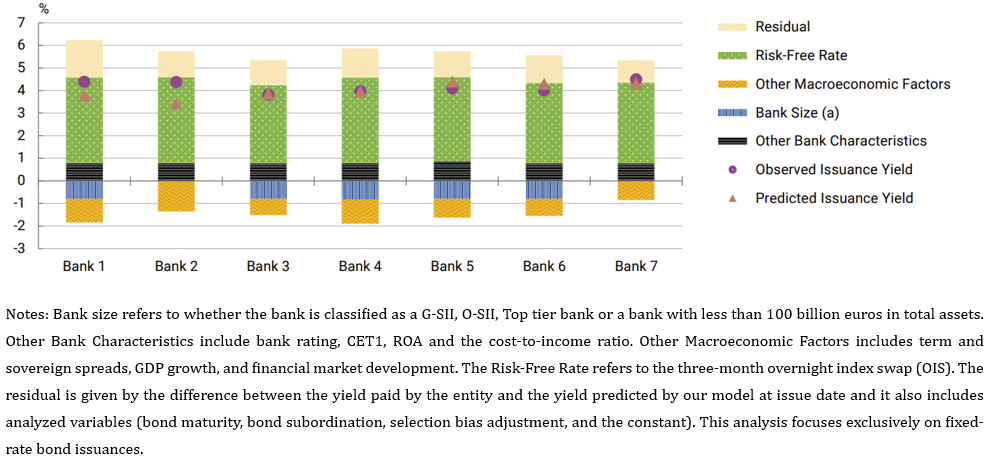
The relevance of bond subordination varies across the Spanish banks analyzed, depending on the specific type of instrument issued and the bank’s credit rating. Although our sample includes highly subordinated instruments, the impact of subordination is limited due to the strong credit ratings of the Spanish banks covered in the analysis. The model would have predicted higher yields, if these institutions had been rated as high-yield or were unrated. Selection bias is found to lower estimated issuance yields, although its magnitude varies across banks. This effect is particularly pronounced among smaller banks, where the lower issuance frequency increases the relevance of market timing.
We use our model estimates to assess how the eventual set up of subordination requirements for a mid-sized bank would affect its net income. Subordination requirements typically apply to banks with assets above €100 billion and compel them to meet MREL requirements with subordinated debt or capital. Authorities can, however, set them on banks which they deem may pose systemic risk upon failure, a group that is more likely to include those close to this threshold. We quantify the additional cost that institutions with total assets of €90-99 billion would incur if authorities take this decision, if entities roll over senior debt maturities into senior non-preferred instruments (the cheapest subordinated instrument that counts toward MREL).
We identify four Banking Union banks with total assets between €90 billion and €99 billion at end-2023, just below the threshold at which banks become subject to subordination requirements. These four institutions belong to the low investment-grade issuer category.
Based on the model-implied spread of 34 basis points between SNP and senior preferred debt for low investment-grade issuers, and using average issue sizes for those banks, we estimate that the implied additional cost of issuing SNP instruments would amount, on average, to €0.8 million (an average of 0.12% of the banks’ net income).
Figure 2. Simulation of the impact of subordinated debt issuance on the bank’s net income
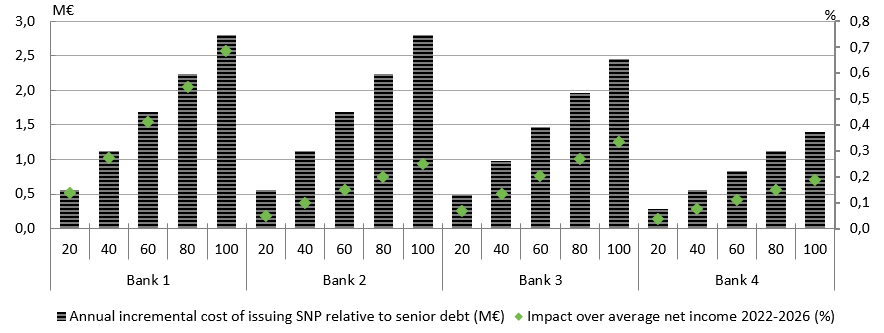
We conduct sensitivity analyses of the cost impact, examining a conservative range of SNP-SP spreads: a 20 bp lower bound (benign scenario) and a 100 bp upper bound (adverse scenario). Figure 2 shows the simulation results. If the SNP‑SP spread compresses to 20 bp, the extra coupon expense of issuing SNP instruments falls to €0.5 million; if it widens to 100 bp, the expense rises to €2.36 million. These extra coupon costs are small relative to average net income, about 0.07% in the benign case and 0.36% in the adverse one. In our simulations, despite some cross‑entity dispersion – largely driven by differences in net income- the impact on profitability remains below 1% for all banks, even under the adverse scenario, suggesting that the transition into stricter subordination requirements would impose limited financial burden for banks close to the threshold.
Overall, our results suggest that the cost of issuing MREL-eligible debt is jointly determined by bank-specific fundamentals, macroeconomic and country‑level conditions, and instrument-specific characteristics. While larger bank size and stronger credit ratings help reduce issuance costs, macroeconomic and country‑level conditions remain key drivers, particularly the risk-free rate, as well as term and sovereign spreads. Moreover, the effect of credit quality is not uniform across instruments, as the funding advantage associated with a higher rating becomes more pronounced for more subordinated instruments.
More broadly, our findings highlight that both market access and issuance pricing are shaped by a common set of factors, underscoring the importance of accounting for selection effects when assessing bank funding costs. From a practical perspective, we show that our model, relying only on observable variables, is able to closely track observed issuance costs. From a policy perspective, our sensitivity analyses suggest that imposing stricter subordination requirements on banks near the regulatory threshold would result in only a limited financial burden.
Berger, Allen N., Charles P. Himmelberg, Raluca A. Roman and Sergey Tsyplakov. (2022). “Bank bailouts, bail-ins, or no regulatory intervention? A dynamic model and empirical tests of optimal regulation and implications for future crises”. Financial Management, 51(4), pp. 1031-1090. https://doi.org/10.1111/fima.12392
Bernard, Benjamin, Agostino Capponi and Joseph E. Stiglitz. (2022). “Bail-ins and bailouts: Incentives, connectivity, and systemic stability”. Journal of Political Economy, 130(7), pp. 1805-1859. https://doi.org/10.1086/719758
European Banking Authority. (2016). Final report on MREL. Report on the implementation and design of the MREL framework. https://www.eba.europa.eu/sites/default/files/documents/10180/1695288/be1ffc3e-e966-4bfe-a5fc-5e80e1873726/EBA%20Final%20MREL%20Report%20%28EBA-Op-2016-21%29.pdf
Keister, Todd, and Yuliyan Mitkov. (2023). “Allocating losses: Bail-ins, bailouts and bank regulation”. Journal of Economic Theory, 210(105672). https://doi.org/10.1016/j.jet.2023.105672
Gonzalez, F, A. Orts, J.M. Serena and M. Tari (2026): “Issuance yield of MREL-eligible bank debt: a benchmarking model”. Bank of Spain Occasional Paper. 2607. https://doi.org/10.53479/42805
Restoy, Fernando. (2023). MREL for sale-of-business resolution strategies. FSI Briefs, 20, Financial Stability Institute – Bank for International Settlements. https://www.bis.org/fsi/fsibriefs20.pdf
Walther, Ansgar, and Lucy White. (2020). “Rules versus discretion in bank resolution”. The Review of Financial Studies, 33(12), pp. 5594-5629. https://doi.org/10.1093/rfs/hhaa032