

This policy brief is based on ECB Working Paper Series, No 3151. The views expressed are those of the authors and not necessarily those of the institutions the authors are affiliated with.
Abstract
Investment funds in the euro area have expanded rapidly over the past decade and have become key players in financial markets, shaping liquidity, asset prices, and even financial stability. This policy brief presents key findings from Hodula and Tiza Mimun (2025) on how monetary policy and macroprudential regulation jointly affect investment fund activity across euro area countries. Using evidence for six major fund domiciles, we document strong cross-country heterogeneity. In financially conservative markets such as Germany, France, and the Netherlands, tighter monetary policy combined with macroprudential tightening is associated with persistent contractions in fund assets. By contrast, in global financial hubs such as Luxembourg, Ireland, and Italy, the same policy mix coincides with asset increases. Using a simple balance-sheet framework, we show that these differences are consistent with interacting funding-cost and collateral-constraint channels and with varying degrees of cross-border financial integration.
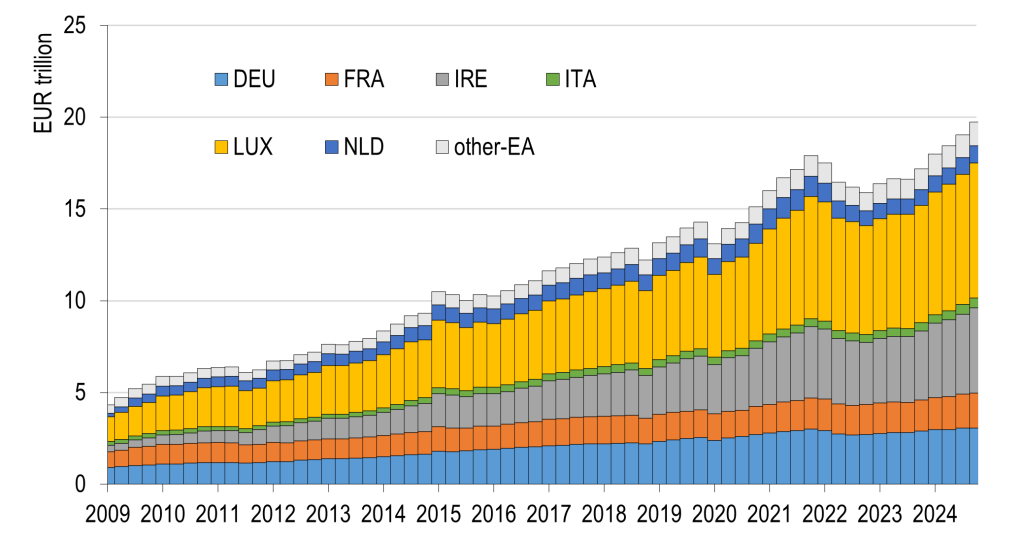
Over the past decade, investment funds in the euro area have grown rapidly, with assets under management nearly tripling (Figure 1). This expansion has been driven by sustained low interest rates (Malovaná et al., 2023), regulatory changes (Bengui and Bianchi, 2022; Gebauer and Mazelis, 2023), and rising investor demand for diversified investment products (Greenwood and Scharfstein, 2013; Barber et al., 2016). As a result, investment funds have become central actors in financial markets, influencing liquidity conditions, asset prices, and potentially financial stability.
Figure 1. Investment funds in the euro area
Source: ECB Data Portal; authors’ calculations
Despite their growing systemic relevance, policy frameworks remain largely bank centric. Monetary policy and macroprudential regulation are primarily designed with banks in mind, while non-bank financial intermediaries are often affected only indirectly. Yet investment funds are closely interconnected with the banking system through funding, collateral, and market channels, implying that policy measures targeting banks can spill over to the fund sector.
This policy brief highlights why understanding the interaction between monetary policy and macroprudential regulation is essential in an environment where non-bank finance plays an increasingly important role. In particular, it shows that similar policy actions can have markedly different effects on investment funds across euro-area countries, depending on domestic financial structures and cross-border funding linkages.
In our paper, we document that the effects of monetary policy tightening on investment funds differ sharply across euro area countries when monetary policy shocks occur during periods of tight macroprudential setting. Similar policy actions can generate opposite outcomes depending on domestic financial structures and the degree of international integration (Figure 2).
In bank-centric, financially conservative markets such as Germany, France, and the Netherlands, tighter monetary policy under tighter macroprudential policy is associated with persistent contractions in investment fund assets.
By contrast, in global financial hubs such as Luxembourg, Ireland, and partly Italy, the same policy mix coincides with asset increases into the fund sector. These jurisdictions host internationally oriented fund complexes with access to deep cross-border funding networks. As a result, investment funds are likely better able to absorb domestic tightening or reallocate funding across borders, offsetting the contractionary effects of higher interest rates and tighter regulatory stance.
Figure 2. Monetary tightening transmission to investment funds under tight macroprudential stance
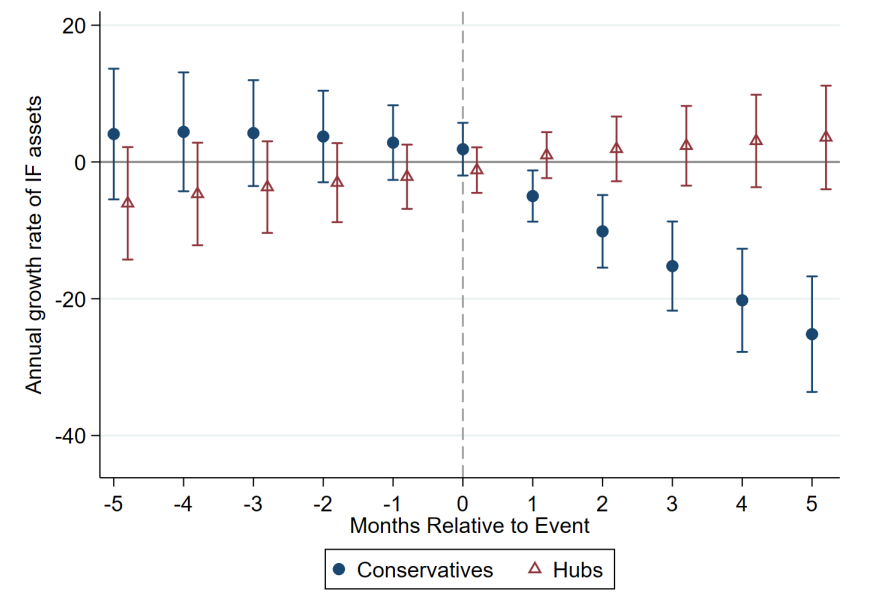
Notes: Conservative markets (Germany, France, Netherlands) versus global hubs (Luxembourg, Ireland, Italy).
Source: Authors’ calculations.
Importantly, we show that these opposing responses largely cancel out in euro area aggregates, masking substantial country-level heterogeneity. This highlights the limits of aggregate analysis and the importance of examining the interaction between monetary and macroprudential policies at the country level.
We show that the contrasting responses of investment funds across countries can be understood through two interacting channels: a funding-cost channel and a collateral-constraint channel.
Higher interest rates increase funding costs for investment funds, compress net returns, and reduce leverage. At the same time, macroprudential tightening raises effective collateral requirements and limits borrowing capacity, particularly when regulatory measures affect banks’ balance sheets. In financially conservative markets, these two channels reinforce each other. Higher funding costs coincide with tight collateral constraints, leaving funds with limited scope to adjust and leading to persistent asset contractions.
In global financial hubs, the same channels operate differently. While higher interest rates still raise funding costs, collateral constraints tend to be less binding due to access to international funding sources. Deep cross-border networks allow funds to reroute borrowing or attract new capital, weakening the impact of domestic regulatory tightening. As a result, the interaction between monetary and macroprudential policy can even turn expansionary for the fund sector in these jurisdictions.
Figure 3 provides a stylised illustration of these mechanisms, highlighting how differences in funding structures and cross-border integration can lead to opposite outcomes under the same policy mix.
Figure 3. Funding-cost and collateral-constraint channels in investment funds
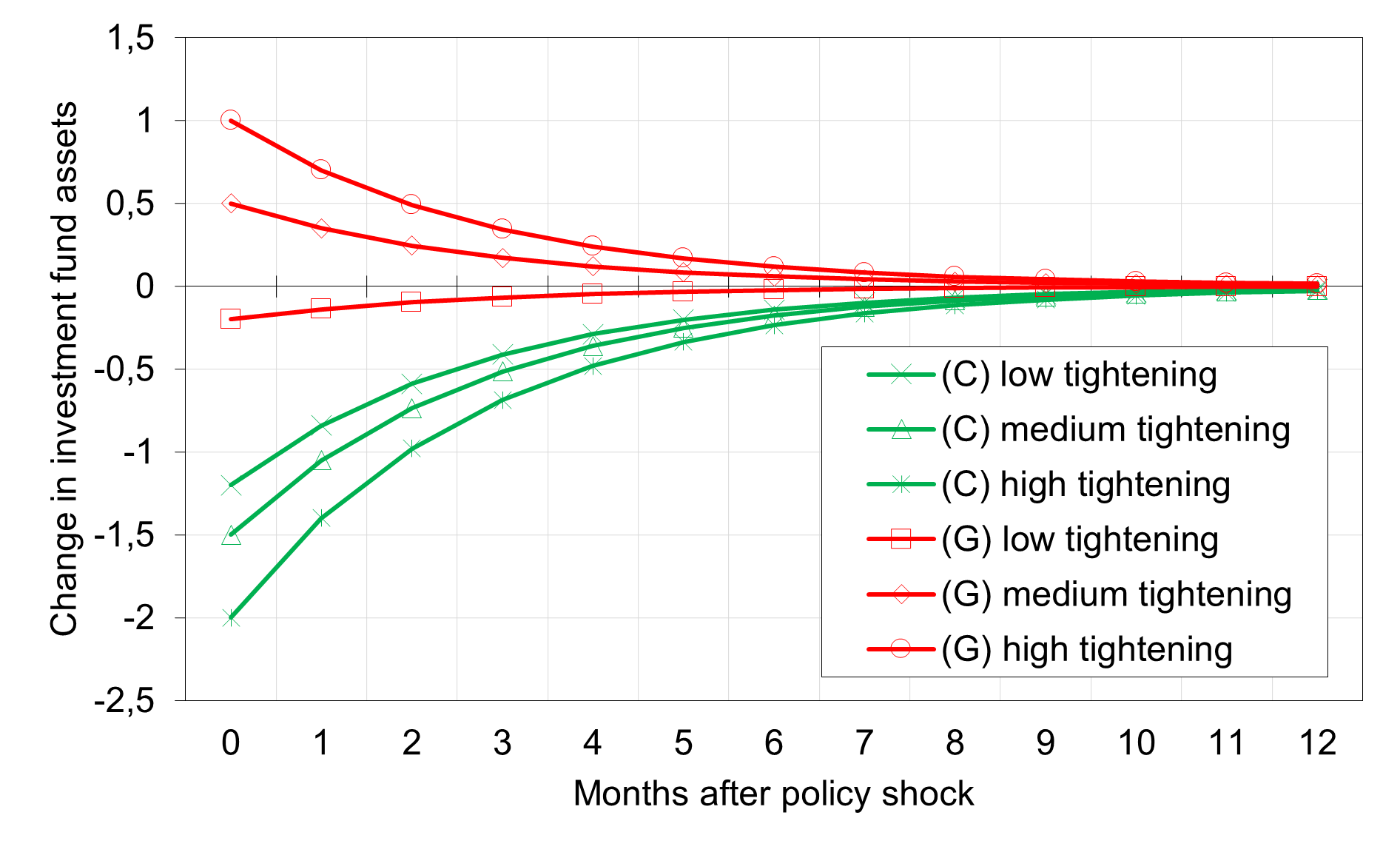
Notes: Stylised illustration based on a simple balance-sheet framework. The figure shows the normalised response of investment fund assets to a stylised increase in funding costs and haircuts. (C) denotes conservative markets, (G) denotes global hubs. Low, medium, and high refer to the intensity of the increase in funding costs and haircuts following a stylised joint increase in funding costs and haircuts.
Source: Authors’ illustration.
The evidence presented in this brief is consistent with these mechanisms and underscores the role of funding structures and cross-border integration in shaping policy transmission to non-bank financial intermediaries.
The interaction between monetary and macroprudential policy also depends on the type of macroprudential instruments. Tight setting of liquidity-based measures tend to trigger faster and more pronounced short-term adjustments in investment fund assets following a monetary tightening, while capital-based measures are associated with more gradual but persistent effects.
Crucially, the scope for regulatory spillovers is found to depend on cross-country coordination. When macroprudential tightening occurs only in a subset of countries, global fund hubs are more likely to experience inflows as activity is reallocated across borders. When tightening becomes more widespread and coordinated across major jurisdictions, these inflows disappear and investment fund assets contract more uniformly across countries.
These findings have several policy implications. First, bank-focused macroprudential measures can generate significant spillovers to non-bank financial intermediaries, with effects that vary across countries. Second, a one-size-fits-all policy approach risks over-tightening in financially conservative markets while allowing regulatory leakage in internationally integrated financial hubs. Third, monetary and macroprudential policies should be assessed jointly, as their interaction can amplify or offset their individual effects. Finally, greater cross-border coordination, combined with improved monitoring and stress testing of large investment fund complexes, would help reduce regulatory arbitrage and strengthen the resilience of the euro-area financial system.
Barber, B. M., Huang, X., and Odean, T. (2016). Which factors matter to investors? Evidence from mutual fund flows. The Review of Financial Studies, 29(10): 2600–2642.
Bengui, J. and Bianchi, J. (2022). Macroprudential policy with leakages. Journal of International Economics, 139:103659.
Gebauer, S. and Mazelis, F. (2023). Macroprudential regulation and leakage to the shadow banking sector. European Economic Review, 154:104404.
Greenwood, R. and Scharfstein, D. (2013). The growth of finance. Journal of Economic Perspectives, 27(2): 3-28.
Hodula, M. and Tiza Mimun, A. (2025). Investment funds and the monetary-macroprudential policy interplay. ECB Working Paper No. 3151, European Central Bank.
Malovaná, S., Bajzík, J., Ehrenbergerová, D., and Janků, J. (2023). A prolonged period of low interest rates in Europe: Unintended consequences. Journal of Economic Surveys, 37(2): 526–572.