

This brief is based on the author’s paper “Identification of expectational shocks in the oil market using OPEC announcements”. The views expressed are those of the author and do not necessarily represent those of the Bank of Italy or the Eurosystem. The clean surprises are publicly accessible at this link: https://github.com/riccardo-degasperi/OPEC-surprises
Abstract
Oil supply news shocks are typically identified from daily surprises in oil futures prices around OPEC announcements. This brief argues that these surprises do not uniquely capture oil supply news. Under imperfect information, markets use the price of oil as a public signal of global demand, and an OPEC announcement simultaneously reveals news about future supply and prompts a revision of beliefs about demand. As a result, surprises conflate a supply news shock and an information-induced demand shock, and identification based on them alone yields biased dynamic responses to the oil supply news shock. An additional sign restriction on the comovement between oil futures surprises and stock price surprises disentangles the two shocks. Based on this cleaner identification, adverse oil supply news shocks have deeper, faster, and more persistent stagflationary effects than previously documented.
Oil prices are a forward-looking variable: expectations about future oil supply can move prices sharply before any change in physical production materialises and shocks to these expectations propagate to global economic activity and inflation. Identifying such shocks is difficult because oil prices and oil price expectations respond endogenously to both supply and demand conditions (Kilian, 2009).
A prominent identification strategy in the recent literature exploits OPEC announcements. Surprises in the price of oil futures on OPEC conference days are used as an instrument for the oil supply news shock (Känzig, 2021). The rationale is that OPEC production decisions generate variation in future oil supply that is unanticipated by market participants, so that price surprises in a daily window around announcements reflect exogenous revisions in oil supply expectations.
This interpretation relies on three conditions: the event window is narrow enough to rule out contamination from other shocks; risk premia do not move within the window; and OPEC and the market share the same information set. The third condition is the weakest. OPEC sets production quotas through closed-door negotiations among member countries, members often deviate from agreed targets, and the extent of compliance is only gradually revealed through OPEC’s own reporting and secondary sources. OPEC therefore holds an informational advantage over the market about both current and future oil supply.
Conditional on the supply of oil being stable or observable, movements in oil prices are a timely indicator of global demand. When an OPEC announcement reveals supply conditions, it also removes noise from the public signal that oil prices provide about demand, prompting agents to revise their expectations about it. Surprises in oil futures therefore capture both a genuine supply news shock and an information-induced demand shock.
The argument can be formalised within a standard model of information frictions in commodity markets (Sockin and Xiong, 2015). Firms use oil as an input and observe two signals of aggregate demand: a noisy private signal and the equilibrium price of oil, which aggregates dispersed information. An unobserved oil supply shifter acts as noise in the public signal. Before an OPEC announcement, firms cannot fully separate supply and demand drivers of oil prices. In particular, they may mistakenly attribute a decline in oil prices caused by a positive shift in oil supply to a weakening of demand, which amplifies the price decline relative to the full-information benchmark.
An OPEC announcement induces two simultaneous revisions. News about future oil supply shifts induce markets to update their beliefs about future oil supply – the oil supply news shock. News about realised supply shifts, if markets had previously misattributed part of the price movement to demand, induce them to revise their expectations about aggregate demand. As a result, surprises in oil futures conflate a supply news shock and an information-induced demand shock. The two revisions move oil prices in the same direction but have opposite implications for economic activity. Hence, any identification based on them alone yields biased estimates of the effects of the oil supply news shock.
Importantly, this mechanism does not require OPEC to know more than the market about aggregate demand. It only requires that OPEC knows more than the market about its own production decisions.
The model also suggests a restriction that separates the two components. Because the oil supply news and demand-information shocks have opposite implications for economic activity, they generate opposite patterns of comovement between oil futures and equity prices. An adverse oil supply news shock raises oil prices and depresses equity prices, while an information-induced upward revision in demand raises both. A restriction on the sign of this comovement within the daily window around OPEC announcements therefore identifies the two shocks separately. The baseline results in the paper use the S&P 500 to implement this restriction.
A second, complementary, identification approach directly controls for OPEC’s information set by projecting the raw surprises on forecasts and forecast revisions published in the OPEC Monthly Oil Market Reports. The fitted values from this regression capture the information component while the residuals capture the oil supply news shock. This approach yields impulse responses that are qualitatively consistent with those from the former identification strategy, lending support to the results.
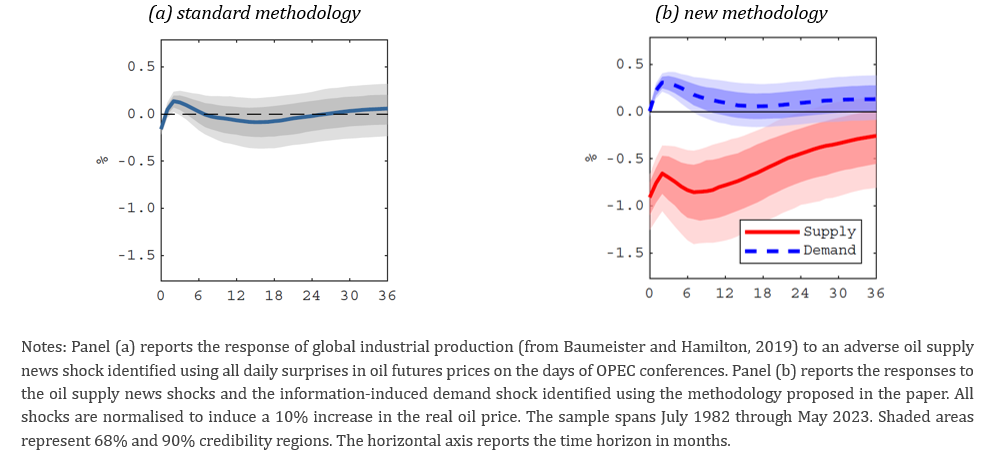
When the full set of oil futures surprises is used as an instrument in a Proxy-SVAR setting without separating the two components, the estimated dynamic responses obtained are unstable across sample periods and display output puzzles: an adverse oil supply news shock may even appear to expand, rather than contract, world industrial production (Figure 1, left panel). These puzzles are a direct consequence of instrument contamination. Indeed, even small correlations between an instrument and a non-target shock can produce substantial bias in impulse responses (Miranda-Agrippino and Ricco, 2023).
When the two components are separated, the effects of an oil supply news shock on the global economy turn out to be larger, more immediate, and more persistent. An adverse oil supply news shock normalised to raise the real oil price by 10% produces a contraction of about 1% in both world and U.S. industrial production, with effects lasting up to three years (Figure 1, right panel, red line). U.S. consumer prices increase persistently, with a peak response of roughly 0.3% within three months. World oil production falls with a lag consistent with the staggered implementation of announced quota cuts, while oil inventories build up.
Figure 1. Response of global industrial production to an oil supply news shock
The same shock contracts equity prices in OECD economies (excluding North America) by around 5%, widens U.S. corporate credit spreads as measured by the excess bond premium, and raises the VIX. The credit channel thus acts as an amplification mechanism for the real effects of the shock, in line with recent evidence (Gelain and Lorusso, 2025). Non-energy commodity prices fall, which suggests that the clean instrument is not contaminated by residual demand shocks.
Market-based inflation expectations respond as well: both short-horizon measures and the five-year, five-year-forward breakeven rate move significantly, indicating that the shock has the potential to unsettle longer-term inflation anchoring.
The information shock, identified from the complementary set of surprises and normalised to the same oil price increase, transmits as a demand shock: global and U.S. industrial production expand, oil inventories are drawn down, consumer prices rise persistently, and equity prices increase (Figure 1, right panel, blue line).
Two main implications stand out for policymakers and applied researchers.
First, the macroeconomic effects of oil supply news shocks are larger, faster and more persistent than suggested by identification strategies that use daily surprises in oil futures without adjustment. An adverse shock is strongly stagflationary, and the trade-off between output and price stabilisation is sharper than earlier estimates imply. Central banks should factor this amplified response into their assessment of risks to the inflation outlook, especially in episodes of elevated geopolitical tension around oil producers.
Second, information effects are not a peculiarity of monetary policy communication (Melosi, 2017). They arise whenever public signals are used to aggregate dispersed information about fundamentals, and they can generate biased estimates of the effects of shocks even when the signalling agent does not possess superior knowledge of demand. Applied work that relies on high-frequency event studies around announcements should routinely check whether the identified shocks are contaminated by information components.
OPEC announcements provide a valuable source of variation in oil supply expectations, but the surprises they generate are not clean instruments. By recognising that oil prices serve as a public signal of global demand, and that OPEC announcements reduce the noise in that signal, one can separate genuine supply news from information effects using a simple sign restriction on the comovement with stock prices. Once this separation is performed, oil supply news shocks emerge as a potent source of global stagflation, propagating through both real and financial channels and complicating the task of monetary authorities worldwide.
Baumeister, C. and J. D. Hamilton (2019). Structural interpretation of vector autoregressions with incomplete identification: Revisiting the role of oil supply and demand shocks. American Economic Review, 109(5), 1873–1910.
Gelain, P. and M. Lorusso (2025). Oil price fluctuations, US banks, and macroprudential policy. Journal of Monetary Economics, 156, 103848.
Känzig, D. R. (2021). The macroeconomic effects of oil supply news: Evidence from OPEC announcements. American Economic Review, 111(4), 1092–1125.
Kilian, L. (2009). Not all oil price shocks are alike: Disentangling demand and supply shocks in the crude oil market. American Economic Review, 99(3), 1053–1069.
Melosi, L. (2017). Signalling Effects of Monetary Policy. The Review of Economic Studies, 84(2), 853–884
Miranda-Agrippino, S. and G. Ricco (2023). Identification with external instruments in structural VARs. Journal of Monetary Economics, 135, 1–19.
Sockin, M. and W. Xiong (2015). Informational frictions and commodity markets. Journal of Finance, 70(5), 2063–2098.