

This policy brief is based on “Simplifying climate change adaptation for banks in the EU”. The views expressed are those of the authors and not necessarily those of the institutions the authors are affiliated with.
Abstract
This Policy Brief provides an analysis and discussion of the prudential assessment of physical climate risks in the EU. We advocate a holistic treatment across scenario analysis, stress testing, transition plans and Pillar III disclosures—an approach that is still missing from the current EU prudential framework. Particularly, we identify the following venues of improvement:1) climate scenario analysis should rely, as far as possible, on common modelling approaches for the same physical risks across the EU; 2) the assessment of physical risks financial impact on Probability of Default (PD) and Loss Given Default (LGD) would also require micro data (e.g. credit registers and spatial collateral coordinates) and a clear distinction of the channels of transmission of ex ante physical adaptation (risk reduction) and property/casualty insurance (risk transfer); 3) “mitigation and adaptation plans,” should define a physical risk derisking strategy and, ideally, establish targets on adaptation compatible with assets’ insurability; 4) requirements should move beyond static gross-exposure reporting toward vulnerability-adjusted disclosures. The present EU Taxonomy should be extended to include ex ante adaptation activities.
Climate risk is inherently forward-looking and characterised by deep uncertainty. Against this background, the regulator has placed particular emphasis on two complementary priorities:
Climate risk adaptation is an overarching legal obligation in the European Union because the global goal of adaptation set out in the Paris Agreement was elevated to one of the six legally binding environmental objectives of the EU laid down in the EU Taxonomy. However, the EU lacks a truly adaptation taxonomy of economic activities. Nonetheless, in line with the EU Climate Law, Member States have implemented national adaptation plans and strategies since 2019. These translate into regional adaptation plans, which identify adaptation measures.
Our Policy Note examines how effectively the European Banking Authority (EBA) Guidelines and Implementation Technical Standards (ITS) encourage banks to adapt to physical climate risks. We go further by considering how the existing framework could be reformed to improve the assessment of these risks and strengthen the role of “ex ante” adaptation (NGFS, 2024) and insurance as risk mitigants. “Ex ante“ adaptation encompasses short-term, firm-specific (e.g. asset realocation, facilities maintenance) and long-term government promoted measures (e.g. infrastructure and technological upgrades).
The tools to assess physical risks and their mitigants are considered in the Guidelines on the management of environmental risks, the Guidelines on environmental scenario analysis, and forms part of the ECB supervisory expectations.
Climate scenarios underpin both financial stress tests and transition plans. The Guidelines on scenario analysis refer to several scenario providers without prioritising among them, while emphasising the need for sufficient consistency between scenarios used for physical and transition risks, even where different modelling approaches are applied. In practice, these differences limit comparability across the scenario providers used by banks across the EU, as shown in the Annex to Nieto and Papathanassiou (2026). Moreover, none of the scenario providers treats “ex ante” adaptation as a risk mitigant or insurance for that reason.
The Guidelines state that adaptation policies should be included in climate risk scenarios but provide limited guidance on how this should be operationalised. Given that adaptation is highly heterogeneous and often firm- or asset-specific, it cannot be incorporated as a uniform macro-scenario adjustment.
Macro-climate scenarios aggregate data at the sectoral and regional or headquarter levels, limits the possibility of capturing establishment-level nuances that are important for the assessment of physical risks. As a result, important factors like asset-specific adaptation and local insurance mechanisms — elements that can fundamentally alter credit risk parameters during a stress event — are not captured.
The Guidelines on the management of environmental risks require institutions to quantify climate related risks, such as by estimating magnitude of their financial impacts (credit, market and operational) into their internal capital and liquidity frameworks. Climate stress test should be integrated into the overall stress testing of banks. This is compatible with targeted stress tests that capture physical risk heterogeneity (hazard and vulnerability) as well as institutional capacity. Inevitably, the assessment of physical risks financial impact on PD and LGD would require not only top-down climate models but also micro data.
In supervisory practice – such as the EBA 2027 EU-wide stress test framework – physical risk is operationalized as an instantaneous acute shock. Furthermore, while central banks and supervisors increasingly embed physical shocks into climate scenarios and stress-testing exercises, doing so continues to present major analytical and operational challenges for financial institutions (Baudino and Svoronos, 2021), in particular, translating granular micro data (credit registers and spatial collateral coordinates) into credit risk parameters requires looking beyond headquarter-level metrics. Nonetheless, we need to acknowledge that identifying precise site-level locations for geographically dispersed production assets is one of the biggest practical bottlenecks in physical climate risk assessment. Crucially, mapping physical risk heterogeneity requires to differentiate between two fundamentally distinct risk mitigants: ex ante physical adaptation (risk reduction) and property/casualty insurance (risk transfer).
For example, in the case of commercial real estate, distinguishing asset types at the establishment level reveals a critical dual-transmission mechanism that separates “container” losses (real estate premises) from “content” losses (production equipment and inventory) (de l’Estoile et al., 2025). Property damage to the “container” reduces landlord asset values, increasing LGD on real estate collateral. Conversely, damage to the “content” impairs the operational equipment of the occupying firm, destroying productive capacity, depressing cash positions, and elevating debt leverage. Empirically, physical shocks translate into significant credit risk through both reduced repayment capacity and collateral impairment (Albertazzi et al., 2024), with bank credit losses originating from “content” damages (the occupier channel via PD) being substantially more severe than those stemming from “container” damages (the owner channel via LGD). Ex ante physical adaptation protects both container and content over longer time horizons. By safeguarding operational continuity, adaptation preserves debt-servicing capacity over time, structurally lowering baseline and tail PDs as well as collateral LGDs, though predominantly over extended multi-year horizons.
Insurance, by contrast, operates as a post-event financial liquidity buffer rather than physical risk prevention. While most EU primary insurers rely predominantly on private reinsurance, select jurisdictions feature multi-layered public-private risk-pooling mechanisms – such as the French Cat Nat regime and Spain’s Consorcio de Compensación de Seguros. In these state-backed institutional settings, complemented by mutual credit guarantees, public support and conservative lending standards, the short-term transmission of physical shocks to banking and insurance balance sheets is significantly muted. Empirical evaluation of French regional and Spanish banks facing extreme disasters like the 2015 flash floods, 2020 Storm Alex (Boungou and Dees, 2026) or the 2024 Dana in Valencia (Pérez Montes et al., 2025) reveals that while affected borrowers experience transient liquidity strain – prompting deposit withdrawals for urgent repairs and surges in reconstruction loan demand – bank credit quality suffers only minor degradation. This safety net acts as an effective short-term liquidity shock absorber, substituting destroyed physical collateral with monetary claims and maintaining immediate borrower solvency following an instantaneous shock. Table 1 describes the credit risk transmission differences between ex-ante adaptation vs. insurance.
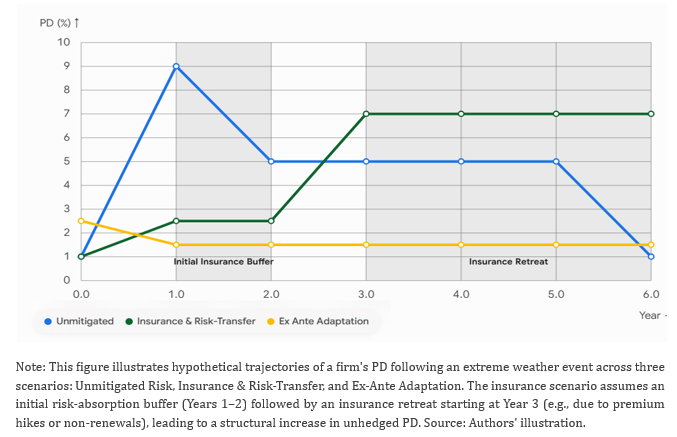
However, relying on insurance mechanisms as equivalent risk mitigants within supervisory stress testing frameworks introduces severe long-term modelling flaws. Unlike structural ex-ante adaptation investments matching multi-year loan maturities, property insurance policies operate on annual renewal cycles. As climate change accelerates hydrometeorological event severity, surging claims can strain the supply and demand of insurance. In multi-year stress scenarios, static insurance coverage assumptions fail to capture dynamic risk repricing, widening deductibles, or total insurance retreat in high-risk areas and even the possibility of obsolescence of some adaptation strategies. Following an initial Year 1 shock (e.g. floods), unhedged “content” and property exposures in outer stress years trigger sharp, non-linear PD and LGD spikes as protection gaps expand (Figure 1). This limitation is even more pronounced for chronic hazards such as heatwaves. While acute floods trigger property public indemnification, chronic heat stress inflicts widespread, uninsurable income-statement losses through productivity declines.
Table 1. Credit Risk Transmission: Ex-ante Adaptation vs. Insurance
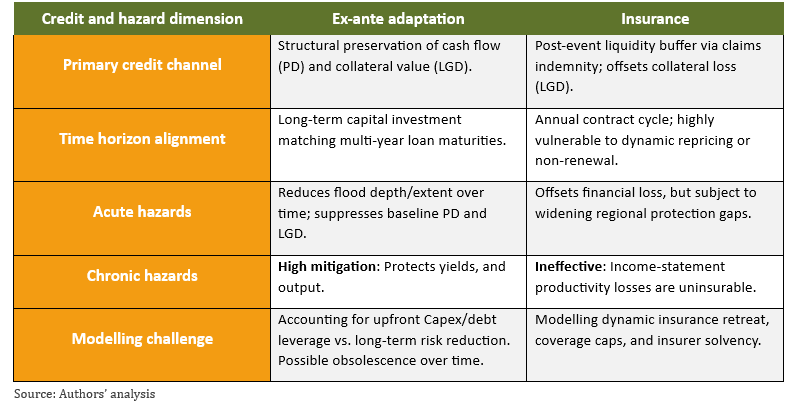
Figure 1. Hypothetical portfolio Probability of Default (PD) trajectories under acute flood stress
Despite their name, transition plans ensure that banks monitor and address both transition and physical risks.
The scope of transition plans is comprehensive and may rely on a combination of methodologies, including portfolio-, exposure- and sector-based approaches. In principle, such methodologies could take account of hazard severity, ex ante effective adaptation measures—such as tangible physical protection—and insurance as risk mitigants.
However, the Guidelines do not require consistency across scenario analysis, stress testing and transition plans—for example, by requiring these tools to consider the same physical hazards, geographic areas, assets or vulnerability assumptions. Nor do they require banks to monitor physical risks above specified return-period thresholds, set ex ante adaptation targets, or assess the impact of adaptation and insurance strategies that may change over the 2050 horizon. This long-term horizon creates important assessment challenges, including insurance retreat, coverage caps, insurer solvency constraints and the potential obsolescence of adaptation strategies.
In June 2026, the EBA published the final version of the legally binding ITS for the disclosures on ESG risks. The ITS is inspired by the simplification efforts that have guided the recent work of the EU Commission. The result is a reduction of the number of data points for all banks.
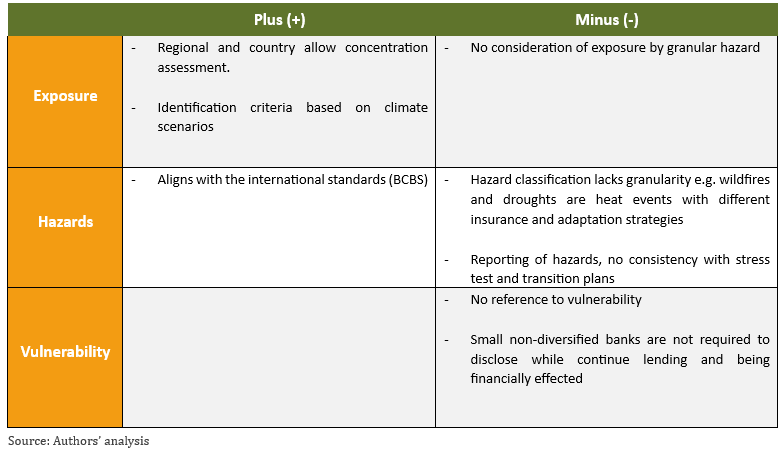
The ITS are mandatory only for large institutions (listed or not) and large listed subsidiaries making no reference to vulnerability, as of December 2026. Small banks with little geographic diversification are not obliged to report despite been the most financially affected (Pagliari, 2021, Álvarez-Román et al. (2023).
In line with the Basel Committee of Banking Supervision (BCBS) approach, the distinction of acute and chronic physical risks has been dropped, and risks are reported in broad categories: water, heat, wind, solid mass. Table 2 summarizes our assessment of the final ITS.
Table 2. Our assessment of the final ITS on environmental disclosures
It is surprising that the regulator did not use this opportunity to require regular, comparable information on vulnerability that banks already disclose in their public annual reports, albeit in a non-comparable and delayed manner. For example, in Greece where 97% of bank loans are exposed to physical risk, Greek significant institutions do so. Their methodologies include climate hazard, exposure and vulnerability forward looking assessments until 2050 for chronic and 2060 for acute physical risks taking into consideration hazards, economic sectors and regions.
Physical climate risks require a holistic approach across banks’ scenario analysis, stress testing, transition plans and Pillar 3 disclosures — an approach that is still missing from the current EU prudential framework.
Climate scenario analysis should rely, as far as possible, on common modelling approaches across the EU and apply a consistent framework to all relevant physical hazards, including compound risks to secure a level playing field. To align internal capital frameworks with the EBA Guidelines, institutions and supervisors must refine physical risk modelling along three key dimensions. First, stress testing engines leveraging granular credit registers must incorporate establishment-level micro data capable, for example, of explicitly decoupling occupier “content” risks from owner “container” risks. Second, risk models must uncouple long-term collateral and corporate solvency projections from static insurance assumptions, explicitly modelling dynamic insurance premium hikes, protection gap expansions, over multi-year horizons. Third, credit risk engines must internalize the dual financial profile of ex-ante adaptation, balancing the short-term leverage increases resulting from debt-funded adaptation capital expenditures against its substantial, long-term stabilization of corporate cash flows, collateral integrity, and overall financial system resilience.
Regarding climate transition plans, the existing guidance is not sufficiently aligned with its own recommendations on stress testing and the Pillar 3 disclosures, particularly in relation to hazards, vulnerability, insurance and ex ante adaptation. A more accurate label for these plans would therefore be “mitigation and adaptation plans,” which should define a physical risk derisking strategy and, ideally, establish targets on adaptation compatible with assets´ insurability. Pillar 3 disclosures demand granular information on hazards. Moreover, Pillar 3 requirements should move beyond static gross-exposure reporting toward vulnerability-adjusted disclosures and micro data in line with the stress tests. Hence, proportionality should reflect vulnerability, for example, by requiring disclosure of hazards with return periods above specified thresholds. Adaptation measures adopted by, or otherwise benefiting, the borrower should also be disclosed.
Finally, we identify the need to extend the present EU Taxonomy to include ex ante adaptation economic activities.
Albertazzi, U., Djekic D., Marques A.P. (2024). Physical Climate Risk, Credit Risk and Lending Activity. ECB Working Paper Series, No. 3224.
Álvarez Román, L., Mayordomo S., Vergara-Alert C., Vives X. Climate Risk, Soft Information and Credit Supply. Banco de España Working Paper Series, No. 2406 (23 February 2024),
Baudino, P. and Svoronos J-P. (2021). Stress-Testing Banks for Climate Change – A Comparison of Practices. BIS FSI Insights No. 34.
Boungou, W. and Dees, S. (2026). The French Exception? Risk-Pooling and Bank Resilience in Disaster-Prone Areas. Economics of Disasters and Climate Change, Vol.10 (26). https://doi.org/10.1007/s41885-026-00207-w.
de l’Estoile, E., Kerdelhué, L., & Verdier, T. (2025). Container or Content: From Flood Hazards on Firms’ Physical Assets to Credit Risks. Banque de France Working Paper Series, No. 1022.
European Banking Authority (EBA) (2026). 2027 EU-wide Stress Test – Draft Methodological Note. EBA Technical Report.
Nieto, M. J. and Papathanassiou, C. (2026). Simplifying Climate Change Adaptation for Banks in the EU. ECB Occasional Paper Series, No. 386.
Pagliari M. S. (2021). LSIs’ Exposure to Climate Change Related Risks: An Approach to Assess Physical Risks. ECB Working Paper Series, No. 2517.
Pérez Montes, C., GarcíaVillasur, J., Gutiérrez de Rozas, L., Jiménez, G., Lavín, N., Matyunina, A., and Vegas, R. (2025). The Impact of the Autumn 2024 Flash Floods in Spain from a Financial Stability Standpoint. Banco de España Financial Stability Review, (48).