

This SUERF Policy Brief is based on BIS Working Paper No 1324. The views expressed here are those of the authors and do not necessarily reflect those of the Bank for International Settlements, Consejo Mexicano de Negocios, the Bank of Spain or the Eurosystem. Any errors and omissions are our own.
Abstract
This piece studies the impact of domestic economic policy uncertainty (EPU) on macroeconomic and financial variables in Latin America. Using a panel dataset for Brazil, Chile, Colombia and Mexico from 2005 to early 2025, we find that domestic EPU shocks cause significant macroeconomic disruptions, leading to a contraction in output and a rise in inflation, akin to a supply shock. These effects are transmitted through a financial channel in the short term, via higher risk premia, increased equity market volatility and exchange rate depreciations, and through a real channel in the medium term, via declines in growth expectations and consumer and business confidence. Our analysis further reveals that EPU shocks are most damaging when the economy is weak or financial conditions are tight, while stronger economies are better able to absorb such shocks.
Emerging market economies (EMEs) generally experience higher levels of domestic uncertainty than advanced economies (AEs) (Bloom (2014); Choi and Shim (2019)), and this heightened uncertainty can jeopardise macro-financial stability (Bloom (2009); Al-Thaqeb and Algharabali (2019)). Recently, geopolitical risks and trade tensions have further contributed to uncertainty (IMF (2024)), disrupting supply chains, affecting trade flows, triggering sudden policy changes, increasing commodity price volatility, and lowering investors’ risk appetite. Latin America is no exception, as both global and domestic uncertainty pressures create a challenging environment (Tombini (2024)).
This analysis evaluates the macroeconomic impact of domestic economic policy uncertainty (EPU) in EMEs, using Latin America as a case study, based on recent work (Aguilar et al (2026)). The findings show that domestic EPU shocks lead to output decline and higher inflation. Additionally, we go beyond the average effects to examine the heterogeneous impact of domestic uncertainty by assessing downside and upside risks in tail events (ie the 10th, 50th and 90th percentiles of macroeconomic variables). The results indicate that uncertainty has a greater impact on already weak economies (10th percentile) and can further increase inflation in economies where inflation is at risk of de-anchoring (90th percentile).
Finally, we also explore the transmission of EPU through two channels: a financial channel and a real channel. In the short term, the financial channel operates via higher risk premia, increased equity market volatility, and exchange rate depreciations. In the medium term, the real channel transmits effects via declines in growth expectations and consumer and business confidence.
We use the EPU series developed by Baker et al (2016), which relies on text analysis of local newspapers.1 Their methodology identifies and counts keywords associated with (i) uncertainty, (ii) the economy and (iii) policies. The EPU index increases when more articles contain keywords from all three categories in close proximity within a phrase or paragraph. In Latin America, the EPU index has effectively captured significant historical and recent events (Graph 1). Notably, EPU levels have risen in the post-pandemic period, driven by ongoing political turmoil, reforms, and government transitions.
To examine how domestic uncertainty in Latin America affects the macroeconomy, we identify domestic EPU shocks by fitting the data into regressions that include contemporaneous and lagged variables of key global sources of uncertainty, as well as lagged variables of domestic EPU. This method helps us to separate potential foreign sources of EPU shocks from domestic EPU shocks, following established practices. Finally, we perform panel local projections à la Jordà (2005) to estimate the impact of domestic EPU shocks on macro-financial variables in Latin America.2
Graph 1. Economic policy uncertainty in Brazil, Chile, Colombia and Mexico
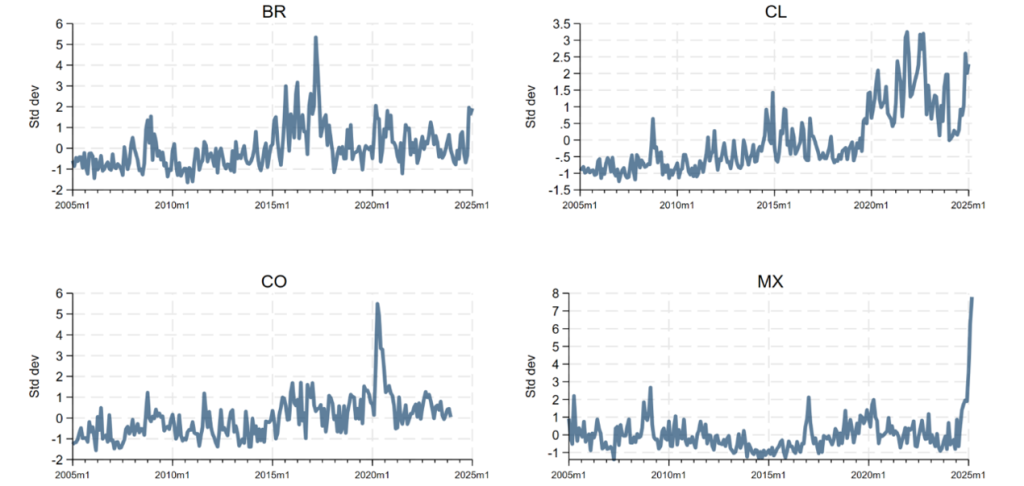
Note: For Colombia, the series ends in M12 2023. Sources: Bloom et al (2016); Cerda, Silva and Valente (2016); Gil and Silva-Pinzón (2020); authors’ calculation.
First, we present the baseline impact of domestic EPU shocks on output and inflation (Graph 2). We find a negative effect on output, with a magnitude of approximately 0.3% (panel A). Additionally, we observe that increased EPU shocks raise inflation by around 0.15 percentage points, with a 95% confidence level (panel B). These findings suggest that EPU shocks reduce output and increase inflation, resembling the dynamics of a perceived supply shock or stagflationary shock.
When analysing the real transmission channel (one of the two proposed channels), we find that uncertainty shocks lead to a decline in one-year-ahead GDP growth expectations of approximately 1 percentage point. This suggests that private forecasters adjust their growth expectations in response to domestic EPU shocks within a one-year horizon. Further, a domestic EPU shock leads to a decline in consumer confidence in Latin America, indicating that consumer sentiment is influenced by domestic innovations in economic policy uncertainty.
In the financial channel, two of the three proposed variables are affected by a domestic EPU shock: bilateral exchange rates and risk premia. Uncertainty shocks result in domestic currency depreciation against the USD and increases in risk premia. These effects, while short-lived, align with findings in the existing literature, particularly within 90% confidence intervals. This is consistent with IMF (2024), which highlights the risks of uncertainty for financial stability in both AEs and EMEs.3
Our findings confirm the presence of a short-lived financial channel and a medium-term real channel through which domestic EPU affects macroeconomic outcomes in Latin America, underscoring the critical role of uncertainty in shaping the region’s economic dynamics.
Graph 2. Impact of a one-standard-deviation increase in domestic EPU shocks
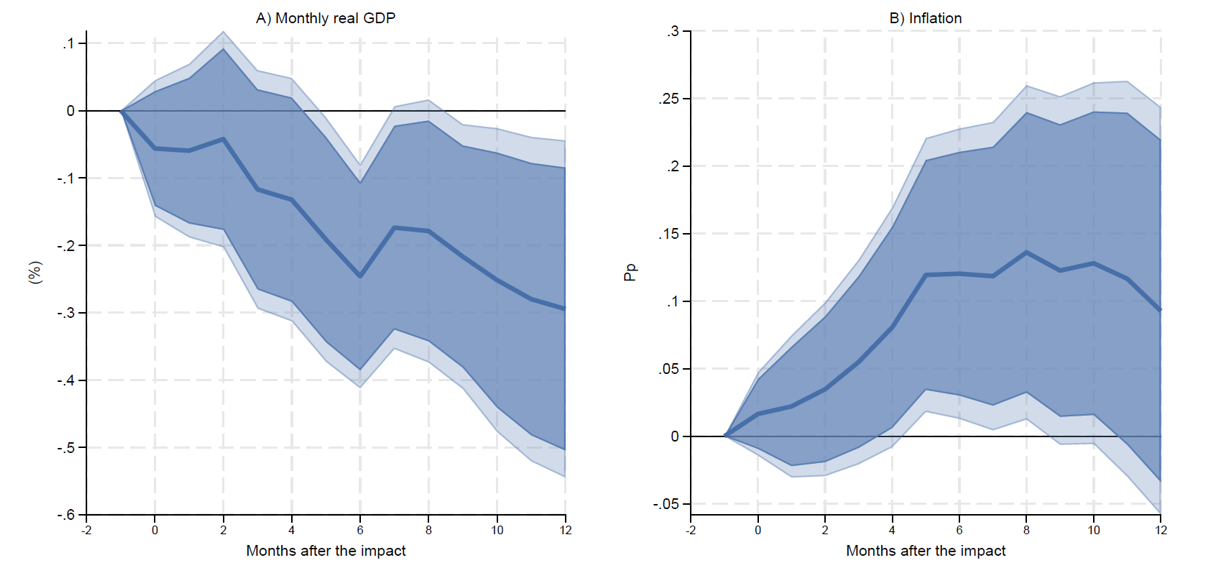
Note: Confidence intervals at 90% and 95%. Driscoll and Kraay standard errors account for interdependence across countries in the region. Country and time fixed effects are included.
Then, we study the heterogeneous effects of domestic EPU shocks on the economy using a quantile regression approach.
Graph 3 shows the impact of a one-standard-deviation change in EPU shocks on the 10th, 50th, and 90th percentiles of GDP growth (upper panel) and inflation (lower panel). In the lowest percentile, EPU shocks significantly reduce growth by 0.3% in the first month and up to 0.8% seven months after the shock (upper panel, in red). In contrast, the impact on the middle and upper percentiles is smaller (in blue and green).
Regarding inflation, EPU shocks add inflationary pressures when inflation is well above target. In the lower panel of Graph 3, EPU shocks have no significant impact on inflation in its lower percentiles (in red) and only a limited impact of less than 10 basis points at the median (in blue), when inflation is within or moderately above target ranges. However, when inflation is already high, EPU shocks can add 5 basis points upon impact, accumulating to 25 basis points after six months and 30 basis points after a year. The quantile approach reveals significant heterogeneous inflation responses to EPU shocks, which are not evident in the mean estimates from the previous analysis.
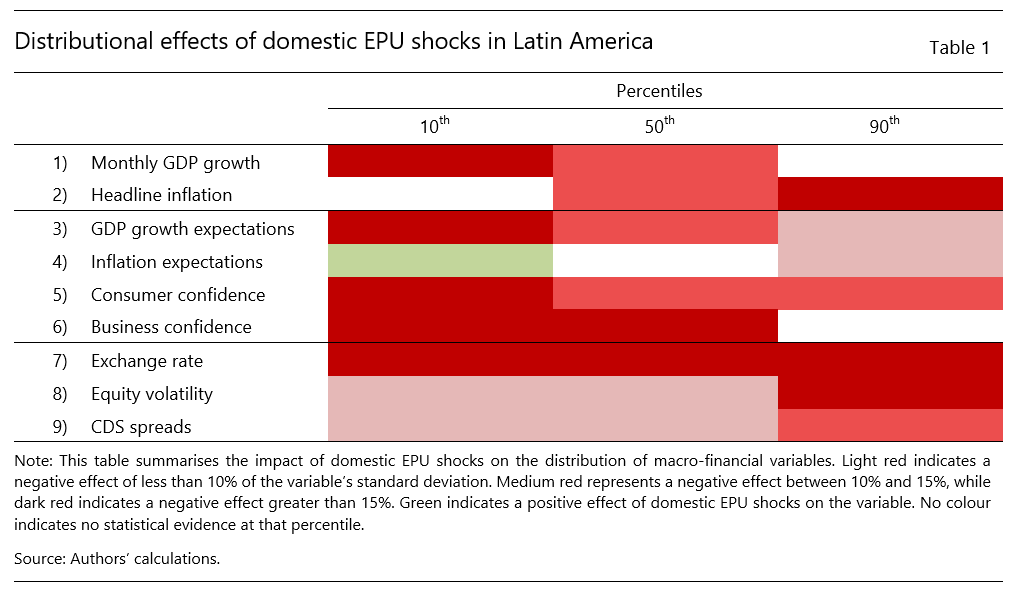
Finally, our heterogeneous analysis reveals that EPU shocks asymmetrically affect both the real and financial channels. In the real channel, the impact on growth expectations, consumer confidence and business confidence are strongest when the economy is weak, with recovery occurring within a year. When the economy is strong, growth expectations and consumer confidence are less affected by EPU shocks (Table 1, rows 3, 5 and 6).
For inflation expectations, the response to EPU shocks varies across their distribution. When expectations are low, EPU shocks ease inflation expectations slightly. Conversely, when expectations are high, EPU shocks increase them significantly. This result indicates that EPU shocks primarily increase the dispersion of inflation expectations, reflecting higher volatility in inflation expectations after EPU shocks (Table 1, row 4).
Graph 3. Impact of a one-standard-deviation increase in domestic EPU shocks on the 10th, 50th and 90th percentiles
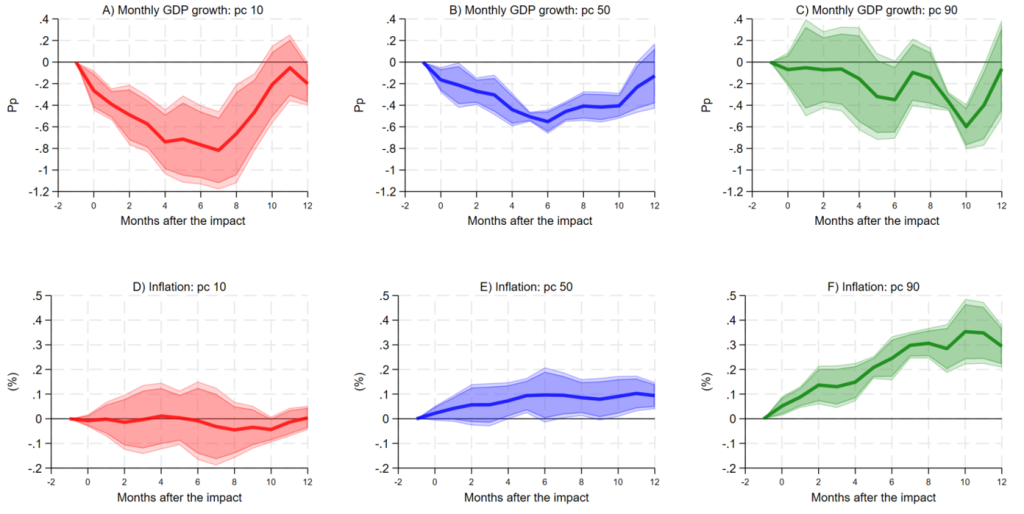
Note: Confidence intervals at 90% and 95% computed using bootstrapping with 500 iterations. Country fixed effects are included, along with a lag of the dependent variable.
In the financial channel, the effects of EPU shocks are more pronounced when financial conditions are tight. Equity volatility, CDS spreads, and exchange rates respond strongly to EPU shocks under such conditions, with impacts peaking within six months. By contrast, when financial conditions are loose, the effects are smaller (Table 1, rows 7, 8 and 9). These findings underscore the short-term nature of the financial channel and its sensitivity to existing financial conditions.
These results have important policy implications.
For monetary policy, the findings highlight the need for central banks to remain vigilant in the face of uncertainty shocks. Domestic EPU shocks not only depress output but also exert upward pressure on inflation, with short-term inflation expectations rising significantly. This dynamic resembles a cost-push or stagflationary shock, complicating the trade-offs faced by monetary policymakers. EPU shocks can push inflation expectations and inflation even higher when inflation is already above target. In line with the two-regime view of inflation (Borio et al (2023)), these findings suggest that EPU shocks could increase the risk of transitioning into a high-inflation regime. Clear and consistent communication of monetary policy intentions can help anchor inflation expectations and mitigate uncertainty’s adverse effects on private sector behaviour (Tombini (2025) and BIS (2025)). Central banks should also enhance their analytical frameworks to incorporate uncertainty measures, enabling more precise assessments of its impact on inflation and growth.
For fiscal policy, the results underscore the importance of robust fiscal frameworks to mitigate the adverse effects of EPU shocks. Elevated uncertainty, particularly through the financial channel, is linked to increased risk premia and exchange rate depreciation, raising borrowing costs and straining public finances. Governments in Latin America should prioritise institutional reforms that enhance fiscal credibility, increase policy predictability, and strengthen investor confidence.
Aguilar, A, R Guerra, C Müller and A Tombini (2026): “The macro-financial impact of economic policy uncertainty in Latin America”, BIS Working Papers, no 1324, January.
Al-Thaqeb, S A and B G Algharabali (2019): “Economic policy uncertainty: a literature review”, The Journal of Economic Asymmetries, vol 20, no e00133, November.
Baker, S, N Bloom and S Davis (2016): “Measuring economic policy uncertainty”, The Quarterly Journal of Economics, vol 131, no 4, pp 1593–1636.
Bank for International Settlements (BIS) (2025): “Monetary policy decision-making and communication under high uncertainty”, BIS Papers, no 163, 15 December.
Bloom, N (2009): “The Impact of Uncertainty Shocks”, Econometrica, vol 77, no 3, pp 623–85.
Bloom, N (2014): “Fluctuations in Uncertainty”, Journal of Economic Perspectives, vol 28, no 2, pp 153–76.
Borio, C, M C Lombardi, J Yetman and E Zakrajsek (2023): “The two-regime view of inflation”, BIS Papers, no 133, March.
Cerda, R, A Silva and J T Valente (2016): “Economic Policy Uncertainty Indices for Chile”, available on https://www.policyuncertainty.com/chile_monthly.html.
Choi, S and M Shim (2019): “Financial vs policy uncertainty in emerging market economies”, Open Economies Review, vol 30, pp 297–318.
Gil-León, J M and D E Silva-Pinzón (2020): “Economic policy uncertainty index (EPU) for Colombia, 2000–2017”, Ensayos de Economía, vol 59, no 55.
International Monetary Fund (IMF) (2024): “Macrofinancial Stability Amid High Global Economic Uncertainty”, Global Financial Stability Report, Chapter 2, October 2024.
Jordà, Ò (2005): “Estimation and Inference of Impulse Responses by Local Projections”, American Economic Review, vol 95, no 1, pp 161–82.
Tombini, A (2024): “Embracing uncertainty: monetary policy in Latin America”, speech at the Central Banking Autumn Meetings, 13–14 November 2024, Mexico City.
Tombini, A (2025): “Fulfilling central bank mandates in times of high uncertainty”, speech at the IMF Regional Central Bank Governance Forum, Quito, Ecuador, 4 April.
We use the country series developed by Baker, Bloom and Davies (available on their website) for Brazil and Mexico, the EPUC series from Cerda, Silva and Valente (2016) for Chile and the series developed in Gil and Silva-Pinzón (2020) for Colombia.
For further technical aspects and the implemented empirical strategy, consult Aguilar et al (2026).
To see the graphical results, please refer to Aguilar et al (2026), Graph 6.