

This policy note is based on a speech by Aino Bunge at Conference ”Morgondagens Samhälle”, Münchenbryggeriet. The views expressed are those of the authors and do not necessarily reflect those of Sveriges Riksbank. Acknowledgments: We want to thank Ebba Eliesson, Mika Lindgren and Frida Widholm for their help in preparing the figures and Hanna Armelius, Charlotta Edler, Rebecka Hallerby, Mattias Hector, Marie Hesselman, Iida Häkkinen Skans, Caroline Jungner, Henrik Lundvall, Åsa Olli Segendorf, Anna Seim and Andreas Westermark for their valuable comments. We would also like to thank Elizabeth Nilsson for translating the text to English.
Abstract
We read daily in the news, with equal parts concern and fascination, about the impact of AI on society and the economy. In this article, we take an economic-historical perspective and look backwards to try to look forwards. One lesson from history is that old jobs tend to be replaced by new ones over time, but that the transition can often be difficult for the people in the occupations being automated. In the case of AI, developments so far suggest that young people may be particularly affected, but at the same time they are usually in a good position to adapt to new conditions. On the broader issue of how AI could affect the macroeconomy and monetary policy, we address issues such as business costs, the so-called neutral interest rate, investment demand and the risk of a stock market bubble. We also refer to modern history and how the discussions went during the dotcom boom, the “new economy” and “digitalisation”, noting that it may take time before we see the effects in mainstream macroeconomic statistics. The overall conclusion we draw is that AI has not yet penetrated the labour market and productivity in Sweden to such an extent that it affects current monetary policy, but developments are moving very fast and this means that we will have to monitor what happens in the coming years.
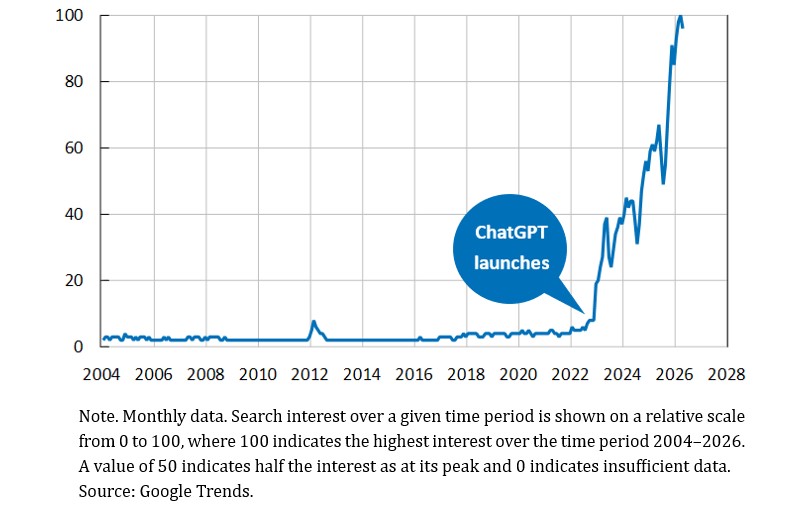
Somewhat overshadowed by geopolitical events at the moment, we can nevertheless read daily about AI and its impact on both society and the economy. AI has been a recognised field for a long time.1 But it was in connection with the breakthrough of generative AI and language models such as ChatGPT that developments and discussion in society really took off (see Figure 1).
Figure 1. Search interest in AI in Sweden
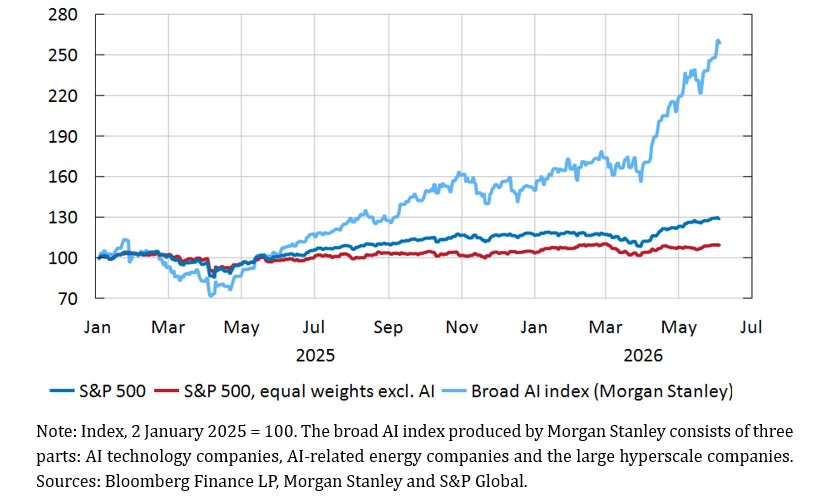
News reporting today is characterised as much by concern as by fascination. In a telling example, a song produced with the help of AI recently topped Spotify’s top 50 in Sweden, prompting an outcry among artists.2 At the same time, AI-related companies are breaking one stock market record after another, while companies seen as losers in the new AI society are plummeting in value (see Figure 2). We also see the concern that Anthropic’s latest model Mythos has caused in terms of cybersecurity.3 The reason why so many different areas are affected by AI is that it could be regarded as a technology or invention that affects not only a specific area but our society as a whole. It is usually referred to as a general-purpose technology or GPT.4 Other examples are the steam engine, electricity and the internet.5
So there are many issues to touch on, but in our article we want to discuss how AI can affect the economy and monetary policy in the slightly longer term. Of course, much of the debate focuses on the labour market and which of our jobs AI can take over. But we intend to try to broaden the discussion to how the macroeconomy in general and monetary policy might be affected.
Figure 2. Stock market performance with and without AI companies
We will take an economic-historical perspective and look backwards to try to look forwards. There is a lot of exciting research on the impact of previous technology leaps on the economy, which we think can be very useful when we think about the impact of AI. Some of the discussion among central bankers also centres on a more modern story and the similarities with the dotcom boom of the 1990s. we will also discuss some of the effects we are already seeing in Swedish companies.
A paradox emerges when looking at historical developments: Many of the technological innovations have aimed to replace the humans who previously performed the tasks with machines. Shouldn’t this lead to an increase in unemployment over time?
Ever since the Industrial Revolution, technological inventions have created job insecurity.6 John Maynard Keynes introduced the concept of technological unemployment in an essay in 1930. And economics laureate Wassily Leontief warned in the 1950s that humans in the future would suffer the same fate as horses in the early 20th century.7 However, historical experience shows that total employment in the economy has not declined as a result of technological advances. How can that be?
Here it is worth pausing for a moment to consider the mechanisms at play (see Figure 3). The most obvious mechanism is automation, which involves machines replacing people. This reduces the demand for labour.
But automation also brings productivity gains, meaning that we can produce more with the same number of employees or hours worked.8 This results in increased prosperity, which in turn increases the demand for labour and therefore creates new jobs. Let us return to John Maynard Keynes. In his 1930 essay, he also made a famous prediction of what the economy would look like in 100 years in industrialised countries. He predicted surprisingly well that prosperity would increase in much the same way as it has. But one prediction that turned out not to be true was that people would choose to take much of the increased prosperity by working less, just 15 hours a week.9
Figure 3. Historically, technological advances have not increased unemployment
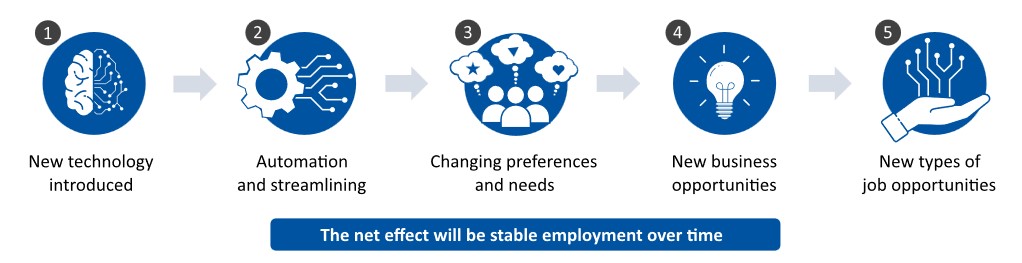
This is where preferences come into play, and how we choose between consumption and leisure. People have changed their consumption patterns and continuously increased their consumption in line with their income. We find new things to spend our money on, from travelling to going to the gym and restaurants. This is reflected in the increasing demand for labour in new sectors.10 If we compare today with 1940, we may find that many professions are the same, such as teacher, doctor and bus driver. But data for the United States show that 60 per cent of occupations today did not exist in 1940.11
A very illustrative and interesting historical example is switchboard operators.12 Some of you may know of an elderly relative who has had that job or noticed it in old black and white films. When automatic telephone exchanges began to be introduced in the first half of the 20th century, it marked a dramatic wave of automation. People could now dial the number directly on a disc and the need for operators disappeared. New research from the US shows that switchboard operators, who were young women, were personally negatively affected by this development. They had to stop working or take lower-paid jobs. However, employment later increased for young women with a similar background to the telephone operators. They found jobs in the office and service sector, and also in new professional categories.13
From this we can learn that old jobs tend to be replaced by new ones over time, but that the transition can often be difficult for the people in the occupations being automated.14
Much of the discussion around the economic impact of AI focuses on the jobs that can be replaced, i.e. automation. The United States has been at the forefront of this and much of the analysis originates there.
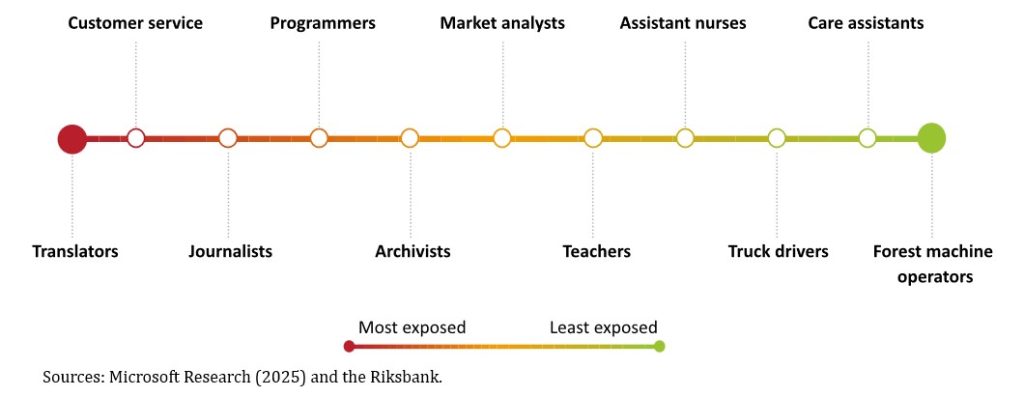
Many professions can be affected by the impact of AI (see Figure 4). One pattern that emerges in the United States is that many young people may be particularly vulnerable.15 This is the case, for example, for programmers and those working in customer service.16 But it seems that so far, companies are following the “no hire, no fire” principle. They are not laying off young people in vulnerable jobs, but they are not hiring those new to the labour market either.17 But how exposed the occupations are does not tell the whole story.18 Much also depends on how easy it is for individuals to adapt to new technologies or new labour market structures. Young people in particular are generally better able to adapt and find new jobs than older people.19
Figure 4. Examples of occupations with high and low AI exposure
We wrote that it was too early to comment on the effects of AI in Sweden in an article on the labour market in the December Monetary Policy Report.20 But things are moving fast, and there are more and more studies using Swedish data. Labour market outcomes are similar to those in the United States, and although we are at an early stage of development, companies seem to be following the “no hire, no fire” principle here as well. Young people in exposed occupations are not being laid off, but the path into the labour market looks more difficult than before.21 This is an issue that we will have to follow closely in the future to get more clarity.
We mentioned earlier that history suggests that technological unemployment is more of a hypothesis than a real phenomenon. But at the same time, research and past experience show that this is not a law of nature. There is always an interaction between technology and the development of the rest of society when creating economic prosperity.22
Sometimes the impact of AI is described rather fatalistically and as something that will affect us whether we like it or not – we have little control over its development. Instead, research suggests that the impact of AI on the labour market and the wider economy is partly what we make of it.
Among other things, it is about how we choose to use technology.23 But politics also has an important role to play, including questions regarding competition, the labour market, education, distribution of income and taxation.24
This brings us to how we at the Riksbank can address the economic impact of AI in the context of our mission.
The discussion on the impact of AI on the macroeconomy and monetary policy is already in full swing among central banks around the world.25 As we have already mentioned, we can learn from previous technological breakthroughs when trying to draw conclusions about the potential impact of AI on the labour market and the economy in the long term. But there is also a lot happening here and now.
There are four main mechanisms that are often emphasised in the international monetary policy discussion (see Figure 5).
Figure 5. How AI can influence monetary policy – four mechanisms
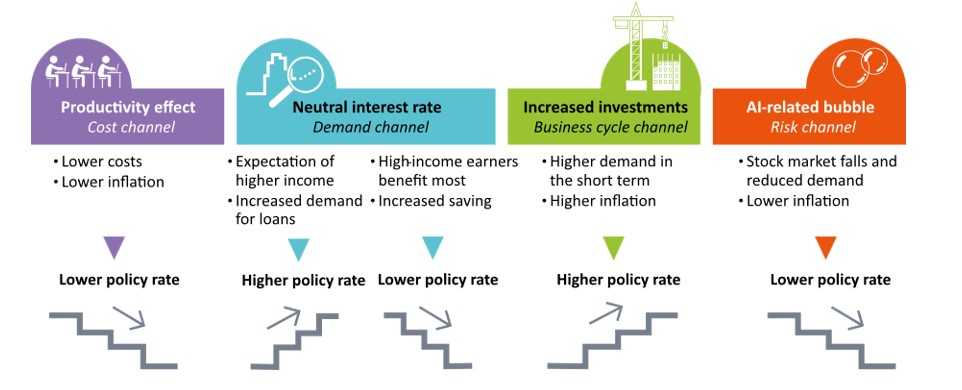
First: As with the internet, we can expect a productivity boost that could allow us to produce more and more with the same labour input. This lowers costs and slows inflation and thus suggests lower policy rates.
Second: In the central banking world, we often talk about the neutral interest rate. This is the level of the policy rate that neither stimulates nor tightens the economy.26 It is not controlled by central banks themselves, but reflects the demand for savings and loans. If a lot of people save, there is plenty of money for those who want to borrow. The neutral rate will then be low, and vice versa. In most macroeconomic models, there is a positive relationship between productivity growth and the neutral interest rate. One way to understand it is that if productivity growth goes up, households expect higher incomes in the future. To some extent, they want to use their future income already today and start consuming more. This often requires loans, and when the demand for loans increases, interest rates are pushed up. An AI-related upturn in productivity growth would thus push up the neutral interest rate. This could instead argue in favour of a higher policy rate over time. However, one factor that could affect the neutral rate in the opposite direction is if AI contributes to widening income inequality in the economy, with high-income earners in particular reaping the benefits of productivity gains. As these households generally save more than others, total savings in the economy would increase and thus contribute to a lower neutral interest rate.
Third: Increased need for AI-related investment drives up demand in the short term, favouring higher inflation and policy rates. This is an effect we have already seen to some extent, and we have highlighted it ourselves in our monetary policy communication as an important explanation for why growth in 2025 and 2026 has been sustained in the United States despite increased tariffs and geopolitical uncertainty.27
Fourth: Just as in the 1990s, new technologies have sent technology companies’ share prices soaring, and there is a risk of an AI-related bubble. Much of the rise in stock market indices is linked to AI companies (see Figure 2). We have warned of this in our recent Monetary Policy Reports and Updates, as well as in the Financial Stability Reports. For the Riksbank, a sharp downward correction in equity prices could affect both monetary policy and, ultimately, our task of safeguarding financial stability. 28 In a way, we think it is inevitable that we see elements of FOMO (fear of missing out) and exaggerated share price runs in some companies. As with the internet, we may see both a disruptive technology with huge socio-economic impacts and short-term over-valuation as everyone wants to “jump on the bandwagon”. One does not have to exclude the other, and in our opinion it is clear that AI has an important part to play in our future economy.
To summarise, a number of different effects can arise from AI that can influence the policy rate in different directions. And the timing of when they occur is very difficult to assess. An unsurprising conclusion is that uncertainty is very high. When discussing the impact of AI on the economy, we also find it impossible to avoid another hot topic – geopolitics. We can see that the development of AI is dominated by a few companies and countries. Whoever controls the technology also has the power to influence. And although it is a digital technology, it requires infrastructure in the form of data centres and energy supply. Here we believe we need to think things through and cooperate within the EU to avoid finding ourselves in an overly vulnerable position.
So how should we think about monetary policy now, and what can we learn from history? Let me delve into the similarities and differences between AI and the dotcom boom of the 1990s. The economics laureate Robert Solow made a famous statement in 1987: “You can see the computer age everywhere but in the productivity statistics.”
Alan Greenspan’s “productivity observation” in the second half of the 1990s had some similarities: The overall figures did not show much of a productivity boost in the United States. However, data and anecdotal information from companies suggested that the impact could be significant on productivity, which would help keep inflationary pressures down. Therefore, the Federal Reserve would hold off on raising interest rates, even though the economy was booming.29 Although this is the usual description, the interpretation of the Federal Reserve’s behaviour during the second half of the 1990s is not entirely clear among contemporary observers in the United States.30
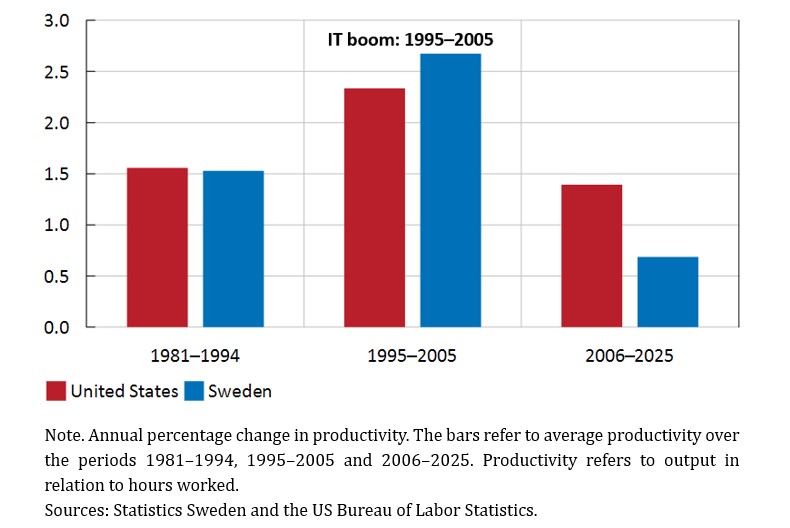
We at the Riksbank also discussed the “new economy” and its impact on monetary policy at this time.31 One clear effect that we can see with hindsight is that productivity growth in both Sweden and the United States accelerated over a ten-year period starting in the mid-1990s (see Figure 6). This led to strong growth combined with low inflationary pressures.
This came back in a new form a little later when we talked about “digitalisation” about ten years ago.32 But despite technological innovations such as smartphones, Google and social media, productivity growth has been weak, especially in Europe and Sweden. A parallel can be drawn with Solow: We see digitalisation everywhere except in the productivity figures.33 At the same time, research and historical experience show that it can take time for technological progress to have an impact on the overall productivity of the economy. Productivity growth often exhibits a “J-curve” when new technologies are introduced: First it deteriorates before eventually improving.34 This is one reason why it can be difficult to assess the economic impact of technological change ‘in real time’.
Figure 6. Productivity growth
So, one lesson from previous technology shifts is that it may take time before we see the effects in mainstream macroeconomic statistics. This raises the question of where we should look for signs of change. One way is to talk to companies and keep your ear to the ground. Households’ perceptions of developments are of course also important to monitor to determine how the economy is affected in a broader perspective.
As we mentioned when discussing the impact on the labour market, the United States is ahead of Europe in terms of both the use of AI and the studies of its impact on the wider economy.35
But how do things look in Sweden?
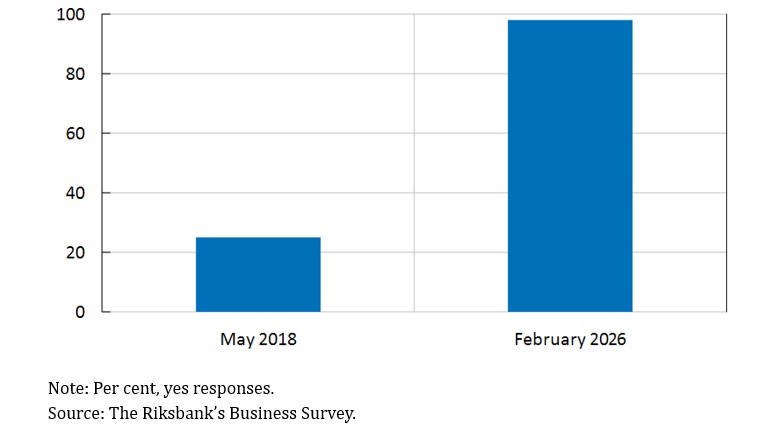
Our own business survey has been very helpful in the past in capturing changes in the economy. One example was when companies testified early on how easy it was to raise prices when inflation started to rise in 2022.36 In the latest edition, we have put a special focus on the impact of AI.37 We wanted to obtain a picture of how companies are using AI and what impact it has had and is expected to have on their business. Interestingly, we asked similar questions back in 2018, but then the theme of the day was digitalisation, which we talked about earlier.38 One significant difference is that almost all companies today use AI in some way, compared to 20 per cent at that time (see Figure 7). That said, most of them say that the use is so far limited and the impact on business is small.
Figure 7. ”Does your company use AI?”
Unsurprisingly, companies see the most important reason for using AI as streamlining operations and work for their employees. However, there is also some discussion of automation in the responses, with companies citing customer service and administration as examples of areas that could be affected.
Although the impact on business has been fairly limited so far, companies expect it to be that much greater in the future, as this quote describes: “I think if you look at 2026, there will not be very much happening. It will be implemented here and there. But in a five-year perspective, a lot will happen.”
To summarise, the results suggest three important things: First, companies are increasingly using AI. Second, usage is still relatively limited and the impact on business is so far small. Third, the impact on business is expected to be all the greater in the future. These three results are broadly in line with business surveys in the United States and other countries.39
We mentioned earlier that the effects of AI on the economy are sometimes described a bit fatalistically, as beyond our control, whereas we believe that to some extent they become what we make of them. In this context, it is very interesting to know how households use and experience AI. A new study from the National Institute of Economic Research examines just that.40 And to summarise, there is both a positive experience of use and some concern about their own work. AI use is already quite widespread, with more than half of households using it either at work or at home. Of those who use AI at work, many find that their work is both faster and better. But at the same time, almost a fifth say they are somewhat afraid of losing their job or becoming redundant because of AI.41
Households thus see AI as both a tool to increase work efficiency and something of a threat to their own position in the labour market. This is also broadly what has emerged from surveys in the United States.42
The overall conclusion for me is that AI has not yet penetrated the labour market and productivity to such an extent that it affects current monetary policy, but developments are moving very fast and this means that we will have to monitor what happens in the coming years.
The debate on the impact of AI on the economy is in full swing. History shows that technological advances have not led to increased unemployment, but that it is not a law of nature either. Policies have an important role to play, including in addressing labour market transitions and competitiveness and distributional issues. Central banks, including the Riksbank, are thinking hard about how the economy and monetary policy could be affected by AI. We have shared some of our thoughts today. However, there is considerable uncertainty for a number of reasons, not least about how quickly the changes in the economy will materialise.
One thing we can say with all the more certainty: We have every reason to return with further analyses from the Riksbank on AI and the economy!
Aftonbladet (2026a), “AI-låt toppar svenska Spotify” (AI song tops Swedish Spotify).
Aftonbladet (2026b), “Uppror i musikbranschen efter Jacub – namninsamling startas” (Uproar in the Swedish music industry after Jacub – petition started).
Acemoglu, D., Autor, D. and S. Johnson (2026), “Building Pro-Worker Artificial Intelligence”, NBER Working Paper 34854.
Atkinson, T. and S. Yamco (2026), “Young workers’ employment drops in occupations with high AI exposure”, Dallas Fed Economics.
Autor, D. (2015), “Why-are-there-still-so-many-jobs? The-history-and-future-of-workplace-automation”, Journal of Economic Perspectives.
Autor, D., Chin, C. , Salomons, A. and B. Seegmiller (2024), “New Frontiers: The Origins and Content of New Work, 1940–2018”, Quarterly Journal of Economics.
Autor, D., Chin, C., Salomons, A. and B. Seegmiller (2026), “What makes new work different from more work?”, NBER working paper 34986.
Bech-Moen, O.C. (2026),”How can AI affect monetary policy?” speech published on 26 January, Norges Bank.
Bick, A., Blandin, A., Deming, D., Fuchs-Schündeln, N. and J. Jessen (2026), “AI Adoption in Europe and the U.S.”, On the Economy Blog, Federal Reserve Bank of St. Louis.
Bracha, A. and J. Tang (2025), “Shaping the Future of Work: Workers’ Optimism and Pessimism about AI”, Current Policy Perspectives, Federal Reserve Bank of Boston.
Brynjolfsson, E., Rock, D. and C. Syverson (2021), “The Productivity J-Curve:How Intangibles Complement General Purpose Technologies”, American Economic Journal: Macroeconomics.
Brynjolfsson, E., Chandar, B. and R. Chen (2025), “Canaries in the Coal Mine? “Six Facts about the Recent Employment Effects of Artificial Intelligence”, Stanford Digital Economy Lab.
Chicago Booth Review (2024), “Is Productivity About to Skyrocket?”.
Dagens Industri newspaper (2024),” Makrorådet: Vad lär oss ångmaskinen om AI?” (What does the steam engine teach us about AI?).
Dagens Nyheter (2024), “Rädsla för AI är inget nytt” (Fear of AI is nothing new).
Daly, M. (2026): “The AI Moment? Possibilities, Productivity, and Policy”, speech published on 17 February, Federal Reserve Bank of San Francisco.
Davis, S. (2026), “AI is simultaneously aiding and replacing workers, wage data suggest” Dallas Fed Economics.
ECB (2026), “Will AI Steal My Job?”, podcast, 21 April, available at Euro Matters – the European Central Bank podcast.
The Economist (2025), “Gita Gopinath on the crash that could torch $35trn of wealth”.
Engberg, E., Koch, M. Lodefalk, M. and L. Löthman (2026), “Ja, AI hotar ungas jobb – men inte som vi trott” (Yes, AI threatens young people’s jobs, but not in the way we thought), DN debate article.
Federal Reserve Bank of Richmond (2026), “The CFO Survey”.
Feigenbaum, J. and D.P. Gross (2024), ”Answering the Call of Automation: How the Labor Market Adjusted to Mechanizing Telephone Operation”, Quarterly Journal of Economics.
Furman, J. (2026), “The real Greenspan lesson for Warsh on inflation”, Financial Times column.
Goolsbee, A.D. (2026), “Remarks at the Hoover Institution Monetary Policy Conference”, speech published on 8 May, Federal Reserve Bank of Chicago.
Hashim, A., Kosar, G. and W. van der Klaauw (2026), “Use of Gen AI in the Workplace and the Value of Access to Training”, Liberty Street Economics, Federal Reserve Bank of New York.
Heikensten, L. (2000), “Monetary policy and the new economy”, speech published on 24 October, Sveriges Riksbank.
Häkkinen Skans, I. (2019), ”Technological change and the labour market”, Economic Commentaries no. 7, Sveriges Riksbank.
Jefferson, P. (2025), “AI and the economy”, speech published on 7 November, Federal Reserve Board.
Jones, C.I., “AI and Our Economic Future”, NBER Working Paper 34779.
Kaplan, S.A., Aitken, J.A., Allan, B.A., Alliger, G.M., Ballard, T. and H. Zacher, (2025), “Revisiting Keynes’ predictions about work and leisure: A discussion of fundamental questions about the nature of modern work”, Industrial and Organizational Psychology, Cambridge University.
National Institute of Economic Research (2026), “Hushållens AI-användning” (Households use of AI), article in the Economic Tendency Survey, published on 11 March.
Royal Swedish Academy of Sciences (2024), “Economy Prize 2024”.
Royal Swedish Academy of Sciences (2025), “Economy Prize 2025”.
Macklem, T. (2026), “Understanding structural change”, speech published on 5 February, Bank of Canada.
Manning, S., Aguirre, T. Muro, M. and S. Methkupally (2026), “Measuring US workers’ capacity to adapt to AI-driven job displacement”, Brookings.
Pew Research Center (2026), “What the data says about Americans’ views of artificial intelligence”.
Populär historia journal (2023), “Växeltelefonister – kvinnor kopplade samman Sverige” [Telephone operators – women connected Sweden].
Ratio (2026),”Ny forskning: AI tycks göra det svårt för unga att få första jobbet”, [AI appears to make it hard for young people to get their first job] news article.
Restrepo, P. and D. Acemoglu (2016), ”The race between machines and humans:Implications for growth, factor shares and jobs”, VoxEU column CEPR.
Rubinton, H. and B.A. Patro (2026), ”Tracking AI’s Contribution to GDP Growth”, On the Economy Blog, Federal Reserve Bank of St. Louis.
Schnabel, I. (2026), ”Navigating inflation and employment in an era of supply shocks and AI”, speech published on 6 March, ECB.
Seim, A. (2024), “The Riksbank’s new assessment of the long-term neutral interest rate”, speech published on 26 November, Sveriges Riksbank.
Svenska Dagbladet (2026), “Stanfordprofessorn Erik Brynjolfsson: Unga i AI-exponerade yrken får allt svårare att hitta jobb” (Young people in AI-exposed professions are finding it increasingly difficult to get a job).
Sveriges Riksbank (2015), “Digitisation and inflation”, article in Monetary Policy Report, February 2015.
Sveriges Riksbank (2018), “Digitalisation has different consequences for prices and employment in different parts of the business sector”, article in Riksbank Business Survey, May 2018.
Sveriges Riksbank (2022), “The Riksbank’s Business Survey: ´I’ve never before experienced customers accepting price increases so easily’”, February.
Sveriges Riksbank (2025) “Ample spare capacity in the labour market”, Analysis in Monetary Policy Report, December.
Sveriges Riksbank (2026a), ”Account of Monetary Policy 2025”.
Sveriges Riksbank (2026b), “There is a labour market before and after AI”, article in Riksbank Business Survey, February 2026.
Swedish Internet Foundation (2025), “The Swedes and the Internet 2025”, in particular Chapter 2: “AI – Artificial Intelligence”.
Syverson, C. (2018), “Why Hasn’t Technology Sped Up Productivity?”, Chicago Booth Review.
Yin, M., Vu, H. and C. Persico (2026), “How (un)Stable Are LLM Occupational Exposure Scores? Evidence from Multi-Model Replication”, NBER Working Paper 35110.
Yotzov, I., Barrero, J.M., Bloom, N., Bunn, P., Davis, S.J., Foster, K.M., Jalca, A.B., Meyer, H., Mizen, P., Navarrete, M.A., Smietanka, P., Thwaites, G. and B. Z. Wang (2026), “Firm Data on AI”, NBER Working Paper 34836.
One of the pioneers in this field was the 1978 Economics Nobel Laureate Herbert Simon, although he was awarded the prize for his research on decision-making in economic organisations.
See Aftonbladet (2026a and 2026b).
In our Financial Stability Report, published on 29 May, we discuss AI-related cyber risks in greater detail.
Please note the difference in relation to the AI tool ChatGPT, where the abbreviation instead stands for generative pre-trained transformer
For an interesting historical overview, please listen to the special episode of the podcast Makrorådet (Dagens industri, 2024).
See for example Dagens Nyheter (2024).
See Restrepo and Acemoglu (2016).
This means that so-called labour productivity is increasing, and this is the concept of productivity we usually use in monetary policy communication.
See Kaplan et al. (2025). It is true that average working hours have fallen somewhat in industrialised countries over the last 100 years, partly due to longer holidays. But full-time work remains a strong social norm. In Sweden, almost 80 per cent of people in employment work full-time, which means a working week of at least 35 hours.
See Autor (2015).
See Autor et al. (2024 and 2026).
See Populär historia (2023).
See Feigenbaum and Gross (2024).
For a more detailed description of technological development and its effects on the labour market from a Swedish perspective, see Häkkinen Skans (2019).
See, for example, Atkinson and Yamco (2026).
See Brynjolfsson et al. (2025). For a general description, see Svenska Dagbladet (2026).
See Davis (2026).
It can also be difficult in itself to determine which occupations are most exposed to the effects of AI; see for example Yin et al. (2026).
See Manning et al. (2026).
See Sveriges Riksbank (2025).
See, for example, Ratio (2026) and Engberg et al. (2026).
This is particularly evident in the research awarded the 2024 and 2025 Economics Prize; see the Royal Swedish Academy of Sciences (2024 and 2025).
See, for example, Acemoglu et al. (2026).
See, for example, Jones (2026).
See, for example, the speeches by Jefferson (2025), Daly (2026), Goolsbee (2026), Schnabel (2026), Macklem (2026), and Bech-Moen (2026).
See the speech by our colleague Anna Seim (Seim, 2024).
See Sveriges Riksbank (2026a). For a more detailed description, see Rubinton and Patro (2026).
Some analysts warn that the consequences of a stock market crash could be worse than in 2000. See The Economist (2025).
Eventually, in 1999-2000, the policy rate was raised several times in a short period of time. The rationale was that demand was growing faster than the economy’s production capacity, which ultimately risked leading to rising inflation. One way to understand this is that the higher productivity growth gradually pushed up expected future income and thus also the neutral interest rate, in the same way as we described earlier.
For different interpretations, see Daly (2026), Furman (2026) and Goolsbee (2026).
See, for example, Heikensten (2000).
See Sveriges Riksbank (2015).
See also Siverson (2018).
See Brynjolfsson et al. (2021) and the Chicago Booth Review (2024). If the term J-curve sounds familiar, it is because it was originally used to describe how the trade balance is affected by an exchange rate depreciation: It first weakens before it improves.
See, for example, Bick et al. (2026).
See Sveriges Riksbank (2022).
See Sveriges Riksbank (2026b).
See Sveriges Riksbank (2018).
See, for example, Federal Reserve Bank of Richmond (2026), Yotzov et al. (2026) and ECB (2026).
See National Institute of Economic Research (2026).
The recurring report “The Swedes and the Internet” in its latest edition also has a survey of household use and perception of AI. See the Swedish Internet Foundation (2025).
See, for example, Bracha and Tang (2025), Hashim et al. (2026), and Pew Research Center (2026).