

This policy brief is based on Petrakis and Sondermann (2026), “Hidden in the aggregate: the cyclicality of EU labour force participation”, ECB Working Paper No. 3275. The views expressed are those of the authors and do not necessarily reflect those of the European Central Bank (ECB).
Abstract
When the economy contracts, do people stay in the labour force and keep searching, or do they give up and drop out? The answer determines how much slack the unemployment rate really captures. Using EU Labour Force Survey microdata for 15 countries and 114 regions over 2000–2020, and isolating genuinely exogenous regional downturns, this brief shows that the aggregate EU participation rate barely moves after a negative growth shock — a clear contrast with the highly cyclical US participation rate. But this aggregate calm conceals sharp differences beneath the surface. Men’s participation falls while women’s holds steady; young workers suffer the deepest and most persistent decline, lasting up to eight years; and less-educated and non-native workers bear disproportionate costs. Hidden slack and the risk of scarring among the young mean the headline number does not tell the whole story.
How quickly, and through which channel, does a downturn reach the labour market? When output falls, some workers lose their jobs and become unemployed, while others stop searching altogether and leave the labour force. The distinction matters for policymakers. If participation falls alongside employment, the unemployment rate understates the true amount of slack in the economy — with consequences for the inflationary pressures relevant to monetary policy, for tax revenues and social spending, and for the design of safety nets.
For the United States, recent research (Cajner et al., 2025) shows that participation is strongly cyclical: after a negative shock it declines for about four years and takes roughly eight years to recover fully. An observer watching only unemployment would therefore underestimate remaining slack for years after a recession. Does Europe behave the same way? It is far from obvious. Stronger employment protection, more generous welfare systems, widespread short-time work schemes and wide institutional diversity across member states could all produce very different participation dynamics. Yet a systematic analysis that separates cyclical from structural movements in EU participation has been missing. We provide the first causal estimate for the EU, using a method designed to be directly comparable with the US evidence.
Our evidence comes from EU Labour Force Survey microdata covering 15 countries and 114 regions from 2000 to 2020. The central challenge is to measure how the labour market responds to downturns that are genuinely exogenous — not caused by local labour-market conditions themselves. We isolate such downturns using differences in regions’ industrial structure: when a region happens to specialise in industries that are contracting elsewhere in Europe, it suffers a slowdown for reasons unrelated to its own labour market. We then trace, year by year, how participation, employment and unemployment respond, stripping out slow-moving structural change such as population ageing and the long-run rise in female participation.
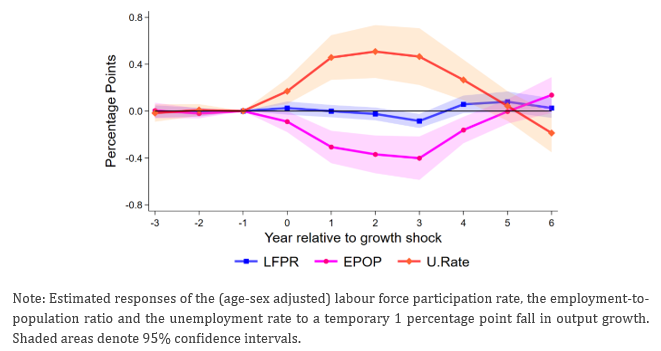
The headline result is striking (Figure 1). After a negative growth shock, the employment rate falls and the unemployment rate rises persistently, with effects lasting four to five years. Yet the aggregate participation rate barely moves: it shows essentially no statistically significant response at any horizon. This is a clear contrast with the United States, where participation declines for four years and takes eight to recover. Because our method mirrors the US study, the divergence reflects differences in labour-market structures, not in measurement. Stronger employment protection limits the flow from work straight into inactivity, while more generous unemployment insurance, short-time work schemes and active labour-market programmes help keep job losers attached to the labour force and still searching.
Figure 1. Employment and unemployment respond; participation does not
This aggregate stability is not the end of the story — it is the beginning. Look beneath the surface and the calm dissolves into offsetting movements across groups. The aggregate resilience turns out to be the product of these cancelling forces rather than genuine, uniform insensitivity.
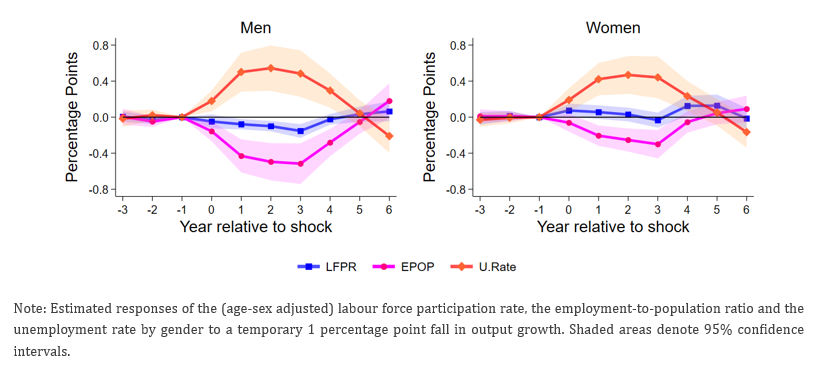
The clearest divide is by gender. Men’s participation falls significantly after a downturn, reaching a trough around three years out, while women’s participation shows no significant response at any horizon (Verdugo and Allègre, 2020). Three forces combine to produce this. First, sectoral segregation: men are concentrated in cyclically sensitive industries — construction and manufacturing — whereas women are more heavily represented in relatively stable sectors such as education, health and public administration. Our sector-level results confirm the mechanism: participation falls in the primary and secondary sectors but not in services. Second, the prevalence of part-time and flexible arrangements among women reduces firms’ incentive to let them go in a downturn. Third, the “added worker effect”: when a household’s main earner loses income, a second earner — often a woman — enters or stays in the labour force to compensate (Figure 2). The net result is the familiar “mancession” pattern, in which men’s participation bears the cyclical adjustment while women’s holds firm.
Figure 2. Men are affected more than women by adverse growth shocks
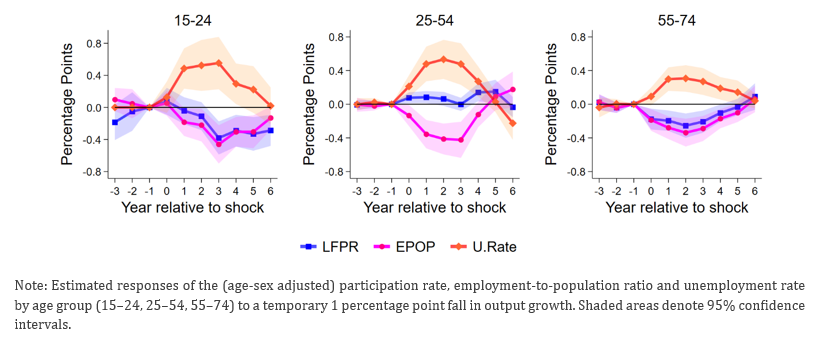
The starkest heterogeneity is by age (Figure 3). The young (aged 15–24) are hit hardest across the board — the largest rises in unemployment and the deepest falls in employment — and they are the only group whose participation decline is both significant and highly persistent, lasting up to eight years. Prime-age participation, by contrast, is essentially unaffected, reflecting the strong attachment that comes with family and financial commitments. Older workers (55–74) also see participation fall, consistent with some sliding into discouragement or early retirement when suitable jobs are scarce. The persistence among the young is the most concerning finding, and it connects directly to the literature on hysteresis (Blanchard and Summers, 1986): a large enough demand shock can leave lasting scars. Young workers are more likely to lose their jobs — less experience, fewer skills, cheaper to dismiss — and more likely to leave the labour force entirely, often retreating into education (Bell and Blanchflower, 2011). The resulting spells can erode skills, weaken professional networks and loosen a cohort’s attachment to work for years. Consistent with this, US evidence finds that a larger local downturn depressed employment rates six years later, even after unemployment had signalled recovery (Yagan, 2019). Because such scarring lowers effective labour supply well into the future, it matters for potential output and, through it, for the conduct of monetary policy.
Figure 3. The young bear the deepest and most persistent scars
Two further groups bear disproportionate costs. Less-educated workers, more likely to hold temporary contracts and to work in volatile industries, suffer larger employment and unemployment responses than the tertiary-educated. Non-native workers, especially non-EU citizens, are the most exposed of all on the employment and unemployment margins. Strikingly, their participation rate does not fall: part of the explanation is that some who lose their jobs leave the country altogether rather than becoming inactive within it, so they exit the statistics rather than swelling the ranks of the inactive.
If participation holds up in the aggregate, does that mean there is no hidden slack? Not quite. After a downturn, the share of inactive people who say they would like to work, a ‘shadow’ labour force beyond the official unemployment count, rises for a few years before fading. Even when participation looks stable, in other words, some genuine slack can escape the unemployment rate. It is also worth stressing that the cyclical exits from employment are overwhelmingly involuntary: dismissals and business closures rise sharply and persistently, while early retirement shows no cyclical response. Europe’s workers are pushed out, not opting out — and, crucially, most remain attached to the labour force as unemployed rather than leaving it.
The picture that emerges is one of aggregate resilience built on offsetting vulnerabilities. What is hidden in the aggregate — the scarring of the young, the gendered rebalancing of household labour supply, and the quiet exit of the less-educated and non-native — is precisely what policymakers need to see. Four lessons follow.
First, watch for hidden slack. Although EU participation is more resilient than in the US, the ‘shadow’ labour force means some slack still hides beneath a stable participation rate; and the persistent damage to youth participation raises the prospect of hysteresis, whereby demand shocks lastingly reduce effective labour supply.
Second, look beyond the average. Aggregate stability can conceal large, offsetting subgroup responses that matter for wage formation and price dynamics across sectors. Tracking participation by group, not just the headline rate, gives an earlier and truer read of where the labour market is heading.
Third, act early on youth. The long-lasting effects on young workers strengthen the case for training, employment subsidies and apprenticeship schemes that keep young people attached to the labour market during downturns, before temporary job losses harden into permanent exits. Fast-acting automatic stabilisers and countercyclical fiscal policy pull in the same direction.
Fourth, mind the distributional margins. The gendered pattern of adjustment, with women cushioning household income shocks by entering the labour force, underscores the value of childcare provision and flexible working. The concentration of costs among the less-educated and non-native points to targeted integration and social-protection measures during downturns.
Bell, D. N. and Blanchflower, D. G. (2011). Young People and the Great Recession. IZA Discussion Paper No. 5674, Institute of Labor Economics.
Blanchard, O. J. and Summers, L. H. (1986). Hysteresis and the European unemployment problem. NBER Macroeconomics Annual, 1, 15–90.
Cajner, T., Coglianese, J. and Montes, J. (2025). The long-lived cyclicality of the labor force participation rate. Review of Economics and Statistics (forthcoming).
Petrakis, C. and Sondermann, D. (2026). Hidden in the aggregate: the cyclicality of EU labour force participation. ECB Working Paper No. 3275.
Verdugo, G. and Allègre, G. (2020). Labour Force Participation and Job Polarization: Evidence from Europe during the Great Recession. IZA Discussion Paper No. 13425, Institute of Labor Economics.
Yagan, D. (2019). Employment hysteresis from the Great Recession. Journal of Political Economy, 127(5), 2505–2558.